Wednesday, December 10, 2014

Climate Tricks 35:Follow the Money, Trillions of $$$

One reason why the ecological movement is persistent on "man-made warming/CC" is because they are targeting amount of money, hundreds of billions of dollars per year, not per decade or one time payment. See various reports below.

Hey taxpayers of rich countries, will you remain rich if this large-scale extortion is implemented via the UN and other multilateral bodies (WB, ADB, IMF, etc.)?

(1) From interaksyon, Dec. 6, 2014

Developing countries may need up to $500 billion per year by 2050 to adapt to the ravages of climate change, dwarfing previous estimates, a UN report said Friday.

The figure was about 20 times today's public spending on climate adaptation, according to the United Nations Environmental Program (UNEP) that warned of a "significant funding gap after 2020."

In 2012-13, the amount of global public finance committed to adaptation was about $23-26 billion, of which 90 percent went to developing countries.

(IPCC) has projected adaptation costs in developing countries to reach $70-100 billion per year by 2050, based largely on World Bank figures from 2010.

And on some calculations, based on national-level rather than global-level studies, "adaptation costs could climb as high as $150 billion by 2025/2030 and $250-500 billion per year by 2050" -- and double that if the global average temperature rise is allowed to approach 4 C.

Ooppss, the climate and environmental socialism movement is not happy with $500 B a year extortion. Some guys there want higher, like $90 trillion over 15 years or $6 T a year. 

(2) From The Telegraph, December 6, 2014

it was again proposed in Lima that richer nations should pay poor countries $100 billion a year to protect them from runaway global warming, the UN’s chief spokesman, Christiana Figueres, dismissed this as “a very, very small sum”. What is needed to decarbonise the global economy, she said, is “$90 trillion over the next 15 years”. It makes the £1.3 trillion we Brits are committed by the Climate Change Act to pay to halt global warming within 36 years look like chicken feed.

(3) From Bloomberg, Dec. 5, 2014

Su was critical of the progress industrialized nations have made to boost climate-related aid to $100 billion a year by 2020. The Green Climate Fund, a UN institution meant to channel an unspecified portion of that aid to developing nations, has pledges for about $9.7 billion so far."


(4) From The Telegraph, Dec, 6, 2014

Developed nations have so far pledged almost $10bn (£6.4bn) of public funds – including £720m from the UK – to a new UN “Green Climate Fund” (GCF) to help developing nations.

China, which aligns itself with many of the poorest countries, has complained the total so far falls far short of a 2009 pledge by developed nations to mobilise $100bn-a-year of “climate finance” by 2020. “$10 billion is just one 10th of that objective,” Su Wei, China’s lead negotiator said, Bloomberg reported.

But Elina Bardram, head of the EU’s delegation dismissed the claim, insisting the $100bn was always intended to be mixture of public and private finance. The GCF was “by no means the only vehicle for delivering the $100bn,” she told reporters on Friday.

(5) From IBT, Dec. 7, 2014

Achim Steiner, executive director of the United Nations Environment Programme (UNEP) said that adaptation costs could climb as high as £96bn ($150bn) a year by 2025 to 2030, and £160-320 bn ($250-500 bn) per year by 2050, compared with earlier estimates of £44-64bn ($70-100bn) yearly by 2050, reports Reuters.

Responding to the UNFCCC report that between $340 and $650bn in finance for climate action is flowing globally with $40-175bn going to developing countries each year, Oxfam has noted that only a small proportion of climate finance is flowing from developed countries to developing countries.

Hmmmm, the higher the extortion money being demanded from rich countries, the bigger will the climate lies ahead.

Meanwhile, our planet's fever keeps rising, we are sweltering and burning as more CO2 is released in the atmosphere. :-)

From WUWT, Onward marches the Great Pause, by Christopher Moncton of Benchley, December 3, 2014.

----------

See also::
Climate Tricks 31: High Intolerance by the Alarmist Camp, May 14, 2014
Climate Tricks 32: Yeb Sano and CCC to Save the Arctic, September 16, 2014

Climate Tricks 33: UN Fooling Government Leaders to Accept Expensive Energy, September 25, 2014 

Climate Tricks 34: Watermelon Movement, Green Outside, Red Inside, October 07, 2014

Tuesday, December 09, 2014

Freedom Flame Awards 2014

Last week, December 04, 2014, I attended the Freedom Flame Awards 2014 and Freedom Dinner sponsored by the Friedrich Naumann Foundation for Freedom (FNF) Philippine Office. It was held at Enderun Colleges, Mckinley Hill, Taguig City.

There are eight awardees this year but only four came. From left: Peter Perfecto of the Makati Business Club (MBC), Arpee Santiago of the Ateneo Human Rights Center (AHRC), Vergel de Dios of the Center for Media Freedom and Responsibility (CMFR) and Jess Lorenzo, taking the place of his mom-awardee who passed away, former Mayor Sonia Lorenzo of Nueva Ecija. Great guys.


The Freedom Speech was given by Congw. Leni Robredo, 3rd District of Camarines Sur, and wife of the late Jesse Robredo, then DILG Secretary when he died in a plane crash. Congw. Leni is a humble and simple lady, soft spoken. She talked about her dreams and legislative proposals to advance more transparency and accountability in government.

She said, "Filipinos are truly enjoying more freedom now than two decades ago. But if the question is 'are we satisfied with this freedom?,' to my mind, the answer is 'not yet.'" See other things she said here.


When former Sec.Jesse Robredo was still alive, I  was able to hear him in one forum at Mandarin Hotel where he was a speaker. He was very explicit in saying that business bureaucratism by government is wrong, so when  he was the Mayor of Naga City, among the things he did was to drastically cut the approval process of getting a business permit. Within months as  Mayor, he cut the number of signatures and days to release the business permit by at least half.

To me, that is the mark of a good liberal -- less government bureaucratism, less or no unnecessary permits and fees imposed on the public -- and not so much about more transparency of a bureaucratic and tax-hungry government. Well I am no fan of BIG government, regardless of "good governance" rhetorics that people may say.

Many people came, friends of FNF in the country. During dinner, I sat at the table of Arpee Santiago with his wife and staff at AHRC.


After dinner and while sipping wine, I sat with the De La Salle Univ. (DLSU) group. Political Science Department faculty members, from left: Roman Dannug, Ian Jason Hecita, and Francisco "Kiko" Magno. The latter is also the Director of the Jesse Robredo Institute for Governance of DLSU, also a friend from UP Sapul in the 80s, and a wedding godfather :-).


FNF-PH Country Director Jules Maaten joined us for another photo. I told Jules, "at dinner I sat with the Ateneo group; after dinner, I sat with the La Salle group, but I am indifferent of these two schools." Jules asked, "where did you study", "UP" was my quick reply and I have no intention to change school affiliation or loyalty, hehehe.


At last year's Freedom Flame Awards held in Intramuros, Manila and attended by many foreign guests, Asian politicians from the Council for Asian Liberals and Democrats (CALD) and some European politicians and leaders from Liberal International (LI), there was a fireworks display. This year, there was a lights show at the quadrangle, just outside the venue.


Another great event. Thanks for the invite Jules.
All photos from FNF-PH fb album.
--------------

See also:
25 Years of Liberalism in the Philippines, December 07, 2011 
Freedom Flame Awards 2013, November 13, 2013 
Freedom Flame Awards 2: More Photos, November 25, 2013 

Freedom Flame Awards 3: The Magazine, April 21, 2014 
Jules Maaten's Lecture on Liberalism, May 11, 2014

Monday, December 08, 2014

Energy Econ 31: Coal, Renewables and Possible Blackouts in Germany

In my continuing debate with some members of the "Amend the Electric  Power Industry Reform Act (EPIRA)" fb group, I posted these 14 news stories there. Still very civil debate, something that  I  like.

1. From WSJ, March 27, 2014:

Shale gas, not windmills, can free the continent from reliance on Russia.

Moscow's invasion of Crimea has now forced European governments to finally admit, among other inconvenient truths, that taxpayer-funded windmills will not deliver energy security, much less improved geopolitical leverage against Moscow. There are few silver linings to Russia's revanchism, but perhaps a serious European energy policy might be one of them.

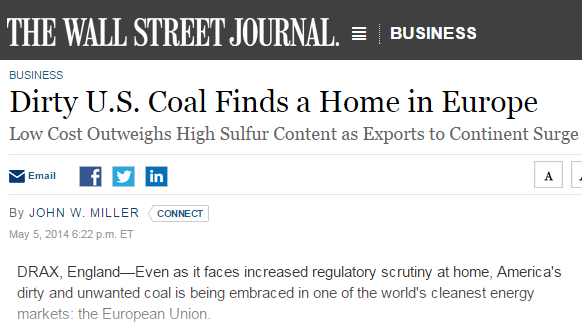
2. From WSJ, May 5, 2014:

Low domestic demand has renewed the focus on U.S. exports, which are on track for a record-setting third straight year of more than 100 million tons. The 28-nation EU imported 47.2 million tons of U.S. coal last year, up from 13.6 million tons in 2003. Exports to the U.K. alone are up tenfold in the same period. The U.S. ranked second only to Russia in supplying Europe with coal last year, and the U.S. could further increase its market share if recent political tensions with Moscow disrupt Russian shipments.

Since 2003, German imports of U.S. coal have risen to more than 15 million tons from under a million tons. A spokesman for E.ON, Germany’s largest power and natural-gas utility, says it now purchases more than four million tons of coal a year, or 17% of its total, from the U.S., up from 800,000 tons in 2010. E.ON operates power plants in several European countries.

3. From Energy Trends Insider, June 09, 2014

Add caption
The average capacity factor — that is the output of an electricity-producing asset over a period of time divided by its maximum theoretical power output — was about 32 percent for wind power in the US over the past 3 years (Source). The Hawi Renewable Development Wind Farm is a little bit better than that at 45 percent, but for the 55 percent of the time that it isn’t producing power, backup is required. Often, intermittent renewable power power supplies are backed up by dirty and inefficient power.

When people talk about the intermittent nature of resources like the wind and sun, they are referring to the fact that there are times — often unpredictable — when these resources aren’t producing. At 7 am, the world is waking up and demand for electricity is climbing. At that early hour, and with the sun perhaps not yet shining brightly enough for solar power to contribute appreciably, back-up power is needed in areas like my neighborhood that utilize wind power when it’s available.

That is the nature of intermittent resources. People don’t usually think about the fact that if the wind isn’t blowing that an electric utility — somewhere — brings on line backup power."

4. From BloombergJune 16, 2014:

consumers are prioritizing cheap fuels over efforts to rein in greenhouse gas emissions blamed for global warming. Coal is the dirtiest fossil fuel, and use of it expanded at utilities fromChina to Germany.

“Europe is increasing its carbon emissions because it’s using too much coal because it’s cheap,” Royal Dutch Shell Plc’s Chief Financial Officer Simon Henry said in an interview on Bloomberg Television June 3.

Coal’s share of global energy use reached 30.1 percent, just below the 32.9 percent share for crude oil, which lost market share for a 14th consecutive year. China was the world’s biggest coal consumer, followed by the U.S. and India.

5. From Bloomberg, June 21, 2014

Coal ranks second among the world’s largest sources of energy. There’s enough to last for 132 years at 2012 production levels. China consumesas much of it as the U.S. does of oil,... In 2011, Germany’s appetite for coal increased to the highest level in four years after Chancellor Angela Merkel shut eight nuclear power stations following the Fukushima disaster in Japan...

6. From Bloomberg, also June 21, 2014.

Germany, Europe’s largest economy, boosted consumption of the fuel by 13 percent in the past four years, while use in Britain, No. 3 in the region economically, rose 22 percent, statistics from oil company BP Plc show...

Germany’s emissions rose even as its production of intermittent wind and solar power climbed fivefold in the past decade....

German fossil-fuel emissions climbed 5.5 percent to 843 million tons in the four years through 2013, the BP data show. To meet its commitment, Germany would have to reduce its pollution by about 379 million tons, a further 45 percent. The BP statistics cover only fossil-fuel burning, which makes up about 88 percent of the nation’s greenhouse gas output. 

7. From Reuters, June 24, 2014:

According to the new draft, industry producing its own electricity in new renewable or combined heat-power plants will pay 30 percent of the current 6.24 cents per kilowatt hour surcharge in 2015, rising to 35 percent in 2016 and 40 percent from 2016.

"It would be a massive own goal in terms of industrial policy if politicians were to put a surcharge on own power production used by many sectors for decades," German industry lobby BDI chief Markus Kerber said in a statement.

Subsidised renewable energy, led by wind and solar power, have sparked a political debate in Germany over high prices for consumers, who pay mandatory charges for green energy.

8. From WSJ, September 6, 2014:

German consumers already pay the highest electricity prices in Europe. But because the government is failing to get the costs of its new energy policy under control, rising prices are already on the horizon. Electricity is becoming a luxury good in Germany . . .

For society as a whole, the costs have reached levels comparable only to the euro-zone bailouts. This year, German consumers will be forced to pay €20 billion ($26 billion) for electricity from solar, wind and biogas plants—electricity with a market price of just over €3 billion. Even the figure of €20 billion is disputable if you include all the unintended costs and collateral damage associated with the project. Solar panels and wind turbines at times generate huge amounts of electricity, and sometimes none at all. Depending on the weather and the time of day, the country can face absurd states of energy surplus or deficit.

9. From Bloomberg, September 22, 2014.

Add caption
Germany used coal, the dirtiest fuel, to generate 45 percent of its power last year, its highest level since 2007...

The transition, dubbed the Energiewende, has so far added more than 100 billion euros ($134 billion) to the power bills of households, shop owners and small factories as renewable energy met a record 25 percent of demand last year. RWE AG, the nation’s biggest power producer, last year reported its first loss since 1949 as utility margins are getting squeezed because laws give green power priority to the grids.

10. From Bloomberg November  20, 2014

“Coal is three to five times cheaper than natural gas in gas-importing countries,” Cedigaz said. “Left solely to market forces, gas cannot compete with coal for base-load power and its role is limited to meeting peak-load demand.

11.  From Bloomberg, Nov. 22, 2014.

Europe faces power shortages in the next decade unless it balances its drive for low-carbon energy with investment in clean-coal and nuclear generation, according to the International Energy Agency.

Policy makers must boost incentives for coal-fired power that includes carbon-capture technology and spur investment in new atomic plants to replace aging reactors, Maria van der Hoeven, the executive director of the IEA, said in an interview. The investment in round-the-clock, or baseload, power is needed to cover intermittent wind and solar supply, she said.


“Not everything can come just from having more renewables,” van der Hoeven said in London on Nov. 12. “The system has to be stable so that the lights aren’t going to turn off the moment the renewables aren’t there.

12. From BloombergNovember 24, 2014:

When it's too cold, Europeans run to coal, not wind or solar, to get warm. Again, not from WSJ, peks man  From Bloomberg again,

"Year-ahead coal rose for a second day, increasing 0.6 percent to the highest since Oct. 9, according to broker data on Bloomberg.

Stocks of coal at three import terminals in the Amsterdam-Rotterdam-Antwerp region dropped to their lowest in six weeks. Inventories fell 3.7 percent to 6.05 million tons from 6.3 million tons a week earlier,

13. From No Tricks Zone, Novenber 29, 2014

When high subsidies are reduced or removed, many if not all renewable companies will be bankrupt. They survive only through expensive electricity being forced by governments to the consumers.

14. From NTZ, December 6, 2014.

there are times when sun and wind combined were less than 2% of the needed supply. Unfortunately, power utilities simply cannot call Mother Nature up and place orders for power days in advance. They have to just take what Mother Nature sends, whether they want it or not, and German law says they have to pay for it even when they do not feed it in. 
------------

See also:

Saturday, December 06, 2014

Free Trade 41: David Ricardo, CPE, FPE and Consumer Surplus

Minimal Government Thinkers, Inc. has a joint project with SEANET, the regional free market think tank based in Kuala Lumpur, to promote free trade and market reforms in the ASEAN countries. This is  the  first of the many public education activities that we will undertake.


The first known theoretician to  articulate the theory and beauty of comparative advantage was the British investor and later, political economist, David Ricardo. After reading Adam Smith's "The Wealth of  Nations", he was enamored with classical economic theories and studied and  wrote on  his  own.


When goods and  services are allowed free mobility with zero  restrictions, all other things being equal, CPE will occur, even temporarily. Or the price difference among  similar or homogeneous products and services will be low.


Theory 3: Factor Price Equalization (FPE)

Substitute prices of goods with prices of labor, capital, technology, other factors of production, in the above graphs

Free mobility of people and services across countries and continents will result in FPE over the long term, all other things being equal.

Countries with expensive labor due to labor deficit and low population will experience decline in labor cost once additional and competing labor of similar skills from abroad come in.

And countries with cheap labor due to high supply of workers, high population, will experience increase in labor cost once the excess labor goes out and work abroad.


The purpose of slapping import tariff and taxes is to make otherwise cheap goods from abroad to become expensive. This is one of the lousiest philosophies and policies of  many governments around the  world, while trumpeting that they "care for the poor".


Countries in East Asia are leaning towards unilateral and regional trade liberalization  compared to their counterparts in S. America and Africa. When  it comes to agricultural products though, many economies become protectionist. 


These were my concluding notes. Photo taken by Lee, one of the students in the class. Thanks Lee.

* Free trade means free enterprises, free individuals. Restrictions to trade is restricting potential economic development.

* Governments should reduce restrictions on people and goods mobility. (a) reduceg tariffs and non-tariff barriers (NTBs) like customs bureaucracies; (b) simplify visa requirements and issuance, reduce the cost of migration; (c) focus on rule of law function, go after real criminals and not ordinary migrants who only wish to improve their condition through hard work.

* Smuggling can  be beneficial  to consumers in  the  form  of lower prices  compared to protectionist prices. But this expands corruption in government. No to protectionism, no need for smuggling, just abolish trade restrictions.

* Unilateral liberalization – no need for or minimum of negotiations, just open the borders at zero tariff – is pro-development. No regulations except bringing in or out of guns, bombs, poisonous substances, other products that are threat to public health.

* Protectionist PH constitution should be amended to allow more foreign investments and competition.

The full 15-slides presentation is posted in slideshare.
---------------

See also:
Free Trade 37: Multiple Concerns and Regulations in the ASEAN, September 11, 2014
Free Trade 38: Liberalize Rice Imports and Demonopolize NFA, September 28, 2014
Free Trade 39: Advantages of Unilateral Trade Liberalization, October 12, 2014 
Free Trade 40: Razeen Sally Joins IDEAS, to Campaign for More Liberalization, November 25, 2014

Welfarism 30: Big Government and Corruption of People's Values

Last Thursday, I went to De La Salle University (DLSU) main campus in  Manila to speak at a class on Development Studies, handled by my wife.

I put here the IPN logo because looking back, IPN  has greatly helped our think tank in guiding us to some policy discussions and advocacies, plus giving us some modest donations. Recognizing their support to us.


Welfarism in my presentation is defined as the political and social belief that individual and parental responsibility should be subsumed or substituted by more government responsibility in improving people’s welfare. So, from education to healthcare, from unemployment allowance to  food stamps, from housing to train fare, from seeds to agri credit, an endless program of subsidies, all financed via high taxes/fees/fines/penalties and endless borrowings.

Welfarism therefore, is giving more powers to governments and their  officials,  elected and appointed. Giving them more spending power and taxation power. Below, an illustration.


Some data, taken from the IMF, World Economic Outlook (September 2014) Database.


Some data on the Philippine government's public debt was also shown. Another illustration below.


Shrinking government -- huge spending on welfarism, taxation, bureauccratism, etc. -- can actually lead to more citizens welfare.


The full 17-slides presentation is available in slideshare. My concluding notes, plus some photos taken by Lee, one of the students who introduced me to the class. Thanks Lee.

1. Welfarism and populism is wrong. Individual and parental/ guardian responsibility should not be subsumed by more government responsibility.

2. Welfarism results in corruption of the people’s values, creates more state dependency and sense of entitlement. The income and investments of hard working people are not entirely theirs, other people are “entitled” to  get a big portion  of it.

3. Governments around the world remain big, or keep expanding. Local, national and international/multilateral government agencies. This means their appetite for more taxes, fees, fines and penalties keep expanding.

4. Existing taxes, fees, fines are no longer sufficient to sustain huge spending by governments. Endless borrowing is  the norm.

5. Almost all governments around the world are indebted, they vary only in the extent of indebtedness. The more welfarist and populist the government, the more  indebted it is.

6. Being indebted is not bad per se. In  cases of  emergencies  and natural  calamities (ex. Big earthquake in 1990, Mt. Pinatubo eruption in 1991), borrow.

7. But  when there are no clear emergencies, governments should have balance budget at least, fiscal surplus if possible and pay back some debt. This is not happening, in most governments worldwide.

8. Fiscal responsibility, governments should learn to live within their means, do not engage in endless borrowings, do not mortgage the future of the next generations.

9. But we must not renege those debt payment, pay them all. The hugeness of the debt and its interest payment is a constant reminder to the current and future administrations that endless borrowing is wrong.

10. Reduce taxes especially personal and corporate income tax, leading to zero income tax. Governments have many other taxes and fees to collect, have many assets to privatize.

11. The promise and hypothesis of “expanding government leads to expanded  welfare” is hardly happening. In most cases, the opposite happens, backward-bending case of diswelfare as government  size keeps expanding.
-----------

See also:

Monday, December 01, 2014

Inequality 21: Marx, Keynes and Pikkety are ideological soulmates

During the Philippine Economic Society (PES) 52nd annual conference last November 14, 2014 held at Intercon Hotel, Makati City, the most stimulating presentation I saw was that by Dr. Raul Fabella, my former teacher in  Econ 141 (International Trade) at UPSE undergrad  in  the 80s. Sir Raul's plenary paper was entitled The "Piketty Inequality and the Role of the State in Economic Thinking. To see the other papers at the  conference, see PES website.

A true blue academic, Sir Raul started with the ideological basis of inequality angst of many current thinkers, especially among  governments and multilateral agencies. Quotes from Marx, Churchill, Ayn Rand, Greenspan and Mises.


Implication of such ideological debate/clash are questions  like: Should governments become more or less welfarist, more or less tax-hungry, more or less interventionist? Or more simply, should we have more  or  less government? Of course if I was asked of such questions and choices, my vote is towards the least, the most lean, tax-hungry government.


It is not possible  to have zero market failure because anyone, anywhere and anytime, can create such market failure. Like people can demand the supply of near-impossible to produce (given current technologies and understanding of nature) goods and services, at very low  prices. Demand is there but supply is zero, or available  but at very high prices. The price of a product or service  is a reflection of its scarcity or abundance. Begging for very low price even if the cost of production  is high immediately creates a market failure.

I agree with the Kuznet theory..


Thomas Piketty and his book argues the opposite of the Kuznet's theorem and says that as growth rises, inequality among people  further rises.


The concluding slides, that the state is necessary to prevent capitalism from self-implosion.


Marx has slightly digressed from the Keynes-Piketty ideological alliance as Marx believed that the state cannot  save capitalism. Thanks Sir Raul for that highly challenging presentation.
------------

See also:

Mining 43: Mandy Armas, Christian Monsod at the PES Conference

The Philippine Economic Society (PES) held its 52nd annual conference last November 14, 2014 at the Intercon Hotel in Makati City. I attended it, I am a lifetime member of the PES.

Nice conference as usual, especially the simultaneous panel discussions in the afternoon. The morning keynote speeches were also good, with Sen. Sonny Angara, then House Speaker Sonny Belmonte. The heads of WB-PH and IMF-PH also spoke and they over-talked. The current PES President, Dr. Stella Quimbo + her team have good political connections to get these two high level legislators.

There were about seven simultaneous panel discussions in the afternoon in one batch, plus another seven total of around 14 panel discussions. In the first batch I attended the panels on energy, labor market and poverty (I was hopping from one room to another).

In the second batch, I attended the panel on mining. Here are the speakers. The moderator was PES board member and DOF Assistant Secretary Maria Teresa Habitan.  All the four speakers were given  15 minutes each to present, to be followed by an  open  forum.

The first speaker was Armando "Mandy" Armas, who was in his usual self – bombastic, bold, sensational, no holds barred. He showed several tables from his book, published recently in August 2014 (below) and he argued that we need mining and its various economic potentials not realized by the anti-mining people.


Then the two young researchers from UPSE (MA and PhD Econ candidates). Then Atty. Christian Monsod, hubby of my former teacher in Econ 199 (undergrad thesis) in the 80s, Ma'am Winnie Monsod, a former Comelec Chairman, a former Constitutional Commissioner, among  others.  Photo below, Mandy speaking while Ragos, Monsod and Adriano were listening.


He was delivering well. I don't have his presentation yet but I saw a paper where he was a co-writer and he was saying the same thing as below -- mining is so detrimental to the environment and the people, they are not exactly anti-mining, they can support it BUT... and this can be tantamount to saying "No  to mining".


Source: Esteban Godiano and Christian Monsod, To Mine or Not to Mine, May 31, 2012.

Then the moderator, ASec Tere reminded him that his 15 mins. allowance (applied to the 3 other speakers) was up. He commented while giving his talk, “So you want me to end now?” Tere nodded. Christian stopped talking, got his things in the table on  stage, and walked out of the room. Pikon, hehe. Hindi naman pini-pikon, simple reminder lang.

Most or all other speakers who are reminded by their moderators that their time is up have three options or reactions. (1) “Can I have a minute extra to wrap things up?” (and almost all  moderators would say Yes), (2) Continue talking as if the moderator does not exist, or (3) stop talking and continue the lecture during the open forum.

So Christian has 3 or more choices, but he took the lousy route, walking out. Beehhh, bondying, hehe. No one  in the room knew what irritated him -- maybe Mandy Armas’ bombastic talk earlier, maybe he has a bad day somewhere, maybe … :-)

In the ballroom when he walked out were guys like NEDA Sec. Arsi Balisacan, former NEDA chief Ciel Habito, FNF Regional Director Siggi Herzog (FNF is the biggest sponsor of PES annual conference), UPSE Dean Ramon Clarete, UPSE/PIDS guy Vic Paqueo, etc. Anyway, the open forum that followed remained stimulating even  without Christian Monsod.

Photo below: UA&P Prof. of Econonics and former PES President Peter Lee U, and Mandy Armas.


Thanks again to the PES for a great conference.
-----------

See also: 

Saturday, November 29, 2014

Pol. Ideology 58: Democracy, Coercion and Civil Society

Democracy has many definitions and people can reveal their philosophical and ideological leaning based on how they define the word. The most common or even generic definition of democracy perhaps is “power by the people, for the people.” This connotes or implies that  the people have similar if not monolithic interests and goals in society, which very often is not the case.

Another common definition is that democracy is  “rule and will of the majority/people” in society and such majority rule should prevail over the minority. Critics of this definition call this as “mob rule” where the mob act in behalf of the majority, whether real or imaginary majority.

And still another definition is that democracy means “equal participation” by the people either through direct involvement or elected/representative democracy.

A lesser-known definition is that democracy means “respect and tolerance of minority opinions” so that such minority opinion can be heard and discussed without feat of persecution and harassment by the State or other armed groups.

One indicator if people hate democracy is that they want all things to be legislated and forcibly enforced nationwide. Or if a local legislation, those things should be forcibly enforced province-wide or city-wide. Choice is zero as things have been legislated already, with fines, penalties and even imprisonment for violation.

Most legislations and coercion are done to favor one sector and deny the same favor to other sectors as if they are not citizens or taxpayers of the same country. For example, if a new state college or university is created in one province, only students and faculty, officials of that new university will get taxpayers' subsidy while students, faculty, officials of private universities in the same province or big city do not get the same subsidy, as if they and their parents are non-taxpayers of the country.

Or when a legislation or Executive Order was made to subsidize MRT/LRT passengers in Metro Manila, passengers in Ilocos, Cagayan Valley, Bicol, Visayas, Mindanao are not given the same fare subsidy as if they are not taxpayers of the country. That is why legislation that favor one sector but exclude other sectors should be avoided whenever possible. Such practices are actually undemocratic as a big portion of the country's population are excluded from certain favoritism by the state.

Most majority decisions are done outside of government and legislation. For instance, if people want cheaper clothes, cheaper shoes, toys, food, etc., they do not go to the streets to rally and demand that government through DTI or LGUs or Congress should impose price control on clothes, shoes, toys, food, etc. of SM, Robinsons, Rustans, Ayala malls, etc. Instead, many people go to Divisoria, Baclaran, tiangge-tiangge, etc. where cheap goods and services are available with zero politics and government horse-trading involved.

My good Indian friend, Barun Mitra, is correct in saying that for government "democracy has to be minimal, so that it does not offend or alienate too many people."

This implies that the more vibrant the democracy is, the smaller the government should be, where smaller social actors (the smallest actor is the individual, not a clan or trade union, etc.) are supposed to be empowered at the expense of the government. 

Civil society or self-government can be considered as democratic governance. When a Rotary club or Lions club or Jaycees etc. conduct medical and dental mission and give away free healthcare, free medicines even for one day, it already has high impact on the people of a community that received such civil society action. More self-government means less institutional, taxpayers-funded government. They are all part of real democracy.

Barun wrote correctly, 

"Democracy is not about majority rule, but about recognition of and respect for minority opinions. So that the minority view of today, may enjoy the freedom to peacefully persuade others, and could become a majority opinion of tomorrow."

A friend asked, “Can a state be truly democratic? Or democracy exists as its tenacious opposition?”

I suggested that unhampered democracy can lead to socialism and totalitarianism. If the majority will decide that they should eat, have free or subsidized housing, etc. even if they donot work or work very little, then a law will be passed to reflect the will of the majority. Socialism and forced equality is the ultimate result, and since the middle class and upper class will resist, then totalitarianism and strong arm dictatorship will evolve.

The limit to democracy is rule of law. The law applies equally to unequal people. If people want to eat even if they do not work, then all other people should be allowed to not work also, the socialist government can collapse. It can stay afloat by endless borrowing, and/or selling its land and other resources so it will have money to feed people who do not want to work. That is one proof why socialism will never be successful, but many intellectuals and masa want socialism. They want to be the new dictators.

An unfettered or limitless democracy will ultimately result in socialism and totalitarianism and hence, a negation of democracy. Democracy tempered by rule of law -- the law against stealing and destruction of property, law against murder and harming other people, law against abduction and repression of individual liberty -- is ideal. Socialism and totalitarianism can never prosper in that condition.

Can unfettered democracy be the button of self-destruction to all types of states, or the button for further/endless expansion of states and governments? 

Notice that almost all democratic governments around the world, from N. America to Europe to Asia have an expanding public sector, not only at the national or federal level but also at the local (state, province, city, village/barangay) levels. Before, a lazy or irresponsible person will have no money, now he can get cash monthly from the government on top of free education for the kids, free healthcare. Before, it is relatively easy to put up a shop; now one needs to get dozens of permits and pay lots of taxes and fees to officially start a business.

To conclude, unlimited or unchecked democracy can lead to populism, welfarism and socialism. From books and education for the poor, medicines and healthcare for the poor, housing and relocation for the poor, tractors and credit for the poor, electric tricycles and MRT fare subsidy for the poor, cash transfer and condoms for the poor, all of which are existing and implemented, an iPad for the poor, 2nd-hand cars for the poor will not be far behind in the near future. All in the name of democracy, unfettered, populism and welfarism will expand.
-----------

See also: