Friday, December 04, 2020

BWorld 463, Senator Recto’s tax cut plan shadows Reagan, Thatcher, and Trump tax cuts

 * My article in BusinessWorld last November 24, 2020.

“Government does not tax to get the money it needs; government always finds a need for the money it gets…. Whenever we lower the tax rates, our entire nation is better off.”

— former US President Ronald Reagan

Tax competition in the ASEAN is real and actual, not fictional. Vietnam and Thailand have corporate income tax (CIT) of only 20% while the Philippines has 30%. Last year, Vietnam and Thailand had merchandise exports that were nearly four times that of the Philippines. In addition, they have graduated CIT rates down to zero or 10%, and their VAT (value-added tax) rates are only 10% and 7%.

Indonesia’s CIT was 25% until 2019, cut to 22% in 2020, and to 20% by 2022. The foreign direct investments (FDI) inward stock (net of FDI inflows minus outflows through the years) in 2019 of Thailand and Indonesia were nearly three times those of the Philippines (see Table 1).

If we further consider Singapore with only 17% CIT and 7% VAT/goods and services tax, the above numbers validate Reagan’s statement that lower taxes result in a better economy, all other things being equal.

In the proposed Corporate Recovery and Tax Incentives for Enterprises (CREATE) bill now in the Senate, the plan is to cut the Philippines’ CIT to 25% immediately and further down to 20% by 2027. Fiscal incentives like special CIT (SCIT) and gross income earned (GIE) are also revised.

Now Senate President Pro-Tempore Ralph G. Recto has proposed more liberal fiscal incentives and deeper tax cuts as he sees the degree of tax competition in the ASEAN. To save space, here is a summary of contentions on reforming the fiscal incentives (see Table 2).

With a high CIT even at 25%, high VAT 12%, high withholding taxes (dividends, interest income, and royalties), keeping the 5% GIE (about 3% goes to national and 2% goes to local government) forever is a good compromise.

And tax tax tax lover Action for Economic Reforms (AER) quickly attacked Sen. Recto. In a column “Ralph Recto, the Donald Trump of the Philippines?” (BusinessWorld, Nov. 16, 2020), AER Convenor Men Sta. Ana criticized the Senator that he “does not grasp the idea of taxes being a creator of wealth.”

“Taxes being a creator of wealth,” this formulation is next to socialistic thinking. If the illogic is extended, it would say that more taxes mean more wealth creation, a dangerous invitation for tax-hungry legislators, bureaucracies, and welfare-dependents out there.

The Senator also proposes two-tiers of CIT. Tier 1, companies with total assets not over P100 million, their first P5 million taxable income will pay only 20% while profits above P5 million will be taxed 25%. And Tier 2, companies with total assets over P100 million will also pay 25% CIT. That 20% CIT proposal is very good.

Furthermore, the Senator proposes other liberal provisions: 1.) raise the threshold VAT exemption on housing for residential lots from P1.5 million to P2.5 million, and for house and lot from P2.5 million to P4.2 million; 2.) suspend the minimum CIT (MCIT) from 2020 to 2022 and cut rate from 2% to 1% from 2023 onwards; and, 3.) just 1% income tax for private, non-profit educational institutions and hospitals for three years.

Good proposals by the good Senator. So is he the “Donald Trump of the Philippines” as sensationalized by AER?

To help answer this question, consider two other leaders.

Ronald Reagan was the President of the United States from 1981 to 1988. The integrated tax rates on corporate profits as computed by the Tax Foundation (US) was 88.7% in 1981, he immediately introduced tax cuts and it went down to 79% in 1982, 59.6% in 1988 at the end of his second term.

Margaret Thatcher was Prime Minister of the United Kingdom from 1979 to 1990. The integrated tax rates on corporate profits in the UK was around 83% in 1979, she later introduced tax cuts and it went down to 68.6% in 1984, and further down to 47.2% in 1990 at the end of her term.

From 1981-1988, the average yearly GDP growth of the US was 3.5% and the UK was 3.3%. In contrast, their neighbors grew slow over the same period: Canada 3%, France 2.2%, Italy 2.1%, Germany 1.7%.

Donald Trump is the first US President to continue Reagan’s tax cut. Trump inherited the high CIT 35% in 2017 and introduced tax cuts to 21% by 2018. From 2017-2019, the average yearly GDP growth of the US was 2.5%, higher than fellow rich countries with no tax cuts: Canada 2.3%, France 1.9%, the UK 1.6%, Germany 1.5%, Japan 1%, Italy 0.9%.

The Senate and later the Bicameral Committee should consider deeper tax cuts, more liberal and longer fiscal incentives in crafting a future CREATE law. These will help attract more investors and keep those who are already here.
--------------

See also:
BWorld 460, Trade, stock markets and indefinite lockdown, November 08, 2020
BWorld 461, GDP contraction, CDC PH, and medicine taxes, November 30, 2020 
BWorld 462, Coal moratorium, climate and flooding, December 03, 2020.

Interview at DZRH on comparative pricing, wind-solar vs coal

This morning I was on live radio interview in DZRH again hosted by Cong. Angelo Palmones. Topic was comparative pricing and power stability of wind-solar vs coal, conventionals.


Here is the audio clip, 9+ minutes long, https://www.youtube.com/watch?v=Ba2OgHpxCdA&feature=youtu.be.

Some related articles I saw recently: 

(1) Cultivating corruption 
Published 1 day ago on December 3, 2020 12:30 AM
By Chito Lozada  @tribunephl_cloz 
https://tribune.net.ph/index.php/2020/12/03/cultivating-corruption/ 

"Lopez Group unit First Gas Power Corp., which operates four natural gas plants — Sta. Rita, San Lorenzo, Avion and San Gabriel — never underwent any open bidding or competitive selection process (CSP) in selling electricity.

The Lopezes when they were majority owner of the Manila Electric Co. (Meralco) also imposed notorious take-or-pay provisions even on its own distribution unit.

Sometime in 2008, a House investigation was launched on what was termed then as ghost deliveries between First Gas and Meralco.

Documents then showed Meralco paid some P12.9 billion to First Gas for electricity that was not actually delivered...."

(2) CNN: “most countries are still choosing fossil fuels over clean energy” 
Eric Worrall / December 3, 2020 
https://wattsupwiththat.com/2020/12/03/cnn-most-countries-are-still-choosing-fossil-fuels-over-clean-energy/

(3) UNRELIABLE, MOST EXPENSIVE: Green Energies Make Germany’s Electricity Prices Highest In Europe! 
By P Gosselin on 28. November 2020 
https://notrickszone.com/2020/11/28/unreliable-most-expensive-green-energies-make-germanys-electricity-prices-highest-in-europe/

(4) Coal Outperforms Wind Power In UK Wind Week!
NOVEMBER 27, 2020   By Paul Homewood
https://notalotofpeopleknowthat.wordpress.com/2020/11/27/coal-outperforms-wind-power-in-uk-wind-week/

See that? 4th week of November 2020, solar + wind contributed only 2.7% of total power generation in UK. The demonized coal contributed 7% while gas produced 61%, nuke 15%.

(5) 1.35 Million Tonnes of “Hazardous Material”, Germany Admits No Plan To Recycle Used Wind Turbine Blades
By P Gosselin on 21. November 2020
https://notrickszone.com/2020/11/21/1-35-million-tonnes-of-hazardous-material-germany-admits-no-plan-to-recycle-used-wind-turbine-blades/.


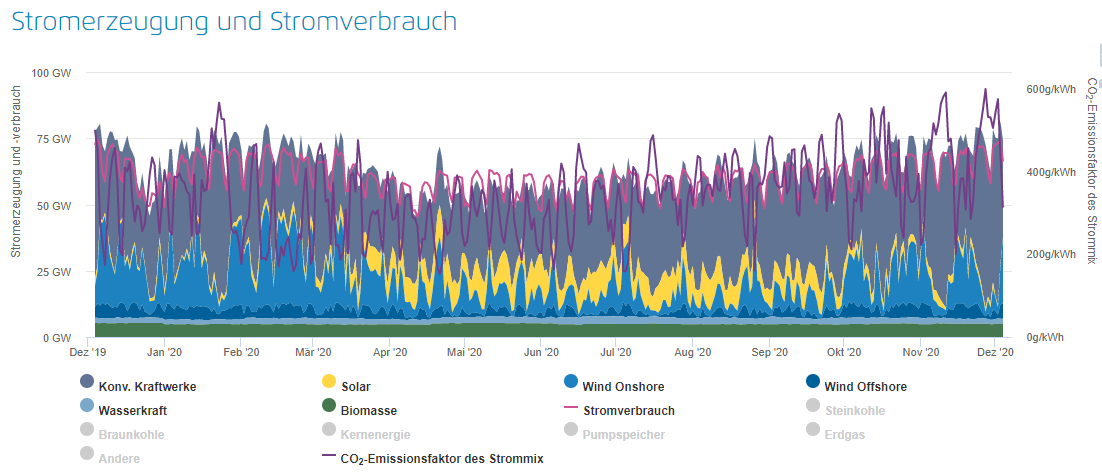
Meanwhile, here is the power generation mix of Germany, Dec. 4 2019 to Dec. 4, 2020. Power demand is high during winter particularly from December to March except in January for some reasons. During those high power demand months when people want more heating to avoid being frozen to death, solar output is minimal while wind onshore has big output. But what really produce stable and dispatchable on demand power are the conventionals, especially coal, nuke and gas.

https://www.agora-energiewende.de/service/agorameter/chart/power_generation/04.12.2019/04.12.2020/
------------------

See also:
Interview at DZBB and Agila TV, August 15, 2020
Agenda One News, Part 6, August 31, 2020 
Interview at PSVR, hosted by Cathy Cruz, September 28, 2020
Interview at DZRH about wind-solar as baseload plants, November 30, 2020.

Thursday, December 03, 2020

BWorld 462, Coal moratorium, climate and flooding

* My column in BusinessWorld last November 19, 2020.

As of Nov. 18, 39 countries around the world have reported their third quarter (Q3) GDP 2020 and only the Philippines has had a double-digit contraction at -11.5%. The Q1-Q3 average is -9.7%, with Malaysia’s -6.4%, Indonesia’s -1.9%, Vietnam’s +2.2%. The Philippine government, in particular the Department of Health, Inter-Agency Task Force for the Management of Emerging Infectious Diseases and their consultants, should realize that their strict and indefinite lockdown policy is the main reason for this crippling of business.

At this rate, the Philippines should grow by at least 11% in 2021 just to be at the same GDP level of 2019 because of the low economic base in 2020.

Energy policies will greatly help or further cripple economic recovery. And last month the Department of Energy (DoE) issued a moratorium, a stoppage of greenfield new coal power plants. Only those coal plants under committed projects and indicative projects which have secured some financing can proceed.

There are two inconvenient truths that the recent DoE order does not recognize.

One, the Philippines’ coal consumption is among the lowest in the emerging and developed economies, only 0.73 Exajoule (EJ) or 17.42 million tons oil equivalent (MTOE) in 2019 (conversion factor is 1 EJ =23.88 MTOE).

Two, cheap energy from fossil fuels, especially coal, is among the most important factors why many countries have developed and industrialized. Countries that expanded their coal use over the last 30 years showed faster growth and countries that reduced and shrank their coal use experienced slower growth. The data in the table is from the IMF World Economic Outlook (WEO) database October 2020, and the BP Statistical Review of World Energy (BP SRWE) database June 2020. I computed the yearly growth from BP SRWE then I took the averages in two groups of 15 years, 1990-2004 and 2005-2019.

The UN Framework Convention on Climate Change’s annual big meeting is coming soon and various climate alarms are being sounded because the various multilateral and national climate agencies desperately need that $100 billion a year of climate money starting 2020 as promised by the rich countries in the Paris Agreement 2015.

So no rain for months, no flood, no storm are proof of “man-made” global warming and climate change. And lots of rains, lots of flood, lots of storms like Goni (local name: Rolly) and Vamco (local name: Ulysses) are also proof of “man-made” global warming and climate change. Whatever weather event, whatever climate, we should send more money to the UN, the various climate and environment agencies. This is similar to gambling in flipping a coin and declaring “heads I win, tails you lose.”

We should prepare for the rising rivers, creeks, and lakes that are happening yearly, not a rising ocean. Rising rivers are actual while a rising ocean is fictional, a product of computer models based on unrealistic assumptions.

Dr. Renato Solidum, Jr., Phivolcs director, already made a simple proposal many years ago that the main solution to regular, annual flooding of Metro Manila, Central Luzon, Cagayan Valley, other areas is massive regular dredging of rivers, creeks and lakes. Costly but practical.

In the Central Luzon provinces, geological estimates show that lahar and sand from the Pinatubo eruption will continue to go down with flood waters for the next 30 years or more and hence, they will continue to cause more siltation and shallow rivers.

Cagayan, Isabela, Nueva Vizcaya, and Nueva Ecija provinces are huge rice-corn producing areas. Planting rice and corn needs land tilling two to three times a year, and tilling by tractors loosen the soil which then easily flows with flood water that goes to rivers, causing thick and high mud siltation.

But the government and Congress would rather spend big on climate agencies, climate junkets, and climate consultants, wasteful use of taxpayers money.

There are three ways to reduce the cost of dredging and dams construction via more involvement of private businesses.

One, invite real estate developers to participate in regular, large-scale dredging of rivers — they get the sand, mud, and other solid materials in river beds for their land reclamation projects in the sea.

Two, invite water companies, hydro-electric companies to build more dams, more weirs, more man-made lakes like Caliraya lake in Laguna.

Three, allow more open pit mining and, once mined out, leave these pits as man-made lakes to help store flood water. An open pit mine that became a lake that is now a tourist attraction in Toledo, Cebu.
----------------

See also:
BWorld 459, Trump energy policies and the US elections, November 03, 2020 
BWorld 460, Trade, stock markets and indefinite lockdown, November 08, 2020
BWorld 461, GDP contraction, CDC PH, and medicine taxes, November 30, 2020.

Walter Williams and limited government

Yesterday a great American economic mind has passed away. Dr. Walter Williams is among the big minds of George Mason University. I read about his passing when I saw the fb post of Dr. Roy W. Spencer, a world known climatologist. Dr. Spencer posted,

"Was saddened to hear of the passing of noted economist Walter E. Williams today. He was a gracious man, taking time to answer my economics questions, and he wrote the blurb for my first book. He was able to explain basic economic principles in simple terms. A great loss to the cause of economic sanity."


A good piece by Prof. Boudreaux yesterday:

Walter Williams, R.I.P. 
By Donald J. Boudreaux
Updated Dec. 2, 2020 5:24 pm ET 
https://www.wsj.com/articles/walter-williams-r-i-p-11606934313

America has lost one of its greatest economists and public intellectuals. Walter Williams died Wednesday morning after teaching his final class at George Mason University on Tuesday. He was 84.

For 40 years Walter was the heart and soul of George Mason’s unique Department of Economics. Our department unapologetically resists the trend of teaching economics as if it’s a guide for social engineers. This resistance reflects Walter’s commitment to liberal individualism and his belief that ordinary men and women deserve, as his friend Thomas Sowell puts it, “elbow room for themselves and a refuge from the rampaging presumptions of their ‘betters.’ ”

A onetime cabdriver who grew up poor in Philadelphia, Walter knew injustice—and understood the way to fight it wasn’t by emoting but by probing and learning. In 1972 he earned a doctorate in economics from the University of California, Los Angeles, where he learned to look beneath surface phenomena for deeper causes and consequences.

His pioneering 1982 book, “The State Against Blacks,” is an eloquent, data-rich broadside against occupational licensing, taxicab regulations, labor-union privileges and other fine-sounding government measures that inflict disproportionate harm on blacks by restricting the employment options and by driving up the costs of goods and services.

The economics profession boasts many excellent minds, but it has precious few with the ability and interest to do rigorous research and to engage the public with its results. Milton Friedman was such a scholar, as is Thomas Sowell. Walter was in their league. From his appearance on Friedman’s PBS program “Free To Choose” (1980) through his stints as guest host of Rush Limbaugh’s radio program to his syndicated column, Walter brought economic lessons to life in a way few others could….

A good video: 

Williams with Sowell – Progressive Racism 
https://m.youtube.com/watch?feature=youtu.be&v=QvC12foKLEk

The current lockdown dictatorships implemented in many countries, in the Philippines done by both national and local governments down to barangay and village levels, officials who are democratically elected and once elected have no concept of limited powers, only unlimited intervention and prohibition powers. Shame.

Monday, November 30, 2020

BWorld 461, GDP contraction, CDC PH, and medicine taxes

 * My article in BusinessWorld, November 12, 2020.

The Philippine Statistics Authority (PSA) released a bad report, saying that the Philippines’ gross domestic product (GDP) contraction continued in the third quarter (Q3) at -11.5%. The second quarter (Q2) was also revised from -16.5% to -16.9%.

I checked our neighbors’ and some developed countries’ GDP performance and among those with Q3 data, the Philippines is the only country which still has a double-digit contraction. The year-to-date (Ytd) contraction is nearly -10% while our neighbors Taiwan and Vietnam never experienced a recession and have modest growth (see Table 1).

Some people do not appreciate the relevance of GDP percentage changes so here are GDP figures in billions of pesos. GDP is measured via demand or expenditure side, and the supply or industry side. On the demand side, the biggest declines this year are on household consumption and private investments. Investments this year in particular are even lower than the level in 2017. On the supply side, the industry sector suffered a big decline. And our GDP size or flow of goods and services in a year in 2020 is even lower than 2018’s level (see Table 2).

The Philippine government’s strict, indefinite, and no timetable lockdown policy is the main reason for the systematic crippling of the economy.

My alumni group, the UP School of Economics Alumni Association (UPSEAA) held a Zoom lecture given by Dr. Benigno “Iggy” Agbayani, Jr., on “Philippines COVID-19 Response, What we got right and wrong” on Nov. 4. Dr. Agbayani is a fellow UP alumnus (BS Biology, Medical Degree, and Residency at UP-PGH). He is currently the Chairman of the Department of Orthopedics, Manila Doctors Hospital. He is also a co-founder of the Concerned Doctors and Citizens of the Philippines (CDC PH) that campaigns to “Flatten the fear” and lift the lockdown.

On the rising number of cases in the country due to rising tests and false positives, Dr. Agbayani said that viral detection is difficult because viruses are everywhere, too small and have similarities with fragments of other viruses or organisms. No test method actually looks for the virus itself but only detects a signature RNA fragment or surface protein. False positives using the RT-PCR is a major cause of over reporting of cases since even a single fragment of an airborne virus multiplied by 40 cycles will be detected. An asymptomatic case, even if it would turn out to be symptomatic, does not necessarily mean that the person is contagious even with an accurate test positive RT-PCR because it does not measure viral load but merely the presence of a fragment of viral RNA. And this causes many bad policies like being quarantined up to two weeks even without symptoms or being contagious.

On herd immunity, he said that it is the end goal of ending or controlling all epidemics or pandemics. He fully agrees with Dr. Jay Bhattacharya, an economist and public health Epidemiologist at the Stanford School of Medicine, who said that herd immunity is just like gravity. How to get there as safely as possible is the subject of debate ranging from vaccination, infection of the less vulnerable, or by strengthening the immunity response through antiviral prophylaxis, or strengthening innate immunity. Herd immunity can be held off by endless lockdowns, mandatory distancing, etc.

He said that CDC PH offers a three pronged approach to end the lockdowns safely and effectively without the need to isolate the elderly and vulnerable for an indefinite period of time, nor wait for a safe vaccine that may be a year away or may never come. The approach is a combination of the Great Barrington Declaration (GBD) focused protection and a safe approach to herd immunity, the use of proven efficacious and safe antiviral drugs like Hydroxychloroquine, Ivermectin and, in the future, Leronlimab, and strengthening our innate immunity through sunlight or Vitamin D, foods rich in Vitamin C and zinc, exercise, good sleep, stress management, and other lifestyle modification.

Meanwhile, a global coalition of independent think tanks and institutes released a short study and position paper, “Overcoming obstacles to medicine access: Joint policy recommendations to the 2020 World Health Assembly,” released also on Nov. 4.

The study identified two important policy measures. One, reduce unnecessary medicine costs by reducing medicine taxes, abolishing medicine tariffs, and eradicating other trade barriers. Two, accelerate access to medicines by simplifying the drug approval process, modernizing government medicine reimbursement decision-making, promoting genuine free trade in medicines, and supporting the innovation system. The paper can be downloaded at https://geneva-network.com/research/overcoming-obstacles-to-medicines-access/. 

Very often, too much government — like strict and prolonged lockdowns, high and multiple taxes and tariffs on medicines — is unhealthy for the economy and patients.
--------------------

See also:
BWorld 458, Property rights and lockdown lefts, October 28, 2020 
BWorld 459, Trump energy policies and the US elections, November 03, 2020 
BWorld 460, Trade, stock markets and indefinite lockdown, November 08, 2020.

Interview at DZRH about wind-solar as baseload plants

 Last Nov. 20, I was on brief, live radio interview, DZRH hosted by Cong. Angelo Palmones. Topic was  "Solar, wind as baseload power?" I said No, far out, only 2.3% of total PH power generation as of 2019.

https://www.youtube.com/watch?v=wjTU_fgKnbA&feature=youtu.be

Cong. Palmones also saw my article the day before, https://www.bworldonline.com/coal-moratorium-climate-and-flooding/

A friend asked me about Swedish young anti-fossil fuel activist Greta Thunberg. I said that I doubt if Greta and her parents use bicycles, manual scooters, or their feet going to work, meetings, school, do groceries, domestic travel, etc. Like the UN and Al Gore, they double talk. Preach something and do the opposite.

Meanwhile, I saw these in one of DOH Reports. Multi-billion pesos public funding (foreign aid plus national government) to further promote RE especially wind-solar.


-------------

See also:
Interview at Turbo Time by Mike Potenciano and Raymond Tribdino, August 16, 2020 
Agenda One News, Part 6, August 31, 2020 
Interview at PSVR, hosted by Cathy Cruz, September 28, 2020.

Sunday, November 08, 2020

BWorld 460, Trade, stock markets and indefinite lockdown

 * My column in BusinessWorld, Nov. 5, 2020.

The Philippines is now into eight months of indefinite, no timetable lockdown since mid-March. The adverse impact on the economy and people’s livelihood is also indefinite. Estimates of the country’s GDP contraction this year range from -6% to -9.5%. At this rate, with this very low economic base in 2020, we need to grow by at least 10% in 2021 just to be at the economic level of 2019.

For this piece, I will briefly discuss the impact of the virus scare plus global lockdowns on two sectors, merchandise or goods trade and stock market capitalization.

The Philippines GDP size in 2019 was $377 billion and ranked 34th worldwide. In merchandise trade, the Philippines in 2019 ranked 43rd with $70-billion exports and ranked 34th with $113-billion imports.

With the COVID-19 scare and lockdowns in many countries, workers, investors and goods, from raw materials to finished products, have limited mobility. Among the countries listed in Table 1, data from the World Trade Organization (WTO) show that the Philippines has the second deepest contraction in exports next to India, the first half 2020 is only 40% of total exports in 2019. In imports, the Philippines has the deepest contraction, the first half 2020 only one-third of 2019 imports (see Table 1).


When it comes to the stock market, data from the World Federation of Exchanges (WFE) show that the Philippine Stock Exchange (PSE) capitalization of $275 billion in end-2019 shrank to only $192 billion by March 2020 and slowly inched up to $220 billion by September 2020, still a huge -20% contraction from the 2019 level and among the deepest dive in the world. Which means the already small capital base of the PSE became even smaller (see Table 2).

Strict lockdown policies — ECQ, MECQ, GCQ — which prohibit many public transportation options, among others, continue to wreak havoc on the economy affecting both rich and poor. Only government officials and personnel are not affected because their salaries and allowances, which have been appropriated in the 2020 budget, are already secured and funded.

The Concerned Doctors and Citizens of the Philippines (CDC PH) wrote to President Rodrigo Duterte on Oct. 7 appealing for lifting the lockdown nationwide. In that letter, the physicians and other signatories argued,

“…we do not need to sacrifice our nation’s economy to save the lives of the 800+ high-risk Filipinos each month who are actually threatened by COVID. To do this we propose the adoption of a scientific, data-driven and objective response: (1) isolation and early treatment of the sick, (2) protection of the vulnerable, i.e. the elderly and those with medical comorbidities, (3) quarantine only of affected localities based on metrics such as death rates, ICU capacity.”

“We propose the early treatment of COVID-19 with a variety of drugs and supplements such as Faviparivir, Budesonide, the very promising Ivermectin and the Zelenko Protocol, which combines zinc and Azithromycin with the highly politicized yet long proven effective hydroxychloroquine. Despite all the controversy surrounding HCQ, there remains very strong medical support for its efficacy in reducing mortality, hospitalization and the severity of the disease…”

The rising number of prohibitions and mandates make our lives and freedom more restricted. There is the mandatory closure of public transportation, closure of schools, churches and cinemas, and soon there will be mandatory vaccination — as if government and vaccine pushers are Gods who cannot make mistakes in the quality and safety of those vaccines. Mandatory vaccination is wrong and should not be imposed on all people.
-------------

See also:
BWorld 457, No to free electricity from Meralco, genco, October 27, 2020 
BWorld 458, Property rights and lockdown lefts, October 28, 2020 
BWorld 459, Trump energy policies and the US elections, November 03, 2020.

IPR and Innovation 48, More medicine access via lower taxes and bureaucracies

Last Wednesday Nov. 4, a global coalition of independent think tanks and institutes released a position paper calling on governments to take steps to accelerate access to Covid-19 medicines. 


Six think tanks from the ASEAN signed this paper, two from Indonesia (Center for Indonesian Policy Studies/CIPS and Paramadina Public Policy Inst.), two from Malaysia (Institute for Democracy and Economic Affairs/IDEAS, Galen Center) and one each from Singapore (Adam Smith Center) and Philippines (Minimal Government Thinkers).

The study was initiated by the Geneva Network which is our friend for many years now. The study identified two important policy measures.

1. Reduce unnecessary medicine costs by: 

* Reducing taxes
* Abolishing tariffs
* Eradicating other trade barriers. 

2. Accelerate access to medicines by:

* Simplifying the drug approval process
* Modernising government medicine reimbursement decision-making
* Promoting genuine free trade in medicines
* Supporting the innovation system,

The paper can be downloaded at https://geneva-network.com/research/overcoming-obstacles-to-medicines-access/
------------

See also:
IPR and Innovation 45, PH IPR courts, BOI-IPO, GII 2019, August 6, 2019 
IPR and Innovation 46, IP rules and Covid-19, April 17, 2020 
IPR and Innovation 47, Our Joint Declaration on WHA, May 18, May 21, 2020.