Showing posts with label Kyoto Protocol. Show all posts

Wednesday, October 14, 2015

From Kyotoism to Paris climatism

On May 31, 2011, I made these observations:

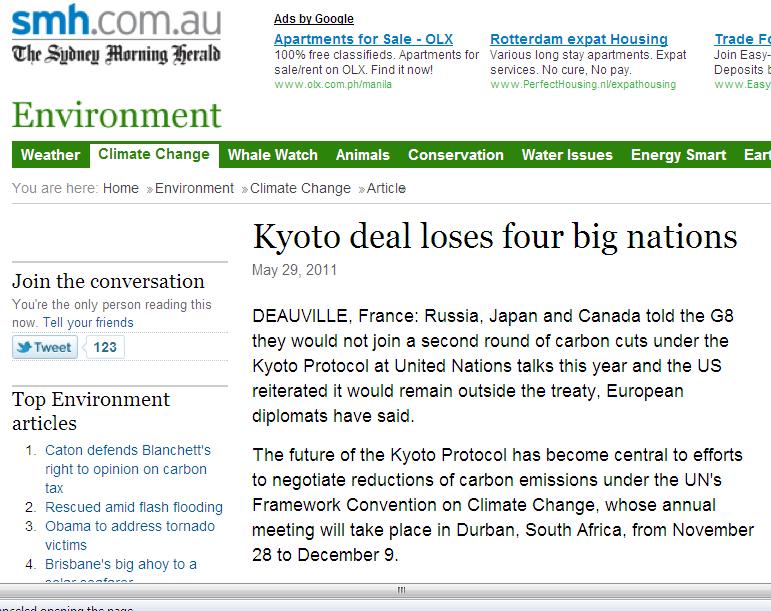
Kyotoism, the philosophy that the Kyoto Protocol (KP) of binding carbon emission reduction by many rich and industrialized countries will help "save the planet", is dying. KP was adopted in 1997 in Kyoto, Japan, and became binding by 2005. It will expire by the end of 2012. Thus, the rush by the UN and many governments to have a new binding agreement that will supplant KP by 2013.

The point organization to prolong climate alarmism -- more environmental regulations, more carbon and energy taxation, more climate bureaucracies and frequent global climate meetings/junkets, more climate loans -- is the UN Framework Convention on Climate Change (UN FCCC). Thus, there have been huge global climate meetings called the Conference of Parties (COP) in the past, particularly the COP 15 in Copenhagen, Denmark in December 2009, then the COP 16 in Cancun, Mexico in December 2010. The next COP meeting will be in Durban, South Africa, this coming December 2011.

Here's the latest update: four countries, the US government (original non-signatory to KP) will be joined by the governments of Japan, Russia and Canada that will not sign any KP part 2. The reason is that "the Kyoto format did not require developing countries, including China, the world's No. 1 carbon emitter, to make targeted emission cuts."

So you have the world's biggest carbon emitters -- China and the US, plus Japan, Russia, Canada -- not signing another round of "Earth-saving" deep emission reductions. The UN officials and bureaucrats particularly involved in climate alarmism -- IPCC, FCCC, UNEP, WMO -- would be panicking by now. If many rich country governments are not convinced of the "urgent necessity" to save the planet, and these same countries have serious fiscal problems like huge public debt, the next move could be the reduction of UN funding, and that might affect all their globe-trotting lifestyle to scare the world.

Read more: http://www.smh.com.au/environment/climate-change/kyoto-deal-loses-four-big-nations-20110528-1f9dk.html#ixzz1NqwXnC00
This illustration possibly explains why public belief in AGW is flatlining or may be declining. When there is more drought, less rain, less snow, they called it "man-made warming". When there is more rain, more snow, they still call it "man-made warming."

Meanwhile, this UN Press Release in 2008 was cool, or hotly kidding. It quoted the head of the UN General Assembly that they projected 50 to 200 climate emigrants or refugees by 2010. Where are those millions of climate migrants/refugees last year?

http://www.un.org/press/en/2008/ga10725.doc.htm
--------

Update:
Next month, thousands of climate officials, negotiators and planet saviours will burn tons of petroleum flying from anywhere in the planet to Paris, France, for the UN FCCC meeting, November 30 - December 11. They will mainly talk about climate money, who should give how many billions of dollars to whom, to "save the planet."

One big problem for the planet saviours: some of them will not accept billions of dollars a year. They want trillions of dollars a year.


The climate alarmism movement  has successfully dug its own hole and graveyard of disappointment, angst and anger. As the movement paints more scary scenarios, they further raise the cost of preventing that scary and fictional scenario. Now the  cost of climate extortion keeps rising.
----------

See also:
TIME mag. on global warming (3), October 04, 2015 

Thursday, March 20, 2014

Energy Econ 16: Electricity and Development

* This is my article in thelobbyist.biz last March 07, 2014.
-----------

Energy is development. It is not possible to develop economically and socially if a country or economy has little electricity and hence, energy prices are high and there is frequent brown out.

In many economic literatures, growth in energy use is often used as proxy or “checking mechanism” for GDP growth as there is a generally one on one correspondence in energy use and real GDP growth.

A data from the Asian Development Bank (ADB) is very interesting, below. Countries are grouped into three: Northeast Asia, Southeast Asia, and others.

  
Some interesting notes here, that as of 2010: (a) China has 5x energy use than Japan; (b) Japan's energy use has almost flatlined over the past two decades; (c) Singapore has twice the energy use of HK; (d) Vietnam has overtaken the Philippines with 50 percent more energy use; (e) from 1990 to 2010, these countries have generally tripled (3x) their energy use: China, S. Korea, Thailand, Malaysia and Singapore; and (f) Vietnam has expanded almost 4x.

One possible explanation here is Kyotoism, the Kyoto Protocol (KP) of countries reducing if not backsliding carbon emission (indirectly, energy use) that is not too far from their 1990 levels. Japan, Hong Kong and Australia must have tried hard to obey the global ecological central planning while real socialists and central planners China and Vietnam have totally disobeyed the ecological targets. This is one reason why KP was abandoned. When it expired in December 2012, there was no succeeding binding agreement among countries and governments. Many developed countries do not want to de-industrialize, they do not want to have electricity black outs soon.

Growth in electricity consumption and energy use in Japan, HK, Australia and several other countries was due to more efficient energy use. For instance, by using only 50 kwh bulb to produce the same street light as a 200 kwh bulb, they could expand street lights 3x or 4x even without adding another power plant. Still, it is good to have more energy capacity while improving energy use efficiency.

Another interesting data from the same publication by ADB, HK and Singapore just keep modernizing and industrializing by relying almost 100% from imported energy for their power needs. HK gets it mainly from China (mainly nuclear, coal and natural gas) while Singapore gets it mainly from Malaysia, Indonesia and Brunei.


There are at least three lessons for the Philippines from the above tables.

One, there is an urgent need to expand energy capacity, to have more power generation plants, in the Philippines as more businesses, more houses and schools, other economic activities, are demanding for more stable power supply and prices.

Two, “energy independence” sounds cool but HK and Singapore show no interest in such goal. They are almost 100 percent dependent on imported energy yet they seem to be not bothered. Aas long as they have the money, they can buy energy from anywhere.

Three, energy prices here must go down through more competition among more private energy producers. Also, government can share the burden by reducing the taxes, fees and royalties for energy projects.
-------------- 

See also: 

Wednesday, December 02, 2009

Warming Hysteria: Kyoto Protocol and Climategate

A good friend of mine asked me what's wrong with the Kyoto Protocol (KP) and the forthcoming Copenhagen meeting (to start next week) projected to produce a sort of KP Part II in binding environmental commitments. He does not see such international environmental regulations restrict economic freedom and individual liberty.

For me, the main problem with KP and soon, the planned Copenhagen agreement, is the extent of new environmental regulations, energy rationing, carbon taxation, carbon cap and trade, carbon tariff and eco-protectionism. In short, an expanded ecological central planning.

The science behind anthropogenic global warming (AGW) is highly questionable, if not discredited. The current "climategate" scandal is one proof that the AGW claim is not even a theory because of the presence of so many contrary data and facts that do not conform with the predictive capacity of the "theory". Thus, imposing those carbon emission restrictions and regulations based on suspicious, heavily debated, if not wrong science, is wrong.

About clean development mechanisms (CDMs), certified emission reduction (CERs) and related schemes for carbon mitigation, these are among the offshoot of carbon rent-seeking. Consider the following examples.

Philippine Airlines (PAL), Cebu Pacific airline, Superferry shipping line, Victory bus line, San Miguel Corp., for instance, will be assigned a carbon cap by the DENR or a new climate bureaucracy by the Philippine government, say at X tons per year starting 2010. Then such climate or carbon control agency will declare,

"You PAL (or Cebu Pacific or Superferry, etc.), your carbon emission cap by 2015 will be reduced to (X - 10%); by 2020, it will further be reduced to (X-20%); by 2030, it will be further reduced to (X - 30%), and so on." 

So as the number of airplanes of an airline company, or the number of boats of a shipping company, the number of buses of a bus company, etc. are increasing because the population and passengers are rising and people are driving less too, the emission from these corporations will be rising. 

So you have a situation of rising emission from these companies but the cap given by government is reducing. What will these airline, shipping line, bus line and other companies do? One is invest in emission-reduction technologies to be put in the engines of their airplanes, boats, vehicles, and other machineries. If this is not technologically possible, or very expensive to do, another option is to buy carbon credits from some companies, whether in the Philippines or abroad, that sell extra carbon offsets (say from a solar power plant or wind power farm). 

As carbon caps across the world are declining, the number of companies seeking to buy carbon credits expanding, the price of carbon credits naturally will rise. The price of carbon per ton will rise. So those airlines, shipping lines, hotel and restaurant chains, bus lines, vehicle manufacturers, etc. will be passing on the extra cost of higher carbon credits to their consumers, to their passengers, to the public.

CDM sounds "clean" in theory if the AGW science is absolutely correct. But in reality, such mechanisms contribute to higher prices, both of energy and consumer items. Lots of reports that such cap and trade system as CDM has resulted in job losses and company closure, in Europe. The value of carbon trading was $128 billion in 2008 alone, and those do not include companies in the US as the US government is not a signatory to the KP.

At home, some political families were said to have made big money with the mandatory Ethanol 10% (E10) and biodisel 5% (B5) provisions. They capitalized on the carbon restrictions, that all petroleum companies in the country, big and small, will be forced to buy from them. Of course there is a related issue of agricultural lands previously planted to food crops have now been converted to fuel crops, contributing to the recent and continuing food price inflation.

A poor household will soon face higher electricity bill as "non-clean" but cheap energy sources like coal will be slapped with high carbon taxes. A poor and middle class family will soon face higher bus fares, higher airfares and boat fares, because of those carbon caps and trade and related CDMs.

So those supposedly "market-based" instruments to drastically cut carbon emission in the atmosphere like CDM and CER, are actually very distortionary of the market economy. Banks, carbon traders and other private and government bodies that live off implementing and monitoring those schemes become the new carbon rent-seekers. They produce not a single kilo of food, transport not a single passenger, or produce not a single kwh of electricity, but they make big money, hundreds of billions of dollars of carbon traded money every year.


My friend suggested that Kyoto Protocol (KP) is an application of the polluter-pay principle. He also suggested that most developing countries, or Annex II countries, are not obliged by KP to make drastic carbon emission cuts.

I think he is right that for now, developing countries like the Philippines are not obliged to make deep emission cuts. But it's just a matter of time. When KP was sealed in 2005 I think, China, India, Brazil, Indonesia, S. Africa, Mexico, etc. were just innocent countries. Now in the Copenhagen meeting, there are direct cap being expected, if not imposed, on them, especially China. In addition, some rich countries are threatening that developing but very big economies like China and INdia, should make their own deep emission cut, otherwise they will impose high carbon tariffs ("eco-protectionism") on their exports. And this makes implementation of the emission cut less transparent. Any rich country can slap different carbon tariffs for different countries, like +10% on top of existing tariff duties for Mexican exports, +15% for Chinese exports, etc.

So for the Philippines having 92 million people, the 12th biggest population in the world, it should be a matter of time and we will be given carbon cap by some international climate bureaucrats.

But even if there will be no carbon emission cap to be imposed on the Philippines and other poorer countries say, in the next 30 years, such economies will also suffer from low and anemic growth that will happen in rich countries. Why? Because the rich countries are the main buyers of our exports, the main employers of our outbound workers (the OFWs), among the main sources of in-bound foreign tourists and foreign investors.

Losing jobs as a result of restricting environmental and energy regulations in rich countries. Last month I read about the biggest aluminum plant in the US closing, going bankrupt. Why -- energy prices in the US becoming more and more expensive. Some states are more strict than the federal government in practically killing coal power plants (which supplies about 60 percent of all US energy needs).

I mentioned that coal is cheap energy source because I read that the per kwh cost of generating electricity from solar and wind power is 10x that from coal. At least in the US energy situation.

I also doubt that the Philippines will be able to sell substantial carbon credits to companies from rich countries because growing domestic demand for more power are often not enough. Whatever new power plants to be put up, from renewables like hydro and geothermal, will be snapped up by domestic industries and households, no credit to be left to foreign companies from abroad wanting to buy carbon credits.

Finally, we should visit and review some scientific literature on anthropogenic global warming (AGW) science, that it is highly debatable if not discredited, because all those carbon regulations are based from that "theory".
---------

On Climategate

Here's one online search even for fun:

Google "global warming", you get 9.8 million entries (as of this writing)
Then google "climategate", you get 13.4 million entries!
The former is 3 decades old, the latter is only 2 weeks old.

The latter is about the hacked emails, thousands of emails and documents at the Climate Research Unit (CRU) of the Univ. of East Anglia in Britain, where a number of warming scientists were emailing each other how they cheated on climate data to "hide the decline" in global temperature, how to hide or destroy climate data to escape UK's Freedom of Information law, how to kill and not publish scientific papers that question man-made warming in some scientific journals, and so on. 

These warming scientists and politicians that give them millions of dollars of climate research funds have one major goal: to scare the world of "impending environmental catastrophies" so that the world will accept their planned ecological central planning agenda.

The big problem of the UN, Al Gore and other warmers now, is that millions of people around the world have already known and read the climate data manipulation and bastardization of climate science. And these people are angry.
-------


A number of NGOs and institutes in the Philippines are pushing now the Freedom of Information (FOI) bill. It was passed in the House of Representatives, awaiting action at the Senate. MG Thinkers is among the 70+ institutes and NGOs that signed the FOI statement.

The UK has a Freedom of Information (FOI) law. In the "climategate" or climate scandal still on-going, a number of the hacked emails showed that the head of the Climate Research Unit (CRU), Dr. Phil Jones, was emailing other warming scientists, "don't let them know that UK has a FOI law" as a number of skeptical scientists were demanding certain climate data. In succeeding emails, Phil Jones later exhorted other scientists to "destroy" climate data before the skeptics would find and see them under the FOI law.

I myself have difficulty getting RP temperature data from PAGASA. I was emailing one official of the meteorology department, cc'd Nathaniel Cruz -- yes, the known and affable Tani Cruz -- and they won't reply to my email. They know my stand that I question man-made warming. Is this the reason?

So, go ahead with FOI bill in the Philippines. Time is very short for the Senate to act as the election campaign period is fast approaching. 

Liars and robbers in government hide from transparency and accountability because they are not obliged by the law to open up certain information to the public.

Saturday, September 12, 2009

Solar Minimum and Copenhagen


Honest people change their position when the data that stare them in the face are contrary to what they previously thought. Dishonest people don’t. They only make totally different interpretations of existing data.

Image source: http://www.friendsofscience.org/assets/documents/FOS%20Essay/GlobalTroposphereTemperaturesAverage.jpg

Above is a chart comparing global temperature and carbon dioxide (CO2) levels in the atmosphere over the past 30 years, latest figure is August 2009. Temperature is from satellite data, UAH and RSS, measured at the troposphere, 8 kms. from the surface of the Earth. Data is from Mauna Loa, Hawaii.

The above chart shows one glaring fact: Global cooling continues despite increases in CO2 concentration in the atmosphere. From January 2002 to August 2009, the best-fit line shows cooling of 0.24 C, whereas CO2 concentration is now close to 390 parts per million (ppm), from only 285 ppm at the start of the Industrial Revolution two centuries ago, and around 385 ppm just about two years ago. But even at 390 or even 400 ppm, this ratio is still very small, only 0.04 percent of total gases in the atmosphere.

This year, it has been mostly cloudy and often raining. Like the first 12 days of this month. There were two typhoons (local names “Labuyo” and “Maring”) that entered the Philippine area of responsibility this month. Although they did not make any landfall, both typhoons dumped lots of rain in Luzon, Metro Manila and almost the entire country, causing heavy flooding and landslides in many areas, and causing several casualties.

Meanwhile, the Sun continues its deep solar minimum. In 2007, 44 percent of all (365) days have zero sunspots. Last year, it rose to 73 percent and this year, from January 01 to September 10, 80 percent of all days have zero sunspots. Some solar physicists and other scientists are even asking if sunspots will disappear in the next few years.

Sunspot activities are indicator of the strength, or weakness, of the Sun’s magnetic field. Weak solar magnetic field results in few or zero sunspots and weak solar wind, etc. Now there are plenty of galactic cosmic rays coming from exploding stars that travel in the universe, some of which reach our planet’s atmosphere. Such cosmic rays help catalyze the formation of low-lying clouds. When there are more of them in the atmosphere, more low-lying clouds are formed. And there are more of them when solar magnetic field and solar wind is weak to push the cosmic rays away. When there are plenty of low-lying clouds in the sky, (a) direct sunlight is blocked from reaching the Earth’s surface and is reflected back to the outer space, and (b) more rains are falling, resulting in global cooling.

At solar maximum, solar wind would be traveling at around 600,000+ kms per second. With the current prolonged solar minimum, solar wind speed is only around 300,000 to 400,000 kms per second. According to one Australian scientist, Dr. David Archibald (www.davidarchibald.info), there is a lag of 1 year from sunspot activities to the formation of low lying clouds. A deep solar minimum became more pronounced from August to December last year. Many scientists including those from NASA thought that solar cycle 23 (one cycle would average 11 years to finish then move to another cycle) was already over, so that by January this year, solar cycle 24 was suppose to have started. They expected an uptick of solar activity. The reverse happened, the deep solar minimum continues up to these days.

So the current frequent cloudy skies – despite the fact that an El Nino is occurring this year – could be explained by the weak solar magnetic field late last year. And since the deep solar minimum continues up to this year, then we can expect that cloudy skies, frequent rains and colder climate will extend up to next year, and the coming decades. It has been the behavior of the Sun that in a solar cycle with deep and prolonged minimum sunspot activities, the next two cycles (ie, solar cycle 24 and 25, corresponding to 2.5 decades) will also be weak. And so, global cooling is expected to last for the next 2 to 3 decades.

Meanwhile, many governments around the world and the UN are busy with almost bi-monthly expensive global meetings in preparation for the UN Framework Convention on Climate Change (UN FCCC) meeting in Copenhagen, Denmark, this coming December. The goal of such big meetings is for various governments to plan and sign a new global climate deal that will succeed the Kyoto Protocol which will expire in 2011 or 2012. They just held a meeting in Bonn, Germany last month. Their next meetings will be in Bangkok, Thailand, this coming September 28 to October 9, and another meeting in Barcelona, Spain, on November 2 to 6, before they move to Copenhagen in December for the penultimate meeting.

The main goal of those frequent and expensive global meetings, is for “climate negotiators” of those governments and the UN to curtail as much carbon dioxide emission into the atmosphere as this gas is believed to be the main cause of what they call as “man-made (or anthropogenic) global warming.”
These government and UN negotiators believe that there is already a "consensus", that “scientific debate is over”, as signified by the UN Intergovernmental Panel on Climate Change (IPCC) reports, so that politics and politicians will now take over to curb as much carbon emission as possible to “save” the planet. For the UN IPCC and global politicians, our Sun is a static and non-changing star whose job is only to give sunlight during daytime.

It is the non-recognition of natural factors – the Sun’s magnetic field and sunspot activities, volcanic eruptions and geologic changes, the ocean – as the main drivers of the Earth’s climate that betrays the evil design of those governments, the UN and the various environmentalist groups. Their grand design is to create and tighten more environmental regulations, to enact new carbon taxes, and to impose ecological protectionism. In short, to arrogate more political power into their hands, to collect more money for them and their favored corporations and banks which are engaged in carbon offsets and carbon trading.

Since there is no scientific consensus yet as more scientific data and studies that discredit the man-made warming theory of the UN IPCC and various governments come up, then those expensive global meetings and the forthcoming Copenhagen meeting, should be scrapped. They are unnecessary and only prolong the big scam that they themselves have invented.

The pre-defined political agenda of governments and the UN – to regulate and ration energy sources, to collect more climate-related taxes, to play God to "save" the planet – becomes more indefensible with each passing days and months. They cannot regulate the Sun's magnetic field, they cannot regulate the cosmic rays that come from outside the solar system, so they have to trivialize and de-emphasize the role of those natural factors. There's no money and additional political power for them if they accept that the Sun is main driver of the planet's climate, whether warming or cooling.

Let's have clean air, clean water, clean environment, fine. Regulate lead, mercury, soot, carbon monoxide, methane, CFC, etc., only for their own sake, and not say to "save the planet" because the planet is never in danger.
---------

Last week, I wrote this:

3 months before Copenhagen, panic continues

A friend referred me to this climate alarmism news report,
http://www.reuters.com/article/latestCrisis/idUSN02547411

It says how the Arctic ice is slowly melting because of global warming.

With the Copenhagen meeting just 3 months away, all the panic is setting in.
Bureaucrats need hundreds of billions of $ of carbon tax, like Obama's cap and trade energy bill worth around $7.5 trillion from 2012-2030, or around $317B/year on federal carbon taxes alone, on top of existing environmental taxes, on top of carbon taxes by various states like California; hundreds of billions of $ in carbon cap and trade (was $128 B in 2008, from private corporations alone in EU and Japan), of several billion $ of subsidies to wind farms, solar farms, etc.

Lie if they must, demonize a useful gas CO2 (the gas that we humans exhale, the gas that plants and crops need) if they must, scare the world as much as possible, so they will get the carbon regulation that they need. Goldman Sachs and many other big banks are too happy to join the bandwagon because they are among the biggest bank-traders of carbon trading.

Several years ago, the world had tech bubble burst. Recently, we had housing bubble burst. And soon, a carbon bubble burst. Another financial disaster in waiting. A non-commodity like the gas that we exhale is now a commodity that is traded in billions of $, that will be taxed by governments by the trillions of $.

Here's one simple but clear paper written by a chemist,'
http://tech-know.eu/uploads/Open_letter_to_Gordon_Brown.pdf

His paper has a short discussion about the Sun-climate link, and why CO2 hardly affects global climate. And if it does, it's for a useful purpose -- helping more plant growth, more agricultural productivity, more trees, more flowers.

Saturday, August 15, 2009

Warming Hysteria: Sunspots and Politics

"Astronomers: 'Sun's output may decline significantly inducing another little ice age on the Earth'
'Maunder Minimum will arrive in time to save planet from utterly foolish global carbon tax'"

That's the headline by Marc Morano,
http://climatedepot.com/a/2452/Astronomers-Suns-output-may-decline-significantly-inducing-another-little-ice-age-on-the-Earth

Marc quoted a number of solar physicists (Dr. William Livingston, Dr. Matthew Penn, Dr. Cornelius de Jager, etc.) who declared that

"regardless of the relation to the sunspot cycles, magnetic intensity in sunspots is decreasing and if this continues in the same way as it has for the last 15 years, the Sun will be devoid of sunspots in five years time: overall the Sun's energetic output will decline significantly inducing another little ice age on the Earth."

This is another significant scientific finding. There is too much science about the Sun, and even the cosmic rays coming from outside our solar system, that the public and policy makers especially, should consider and understand. Over-reliance in blaming carbon emission is too simplistic. There is heavy politics and rent-seeking in carbon regulations like carbon tax, carbon cap and trade, carbon offset, etc.

But as sure as the Sun rising tomorrow and everyday after, the truth about the Sun-climate link will come out.

When that time comes, I really wish that the United Nations, the mother of all climate alarmism bureaucracies in the planet, will be significantly defanged. I also wish that many of its agencies and programs be abolished. All they do is paint all the scariest projections about the planet and its inhabitants, in exchange for more tax money, more political and regulatory powers, and more expensive global meetings.
----------


As of August 13, NASA’s http://spaceweather.com/ has this tally in number of sunspot-less (i.e., zero sunspot) days:

Current Stretch: 34 days
2009 total: 176 days (78 percent)
Since 2004: 687 days
Typical Solar Min: 485 days

Since 01 January 2009 up to August 13, 176 out of 225 days or 78 percent of all days have zero sunspot. This is very significant. In terms of percentage of days with not a single sunspot, this year is already in the top three since 1849. If current slumber of the sun will continue for the rest of the year, we should be hitting 80 to 85 percent of zero sunspot days.

Over the past 160 years, the top five years with highest sunspot-less days were:

1. 1913, 311 days, 85 percent
2. 1901, 284 days, 78 percent
3. 1878, 278 days, 76 percent
4. 2008, 266 days, 73 percent
5. 1912, 253 days, 69 percent

Why is a prolonged stretch of zero sunspot important?

Long number of few or zero sunspot days means (a) weak solar magnetic field, weak solar wind, (b) more galactic cosmic rays enter the solar system including the Earth, weak solar wind to push them away, (c) more low-lying clouds are enhanced and formed, lots of sunlight are blocked, and (d) global cooling results. Such cooling has nothing or very little to do with CO2 concentration in the atmosphere.

There are a number of proofs for the current global cooling. For instance, July 2009 was the coldest July or 2nd coldest July on record for at least 10 states in the US, see “July’s climate: chilly USA, torrid globe.”

Here in the Philippines, cloudy skies have been the norm since last year up to the present, which is consistent with the above-mentioned causation between few sunspots and low-lying clouds. The summer months of March-April-May this year were sidestepped by the prolonged “cold front” that started in late 2008 to April this year. The rainy season came 1 ½ month earlier, in mid-April, instead of the usual July. A number of farms planted to “summer crops” like tomato, onions and water melon were destroyed because of such early onset of the rains.

For the first half of August this year, two typhoons (local names “Jolina” and “Kiko”, international name of the latter was “Morakot”) pummeled the northern part of the country. Morakot killed at least 22 people in the Philippines despite not hitting a landfall, while it killed several hundred people in Taiwan. Too much rainfall eroded mountainsides that were previously thought to be stable, causing widespread landslides.

Meanwhile, the UN IPCC is preparing to produce its 5th Assessment Report (AR5) and the UN FCCC is busy conducting various global meetings prior to the big meeting in Copenhagen this coming December for a “post-Kyoto Protocol” agreements to drastically cut global emission of the “evil” gas, carbon dioxide (CO2).

Until the IPCC and many governments later demonized CO2 as an evil gas that causes global warming, this gas is known in the biological sciences as a very useful gas. It is the gas that we humans exhale, that our pets and farm animals exhale, and it is the gas that our vegetables, fruits, flowers and trees need when they produce their own food via photosynthesis. It is actually plant food.

Now the useful gas is pictured as evil that must be drastically reduced globally. Can environmental bureaucrats and politicians do it? Yes, they think they can. That is why they invented the UN Framework Convention on Climate Change (UN FCCC), Kyoto Protocol, the various expensive global meetings to succeed Kyoto, and the various “anti-climate change” bureaucracies in so many governments, both national and local.

Their grand design is plain environmental regulation. They forget or they deliberately overlook the Sun, inter-planetary orbit around the sun, galactic cosmic rays, volcanoes, the ocean, and other natural causes. For them, only the evil CO2 matters.

Why is this so? Political science, not climate science, provides the answer. Environmental bureaucrats, politicians and their militant environmentalist group backers cannot regulate the Sun and its solar wind. They cannot regulate cosmic rays that come from outside the solar system. They cannot regulate volcanoes and ocean that contribute to emission and/or depository of certain greenhouse gases. But they can regulate carbon emission. So they play the global hero by demonizing this gas and reducing their emission, by regulating and curtailing human economic activities that emit this “evil”.

I believe that we should deal with soot, methane, CFC, lead, carbon monoxide, particulates, mercury, etc. These harmful chemicals and gases have both short-term and long-term negative effects on human health. We should have clean air, clean water, clean environment, mainly for their own sake. But not to "save" the planet because the planet is never in danger.

Because of the successful demonization of CO2 by the UN, many governments and the big environmentalist groups, a non-commodity like the gas that we exhale suddenly becomes a multi-billion dollar commodity.

The carbon cap and trade system was worth US$63 billion in 2007 and US$128 billion in 2008. That was cap and trade among private corporations alone in the EU and Japan. Not included there are corporations in the US, Canada, Australia, China, Brazil, India, Korea, etc. because some or all of them were either not signatory to the Kyoto Protocol yet, or were not covered by the deep carbon emission cut. Also not included are carbon taxes imposed by various governments. In the US for instance, the Waxman-Markey cap and trade bill is estimated to bring home about US$5.7 trillion in the US federal coffer from 2012 to 2030, or US$317 billion/year in federal carbon taxes alone. These are plain carbon rent-seeking.

The trend in the current prolonged solar cycle 23 points to an even weaker solar cycles 24 and 25 (others say that we are in solar cycle 24 already), according to some known astrophysicists, geologists and meteorologists. This points to the Earth entering a little ice age period similar to what happened during the Dalton Minimum (two centuries ago) or the even cooler and longer Maundeer Minimum (three centuries ago). When this happens, people in the rich world will soon be praying for more gases that can help warm the planet. When those temperate countries in the north will have snow from November to June and only four to five months of no-snow, I am sure they will be praying for more carbon emission, if CO2 indeed causes global warming.

Among the useful websites to see the Sun-climate link and other hard sciences are:

http://wattsupwiththat.com/ by David Watts
http://www.icecap.us/ by Joe D’Aleo
http://climatedepot.com/ by Marc Morano
http://scienceandpublicpolicy.org/ by Bob Ferguson, Willie Soon and Lord Moncton
http://www.weatheraction.com/ by Piers Corbyn
http://www.davidarchibald.info/ by David Archibald

There are many other sites actually that discuss the hard science of various external factors that influence the global climate. The above list is just among my favorite sites. Some sites, they just watch the current solar cycle, monitoring sunspots, magnetic field and the ap index. If one will compare the scientific rigor and research of those sites, and compare them with UN IPCC and climate alarmists’ sites, one will easily see the difference of how limited the scope of research of the latter.
-------

Defeat of carbon cap and trade bill in Australian Senate

Yesterday, the Australian Senate voted 42-30 junking the carbon cap and trade bill. It is still reverberating in many countries around the world, especially those that have similar legislative proposals to regulate and reduce the "evil" gas, CO2.

Partly a product of unlikely alliance between the Greens (wanted deeper carbon cuts) and the realists (no cuts). It's like James Hansen of NASA, among the top global warming alarmists today, rejecting the Waxman-Markey cap and trade bill (despite having won in the lower House) because it's not making deep cuts enough.

Sometimes the rabid Greens and alarmists become too irrational that they defy even minor compromise, and worse, they defy hard science. The Sun, cosmic rays, geological changes (like volcanic eruption), the ocean, other natural factors are insignificant for them. Only the "evil" CO2 is significant for them, and the need to regulate it. And that's where Statist greed comes in.

Meanwhile, I hope that the US Senate will reject the W-M cap and trade bill. Obama and the Dems are having a hard time selling their health reform agenda, they got very little time to further scare the public and have it passed in the Senate.

Trivia: one thing i notice, the US legislators think they are encuclopedia readers.
The Waxman-Market bill is almost 1,400 pages long.
The current health care reform bill is 1,000+ pages long.

there should be some logic behind this, something like:
if you can't persuade them with terse and straight logic, confuse them.

Below is one of several news reports.
-----

http://www.reuters.com/article/newsMaps/idUSTRE57C0FL20090813

CANBERRA (Reuters) - Australia's carbon trading laws were defeated in parliament's upper house Senate on Thursday, leaving the government's plan to curb greenhouse-gas emissions in disarray and raising speculation of an early snap election.

Climate Change Minister Penny Wong said the government would submit the package of 11 bills to the Senate a second time before year-end. Thursday's vote was defeated by 42 to 30, meaning the government needs seven more votes to get the plan through.
Wednesday, August 12, 2009

Warming Hysteria: Sunspotless Days, Cooling and Bureaucracy

Since January 1, 2009 up to August 11, 174 out of 223 days or 78 percent of all days have zero sunspot. That’s very significant. Since 1849 or over the past 160 years, the top 5 years with highest sunspotless days were:

1. 1913, 311 days, 85%
2. 1901, 284 days, 78%
3. 1878, 278 days, 76%
4. 2008, 266 days, 73%
5. 1912, 253 days, 69%

Long number of zero sunspot days means (a) less solar magnetic field, less solar wind, (b) more cosmic rays enter the solar system including the Earth, weak solar wind to push them away, (c) more low-lying clouds are formed, lots of sunlight are blocked, and (d) global cooling results. Such cooling has nothing or very little to do with CO2 concentration in the atmosphere.

There are a number of proof for the current global cooling. For instance, July 2009 was the coldest July or 2nd coldest July on record for at least 10 states in the US, see here, “July’s climate: chilly USA, torrid globe”, http://www.usatoday.com/weather/climate/2009-08-10-july-climate-report_N.htm.

Here in the Philippines, cloudy skies have been the norm since almost the start of the year. The summer months of March-April-May were sidestepped by the prolonged “cold front” that started in late 2008 to April this year. The rainy season came 1 ½ month earlier, in mid-April, instead of the usual July. A number of farms planted to “summer crops” like tomato, onions and water melon were destroyed because of such early onset of the rains.

Meanwhile, the UN IPCC is preparing to produce its 5th Assessment Report (AR5) and the UN FCCC is busy conducting various global meetings prior to the big meeting in Copenhagen this coming December for a “post-Kyoto Protocol” agreements to drastically cut global emission of the “evil” gas, carbon dioxide (CO2).

Until the IPCC and many governments later demonized CO2 as an evil gas, this gas is known in the biological sciences as a very useful gas. It’s the gas that we humans exhale, that our pets and farm animals exhale, and it’s the gas that our vegetables, fruits, flowers and trees need when they produce their own food via photosynthesis. It’s actually plant food.

Now the useful gas is pictured as evil that must be drastically reduced globally. Can environmental bureaucrats and politicians do it? Yes, they think they can. That’s why they invented the Kyoto Protocol, the UN FCCC, the various “anti-climate change” bureaucracies in so many governments, both national and local. And because their grand design is plain environmental regulations, they forget or they overlook the Sun, long-term planetary (changing) orbit around the sun, the cosmic rays, the ocean, and other natural causes. For them, only the evil CO2 matters. And they play the global hero by reducing and demonizing this gas and human economic activities that emit this “evil”.

Since more objective scientists (physicists, geologists, meteorologists, etc.) say that the IPCC was lying, and more scientific data – like more sunspotless days – come out to confirm their statement, who’s the real evil now?

Meanwhile, Is Bjorn Lomborg Switching Tack?

There was a news report that was posted by my friend here in Manila, saying that Bjorn Lomborg has "switched" tack on climate change. Mr. Lomborg was quoted as saying, "tackling sources of climate change other than carbon dioxide, such as methane and soot; investing in new tech nologies; adapting to the effects of climate change..."

Personally I have no problem with Bjorn's proposal. Deal with soot, methane, CFC, lead, carbon monoxide, particulates, mercury, etc. Good, we should do that.

Water vapor comprises about 95% of all greenhouse gases (GHGs) in the atmosphere.
Methane, CFC, etc. comprise another 3-4 percent, and CO2 comprises just 1%.

We should have clean air, clean water, clean environment, mainly for their own sake.
Not to "save" the planet because the planet is never in danger.

My beef is when the UN through the IPCC and FCCC, many governments and the big environmentalist groups just focus on CO2, this is wrong. There is a carbon cap and trade system, it was worth $63 billion in 2007, $128 billion in 2008, and that was cap and trade among private corporations alone in the EU and Japan. Not included there are corporations in the US, canada, Australia, China, Brazil, India, Korea, etc. because some or all of them were either not signatory to the Kyoto Protocol yet, or were not covered by the deep carbon emission cut. Also not included are carbon taxes imposed by various governments. This is plain carbon rent-seeking. A non-commodity like the gas that we human exhale suddenly becomes a multi-billion dollar commodity?

As the Earth enters a little ice age period like what happened during the Dalton Minimum (2 centuries ago) or the even cooler and longer Maundeer Minimum (3 centuries ago), the rich world will soon be praying for more gases that can help warm the planet. When those rich countries will have snow from November to June and only 4 to 5 months of no-snow, I am sure they will be praying for more carbon emission, if CO2 indeed causes global warming.

Below is the news report.
------

Sceptic switches tack
By Fiona Harvey in London
Financial Times
Published: August 7 2009 00:00


Bjorn Lomborg, an influential figure among climate change sceptics, has thrown his weight behind a drive to forge a global deal to halt rising world temperatures at a summit in Copenhagen this year.


“It’s incredibly important. We need a global deal on the climate,” Mr Lomborg told the Financial Times.


The comments – from the author of the 2001 book The Sceptical Environmentalist and a 2007 follow-up saying climate change was less important than other world problems – are likely to be greeted with dismay by climate change sceptics who have seen him as an ally on the public stage...


Mr Lomborg argues, there are cheaper ways of halting temperature rises.


These include tackling sources of climate change other than carbon dioxide, such as methane and soot; investing in new tech nologies; adapting to the effects of climate change; planting more forests; and weighing up whether emissions cuts are cheaper to do now or later....

Thursday, June 04, 2009

Russian Astronomer in 2006 Predicted Global Cooling

A Russian astronomer 3 yrs ago predicted about global cooling. And if he is proven to be correct further, then the current cooling is still "mild" compared to the cooling that will happen in 2012-2015. But January this year already saw "record lows" in temperature in some parts of Germany and UK.

Here in the Philippines, the early onset of rains in mid-April (vs. June or July in earlier years) should also be a record. Today we're in 7 days straight of thick clouds and daily rains, though it was a bit sunny for a few days before that.
------------

http://en.rian.ru/russia/20060825/53143686.html

Russian scientist issues global cooling warning
15:53 25/08/2006

ST. PETERSBURG, August 25 (RIA Novosti)- Global cooling could develop on Earth in 50 years and have serious consequences before it is replaced by a period of warming in the early 22nd century, a Russian scientist said Friday.

Environmentalists and scientists today focus on the dangers of global warming provoked by man's detrimental effect on the planet's climate, but global cooling - though never widely supported - is a theory postulating an overwhelming cooling of the Earth which could involve glaciation.

"On the basis of our [solar emission] research, we developed a scenario of a global cooling of the Earth's climate by the middle of this century and the beginning of a regular 200-year-long cycle of the climate's global warming at the start of the 22nd century," said the head of the space research sector of the Russian Academy of Sciences' astronomical observatory.

Khabibullo Abdusamatov said he and his colleagues had concluded that a period of global cooling similar to one seen in the late 17th century - when canals froze in the Netherlands and people had to leave their dwellings in Greenland - could start in 2012-2015 and reach its peak in 2055-2060.

He said he believed the future climate change would have very serious consequences and that authorities should start preparing for them today because "climate cooling is connected with changing temperatures, especially for northern countries."

"The Kyoto initiatives to save the planet from the greenhouse effect should be put off until better times," he said, referring to an international treaty on climate change targeting greenhouse gas emissions.

"The global temperature maximum has been reached on Earth, and Earth's global temperature will decline to a climatic minimum even without the Kyoto protocol," Abdusamatov said.
-------


China vs. rich countries' arrogance in climate talks

There was a news report yesterday in the Financial Times,

"Climate change focus shifts to Beijing"
By Fiona Harvey
2 June 2009
The United Nations, the US and European governments have all stepped up their diplomatic efforts to woo Beijing in recent days, emolliently brushing aside the hardline stance it has taken. Beijing late last month called on rich countries to cut their emissions by 40 per cent by 2020, far more than any has agreed, and to give 0.5 per cent to 1 per cent of their gross domestic product to poor countries to help them cope with climate change....
A fellow member at our CSCCC coalition (www.csccc.info), Daren, commented,
If I were China, I’d be laughing at the UN and the “green” counties. I’d have the leverage and not sacrifice a thing—instead I’d get the other countries to pay for nuclear development and whatever I could think of. Sure I’d pretend to care about global warming, but I’d make these countries pay big-time for their arrogance and desire to somehow keep us from obtaining the wealth and prosperity that they have enjoyed for decades.
I feel that all those climate change "talks" are full of contradictions and ironies. Consider the following:

1. Rich countries to provide climate aid of around $300 billion/year, even $200 B/year -- at a time that those countries are heavily indebted because of their current borrowings for fiscal stimulus, then future borrowings to "fix" their health care, Medicare, medicaid, other welfare entitlement programs. Where will those rich countries to borrow from to finance their additional aid commitment -- China? Yes, from China!

2. While global temperatures are falling, the carbon dioxide concentration in the atmos phere is rising (now around 390 parts per million I think, it was 385 ppm about 3 years ago). The reality between falling temperature and rising CO2 -- said to be responsible for rising(!) temperature -- is 180 degrees apart.

3. All those "renewable" energies the rich countries and climate alarmists are pushing -- wind and solar specially -- produce the lowest (sometimes zero) electricity at a time the temperate countries need energy the most. At winter, the sun seldom shines and the wind seldom blows. Sometimes there is almost zero wind speed in winter time. I read this in the exeperience of wind farms in Scotland. So where will rich and cold countries get huge energy? You guess it, from "non-renewables" like coal and natural gas power plants!

So I agree with Daren. China should drag its butt on those "climate talks" by the UN and rich countries. Let them beg if they have to, but China should proceed its break-neck economic growth using cheap energy sources. It is not possible to grow fast if your energy sources are very expensive, if not very unreliable and very small.

The worst "revenge" that the rich countries can get back at China is trade protectionism. Imposing huge "carbon tax" on all China exports. Fine. Let those countries suffer hyper-inflation with buying their own expensive products and services produced from expensive energy sources, made more expensive by carbon caps passed on to consumers, made more expensive by high taxes and fees.

China has hundreds of millions of alternative market. ASEAN countries alone (Indonesia, Philippines, Vietnam, Thailand, Malaysia, Cambodia, Singapore, Myanmar, Laos, Brunei) is almost 600 million people, or almost the combined population of US and EU. Then there are rich neighbors like Japan, Korea, Taiwan, Hong Kong, with almost 200 million people. And India, Pakistan, Bangladesh, etc. with nearly 1.5 billion people, And China's growing trade relations with Brazil, S. Africa, other countries in Latin America and Africa.

Wednesday, April 22, 2009

Earth Day 2008: Cooling Reality vs Warming Politics


It is Earth Day today, a day where people around the world are reminded once more that the Earth is “in danger” – from climate change, from global warming, from too much carbon dioxide (CO2) and greenhouse gases (GHGs), from rising seawater, and so on. Today, the climate change hysteria is further fanned.

On the other hand, this week, if not this whole month, a climate anomaly is showing – cloudy almost everyday, rain showers at least twice a week, tail-end of a cold front until middle of the month, then occurrence of low pressure area along intertropical convergence zone (ITCZ) in many parts of the country with threats of flash floods in some provinces. This week, April 20 to 26, 2009, Manila (Airport) temperature range on average including forecast is 30° C maximum, 25° C minimum. (Source: http://www.wunderground.com/global/stations/98429.html).

But this month is one of two hottest months of the year. We are supposed to have lots of sunlight and cloudless sky. Having a cold front and cloudy skies in hot April is a climate anomaly that has not been seen for many years now. A review of the weather in other capital cities of south-east Asian countries that are near the equator also show similar pattern: maximum noontime temperatures of only 34 to 35 Celsius (except Bangkok that has been registering 37 to 38 Celsius lately).

Early this year, Europe experienced one of its coldest and nastiest winter in history. It was “record low” in some parts of Germany and there were a number of deaths reported in other European countries as the severe winter coincided with the Russia-Ukraine conflict and natural gas from Russia were not delivered to mainland Europe. In north America, many states in the US experienced some of their worst winter too.

What happened? Where is global warming? The UN’s Intergovernment Panel on Climate Change (IPCC) 4th Assessment Report (AR4) projects global temperature to rise as a result of anthropogenic (man-made) global warming (AGW) between 1.4 to 5.8 °C (almost 10 °F) from 1990 to 2100. Their chart shows a steady upward projection of temperature for one century, a perfect way to really scare people.

Unfortunately for the IPCC and many people who peddle the global warming scare, recent data show cooling, not warming, in world temperature. Warming peaked in 1998 with the big El Nino, and all temperatures after that year were lower, not higher. The temperature drop was more pronounced in 2007 and 2008, and more so this year and the succeeding years. In addition, carbon dioxide (CO2) pathway did not correspond to global temperature trend.

Many physicists, geologists and other climate scientists point to the Sun – the number of solar spots, irradiation, solar cycles and length of such cycles (11 years, 24 years, etc.) – as the main driver of the Earth’s temperature. Solar wind controls the amount of galactic cosmic radiation coming into Earth’s atmosphere. An inactive sun results in more galactic cosmic radiation which creates more clouds which causes cooling. And we are in a period of inactive Sun these years.

A number of astrophysicists, scientists who study the Sun carefully, project global cooling in the next 30 years and possibly beyond.

People who say that “Debate is over, there is world consensus, this is an anthropogenic (man-made) global warming” are liars. There is a big debate that has been going on for many years now. But there is too much power and money involved in sustaining the warming hysteria. Billions of dollars of UN grants, rich governments’ climate research budget and/or subsidies to renewable energy sources, carbon tax being planned and/or currently collected by governments, carbon emission permits being traded and changing hands globally.

Global warming politics is the next communism of the current era. We no longer worry about economic central planning, but ecological central planning. National and international bureaucrats tell us what energy sources we can use or not, how much carbon taxes to pay and how much grants and subsidies to be given to renewable energies and environmental groups, to whom businessmen can buy or sell carbon permits, what new bureaucracies to be created and sustained, and so on.

At home, there is the Presidential Task Force on Climate Change (PTFCC), Presidential Adviser on Climate Change (PACC), Carbon Cutting Coalition (CCC), and a bill creating the Climate Change Commission (CCC) has been passed on 3rd and final reading in the House. Some provincial and city governments have created their local task forces on climate change. Lots of our tax money are being used to create new bureaucracies who are fighting a non-existent enemy.

Meanwhile, a number of scientists who are labeled “climate skeptics/realists” are warning of crop failures in some parts of the world this year due to severe winter, severe rains coming along. But the climate alarmists and bureaucrats will still be singing the same tune of scaring the public to extract more power to regulate our lives and more money from our pockets.
-------

On December 13, 2008, I wrote this:

Climate Alarmism vs. Economic Recession

Yesterday, the United Nations’ 14th Session of the Conference of Parties on Climate Change (UN COP-14) ended its nearly two weeks meeting in Poznan, Poland. Top UN leaders, top environment and climate change officials and bureaucrats of many countries attended that meeting. Their main goal was supposed to hammer a common agreement for “new emissions cut”, among others, when the Kyoto Protocol expires by 2012 or just 4 years from now.

They did not succeed in such a goal as the few “climate rebels”, energy and environment ministers from some countries who oppose drastic emission cuts, like killing coal and other cheaper energy sources and rush renewable but more expensive energy sources, become more assertive.

It is true that there is climate change. The same way that people change, cars and mobile phones change, sports and culture change, cities and communities change, the world and its geography change. Sunspots and solar rays change, expansion or contraction of the universe change, and earthquake belts change. So do climate change. And there are dozens of different factors that contribute to climate change, not just humanity’s economic activities.

Instead of planning how to “stop” climate change, humanity’s energy and effort would be better diverted to discussing how to adapt to climate change. People from the tropics adapt to weather and freezing temperatures in the norh and southern parts of the globe. And vice versa.

But some environment regulators and bureaucrats are salivating at new taxes, fees and fines, regulations and prohibitions to invent, to “stop” climate change. They will also plan what to do with existing high petroleum taxes, whether to retain or further hike them or not. Or plan what power sources to be allowed and subsidized, and what to be heavily-regulated, if not killed. Or plan and propose what new environmental bodies and commissions to be created, complete with big funding and big staff, or what new powers to be vested in existing environmental bureaucracies. People should be afraid of these bureaucrats instead.

The Philippine government recently added a new bureaucracy under the Office of the President called the “Presidential Adviser on Global Warming and Climate” with Cabinet position. The head of this new bureaucracy is a former Senator and former Environment Secretary. He also went to Poznan with a very ambitious Philippine goal of “A 50% reduction in CO2 emissions by 2050” or just 4 decades from now. See the news report here.

Here in the Philippines, there are just a very few people and groups who are not enamored by “principally human-induced climate change” theory. One of them is the Director of Institute of Biology, University of the Philippines (UP), Dr. Perry Ong. In May this year, he presented in one of UP’s big “centennial lectures” a paper entitled “Anthropogenic Global Warming: Beyond the Hype, Doing the Right Thing for the Right Reason”.

In that paper, Dr. Ong said “GHGs spawned by humans contribute merely 33 percent to global warming compared to the 67 percent traced to natural causes, which include changes in solar radiation, volcanic eruptions and the shifting of the Earth’s tilt and orbit… Climate change has become a convenient excuse when there are other [environmental] issues that need to be addressed… If we disproportionately blame ourselves for [climate change], our response will be different … we should look at the [bigger picture] and address other issues.” The news report can be viewed here.

Perhaps the world’s biggest coalition of independent think tanks and civil society groups that recognize there is climate change but does not believe in more government intervention and regulation to “stop global warming”, is the Civil Society Coalition on Climate Change (CSCCC). Our think tank, Minimal Government Thinkers, Inc. is the only Philippine-based institute that is one of the 50 member-organizations of this coalition from 38 countries, all of which are non-profit institutes and independent of political parties and government.

The CSCCC recently released its newest report, “Which Policy to Address Climate Change?”, authored by Prof. Julian Morris, Executive Director of International Policy Network (IPN). Prof. Morris argued that “A cap on emissions of carbon would do little to protect humanity against the threat of climate change but would drastically increase the threat of global economic catastrophe…. For Ministers in Poznan to agree to cap carbon emissions in the near term would be economic lunacy. It would divert resources into ‘low carbon’ technologies and away from more productive uses – thereby slowing economic growth and harming the ability of the poor to address the real problems they face every day, such as diseases, water scarcity and inadequate nutrition.”

Incidentally, the Heartland Institute in the US will hold its second “International Conference on Climate Change 2009” on March 8 – 10, 2009 in New York. It has the sub-title, “Global warming crisis Cancelled: Was it ever really a crisis?” Visit here for details.

The current global financial turmoil would seem to be the biggest hindrance to new regulatory and bureaucratic plans by the climate change alarmists. To pressure developing and emerging countries to cut their carbon emissions by over-regulating, if not killing, coal and other non-renewable but cheaper energy sources within a short period of time, would be asking the humanity to further hasten economic recession to spread to more countries in the world.

At the back of the minds of the hard core climate change alarmists, economic growth from developing countries that use more energy, more mobility of trucks, cars and buses that spew out more pollution as they consume more petroleum products, is bad. They would rather see lack of growth and more unemployment, more poverty, in those countries than see more carbon emissions added to the planet’s atmosphere.

This kind of climate change alarmism, people should expose and reject.

1 comments:
Anonymous said...


Water vapour is the most important green house gas followed by methane. The third most important greenhouse gas is CO2, and it does not correlate well with global warming or cooling either; in fact, CO2 in the atmosphere trails warming which is clear natural evidence for its well-studied inverse solubility in water: CO2 dissolves in cold water and bubbles out of warm water. The equilibrium in seawater is very high, making seawater a great 'sink'; CO2 is 34 times more soluble in water than air is soluble in water.

Correlation is not causation to be sure. The causation has been studied, however, and while the radiation from the sun varies only in the fourth decimal place, the magnetism is awesome. As I understand it, the hypothesis of the Danish National Space Center goes as follows:

Quiet sun → reduced magnetic and thermal flux = reduced solar wind → geomagnetic shield drops → galactic cosmic ray flux → more low-level clouds and more snow → more albedo effect (more heat reflected) → colder climate

Active sun → enhanced magnetic and thermal flux = solar wind → geomagnetic shield response → less low-level clouds → less albedo (less heat reflected) → warmer climate

That is how the bulk of climate change might work, coupled with (modulated by) sunspot peak frequency there are cycles of global warming and cooling like waves in the ocean. When the waves are closely spaced, the planets warm; when the waves are spaced farther apart, the planets cool.

Using a box of air in a Copenhagen lab, physicists traced the growth of clusters of molecules of the kind that build cloud condensation nuclei. These are specks of sulphuric acid on which cloud droplets form. High-energy particles driven through the laboratory ceiling by exploded stars far away in the Galaxy - the cosmic rays - liberate electrons in the air, which help the molecular clusters to form much faster than climate scientists have modeled in the atmosphere. That may explain the link between cosmic rays, cloudiness and climate change.

The ultimate cause of the solar magnetic cycle may be cyclicity in the Sun-Jupiter centre of gravity. We await more on that. In addition, although the post 60s warming period is over, it has allowed the principal green house gas, water vapour, to kick in with humidity, clouds, rain and snow depending on where you live to provide the negative feedback that scientists use to explain the existence of complex life on Earth for 550 million years. The planet heats and cools naturally and our gasses are the thermostat. Check the web site of the Danish National Space Center. http://www.space.dtu.dk/English/Research...

Keeping in mind that windmills are hazardous to birds, be wary of the unintended consequences of the all-knowing environmental lobby groups.