Friday, June 10, 2016

B360-36, GDP expansion in South Asia, 1995 - 2015

* This is my article in the business magazine in Kathmandu, May 2016 issue.

GDP expansion in South Asia from 1995 to 2015

Anywhere in the planet, the pursuit for faster and quicker economic growth by countries and economies is being sought and tested. This is because no amount of income and property redistribution will be successful if the economic pie remains small. The pie must expand first so that the share of various sectors and stakeholders will rise in absolute amount, even if their percentage share remains the same or small.

Let us review the economic expansion of South Asian economies over the past two decades, from 1995 to 2015, and draw some lessons from them.

In nominal prices, India’s GDP has expanded 5.7x; Pakistan’s GDP by 3.4x; Bangladesh’s by 4.5x; Sri Lanka’s by 6.3x; and Nepal’s by 4.2x.

In PPP values for the same period, India’s GDP has expanded by 5.6x; Pakistan’s by 3.3x; Bangladesh’s by 4.5x; Sri Lanka’s by 4.4x; and Nepal’s by 3.3x. These are modest growth and may be fine, although certain sectors in these countries would be unhappy with such expansion of their economy after 20 years. They would wish to copy many South East Asian economies that expand their GDP by 6-10x after two decades. 


 Notice Japan’s economy: in nominal prices, its GDP has stunted while in PPP values, the economy expanded less than 2x after two decades. Whereas economic expansion in China was buzzing at a fast rate.

In per capita GDP at current or nominal prices from 1995 to 2015, South Asian economies’ per capita income has expanded between 2.2x (Pakistan’s) to 5.3x (Sri Lanka’s). In PPP values, the per capita income expansion was between 2.1x (Pakistan’s) to 4.2x (Maldives’).

Compared to the levels enjoyed by developed Asian economies like Singapore, Brunei, Hong Kong and Japan, their per capita GDP are really huge. 


If we review again the growth trajectory of many Asian tiger economies aside from Japan – S. Korea, Taiwan, Singapore and Hong Kong – they managed to grow fast because of (a) market- and outward-oriented economic policies, (b) technological advances and competition, and (c) prevalence of the rule of law. So while their governments started with cronyism and state-sponsored industrialization, the main contribution of their governments was the promulgation and respect for the rule of law. Laws that generally apply to everyone, little or no exception.

Doing business in this kind of environment is stable and relatively easier. Entrepreneurs can put their huge savings and borrowings to long-term business projects knowing that rules and policies remain for many years and not changed midway to favor certain business interests that are close to the President or Prime Minister of the country.


It is good that a number of South Asian economies are slowly realizing this. More trade liberalization, whether via regional, bilateral or unilateral liberalization, any of such move will produce net gains (advantages are larger than disadvantages) because people trade only if they realize there is net gain for them.
------------

See also:

Thursday, June 09, 2016

Energy 70, ACEF 2016 on the ASEAN grid and Nordic electricity exchange

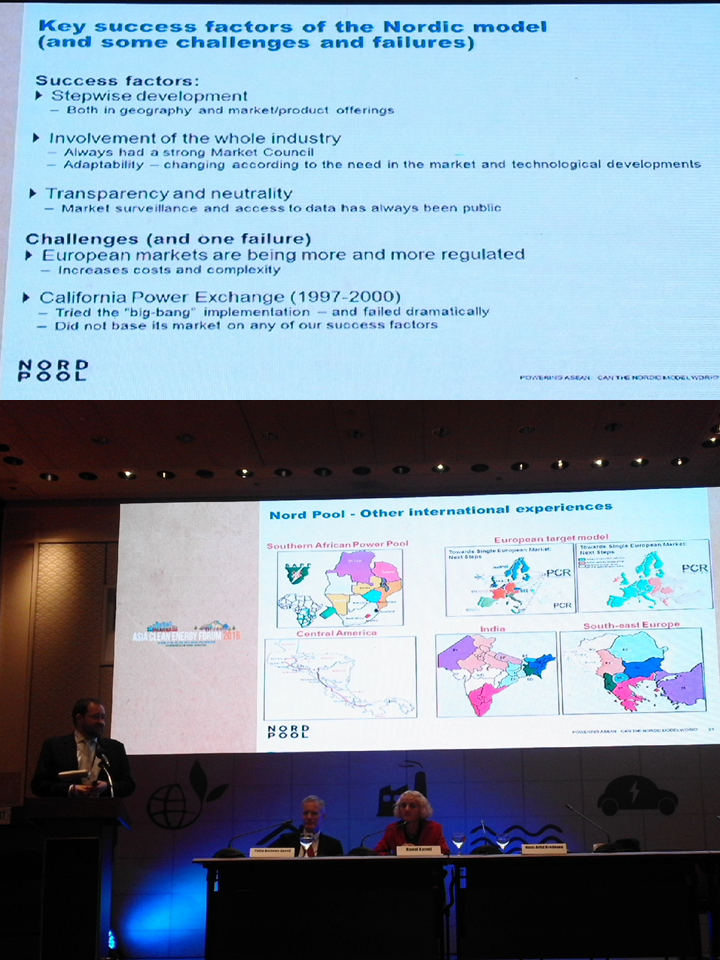
Last Monday afternoon during the Asia Clean Energy Forum (ACEF) 2016 at the ADB, I attended the deep dive workshop on "Powering ASEAN: Can the Nordic Model Work?" The first speaker was Mr. Bambang Hermawanto, Chairman of the ASEAN Power Grid Consultative Committee (APGCC).

Photo below from left: Bambang Hermawanto, Dr. Philip Andrews-Speed, Principal Fellow at the Energy Studies Institute, National Univ. of Singapore (NUS), and Mr. Hans-Arild Bredesen, CEO of Nord Pool Consulting. Philip was the moderator and Hans was the speaker on the Nordic Electricity Exchange.


This is the second time that I heard Bambang, cool guy. First time was during the "Philippine Electricity Summit" last December 2015 at Crowne Plaza, Ortigas. The event was sponsored by PEMC and NGCP, the Philippines electricity market operator and system operator, respectively.

During the open forum, I asked what would be the implication to the ASEAN grid if China trades electricity with its neighbors that are ASEAN members -- Myanmar, Thailand, Laos, Vietnam. Like if Myanmar and Laos will buy more electricity from China rather than from the ASEAN grid. Bambang replied that given China's thirst for more electricity, it is likely that China will buy (hydro) power from Myanmar and Laos, not the other way.

Next speaker was Hans. When he showed this slide, I was surprised. Norway has only 5.5 M people and they have 30 GW installed power capacity, vs. the Philippines with 101 M people and only 16+ GW of installed capacity, wow.

And unlike the Philippines' Wholesale Electricity Spot Market (WESM) where electricity trading is for only 1 or few hours ahead, the Nordic system allows one day ahead.


Good synergy between hydro and gas/nuke power plants depending on the season and situations. Winter time, the rivers are either frozen or have little water flow, thermal and nuke plants will be running. Summer, frozen water in rivers and lakes are melted, the hydro plants can provide more than what Norway needs, export the surplus electricity to other members of the Nordic exchange market.


I did not ask question during the open forum but during the coffee break, I asked Hans about the independence and board composition of the Nordic model. No government official on the board -- hence, independent of government -- and mostly industry players. Singapore's electricity exchange is independent of both government and industry players. The Philippines' WESM is a different breed, the market operator (PEMC) is very dependent on government -- DOE Secretary is the Chairman of the board, and there are 3 other government officials in the board (from TransCo, Napocor and PSALM) plus board of advisers who are also from the government (DOE, NEA,...).

Hans nailed it when he said that national governments + EU regulations on energy and climate make the system getting more costly and more complicated.


The 3rd topic that afternoon was about Nord Pool's engagement in southern African states (S. Africa + about 8 other countries) and India. I did not finish the session and went home.

Lessons from this panel:

1. ASEAN countries are extending the regional free trade of goods and services to the energy/electricity sector. Nonetheless, the Philippines will not figure prominently in the ASEAN grid because of our geography, too far to be connected via submarine transmission cables from the northern neighbors, and only Sabah (Malaysia) -- southern Palawan as the nearest possible connection.

2. Good lesson on how to run an electricity exchange market, get government out of the board and decision-making. Government via the DOE and ERC is the overall regulator and yet the DOE Secretary chairs the PEMC board that is being regulated by the DOE and ERC, conflict of interest or convoluted interest.
-------------

See also:

Wednesday, June 08, 2016

Pol. Ideology 67, Socialism and Venezuela


A friend said that my advocacy for “inviolable rights of the individual" means that one is detached from the rest of society and hence, he/she has no responsibility for the others, especially the less fortunate ones.

Wrong interpretation, of course. The “inviolable rights -- and responsibilities -- of individuals" simply follows what John Stuart Mill articulated something like "do anything you like provided you do not harm other people." Thus, if you want to work 15, 20 hours a day, do it. If you want to spend all your savings on travel, or fancy clothes, or parties and drinking, do it. It is different when a person steals, or destroys other people's property, to pursue his personal, political, religious or whatever goals.

That is why socialism is evil because it forces and coerces people to socialize many things they have -- their income, their savings, investments, etc. Ok sa mga batugan, the lazy because even if they do not work they will eat. Or for bureaucrats, even if they produce nothing useful, just issue endless regulations and prohibitions, they will eat and have various perks. For the hard working and efficient people, it's lousy.

Socialism encourages free riding problem. Why aspire to become efficient, one can be mediocre and below-average and still get paid almost similarly as the efficient ones.

The case of Venezuela is only the most recent example. Hugo Chavez, then Maduro, discouraged private enterprise innovation and competition by nationalizing and socializing many important sectors and companies.

Charity work, spending for other people voluntarily, that is civil society and volunteerism, or voluntaryism. If you have lots of resources and you share it willingly to the needy people, that's civil society.

In socialism, it's all coercion. That is why there is one-party state, "dictatorship of the proletariat". Even if you know that many of those hungry people are outright lazy, you must give your money and savings to the state, and the state will feed the irresponsible and a thick layer of bureaucracy.

In classical liberalism philosophy, civil society is the "replacement" of a big state. Things that can be done by parents, by siblings, by neighbors, classmates, officemates, church, etc. -- do NOT give that function to the state or local governments. Like telling people that over-smoking, over-drinking is bad, we do not need government bureaucracies to do that.

We only need a lean state or minimal government to perform things that cannot be done by civil society. Like dealing with armed and organized criminals, or armed harassment in the seas, or military aggression from other countries.

There is a belief that Scandinavian countries are socialist. No, one can own a factory, a bank, a school, land, an airline, etc. in Scandinavian countries. In socialism, all or most of the means of production – factories, banks, farms, land, etc. -- cannot be privately-owned, they are state-owned, socialized, communized. Things are socialized by force and coercion. 
--------------

See also:

Surplus under socialism, January 30, 2010 
Can UK hug socialism again? August 15, 2015

BWorld 62, Unemployment and underemployment data may be overstated

* This is my article in BusinessWorld last June 02, 2016.


Based on the latest January 2016 labor force survey data by the Philippine Statistics Authority (PSA), there were 2.47 million unemployed and 7.88 million underemployed Filipinos, representing 5.8% and 19.7% of the total 42.5 million total labor force in the country. So 10.35 million (25.5% of labor force) were either unemployed or underemployed, a big figure.

Also from among East Asian economies, Philippine unemployment rate is the highest. From 2010-2015 especially, where the Philippines has the highest average GDP growth rates in East Asia except China, Cambodia, Laos, and Myanmar, unemployment rate remained the highest in the region. Not included in the table below are Cambodia and Laos because no data was available in the IMF database (see table).


What explains for this discrepancy or disconnect between the Philippines’ fast growth and persistent high unemployment?

I myself have doubts about the country’s unemployment data since several years ago.

But it’s not about the data itself as collated and reported by the PSA but the attitude and response of survey respondents when PSA survey staff talk to them.

The reasons for my skepticism are the following:

One, survey respondents tend to highlight the adverse side of their economic status. When people approach the public for social surveys, the tendency of respondents is to report the pessimistic side of their lives mainly to avoid taxation if they declare that they have a regular job, and/or they expect more welfare and subsidy programs, especially if more of them will declare that they are unemployed or underemployed.

Two, voluntary and short-term unemployment.

A person offered a P60,000 a month job but declined it because he is waiting for a possible job offer with a higher salary is technically jobless and unemployed, especially if that person happened to be surveyed by the PSA at that time. That person has a high “reservation wage” but neither is he poor or miserable.

Countries with unemployment rate of 1%-3% are considered having a “full employment” economies because those 1%-3% of the labor force who have no jobs are voluntary or temporarily unemployed, like resting for a few weeks while raising their reservation wage for the next job offer.

Three, fully-employed yet underemployed persons.

The PSA defines underemployment as “employed persons who express the desire to have additional hours of work in their present job, or to have additional job, or to have a new job with longer working hours”

So a person already working 40-50 hours a week and earning P150k a month but still want additional work because he needs at least P170k a month or more is technically underemployed, even if he is already well off compared to the average income of the population.

Four, my experience looking for a house helper last week in my hometown, Cadiz City, Negros Occidental opened my eyes to what’s happening on the ground.

I went to four rural barangays, most of which are sugar-dependent and roads to which are still unpaved until now. These things surprised me.

(a) Unemployment is almost zero. People have jobs, mostly low-paying or contractual and seasonal jobs in the informal sector, but people have jobs. Many of the younger ones are working in Bacolod City, the provincial and commercial capital, or in Metro Manila. The older ones work in the sugarcane fields, or tricycle drivers, carpenters, construction workers, in shops in Cadiz City proper, etc.

(b) Voluntary unemployment is evident. The few who have no stable jobs and want one chose not to work in Manila for various personal reasons like they do not want to be far from their kids, parents, etc. They would rather be unemployed or underemployed than be fully employed but far from their loved ones. In the provinces, families have relatives and other network that can help them tide over. Some have parents or siblings who work abroad and regularly receive their monthly allowance and opt to stay in the province where the cost of living is low.

(c) High “reservation wage” also exists in the lower strata of society.

I offered a prospective househelper a starting pay of P4,000/month + free travel to Manila + days-off or overtime pay on their days-off (if prefer to work instead) + pay hike after 4 months ++.

One that I interviewed used to receive P6k a month ++ and will work for me only if I will at least match her last pay. The P6k a month ++ is her reservation wage.

Months before, my sister and other folks told me that it is hard now to get a helper even in rural areas.

After going to different barangays in three days, I was able to find one. She’s never been to Metro Manila and she wants to work there. More importantly, she is my distant relative and I will be comfortable leaving my two young girls to her when I and my wife go to work. She used to work for a department store in Cadiz City and enduring a pay of P120/day, 7 a.m. to 7 p.m., sometimes until 8 p.m., no meal or transportation allowance, and only 3 months contractual work.

With those four reasons above, I think that the Philippines’ unemployment and underemployment data is overstated. Consequently, even the SWS’ survey data of “self-rated poverty” is also overstated. The actual state of unemployment in the country should be lower than what is reported.

How to verify, prove or disprove the above hypothesis?

One possible way is to conduct a survey asking people, with work or no work at the time of the survey, if they are willing to work as house helpers, as gardeners, as messengers and janitors, etc. in Manila or Cebu at X monthly pay ++. If people are so poor and desperate for work, they will grab even “low pay” work and/or being far from their families, just to get a stable source of income.

Acceptance of those deemed “low pay” work should be counted as the proxy unemployment rate. If this method can be used, my bet is that Philippine unemployment rate will be between 1%-3%.

And those endless, ever-expanding government welfare and subsidy programs should be streamlined to only a few, with a timetable of cutting them in the future. New welfare programs should be initiated only if some old welfare programs that obviously do not work are discontinued and defunded.

Bienvenido S. Oplas, Jr. is the head of Minimal Government Thinkers, a Fellow of SEANET and Stratbase-ADRi. minimalgovernment@gmail.com
-----------

See also: 

Tuesday, June 07, 2016

Energy 69, ACEF 2016 on wind power in Asia

Yesterday, I attended the first of the 5-days "Asia Clean Energy Forum 2016" held at the ADB headquarters in Ortigas. Main sponsors are the ADB, USAID, Korea Energy Agency, and World Resources Institute. Plus eight other donors -- DFAT-Australia, DECC-UK, MFA-Norway, MET-Spain, Canada, Japan, Sweden, and the Global CCS Institute. And dozens of partners.

I attended the deep dive technical workshop on Wind Power Development.


From a presentation by Iban Vendrell, Mott McDonald, Thailand. They have 40.5 GW of installed power capacity, wow. It's only 16+ GW in the Philippines. But see the huge discrepancy in wind tariff vs retail tariff, peak and off-peak hours. Clear energy favoritism or cronyism.


From a presentation by Rakesh Goyal, Tetra Tech ES, India. They have 288.7 GW of installed power capacity. Good thing the price discrepancy between wind tariff and retail/wholesale tariff is zero, or minimal. But wind has various incentives that are not available to conventional energy sources.


This is a recurring claim or urban legend, that there is "convergence" or "grid parity" between RE and conventional power like coal and natural gas. Still far out, otherwise there will be no need for feed in tariff, priority dispatch to the grid, various fiscal and non-fiscal incentives and subsidies for RE.


From a presentation by Ishak Burhani Nasution of PLN, Indonesia. Coal share from 57% this year to decline to 50% by 2030. The shares of hydro, geothermal and LNG to rise.


From 2016 to 2025, they are adding 80.5 GW of new power capacity or an average of 8 GW a year. Of which 22.2 GW will be from old and new renewables, average of 2.2 GW a year.


From a presentation by DOE Assistant Secretary Marasigan, RE plans in the Philippines.


From a presentation by Mike Ellis of Deloitte Consulting, representing USAID's Low Emission Energy Program in Vietnam. Vietnam plans a 129.5 GW power capacity by 2030, wow. Versus the PH's target of only 23+ GW by 2030. And they are not giving special pricing favoritism to wind power, only some fiscal incentives.


Share of coal power in the energy mix to decline from 45 or 46% in 2020 to 43% by 2030.


Duterte vs Media, Bernard Ong's analysis

I am reposting two analysis by a friend. Not much to add, just highlight the point that assassination and murder -- by corrupt or non-corrupt, sob or non-sob, media/politicians/NGOs/academics/church/ corporate leaders, etc -- is not justified. There are existing laws that provide a system of penalties for wrong doing, and assassination is not one of them. I am also adding some news headlines, not part of Bernard's comments.
-----------

(1) From Bernard Ong, June 01,2016:

"EXTRAJUDICIAL MEDIA KILLINGS

Duterte blames media corruption as root cause of journalists' killings. “Di ka naman papatayin kung wala kang nagawa. It’s not because you’re a journalist you’re exempted from assassination if you’re a son of a bitch.”

1. Nobody - including corrupt journalists - should be assassinated. There is the law & due process to settle wrongdoing.

2. The statement "corruption is root cause" is wrong. Many journalists are killed because they threaten powerful interests like corrupt politicians or crime groups.

Couple of high-profile cases to illustrate the mistake:
Gunmen linked to Ampatuans massacred 32 journalists & 25 other civilians in 2009. The journalists were merely accompanying family members of a rival candidate. (To put that number in context, total number of mediamen killed in 2010-16 Pnoy administration is also 32).
Palawan ex-gov & his then-mayor brother were convicted of murder of hard-hitting environmentalist radio broadcaster Jerry Ortega.

3. It was actually Duterte's idol - Ferdinand Marcos - who corrupted media wholesale as an institution. The dictator took over media outlets, bribed or rewarded loyal journalists (while killing or jailing critics). It was called "developmental journalism" which was widely ridiculed as "envelopmental journalism".

4. Sounds like it is open season on journalists on the suspicion that they are "corrupt". Name one politician assassinated on the mere suspicion of corruption.

None. So why pick on journalists doing their job."

(2) From Michael Ortega, June 01, 2016.

"Our family is incensed by the hasty and crass generalizations made about murdered journalists in the country. Doc Gerry Ortega was killed for his courage and integrity. He was murdered precisely because he was honorable. He fought for social justice. He stood up against mining in Palawan. He exposed corruption in the provincial government, which included the misuse of billions of pesos from the Malampaya funds.

This kind of speech is alarming because without due process, it casts absolute judgment on all murdered journalists including those who were killed for telling the truth."


(3) From Bernard Ong again,  June 02,2016:

"APOLOGISTS WHO DON’T APOLOGIZE

Apologists are out in full force. Senator Koko Pimentel said Duterte was misinterpreted. Spokesman Peter LaVina said his statement on media killings "was taken out of context, misinterpreted, and misunderstood." Incoming Press Secretary Panelo told media to be more discerning, saying there was no mistake in Duterte's media killing statement. Their statements amplified a million times by repetition on social media.

The problem with these explanations is their dissonance with what was spoken in simple English & Tagalog. The questions were clear. The answers equally clear. The specific context was media killings. There was little room for misinterpretation.

Here’s a short transcript.

“Q: What is your policy about the journalists’ killings that the Aquino government failed to act?
A: Kung papatayin ka talaga, papatayin ka… Hindi ka naman talaga papatayin diyan kung wala kang ginawa. Nabigyan na tapos especially if you want to take sides. Nabayaran mo na tapos you play. Yan ang karamihan na mamatay. Or tumatanggap na sa mga sugarol. There is still corruption sa inyong side. Marami yan… Kasi kung journalist ka lang na tama, wala man gagalaw sa iyo.

Q: Is that an excuse to kill him, just because a journalist is corrupt
A: Well that is the reason. You are asking why. That is the reason. Na sinabi mo hindi dapat, you have to debate with the killer not me. Of course, I know who killed him (referring to Duterte critic Jun Pala). Kasi binastos niya yung tao… Do not make it appear that they are clean. Kaya namamatay, ang sinasabi ko karamihan niyan nabayaran na. They take sides. Or sobrahan nila ang atake.

Q: Banta ba ito sa freedom of expression?
A: Yung freedom of expression cannot help you if you have done something wrong. Just because you are a journalist, you are not exempted from assassination if you are a son of a bitch.”

Notice the following:

1. He did not directly answer the policy question of what his administration will do about media killings, and went on to expound why they are being killed in the first place

2. He unequivocally said corruption & bias are root causes of most media killings

3. He claimed to know mastermind behind killing of Jun Pala – a media critic & resident of Davao City. He knew about murder suspect but failed to inform police on material lead that could help prosecute the killers. Seems to imply Pala’s killing was justified, because he was a son-of-a-bitch

4. He did not defend freedom of expression, or due process, at any point in the interview.

Proper context includes reflecting not only on the speech but also on the speaker. Statements out of the horse's mouth - from rape jokes to throwing dead criminals to Manila Bay - show a lack of respect for human life. "Kill" is the top verb in the speaker's vocabulary. And he uses it as simplistic solution to complex problems like drugs, crime, and corruption.

It does not help that the apologists have frequently covered up for Duterte in the past. Sometimes with conflicting narratives. Recall the fake rape joke pseudo-apology issued by his campaign team, which was disavowed by Duterte barely hours later. This frequent urong-sulong between Duterte and his apologists, sometimes between Duterte before and Duterte later, does not inspire confidence in their words.

Finally, there is the matter of the credibility of the apologists themselves. Pimentel used to be a fighter against corruption & human rights abuses. He lost his mojo when Duterte's bank deposits reached the headlines. The Duterte campaign was itself a master class in deception – Sun Tzu they proudly call it. Good for winning votes perhaps, bad for governance.

And then there is the primus inter pares – first among equals – of the apologists. Last time Salvador Panelo talked about media killings, he was lying about the Ampatuans role in the killing of 32 journalists at Maguindanao – that they were just framed up for the massacre in their stronghold, 200 witnesses notwithstanding. Doubtful if anyone, even his clients, believed him.

So we have apologists who don’t find error in their master’s ways - blaming the public instead for lack of discernment, weak understanding, contextual difficulties. They have forgotten what is usually taught to toddlers - when you have done wrong, apologize."
--------------

See also:
BWorld 56, Thomas Hobbes, Saul Alinsky and Duterte, April 30, 2016 
BWorld 57, Eric Hoffer, Machiavelli and Duterte, May 06, 2016 
Election 22, Is Du30 victory almost certain? May 07, 2016

Saturday, June 04, 2016

Tax Cut 25, Presentation at Ateneo Ignite's Tax Exchange

I made this presentation at Ateneo  more than two months ago. The 24-slides presentation is available at my slideshare account. I will show a few slides here.


I got this photo from Mon Abrea, a famous tax consultant and tax simplification advocate. This  is after the event.


Our tax system is among  the highest, most envy-inspired in Asia. Data from WB-PWC's Paying Taxes 2016 Report.


These + other tables mean…

Tax wise, PH is NOT an attractive place to do business in the ASEAN. Highest total tax rate (TTR) in the region plus complicated and bureaucratic procedures. Only developed welfare countries Australia and Japan, and socialist China have higher TTR than PH.

Although in number of hours, VN proves it is indeed a socialist and bureaucratic state; in number of payments, ID’s bureaucracies are most notable.

Tax competition among ASEAN countries is happening. BR, SG and CM keeping  their low TTR, MM significantly cut its TTR last year. Only MY is dueling  with PH in high TTR.

The time to cut the PH’s (a) number of taxes and forced contributions, and (b) income tax rates, was yesterday. So we need to move fast today and tomorrow.

So if we can not significantly cut income taxes, one alternative is...


Proposal 3: National income tax is zero, allow provinces to impose income tax.

“No tax on work.” Survival and prosperity of societies are based on work of people. Work should not be penalized and discouraged with taxes, the way governments discourage smoking and drinking with more taxes.

National income tax is zero, or 5% max. National government to keep collecting consumption-based taxes (VAT, excise, franchise, vehicle registration, other taxes) and regulatory fees, while devolving more functions to provincial governments.

Provinces can impose income tax. Let there be tax competition, governance competition among them.

Concluding Notes

Tax and governance competition, infrastructure and security competition among provinces will empower the people and companies to vote with their feet.

Of 3 proposals, most feasible is #1, cut income tax rates to 20% or lower. Higher Q, wider tax base, will compensate for the reduction and propel higher TR.

Proposal #3 will attract the advocates of federalism and more decentralization and denationalization.

Proposal #2 will attract the more daring politicians, business and civil society leaders. Long-term view.

All 3 proposals can lead to more individual freedom, freer markets and limited government.
--------------

See also:

Friday, June 03, 2016

BWorld 61, 100 indicators better than GDP

* This is my article in BusinessWorld last May 26, 2016.


Many people are getting impatient with gross domestic product (GDP) growth data, especially growth rates of 6% or higher, saying these numbers are “irrelevant”, “useless”, “misleading”, and “mean nothing” to their lives. Stronger criticisms of GDP growth numbers include “jobless growth” and “outright lies” that paint a rosy picture of an otherwise thorny and despicable society.

While there are some truths to these sentiments, especially for people who live under dictatorships and harsh political repression, a number of these sentiments are themselves misleading and full of angsts and misdirected anger.

One recent article that got circulated well in social media was published by the World Economic Forum (WEF) blog, “Five indicators better than GDP.” The author cited a study by the New Economics Foundation (NEF) and listed these five criteria as “better than GDP” and may imply that GDP data can be dispensed with:

1. Good jobs. Employment statistics tell us what proportion of people have jobs. They don’t tell us what proportion of those with jobs are paid too little to afford a decent standard of living, or worry about whether they’ll still have work next month.

2. Well-being. A growing economy is not an end in itself -- it’s a means to improving people’s lives. Few would disagree that the ultimate aim of public policy is well-being; we care about GDP because we assume it means more well-being. So why not also measure well-being directly?

3. Environment. The NEF proposes a national indicator of lifestyle-related carbon emissions, relative to an allocation calculated from global targets for avoiding dangerous levels of climate change.

4. Fairness. Research increasingly shows that high income inequality has negative social consequences, while casting doubt on the idea that it incentivises hard work.

5. Health. The NEF proposes “avoidable deaths” as a simple, easily-understandable measure that captures the quality of health interventions -- not only treatment, but also prevention.

Let us take for the sake of argument that we can dispense with, even throw away, GDP growth data and use those five indicators instead. Then other problems can crop up, like some people will complain, “Why only those five? Why not also include indicators on (6) affordable housing, (7) efficient public transportation, (8) good anti-flooding, (9) more CCT welfare, (10) cheap and stable electricity, (11) cheap nutritious food, (12) free or affordable university education,... (100) fast, free Wi-Fi.”

Thus, a replacement of “irrelevant, useless, misleading, jobless growth...” GDP data can actually result in numerous indicators that can raise more questions and suspicious how they are computed, what factors are included in their computation, for each of those 50 or 100 indicators.

So that WEF article, like many of its predecessor and similar papers, is lousy. Computing the GDP actually involves tons of data from so many sectors and sub-sectors. Whether computing the GDP on the demand side (GDP = C + I + G + [X-M]) or the supply side (GDP = gross value added in Agriculture + Industry + Services), lots of data in each of those factors in the equation are dug, verified, and counter-checked. An overstatement of the numbers last year to project a rosy achievement would mean possible understatement of the actual numbers this year, or further tinkering of the data to sustain the deception.

One problem with this method is that when people continuously torture data, the latter will confess and the real numbers will surface. So through time, various governments and their national statisticians have learned to respect their real data, and if they have to torture it, not too much otherwise the data will confess sooner than later.

Bottom line, GDP growth (or non-growth) data are the result of hundreds or thousands of nuances in each sub-sector of the economy, collating thousands of numbers to produce only two figures, (a) the value of the flow of goods and services in one year, and (b) growth rate over the previous year.

Having established this, let us now check GDP growth numbers of the Philippines compared to its neighbors in the region. I chose the years of each administration in the Philippines (see Table 1).


Then I got the average GDP growth for the yearly data of these 16 members of the Regional Comprehensive Economic Partnership (RCEP), plus Hong Kong and Taiwan as they are neighbors of the Philippines (see Table 2).


The above numbers show the following:

1. President Benigno S. C. Aquino III’s administration has experienced or facilitated the fastest growth of the Philippine economy over the past 3 decades. For his detractors who say that the 6.2% average growth rate was “meaningless”; perhaps an average growth of 2%-3% would have pacified them? Or they would be angrier because we could have grown much faster than 3%?

2. The fastest growing economies in the ASEAN in recent years is actually not the Philippines but Laos, Myanmar, and Cambodia. But these nations have low economic bases and hence, potential for growth is much higher than countries with bigger economic bases. Would the GDP detractors or skeptics also dismiss the growth achievement of these three countries as “meaningless and irrelevant”?

3. From 1980-1997, the Philippines has the slowest growth rate in the Asia Pacific except Brunei and Japan, earning the ugly label of the “sick man of Asia” for nearly two decades. Would the local GDP bashers consider that fact as “meaningful, relevant” because the Philippines was the laggard?

Readers can make their own interpretations and conclusions of the economic performance of the Philippines and other countries from the table.

High GDP growth almost always create more jobs. If people are jobless even temporarily, there are at least two possible explanations. (a) They simply want to bum around and their rich parents or siblings, etc. can feed them; or (b) they are industrious but have high “reservation wage”, meaning if are offered P20k a month job, they reject because they are waiting for a P25k a month or higher job offer.

High GDP growth expectation also produce high employment and wage expectations. That is why some people who receive P30k a month last year are disappointed that they only get a raise to P31k this year instead of P35k or higher, so when SWS or other surveyors come to ask about their standard of living, they feel bad or poor. And they become one of the GDP skeptics/bashers.

Not that I am a fan of centralized economic planning. I only with to point here that GDP bashing is actually more bashful than the subject that they deride.

Bienvenido S. Oplas, Jr. is the head of Minimal Government Thinkers and a Fellow of SEANET and Stratbase-ADRi.
--------------

See also: