Friday, October 12, 2018

BWorld 257, Inflation king of Asia, world’s second worst stock market

* This is my column in BusinessWorld last October 08, 2018.


The Philippines’ inflation rate has been rising nonstop ever since the TRAIN law was implemented: 2.9% in December 2017, 3.4% in January 2018 (first month of TRAIN law), 3.8% in February, 5.7% in July, 6.4% in August, and 6.7% in September.

This is the country’s highest inflation rate in nearly a decade, since 7.2% in February 2009. The increase largely came from the food and non-alcoholic beverages index, a big component of the overall consumer price index (CPI), which increased to 9.7% last month.

So the Philippines is now the undisputed inflation king or queen of Asia. Year to date (Ytd, January to September), 2018 inflation is already 5.0%, a lot higher than the government target of 2-4% full year 2018.

Numbers below, those with updated January-September 2018 data are Indonesia, Philippines, S. Korea, Sri Lanka, Thailand and Vietnam. The rest have January-August only (see Table 1).


In the stock market, the Philippine Stock Exchange (PSEi) as of Oct. 5 closing was the second worst performing in the world. China (Shanghai) has been the #1 worst performing for several months this year but last week, it has recovered while the Philippines and Turkey continued their slide.

Last 52 weeks, PSEi (-14.8%) is also the second worst in the world after China (Shanghai, -15.8%).


To control high inflation, the most visible action by the government comes from the Bangko Sentral ng Pilipinas (BSP) raising domestic interest rates. I do not think that this will be effective since the current inflation is largely cost-push, starting from TRAIN tax hikes in January and exacerbated by high world oil prices. This is not demand-pull inflation.

Another action is agricultural import liberalization, expanding rice importation to help reduce domestic rice prices, and replacing quantitative restrictions (QR) with tariffs of up to 35%, the bill is being hastened in Congress. The impact so far is not clearly felt as rice prices remain high.

One ‘action’ by government is non-action on fare hike petitions by buses, jeepneys, taxi, and air-con vans or ‘UV Express.’ The government has become terribly insensitive and Machiavellian in pinning down public land transportation operators to endure very high oil prices with no corresponding fare hike, except the P1 increase in jeepneys which is still not sufficient.

Domestic airlines’ petition to have fuel surcharge on ticket prices have been granted and this will have inflationary pressure from October onwards. Another pressure will come from a series of wage hikes.

One single most important measure that government can do to reduce inflation is to cut the VAT rate from 12% to around 8% and significantly reduce the exempted sectors. My best example for suggesting this is Malaysia. It had a gross sales tax (GST) of 6% until May then it was abolished in June. Its average inflation rate three months before (March 1.3%, April 1.4%, May 1.8%) was 1.5%, became 0.3% three months after (June 0.8%, July 0.9%, August 0.2%).

High and multiple taxes are always inflationary. To help reduce high inflation, taxes should be smaller and fewer. The number of politicians, bureaucrats and subsidies forever should be smaller and fewer too.
-------------


Monday, October 08, 2018

Energy 114, Fossil fuels are good, end the disinformation

I am reposting this press release by the Heartland Institute last Saturday. I believe that the benefit of fossil fuels, like 24/7 electricity with no blackout even for a minute, fast transportation in land, water and air, far outweigh whatever is the imagined social cost and 'damages' created by fossil fuels.
--------------

International Panel Calls for End to Global War on Fossil Fuels

OCTOBER 5, 2018 – More than 100 leading scholars from 12 countries have issued a report contending “the global war on fossil fuels ... was never founded on sound science or economics” and urging the world’s policymakers to “acknowledge this truth and end that war.”

The Nongovernmental International Panel on Climate Change (NIPCC), an independent organization founded in 2003 to fact-check the work of the United Nations on the issue of climate change, today released theSummary for Policymakers of Climate Change Reconsidered II: Fossil Fuels. The 27-page Summary provides an early look at a 1,000-page report expected to be released on December 4 at a climate science symposium during the United Nations Conference of the Parties (COP-24) in Katowice, Poland. 
In the new NIPCC report, 117 scientists, economists, and other experts address and refute the United Nations’ Intergovernmental Panel on Climate Change (IPCC) assertions that the impacts of climate change on human well-being and the natural environment justify dramatic reductions in the use of fossil fuels. The Summary provides more than 100 references to peer-reviewed literature, while the full report provides nearly 3,000 such references. 
Click here to read the Summary for Policymakers report in digital form (PDF).
For more information about the Summary for Policymakers, NIPCC, and The Heartland Institute – and to talk to authors or editors of this report – contact Director of Communications Jim Lakely at jlakely@heartland.orgor 312/731-9364 (cell).

Among the findings reported in the Summary for Policymakers:

·        Fossil fuels deliver affordable, plentiful, and reliable energy that is closely associated with key measures of human development and human welfare. There is a strong positive relationship between low energy prices and economic prosperity. Economic prosperity in turn is crucial to human health and welfare. Wind and solar power are incapable of delivering the affordable, plentiful, and reliable energy that is delivered by fossil fuels.

·        Fossil fuels require the development of substantially less surface area than renewable energy sources, rescuing precious wildlife habitat from development. The power density of fossil fuels enables humanity to meet its need for energy, food, and natural resources while using less surface space, rescuing precious wildlife habitat from development. In 2010, fossil fuels utilized roughly the same surface area as devoted to renewable energy sources yet delivered 110 times as much power.

·        The environmental and human welfare impacts of fossil fuels are overwhelmingly positive.Sixteen of 25 identified impacts of fossil fuels are net positive. Eight are uncertain, only one is net negative. Some of the identified impacts include agriculture, air quality, extreme weather events, human health, and human mortality.

·        Reducing fossil fuel use to achieve dramatic reductions in carbon dioxide emissions would inflict tremendous economic hardship. Reducing greenhouse gases to 90 percent below 1990 levels by 2050 would require a 96% reduction in world GDP, reducing per-capita GDP to $1,200 from $30,600 now forecast. Per-capita income would be at about the level it was in the United States and Western Europe in about 1820 or 1830, before the Industrial Revolution.

Scientists and experts will be in Katowice, Poland the week of December 4 to publicly release the full volume of Climate Change Reconsidered II: Fossil Fuels. Credentialed media are invited to attend the December 4 symposium to learn more about the report and question some of the scientists who agree with its findings. Details on where and when that symposium will be held are coming soon.
---------------

See also:

Sunday, October 07, 2018

BWorld 256, Mandatory and coercive welfarism by private enterprises

* This is my article in BusinessWorld last October 04, 2018.


The private sector and civil society groups are the domain of voluntary exchange and volunteerism. In a competitive environment, people sell something, a commodity or service. If the price is good and attractive to many buyers and donors, sellers can prosper; if the price is high compared to quality, buyers and donors will shy away and sellers/providers can go bankrupt.

The government and state is the domain of force and coercion. People should not steal or damage/burn properties by others, people should not abduct, harm, shoot or kill others even if they have a valid complaint. The state will penalize them hard.

When the government coerces private enterprises to do mandatory services, to coerce price discounts and yet the state will not give a tax rebate for the decline in revenue and reduced profit, then the state abuses its coercive power and this will result in negative, unintended consequences to society.

In the Philippines, there are many new mandatory services, mandatory price discounts — on top of existing ones — proposed in Congress:

1. Mandatory maternity leave with pay for 100 days (HB 4113) or 120 days (SB 1305), parental leave with pay for adoptive parents, additional 30 days for solo mothers (same SB). It has passed the bicameral committee.

2. Requiring all employers to pay their employees a 14th month pay (HBs 402, 3815 & 8095).

3. Security of Tenure (SoT) bill (SB 1826) aka Anti-ENDO bill, certified as urgent by President Duterte.

4. Granting bereavement leave of 10 working days with pay to employees on death of an immediate family member (HBs 4071, 6043, 6581), or five working days with pay (HBs 5711 & 6119).

5. Expanded students’ 20% fare discount (SB 1597) – to become year-round, to cover all Filipino students from elementary to college and in technical-vocational schools, to apply even during weekends, holidays and sem break, and cover all means of transportation from buses, jeepneys, taxis, tricycles, transport network vehicle services (TNVS), MRT, LRT, to airlines and passenger ships. The Senate has passed this bill on third and final reading.

Proposal #1 will lead to less hiring of women in the formal sector, so more women workers will be relegated to the informal sector where multiple labor and related laws are often not enforced.

#2, #3 and #4 will lead to less hiring of workers, men and women, and more employers will use more machines, robots and AI in work that are generally repetitive. Their customers demand stable or cheap prices so they must cut costs somewhere. Employees already have vacation leave, sick leave with pay of 15 working days each, maternity leave with pay of 60 days, etc.

#5 will lead to higher fares in land, sea and air public transportation. Since there will be many students, senior citizens, and persons with disabilities that must be given 20% discount all year round, the fare of non-students, non-senior citizens must rise to compensate for reduced revenues.

Again, those proposals are on top of existing mandates and forced price discounts. These will further raise the cost of hiring people so companies will either hire less people and use more machines and unemployment can rise. Or some companies will dishonor those new laws and bribe labor inspectors instead as government corruption remains high until today.

The Philippines also has high corporate income tax (CIT) compared with many neighbors in Asia. Tax competition is very real as many countries and economies further reduce their CIT to attract more investors and make them stay.


The TRABAHO (aka TRAIN 2) bill in Congress, if enacted into law, intends to remove many fiscal incentives by 2019 but will reduce CIT from 30% to 20% by 2029. Sigurista.

Since the country’s business competitiveness will be adversely affected by those mandatory welfarism by private enterprises, the government should compensate by having a deep tax cut in CIT. An 18-20% starting 2019 will improve our competitiveness.
---------------

See also: 
BWorld 253, Cheap, stable electricity vs climate alarmism, September 30, 2018 

Thursday, October 04, 2018

Scam on UN-Federal government "grant"

Last week I got a friend request in fb from Curtin Winsor Jr., I accepted because he's a former Atlas Director. But I noticed that his profile has no work or profession, no address, no posting.

Then he said that he's helping friends secure a $100,000 and up grant from the UN and US federal government. Purpose is to help people start a business, repair a house, etc. then he gave me a tel no. that I must text and he will follow through.

I inquired what's the name of that office, address, email add to write inquiries, he said there's no email add, only a number where he also got a $100,000 cash grant, and recipients or beneficiaries won't have to repay.

Too good to be true, right? No email, no formal correspondence, just text the number and he will follow through and I'll get a huge grant, wow. So I became suspicious. Then he kept emailing me if I already texted the number he gave -- "+1320 334-8025 ... Do it now so I can be putting you through how it works."

I asked some friends and indeed Mr. Winsor may not even be on fb. The profile has no name, only the photo of Mr. Winsor and this link, https://www.facebook.com/profile.php?id=100029042222026

Yesterday, all his pm to me were gone, instead this notice replaced all his pm, "This message has been temporarily removed because the sender's account requires verification."

Lesson -- when it's too good to be true, very likely it's a scam. I was smiling whether to text that number, I did not, of course. Why would I ask or apply for UN or US government money when I advocate minimal government, minimal taxes? 

Wednesday, October 03, 2018

BWorld 255, Improving passenger convenience, innovation vs regulation

* This is my column in BusinessWorld last Monday, October 01, 2018.


People are rational, they seek convenience and safety for themselves, their families and friends. Thus, if it is very inconvenient and unsafe to take multiple rides from house to work and vice versa, say tricycle from house and village, jeepney or bus, MRT/LRT, jeep again to office, repeat the 4 rides going back home, then people would rather drive their cars or motorcycles even if they have to endure heavy traffic, high parking fees, and occasional street flooding during the rainy season.

But when it is easy, safe and inexpensive or competitively-priced to get a ride-sharing vehicle, taxi or transport network companies (TNCs), people would leave their cars or motorcycles and relax or do work while inside the taxi or TNCs, which increases their productivity per day and hence, their income while reducing vehicle volume on the roads.

It is important therefore, that government regulations like those implemented by the Land Transportation Franchising and Regulatory Board (LTFRB) should expand and not restrict the supply of competing ride-sharing vehicles so that passengers will have more choices.

In a paper, “Innovation Versus Regulation: An Assessment of the Metro Manila Experience in Emerging Ridesourcing Transport Services” (2017) published in the Journal of the Eastern Asia Society for Transportation Studies, Vol. 12, authors Ma. Sheilah G. Napalang (UP School of Urban and Regional Planning) and Jose Regin F. Regidor (UP College of Engineering) cited the result of a survey made by Uber Philippines in 2016 that covered 1,450 respondents.

They also cited a study by de la Pena and Dizon (2016) on passenger preference between Grab taxi vs regular taxi. The two results are shown in table 1.


There, the two surveys show that people’s trips are work- and household-related and they value a lot convenience, reliability and safety.

In addition to the above-stated convenience, the presence of multinational players like Grab and previously Uber also enable the passengers to use their account whether they are in the Philippines or Malaysia, Singapore, Indonesia, Thailand, other ASEAN countries. That is one advantage of multinationals compared to country-specific services and companies like regular taxi and buses.

The Metro Manila Development Authority (MMDA) also made a study last year on the busiest and often most congested roads in the region, and composition of traffic volume by type of vehicles. EDSA is the busiest and 67% of all vehicles there are private cars. These are people whose houses and offices are far from EDSA and hence, must take multiple rides if they do not drive their cars or motorcycles (see table 2).


So when the LTFRB further bureaucratizes and makes it difficult for existing and new players in ride sharing to expand their services, people will experience (a) longer waiting time to get a TNVS or taxi, and (b) higher prices as these vehicles and drivers deal with high demand but supply is limited. And so many of them will have to drive their cars more often. Which further worsens the traffic congestion in EDSA and many other roads in Metro Manila.

The LTFRB and other government agencies (MMDA, city governments, LTO, etc.) must realize that their eagerness to “protect the commuters” and “reduce traffic volume” very often result in more bureaucracies, less players and hence, an outcome opposite to what they wish to achieve.

Competition leads to innovation – in pricing, convenience, safety — and hence, better choices for customers and passengers. But some players lobby for more regulations that tend to disadvantage new players, like big taxi operators who dislike the competition by new TNCs.

From the perspective of consumers and passengers, more players, more competition via innovation is better than regulations that limit competition. Limited competition means limited innovation, and hence, limited passenger choices.


Bienvenido S. Oplas, Jr. is the President of Minimal Government Thinkers, a member of Economic Freedom Network (EFN) Asia.
---------------

See also: 
BWorld 249, Reduce fares and increase passenger convenience by increasing supply, September 13, 2018 

Tuesday, October 02, 2018

The IAF-FNF alumni reunion 2018

Last week, September 25, I attended the alumni reunion of those who attended the International Academy for Leadership/Freiheit (IAF) of the Friedrich Naumann Foundation for Freedom (FNF). IAF is in Gummersbach, Germany, near Cologne. I attended the 8-days seminar (morning till evening) on "Civil Society and Local Government" in October 2008.

I like the venue, The German Club Manila, in Makati City.


I enjoyed German beer, German sausage, other meat. Below from left: Noel Medina, John Coronel, me. Hidden is Odette Padilla, then Ted Gaerlan,...


There was a kapihan type, volunteers in the middle to start the free wheeling discussion. That day by the way was when a Makati trial court issued an arrest warrant vs Sen. Trillanes on revived rebellion charges. The Senator was able to file a bail, he did not go to jail.

Discussions centered on the Duterte government. Which for me is economically lousy, politically insecure and murderer by the thousands via EJKs.


Group photo. FNF PH Country Director Wolfgang Heinze is the tall guy standing at the back, blue shirt. He's cool, met him first time in 2010 (EFN Asia conference in Jakarta) or 2011 (EFN conference in KL). CHR Chair Chito Gascon is seated on the left.


Thanks Wolfgang, thanks FNF guys. All photos from the FNF-PH fb page.


Monday, October 01, 2018

BWorld 254, Duterte inflation in prices and political insecurity

* This is my article in BusinessWorld on September 27, 2018.


President Duterte’s government can be described currently as having double inflation in both consumer price index (CPI) and political insecurity index.

His economic managers’ usual and repeated alibi on why the country’s inflation rate is high is mainly because of external factors like high world oil prices and high US interest rates. This is a half-truth. The main reason is the TRAIN law that was implemented starting January this year.

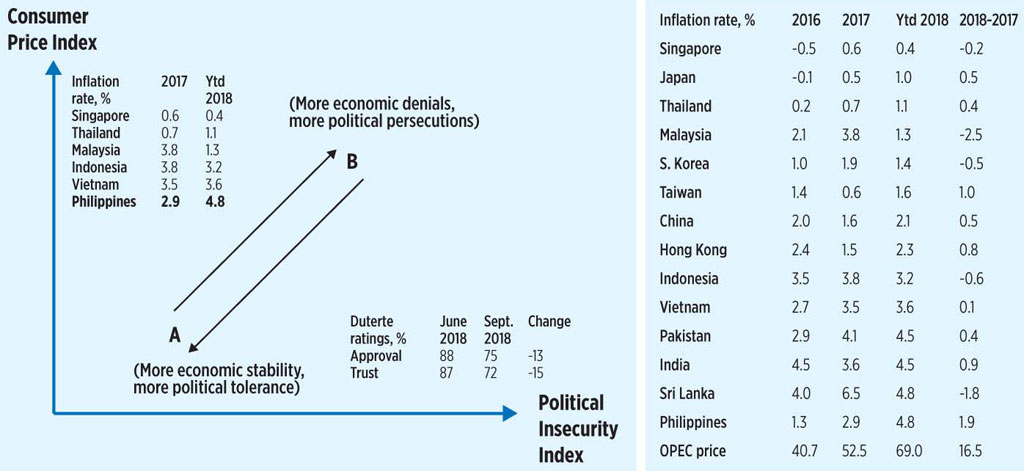
From the monthly data of inflation rate, the January to August 2018 or year-to-date (ytd) average is taken. These Asian economies have complete data until August. Those with incomplete data (Cambodia, Bangladesh, etc.) are not included here (see table).

So while world oil prices and US interest rates increase, five countries have experienced lower inflation this year compared to 2017, between -0.2 (Singapore) to -2.5 (Malaysia) percentage points. Four countries have mild increase of up to 0.5% in 2018 compared to 2017: Japan, Thailand, China and Pakistan.

The Duterte government’s dishonesty in admitting the significant contribution of their TRAIN law — especially the tax hikes of oil products — disables them to realize that part 2 of oil and coal tax hikes this coming January 2019 will create another round of higher inflationary pressure.

The political insecurity index of the Duterte administration can be proxied by the latest Pulse Asia survey on the Approval and Trust ratings of the President. Its Approval rating has declined from 88% in June 2018 to 75% in September 2018 while its Trust rating has also declined by similar figures for the same period.

The consistent persecution and jailing of very vocal opposition legislators — first Senator De Lima and now Senator Trillanes — is one proof of President Duterte’s political insecurity and intolerance. While Sen. Trillanes has posted bail and is free temporarily, he can still go to jail if the administration will find other ways. After all, the coup d’etat charge again confronting him is a non-bailable offense.

They cannot arrest the spiraling inflation — only 2.9% in 2017, 3.4% in January 2018 or first month of TRAIN law, up to 6.4% in August 2018 — so they arrest vocal opposition leaders.

The government’s performance can be depicted in this hypothetical chart.


Instead of aspiring to be in point A, the administration further moves away, outwards to point B where both price index and insecurity index are high.

One important policy that the government can undertake is to reduce VAT from 12% to 8% with very few exempted sectors. There is a concrete and very recent example why this policy can work.

Malaysia abolished its gross sales tax (GST), the equivalent of our VAT, as a result of an election promise in May 2018 fulfilled by PM Mahathir. With GST of 6%, Malaysia inflation rate was 1.4% in April then 1.8% in May 2018. When GST moved from 6% to zero last June, inflation rate significantly declined to 0.8% in June, 0.9% in July, and 0.2% in August. Massive, large-scale price decline across many sectors by the simple abolition of GST.

So President Duterte and his economic team can try the Malaysian model so that it can hopefully move towards point A in the illustration. Cut the VAT rate from 12% to 8% with very few exempted sectors.
-------------

See also: 

BWorld 227, Inflation, taxation, and protectionism, July 14, 2018 
BWorld 235, Inflation worldwide is declining, no special credit to Dutertenomics, July 27, 2018

Intolerance and self-righteousness by many US Dems and supporters

Today, a friend posted supporting the bullying of Sen. Ted Cruz and wife by some Dems activists/supporters, I commented on it. See the rest of exchange, the language in particular of this Dino Abellanosa.


People love to brag and announce their self-righteousness and insecurity. So be it.