Friday, September 07, 2018

On the Peso depreciation

Lousy Dutertenomics. The previous day, the 6.4% August inflation rate report; yesterday the PSE was back to double digit negative, -10.8% ytd. Early today, the PH Peso/US$ is almost 54. Meanwhile, lousy Du30 politics focus on jailing its vocal critics. Mga bueng.

https://quotes.wsj.com/fx/USDPHP

BPI's Chief Economist Jun Neri commented that Rupee, Rupiah and CNY are in the same boat as PHPeso, data as of end August 2018.


Mid-2016 or days before Duterte was officially inaugurated as President, the PH Peso was generally on the same level as its neighbors' currencies. After 2+ years...


BWorld 245, Renewables illusion and coal realism

* This is my column in BusinessWorld last August 29, 2018.


THE “renewables cheaper than coal, fossil fuels” urban legend continues until today. For instance, three articles published in BusinessWorld recently:

1. Reducing power plant carbon emissions by 70% is doable (Aug. 20) by Roberto Verzola.

2. Rooftop solar could help reduce diesel, coal imports — report (Aug. 21).

3. Low-carbon path (Aug. 27) by Roberto Verzola.

Among the arguments of these and other papers are the following:

1. “Rooftop solar costs P2.50 per kWh without financing expenses, P5.3 per kWh with financing expenses. Utility-scale solar power can cost as little as P2.99 per kWh” (Institute for Energy Economics and Financial Analytics (IEEFA).

2. “Low carbon scenario of 64,280 GWh by 2022, 54.602 GWh by 2030” (Verzola).

3. “Low-carbon scenario limits at most 64,280 GWh (54%) of fossil-based generation by 2022, balance of 53,720 GWh (46%) must be covered by RE (Verzola).

A lot if not all of these numbers and projections are products of delusion and irrationality.

On #1, if solar cost is indeed declining, then why don’t the solar lobbyists and developers simply abandon the high feed-in-tariff (FIT) or guaranteed high price for 20 years, now P10+/kWh? Why not call for drastic reduction of FIT to P4-P5/kWh, even abolish FIT altogether?

   
On #2, as the Philippines relies more on coal — 38.8% of 72.92 tera-watt hours (TWH) of electricity generation in 2012, up to 49.6% of 94.37 TWH of generation in 2017 — our electricity prices decline. See Meralco rates for instance, weighted average for all customers (residential, commercial, industrial). The rates exclude VAT but include all other non-recoverable taxes and charges.
(in US$ cents per kWh)


In addition, we already have 94.37 TWH of power generation in 2017 (75% of which are from fossil fuels coal, natural gas, oil), some guys want us to use just 2/3 of that by 2022, very backward thinking.

On #3, moving away from coal and fossil fuels and embracing renewables like wind/solar has been the goal of many developed countries for the past two decades or more. And yet by 2017, many of them still rely 30% or higher on coal while their RE generation (wind, solar, biomass, geothermal) remains small.


The solar lobbyists also silently demand to cut and murder all tall trees near houses with solar roof and all utility solar farms. Solar hates shades — from clouds, rains and tall trees. It is anti-green.

The bottom line of more renewables cronyism via continued expensive subsidies, mandatory dispatch and related provisions is that whether we have less rain, no rain or more rains; less flood, no flood or more floods, less storms or more storms, we should endure expensive and unstable electricity. We should send more money to the UN, Al Gore, CCC, WWF and Greenpeace, get more climate loans from the WB and ADB. Lousy.

Bienvenido S. Oplas, Jr. is president of Minimal Government Thinkers and a fellow of Stratbase — ADRi.
----------------

Monday, September 03, 2018

US economic growth from WW2 to present

Talking about GDP growth, Obama stands out as the ONLY administration that never achieved an annual growth rate of 3% or higher since WW2. Bush Jr, Clinton, Bush Sr, Reagan, Carter, Ford, Nixon, Johnson, Kennedy, Eisenhower, Truman – ALL of their administrations have seen growth of 3% or higher. From this simple but important criteria, 8 years of "hope and change" was the lousiest administration in the US post-WW2 economy.


Source: US BEA.

Meanwhile, this article says,

"Overall, President Obama managed to turn the terrible economic hand he was dealt into a mixed economic record" 

Not true. During that period, 2009-2016, even anemic economies of fellow rich countries managed to grow above 3%: Japan experienced 4.2% growth in 2010, UK grew 3.1% in 2014 while Germany experienced growth of 3.9% and 3.7% in 2010 and 2011, respectively.


There are observations that “Trump is profiting from policies introduced by the Obama administration.” 

Far out. The reality is that Trump is REVERSING, not continuing and profiting from, the Obama policies. Exiting from Paris climate racket, throwing away the clean power plan (CPP), deep tax cut, etc.

Comparing US vs EU growth may be cool but the real economic competition and rivalry is US vs CN. Capitalist and democratic US vs communist and dictatorial CN. CN has weaponized its fast growth and Obama was watching as his interventionist policies have some similarity with CN socialist policies, like singing halleluiah to global ecological central planning.

Sunday, September 02, 2018

BWorld 244, Property rights and political lefts

* This is my column in BusinessWorld last August 24, 2018.


PRIVATE property rights is among the cornerstone of a free and dynamic economy. If people have no sense of control and ownership over their house, car, cellphone, appliances, savings, they will not work hard, invest, and accumulate wealth both at the household and macro or country levels. They will be in perpetual stress and fear that some bullies can claim and expropriate such properties away from them.

There is a measurement of global property rights protection worldwide being done regularly by the Property Rights Alliance (PRA), a Washington DC-based think tank. It is the International Property Rights Index (IPRI) annual reports.

PRA partners with 100+ independent and market-oriented institutes and think tanks worldwide in producing and propagating this report. In the Philippines, PRA partners are Minimal Government Thinkers and the Foundation for Economic Freedom.

The IPRI is composed of three major areas: (1) Legal and Political Environment (LPE), (2) Physical Property Rights (PPR), and (3) Intellectual Property Rights (IPR).


LPE is composed of judicial independence, rule of law, political stability, and control of corruption. PPR is composed of physical property rights protection, registering property, ease access loans, while IPR include the protection of patents, copyright, trademark and brand, trade secrets and control of piracy. The highest score is 10, meaning high protection of property rights.

IPRI 2018 was released and launched two weeks ago and out of 125 countries covered, the Philippines ranked 70th, a decline of six notches from 64th in the IPRI 2016 and 2017 reports out of 127 countries covered.

Complementing the results of IPRI report is the Global Innovation Index (GII) 2018 report that was released about two months ago. GII is jointly produced by the World Intellectual Property Organization (WIPO), INSEAD, and Cornel SC Johnson College of Business.

GII is composed of seven pillars — Institutions, Human capital and research, Infrastructure, Market sophistication, Business sophistication, Knowledge and technology outputs, and Creative outputs.

The Philippines continues to rank low, 73rd out of 126 countries, in the GII 2017 and 2018 reports.

Let us focus on the IPRI 2018 report. The main reason for the decline in the Philippine score and ranking this year is the big drop in the country’s score in LPE, only 3.81 vs 4.14 in 2017. Which means there is a decline in the rule of law, decline in control of corruption, and more political uncertainty.

Countries that are strong on rule of law (the law applies equally to both governors and governed, administrators and administered, little or no exemption) are also the more developed, less-corrupt economies.

The Philippines seems to be moving away from more property rights protection as the current administration veers towards political leftism — rising taxes, rising welfarism, rising corruption, arbitrary closure of businesses like those in Boracay, and disrespect of certain provisions of the Constitution.

Government should focus on improving the legal and political environment, making the rules more stable and predictable. Property rights protection is inconsistent with political leftism.
----------------

Climate Tricks 72, Calling El Nino-La Nina as weather anomalies

I don't like academics fanning climate alarmism. My friend since 3+ decades ago at the UPSE, Dr. Oggie Arcenas, wrote a paper where his opening sentence is terribly wrong,

"Among the weather anomalies and climate shocks that are known in the modern world today, perhaps the most known are the “wonder twins” El Niño and La Niña..."

Again, Oggie is my friend, very jolly and friendly guy until now, but I don't like some stuff that he writes like the above statement. El Nino-La Nina are NOT weather anomalies, NOT climate shocks. They are 100% perfectly normal, natural and cyclical since millions of years ago. Part of natural climate change of warming-cooling-warming-cooling...

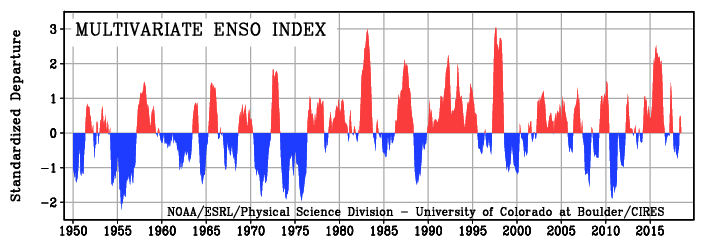
In the chart below, light green are La Nina period, orange are El Nino period.


The paper was published in April 2018, available at


On page 3, Oggie wrote,
"Recently, the intensity of these two weather deviations has also been observed to be growing, with the current El Niño phenomenon described to be the third strongest in modern history."

He wrote it in April 2018, a La Nina period but he wrote “current El Nino”, not good. 


There are good sites to check ENSO data, like https://wattsupwiththat.com/enso/.

On page 4, Oggie wrote,
“severity of weather anomalies, such as the “children” El Niño and La Niña, which are deviations from average temperature and average amount of precipitation… increasing regularity and intensity of El Niño and La Niña...”


Far out. Recent El Nino-La Nina are NOT severe, NOT increasing intensity. From 1950 to present, while the 2016-2017El Nino was 3rd biggest, the 2011-2012 La Nina was also the 3rd or 4th biggest. There are periods of weak or strong El Nino-La Nina like the periods mentioned, there are single-dip and double-dip La Nina, there are also single up or double up El Nino. That’s how nature works, sometimes weak sometimes strong events but overall, they are 100% natural, 100% cyclical. 


When one embraces climate alarmism peddled by the UN-Al Gore-WWF-Greenpeace-national governments, etc. (because they are the 'planet saviours' via more environmental regulations and energy taxation) one can lose objectivity.
----------------

See also:
Climate Tricks 69, Junkets to 'save the planet' limited by Duterte, July 28, 2018 

Climate Tricks 70, Greenpeace and the Economist love fossil fuels, August 06, 2018 

Climate Tricks 71, "Rising ocean" when reality is rising rivers, lakes, August 13, 2018

Friday, August 24, 2018

BWorld 243, NAIA closure, Passenger rights and MIAA

* This is my article in BusinessWorld last August 21, 2018.


On Aug. 16, 2018, Thursday near-midnight, a Xiamen Airlines plane skidded at the Ninoy Aquino International Airport (NAIA) and caused the runway closure for some 36 hours. The result was a nightmare for thousands of passengers. Many arriving flights were rerouted to Clark and Mactan-Cebu airports while passengers departing from NAIA were stranded for a day or two or even more as it was not easy to rebook a flight.

Among the issues and questions that came out of the incident are the following:

1. The DoTC-DTI Joint Administrative Order No. 1, s. 2012, “Providing for a Bill of Rights for Air Passengers and Carrier Obligations” — does it apply to stranded passengers in this case?

2. If not, who should shoulder at least the meals of the stranded passengers — the passengers themselves, Xiamen Airlines, MIAA, TIEZA/DoT?

3. This is not the first time that NAIA was closed due to plane accident on the runway. Were there lessons learned?

4. What are the impacts on the Philippine tourism sector?

On #1, seems that the answer is No. The cancellations and flight delays at NAIA were not caused by the other airlines, they even suffered huge losses because of extra hours, fuel and other costs associated with landing in Cebu or Pampanga, and flying out with no passengers as their passengers were trapped at NAIA.

Thus, those airlines may not be obliged to give free meals. Passengers who opted to cancel their delayed trips should get refunds but it takes a long time and there are standard deductions from the original ticket prices.

On #2, still subject to investigation and legal debates but it seems that Xiamen Airlines and/or the Manila International Airport Authority (MIAA), as well as the Tourism Infrastructure and Enterprise Zone Authority (TIEZA), should have covered even the meals of the stranded passengers.

MIAA collects P200 per domestic passenger as airport terminal fee, and P550 per international passenger, meaning the agency should provide certain services to the passengers especially for emergency cases like this.

TIEZA, an attached agency of the Department of Tourism (DoT), collects travel tax of P1,620 per Filipino traveling abroad on economy or business class, and P2,700 for those on first class. TIEZA projects seem “invisible” and non-tangible for Filipino travelers, the government simply collects money from them and give the officials and personnel lots of perks and good salaries.


On #3, the answer seems to be No. This is because each administration brings its own airport officials and bureaucrats, some of whom may have little skills in managing big and strategic agencies like MIAA and NAIA.

On #4, the impact is obviously negative. Foreigners or returning Filipinos (balikbayan) with only few days of stay here have already blown off their vacation with lots of unnecessary stress and expenses.

Philippine tourism arrivals in 2016 were only one-half (½) those in Vietnam and Indonesia and one-fourth (1/4) those in Malaysia. In tourism receipts, the Philippines got only one-third (1/3) that of Malaysia and Singapore and one-eighth (1/8) that of Thailand.


Too bad for the new DoT Secretary, this event is a sure headache in terms of missed targets. This is on top of the ugly Duterte policy of Boracay closure for six months, April 26 to October.

Some implications and policy adjustments for this event would be the following:

One, MIAA and TIEZA which are regular collectors of taxes and fees from passengers should learn to spend for the affected and often hapless passengers.

Two, MIAA should be considered for privatization but the private owners-operators still subject to various regulations by government agencies like the DoTr, CAB, SEC. The purpose is to strengthen professionalism and help depoliticize the management and operation of the airport, since officers are not subject to mandatory replacement every time a new administration comes to power.

Three, NAIA expansion to have a second or third big, wide runway for big planes, should be expedited. Or the creation of second and third international airports as alternative to NAIA — in Sangley Point, Cavite, and/or Bulacan should be expedited as well.

Four, integrated PPP (construction then O&M to be done by the same entity) and not hybrid PPP should be adopted in NAIA expansion and/or creation of alternative airports.
-----------------


Thursday, August 23, 2018

Lion Rock 24, Is everything under control?

I am reposting another good article from a friend, Nick Smith of Lion Rock Inst. in HK. This was published in March 2018.


Nick Sallnow-Smith
Chairman, The Lion Rock Institute

You may not think it from my title but this piece is about the Budget. Let me explain. Human beings, when faced with the chaos of nature, crave some degree of certainty. Governments respond to that innate desire with welfare programmes, the promise to outlaw or regulate all unpopular behaviour, and other measures that promote the idea of keeping society “under control” for the public good. What, you may ask, has the budget got to do with that?

Let’s take a step back from the myriad individual tax changes, Government subsidies, incentives and the other minutiae that the media tend to obsess over with any budget. The immediate news round is taken up by a litany of groups who didn’t get a handout or received too little. Our local Santa Claus never gives out enough presents to satisfy those with their begging bowls outstretched. But behind the usual post-budget noise what longer term trends can we discern?

Budgets can be broken down into three parts. How much does the Government take from individuals and businesses? What does it spend it on? Can the first element fund the second? In much of the world, the third question gets most attention. How big is the “deficit”? Is the borrowing or money printing required to make up the difference a problem? Because Hong Kong typically does not have this problem, attention can move to the first two. On the face of it, since the government takes much more than it currently spends, an obvious solution would be to cut taxes. Yet this is not seriously considered by Government, nor by commentators or political parties. Of course there is a debate about “handouts” but not about tax reductions. (The idea of “giving back” something the Government took in the first place is rather odd. If I take $100 from your pocket and then give you $20 back, is that a handout?)

Instead of thinking about a lower tax economy, the debate and pleadings are about how the cash is spent by Government. The Government has the wherewithal to do “more” for society. The assumption is that it is a positive thing for the government to be able to spend more, without thinking that the private sector is thereby spending less, because of the excess taxes paid. In a Western economy, this focus on spending would hardly be a surprise. But Hong Kong’s reputation as a free economy has been built on low taxes and small government. These principles have the combined effect of leaving a large portion of daily life in the hands of individual choice. Moves to reduce the size of the private sector and grow the Government ought to attract a lot of attention here. But since the handover, and with increasing frequency since C Y Leung’s tenure as CE, voices have been raised against free market principles. These voices now come from within the Administration as well as from political parties. Positive non-interventionism had already been denounced as out of date long before this budget. Now two more nails have been hammered into free market’s coffin.

The risk that pressures would grow to increase the size of the public sector was recognised by the Basic Law drafters. A number of lines in the sand were drawn, in an attempt to provide some barriers that might help administrations resist these inevitable political pressures. I use the metaphor “lines in the sand” advisedly. Such lines can, after all, be erased by a rising tide. And a tide in favour of a bigger role for government is now creeping ever higher up the beach. Two of those lines in the metaphorical sand were that Government spending should not exceed 20% of GDP and that should not increase faster than the growth of the economy. This budget erases those lines from the sand. It does so without any expressed concern or excuses. Instead, the Administration appears to be proud of getting rid of these tiresome barriers to more Government. Yet here was a great opportunity to reassess the overall burden of taxation. A ten year projection could have been made which concluded that a balanced budget could be achieved with, say, taxes reduced to 10% on both individuals and companies. Businesses large and small could then have been able to plan investments with the expectation of higher  returns. But instead of increasing the number of investments driven by private decisions, Government bureaux will guide an ever larger portion of our economy. The IT sector is a classic global example of how entrepreneurial investments can create huge value. The idea that Government committees can help decide what is “right for Hong Kong” in this area by favouring some startups over others is astonishing. Despite a hundred years, and counting, of the failure of state decisions over those of individuals to create sustainable growth, the call for Government to intervene to save us from ourselves never seems to die.

Where does this perennial call come from? At the beginning of this piece I hazarded a guess. The idea that Government can take away risk, make the right choices, protect us from “bad things”, runs very deep. In economic choices this is very damaging. Governments protect the status quo and delay adjustment to change. This disincentivizes new ideas and risk taking. Yet many people crave it. Like a life-long parent, the government makes decisions, allocates pocket money, protects us from harm. This temptation; to expect Government to create a city-wide “safe space” for all citizens; is massively damaging. It disincentives accountability and self-reliance and makes it much harder for our city to adjust to change and cope with threats, because – after all – the Government does that, doesn’t it? But it cannot and it will not. We each need to be accountable for ourselves, to plan for our own futures, to take our own risks, and not think we can outsource these to our bureaucracy. As Hong Kong grew to maturity in the postwar period, these personal accountabilities were widely respected and shared. Step by step they are fading away.

Someone once said “democracy dies in the darkness”, now on the Washington Post masthead I believe. However my concern is that in Hong Kong “freedom will die in the clear light of day”! Freedom can of course be lost at the hand of oppression. But it can also be lost because ordinary people ask, even require, their governments to take charge of their lives; to “take control”. Without the worry of rising taxes (and without asking for them to be reduced), many people spend their time pushing government to get involved in more and more aspects of our lives. The uncertainties of life, which create freedom and opportunity, are rejected in favour of safe spaces of all types. The ultimate “safe space” is a padded cell however.

If calls for the Government to “take control” continue to grow, freedom here will wither like leaves in autumn. It is crucial that these risks are recognised and discussed in our society. Change can happen very fast. In high summer, autumn seems impossibly far away. Yet if you look closely, the leaves are already reddening. In Europe, Estonia has blossomed from a communist winter to a wonderful spring of free enterprise within two decades. Don’t think Hong Kong cannot equally quickly wither from its free market glories to a limp socialist-style economy with too little enterprise to generate the wealth an aging population will need.

The announcement of a huge surplus, with cash handouts everywhere may look like the wrong time to play the fiscal Cassandra. I disagree. The leaves are turning colour in Hong Kong. Don’t assist by pulling them off the tree yourselves.
--------------

BWorld 242, PH defense spending and the SCS

* This is my column in BusinessWorld last August 20, 2018.


On Aug. 13, Armed Forces of the Philippines (AFP) Chief of Staff Gen. Carlito Galvez, Jr. admitted that China’s radio warnings to Philippine aircraft and ships in the South China Sea (SCS) are “a daily occurrence.”

The AFP leadership has actually been mum about this, giving only occasional admission of such China warnings until BBC, one of the international TV networks allowed by US Navy Patrol in one of its recent patrols at the SCS, reported that it was able to pick up China’s aggressive warning to a Philippine military aircraft supposedly flying nearby: “Philippine military the aircraft. I’m warning you again: Leave immediately or you will bear responsibility for all the consequences.”

BBC observed that China’s radio warning to the Philippine aircraft was less courteous compared to the US Navy aircraft which also received a China military warning.

The previous Aquino administration hauled China to the UN-backed Permanent Court of Arbitration (PCA) in The Hague, Netherlands. It was a good move and on July 12, 2016 or less than two weeks into the Duterte administration, PCA rewarded the Philippines with a ruling that China’s 9-dash line has no basis in international law.

President Duterte, however, has never explicitly used and cited that PCA award and instead, tried to appease if not kowtow outrightly with the Beijing communist government.

This policy shift was reassessed during the Stratbase-Albert del Rosario Insitute (ADRi) forum last July 12. VP Leni Robredo, former DFA Secretary del Rosario, SC Associate Justice Antonio Carpio, UP Law Prof. Jay Batongbacal were among the speakers and they highlighted the lack of importance given by the Duterte administration on the value of such arbitral award.

In terms of defense spending, there is some change made by Duterte — there is marked increased in the proposed budget for the Army, Air Force and Navy and decline in the general headquarters (HQ) and other support units. Obligation budget refers to possible extension of service delivery and payment beyond the calendar year while cash budget refers to service delivery and payment within the calendar year with maximum extension of three months (see table 1).


Looking at the regional picture in defense spending, the World Bank’s World Development Indicators (WDI) has some interesting data.

In terms of absolute values of military spending, China is #1 hands down. Its GDP size (nominal) in 2016 was $11.2 trillion so 1.9% of it is $212.8 B, a huge amount (see table 2).


The Philippines’ military personnel and spending look small compared with its neighbors, but considering that it has little external defense capability and the main function of the AFP is internal defense like fighting the NPAs and ragtag separatist and Islamic fundamentalist groups, the spending looks big.

Other Asian countries have used both diplomatic and limited military engagement in facing China bullying in the SCS. Vietnam and Indonesia, for instance, have sank some intrusive Chinese fishing boats that are sometimes backed up by China Coast Guard boats.

The Duterte administration’s kowtow attitude to the China communist government is shameful. It should redeem itself by reasserting the Philippines’ ownership of those stolen islands and territories, have military coordination with the US Navy and have regular joint patrols in the area, among others.
--------------- 

See also: