Wednesday, March 01, 2023

BWorld 584, Ten trends in inflation, PPP, employment, cancer treatment and energy

BusinessWorld Feb. 13, 2023.
------------

Last week, several important pieces of news and events came out. I am summarizing them here.

1. The Philippines inflation rate was 8.7%. The Philippine Statistics Authority (PSA) released the January inflation data last week, and the number is indeed bad. But last year, Thailand and Singapore also experienced inflation at 14-year highs, South Korea hit a 24-years high, Japan has a 41-year high.

The main contributors of the 8.7% inflation rate (the highest since November 2008) are from housing, water, electricity, gas, other fuels, transport, and food. These are basic necessities so even if the Bangko Sentral ng Pilipinas (BSP) interest rates further rise from the current 5.5% (only 2% last April) to 10%, people will still spend for them. The appropriate policies are to encourage more supply of those goods — cement, steel, electricity, water, etc. — both through domestic production and trade liberalization.

2. Low unemployment rate despite high labor force participation rate (LFPR). The PSA also released last week employment data for December 2022. LFPR is an indicator of people’s optimism or pessimism about the jobs market. They enter the labor force if they think they can find a good job, they don’t join if they think good paying jobs are not available anyway. The two highest LFPR in 2022 were recorded in November at 67.5% and December at 66.4%.

The two lowest unemployment rates in 2022 were also in November at 4.2% and December at 4.3%. That is a three-year low and it is the best situation that one can hope for in the jobs market. People are optimistic they can find good jobs or they can employ themselves via entrepreneurship. And when they do enter the labor force, very few are unemployed.

Last year among the ASEAN-6, the Philippines had the third highest inflation rate next to Thailand and Singapore. And when it came to the unemployment rate, the Philippines had the second highest as of September 2022 next to Indonesia. But the good thing is that Philippines unemployment shows a consistent decline (see Table 1).

3. Lecture on public-private partnership (PPP). On Feb. 8, the inaugural Ruperto P. Alonzo lecture series was held at the UP School of Economics. The speaker was Cynthia Hernandez, Executive Director of the PPP Center. She discussed the big PPP projects since the time of former President Cory Aquino under RA 6957 or build-operate-transfer (BOT) law of 1990, then RA 7718 or Amended BOT law of 1994 under former President Fidel Ramos, and so on. The main reason why I support more PPP in big infrastructure projects is that it relies on user-pay principle, not all taxpayers-pay principle. So the North Luzon Expressway (NLEX) will be paid only by those who use it and not by people who hardly or never use it, like taxpayers and businesses in Bicol, the Visayas, and Mindanao.

4. The Philippine Business Opportunities Forum (PBOF) in Japan. Last Friday, President Ferdinand Marcos, Jr. and the economic team plus infrastructure team held the PBOF in front of many Japanese and foreign investors. Among the important outcome of the Japan trip was the signing of 35 Letters of Intent (LOIs) between the Philippines and Japan that cover business opportunities in energy, manufacturing, transportation, healthcare, and other sectors.

5. Cancer center and treatment is highlighted. Also during the lecture by Ms. Hernandez last week, she mentioned the University of the Philippines-Philippine General Hospital (UP PGH) Cancer Center, a $95 million (or about P5.5 billion) 300-bed capacity hospital for cancer patients. A week before, it was also reported in BusinessWorld, “Cancer center is Marcos gov’t’s first PPP project” (Feb. 2).

6. Cancer is third main cause of death in the Philippines. Last month, the PSA released the “2022 Causes of deaths in the Philippines,” data covering January-September 2022. I expand here with data from way back to 2017. For some reasons, cancer deaths and pneumonia deaths have declined significantly in 2021 and 2022 while COVID deaths came in (see Table 2).

It is possible that regular pneumonia deaths were labeled as COVID deaths because reporting of COVID cases and deaths were incentivized via higher PhilHealth coverage and subsidies if the patient was sick or died of COVID than non-COVID causes.

7. Cancer treatment is underfunded while COVID vaccination funding remains bloated. Another report in BusinessWorld last week was “More public funds seen needed for cancer care in PHL” (Feb. 9). It quotes Dr. Marvin Jonne Mendoza, head of the medical oncology section of the National Kidney and Transplant Institute, saying that the 2023 General Appropriations Act includes P1.56 billion for two cancer funds but for breast cancer, a patient needs P300,000 to P450,000 to complete the required 18 treatment cycles, and there are at least 27,000 new breast cancer cases/year in the Philippines. Even taking the low-end of P300,000/patient, this means some P8.1 billion is needed to deal with breast cancer alone.

Compare that with COVID vaccine procurement plus logistics of about P88.6 billion in 2021, P45 billion in 2022, and P24.5 billion in 2023.

8. New medicines are replacing chemotherapy. My older brother, Manong Nestor Oplas, died about 17 years ago of prostate cancer. His wife and my sister-in-law, Ate Alita Oplas died of cervical cancer several months ahead of Manong. As both went through painful and expensive treatments including chemo, my well-off sister covered their costly treatment, but both died young, only in their early 50s. My father died of liver cancer but he was almost 90 years old when he rested. Three of my wedding godparents also died of cancer.

If these new anti-cancer medicines — through intravenous or subcutaneous delivery — were available say two decades ago, my brother and sister-in-law, godparents and many other friends, may have lived longer.

9. The budget this year for “Prevention and Control of Non-Communicable Diseases” like cancer is P2.91 billion. The Department of Health has a total budget of P209.13 billion from the General Appropriations Act of 2023.

10. Last Friday, the Independent Electricity Market Operator of the Philippines (IEMOP) held a media briefing and they reported two pieces of good news. One was the launch of the Wholesale Electricity Spot Market (WESM) Mindanao on Jan. 26. Two is the start of operation of the Mindanao-Visayas Interconnection Program (MVIP) this coming March. This is a long-delayed project by the National Grid Corp. of the Philippines (NGCP) — the original target was end-2020, which became 2021, then became 2022. With President Marcos Jr. at the WESM Mindanao launch and announcing the March 2023 operation of MVIP, the NGCP will have no more excuses to keep delaying completion of the project.

The MVIP is important because Mindanao often has power surpluses — it has many new coal power plants — while Visayas and Luzon have occasional power deficits. In Mindanao, coal is 53% of installed capacity but contributes 62.5% of actual power generation.

The trends show bad numbers in inflation but good numbers in employment, energy, PPP, and foreign investments. In health, the continuing distortion in public spending in favor of COVID vaccination spending should stop and resources be diverted to controlling cancer and other non-communicable diseases.
-------------

See also:
BWorld 581, 10 trends in GDP and trade in 2022 and 2023, February 09, 2023
BWorld 582, Ten things about the military and uniformed personnel pension system, February 16, 2023
BWorld 583, Ten trends in global and Philippine energy, February 17, 2023.

Inequality 43, Socialistic aspirations in the PH 1986 Constitution

A revealing article from former Constitutional Commissioner who drafted the Philippines' 1986 Constitution, 

Full text: 1987 Constitution has 3 central themes, 2 mistakes, says framer
Christian Monsod February 27, 2023
https://www.philstar.com/news-commentary/2023/02/27/2248029/full-text-1987-constitution-has-3-central-themes-2-mistakes-says-framer

"EDSA was not only about the restoration of democracy, it was also the promise of a new social order that remains unfulfilled through every administration since EDSA.

... three central themes:

1. FIRST, the heart of the Constitution is social justice with the poor as the center of our development, as enunciated by the President of the Constitutional Commission former Justice Cecilia Munoz-Palma. Hence, a new Article on Social Justice to address not only mass poverty but also the gross social, economic and political inequalities...

2. SECOND, never again to any authoritarian government. Hence, the strict limitations and conditions for declaring martial law with new provisions, including in the Bill of Rights, to protect citizens against abuses by the State; and

3. THIRD, the national destiny must firmly and safely rest on Filipinos themselves. Never again amendments similar to the 1935 Constitution that gave Americans equal rights to our patrimony, and economic policies..."

There, Atty. Christian Monsod really has socialistic aspiration for the Philippines. The 3 central themes of the Constitution that he identified -- anti-inequality (ie, socialistic), anti-foreign parity (ie, nationalistic), and anti-authoritarianism (ie, democratic). I understand the third but not the first two. And he is vehemently against changing the Consti. He'd rather have full implementation of those 3 themes -- more equality in social outcome, more restrictions on FDIs, and anti-dynasty law. Again, I support his 3rd concern but not the first two.

That is why Ma'am Winnie Monsod, his wife and my former teacher in UPSE in the 80s is also against changing the constitution especially on removing the 60-40 foreign equity restrictions in many sectors. Her problem is that she used or quoted the lousy "analysis" of Ibon or bird-brain foundation. JP, KR, TW, even CN are done on the stage of new FDI inflows, they are already in the stage of net FDI outflows, exporters of capital. Thanks to their early policy of encouraging lots of FDI inflows, technology transfer, management modernization.

I am in favor of amending the Constitution with only one wish -- make it as short as possible. 10 pages maximum. No details, all general principles and strong on civil liberties -- what sectors or rights the government especially legislature can NOT restrict or pass into law. 

All details like 60-40 foreign equity restrictions, minimum age of those running for President, VP, Senators, Congress, etc. should be done via legislation, not in the constitution.

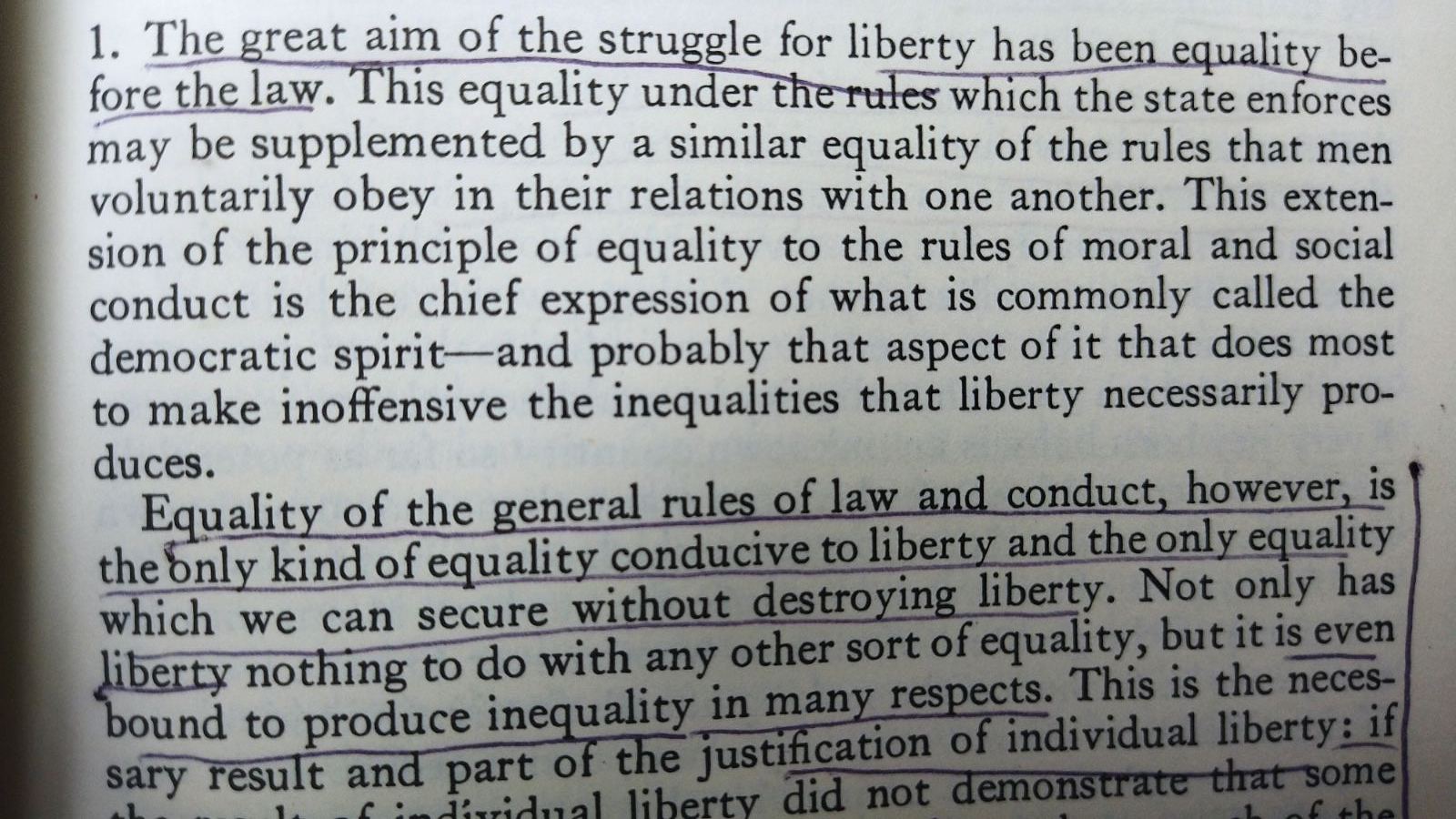
This is the kind of equality that I believe in -- equality before the law, the law applies equally to unequal people. From Friedrich Hayek's "The Constitution of Liberty" (1960), Chapter 6, "Equality, Merit and Value",


And this. Equality in opportunity is the same as equality before the law, desirable. Equality in outcome or result is anti-freedom, anti personal responsibility, undesirable.

Meanwhile, every single year, Oxfam announces its math stupidity by making this kind of non-math.

9 Filipino billionaires wealthier than 55 million Pinoys: Oxfam report
Jan 16 2023
https://news.abs-cbn.com/business/01/16/23/9-richest-pinoys-wealthier-than-half-of-ph-population/

Why? Because their numerator, wealth of rich families, is accumulated wealth for 5, 6 decades, even one  century or longer. But the denominator is GDP flow of income for only one year. Or GDP per capita for one year.

To correct Oxfam stupidity, they can keep the numerator but the denominator should be accumulated GDP for at least 50 years. Then see the quotient or result.
--------------

See also:
Inequality 40, Real minimum wage is zero, May 15, 2021 
Inequality 41, WB's report on poverty and inequality in the PH, November 25, 2022
Inequality 42, Exclusivity is good, February 02, 2023.

Friday, February 17, 2023

BWorld 583, Ten trends in global and Philippine energy

* BusinessWorld February 6, 2023. 
-----------

Some developments on the energy front in early 2023, both global and national.

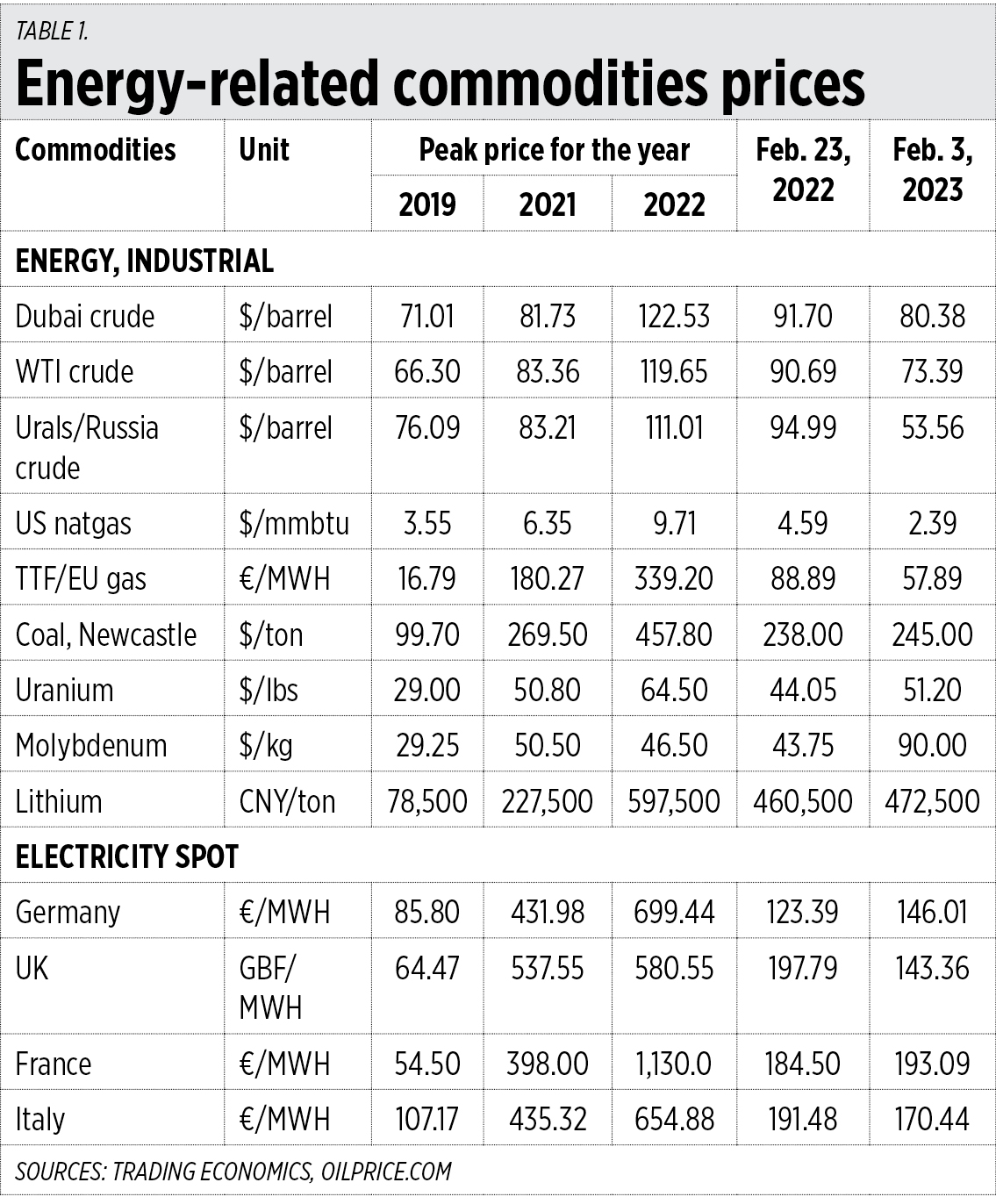
1. Oil and gas prices are now lower than during pre-war Ukraine. Comparing prices last week with Feb. 23, 2022 or a day before Russia invaded Ukraine, Dubai crude is $11/barrel cheaper and WTI crude is $17 cheaper. It’s the same trend for EU gas and US natural gas prices.

2. Coal prices have significantly cooled down. From a peak of $458/ton in 2022, it was down to only $245 last week. Since about 58% of total power generation in the Philippines is from coal, this is good news.

3. E-vehicle prices are rising and charging them is more expensive than using gasoline. The price of lithium, the main material in producing batteries, is higher than the pre-invasion period, twice the peak price in 2021 and six times the peak price in 2019. Electricity prices in Europe last week were about twice the peak prices in 2019. Peak prices in 2022 were 6-20 times higher than peak prices in 2019 (table 1).

4. Continuing threats of blackout, spot market price control. It has now been 32 years since the big blackouts of 1990 to 1991 in the Philippines and the possibility of occasional blackout remains. See these recent reports in BusinessWorld: “DoE expects 12 yellow alerts in Luzon grid” (Jan. 10), “Still no agreement on Ilijan gas supply — DoE” (Jan. 12), “ERC reviewing secondary price cap after DoE cites potential to unlock investment” (Feb. 1).

Government price control in the electricity spot market is wrong and should be removed. Frequent price spikes are indicators of thin reserves, and power distributors and consumers are willing to pay higher just to avoid blackouts. When price control kicks in too often, it will discourage investment in more peaking plants. The most expensive electricity is no electricity. Candles and more expensive generator sets are bad alternatives.

5. Rise in subsidies to off-grid islands and provinces. Island-provinces like Palawan, Mindoro, Masbate, Marinduque, Batanes, etc. rely on big gensets by the National Power Corp. (Napocor) small power utilities group (SPUG)  and private producers. Since generation via oil gensets is expensive, off-grid consumers are subsidized by on-grid consumers through the universal charge for missionary electrification (UC-ME) in our monthly electricity bill. See these recent stories in BusinessWorld: “Napocor to cut service to SPUG areas due to high diesel prices” (Jan. 19), “Universal charge hike proposed to sustain off-grid power services” (Jan. 30).

Current UC-ME is P0.178/kWh and Napocor is asking for P0.15 more. If approved, it will become P0.328/kWh. The UC-ME should go, off-grid provinces should use small coal or gas plants or small modular reactors to have cheaper electricity and will not need subsidy. Note also in table 2 below, Napocor is earning P2-3 billion a year.

6. Obstinate San Miguel petition at ERC and CA. San Miguel Corp. units South Premiere Power Corp. and San Miguel Energy Corp., the administrators of the gas plant in Ilijan, Batangas, and the coal plant in Sual, Pangasinan, respectively, sought a rate hike at the Energy Regulatory Commission (ERC) in August. ERC rejected the petition in September. San Miguel went to the Court of Appeals (CA) the following month. Last month, the appellate court’s 13th Division gave South Premiere a writ of preliminary injunction, suspended the power supply agreement between South Premiere and Manila Electric Co. to allow them to negotiate. But the court’s 16th Division rejected a similar injunction motion from San Miguel Energy. Both cases will be consolidated at the 13th Division, and if South Premiere and Meralco agree to increase the price, it will go back to the ERC again. Terminating the power supply agreement does not seem to be the least cost for the public.

See these reports in BusinessWorld: “Meralco to start sourcing 670 MW from spot market” (Jan. 26), “ERC says court denied hold order vs its ruling in Sept.” (Jan. 27), “Competitive power rates sought after court move on supply deal” (Jan. 30) and “ERC looks to high court amid suspended power supply deal” (Feb. 6).

7. San Miguel Energy and South Premiere earned, not lost, in 2021. San Miguel said it had losses of P15 billion from units South Premiere and San Miguel Energy. Data from BusinessWorld’s Top 1000 Corporations in the Philippines 2022 showed they earned P5.34 billion and P4.5 billion, respectively (table 2).

Meanwhile, South Premiere or the Ilijan gas plant is on economic shutdown. So far, there seems to be no investigation for anti-competitive behavior. Ilijan must run on liquid fuel, expensive diesel and generation companies have to obey the must-offer rule in the spot market. The plants have to run.

8. NGCP was the most profitable among energy players, perhaps in the whole country. Its net income over gross revenue ratio from 2017 to 2020 averaged 45.7% (table 3). Two things here — high profitability while the country suffers from persistent yellow-red alerts yearly, up to now, and NGCP is the sole private nationwide monopoly system and network operator.

NGCP has a big asset base but must do certain investments stipulated in its franchise. The high profitability possibly comes from not investing in the committed asset base, which was the basis for its transmission rates. It’s like not having a firm contract for ancillary services that should significantly augment power reserves, and long-delayed transmission lines to avoid power congestion in certain areas and where supply is available to areas where they are needed.

There is an ongoing fourth regular review and fifth regulatory reset of NGCP at the ERC. ERC should look at these profitability figures.

9. Nuclear energy is becoming more acceptable in the Philippines. See these recent reports in BusinessWorld: “Energy dep’t designates RE, nuclear as 2023 priorities” (Jan. 2), “Philippines in nuclear push as power crisis looms” (Jan. 24). Uranium prices in the table above show they don’t swing wild unlike Europe electricity prices that rely increasingly on intermittent wind and solar power.

10. Persistent calls for expensive electricity via carbon pricing and taxation. The International Monetary Fund (IMF) is tone-deaf to the plight of Philippine businesses and households as it continues its irresponsible and corrupt lobby to impose carbon pricing and taxation in the Philippines. See this report in BusinessWorld: “IMF says carbon pricing may raise $7-B revenues” (Jan. 4).

In this period of high inflation, more expensive electricity, transportation and other commodities are the least that we should aspire for. People can’t be serious if they blame CO2 — the gas that we humans and animals exhale, the gas that plants and crops use to produce their own food via photosynthesis — as causing less and more rain, less and more flood, less and more cold, fewer and more dogs.

Meanwhile, the Ruperto P. Alonzo lecture series will kick off at 3 p.m. this Wednesday, Feb. 8 at the UP School of Economics. It is free and open to the public. The topic is “29 years of BoT law and the way forward.” The speaker will be Cynthia Hernandez, executive director of the PPP Center. The three discussants/reactors are Roderick Planta, assistant secretary for investment programming at the National Economic and Development Authority; Vaughn Montes, director at Rizal Commercial Banking Corp.; and Paul Imperial, vice-president for Structuring and Regulatory Affairs at Aboitiz InfraCapital, Inc.
--------------

See also:
BWorld 580, Ten themes in development economics (and the Ruperto Alonzo lectures), February 03, 2023 
BWorld 581, 10 trends in GDP and trade in 2022 and 2023, February 09, 2023
BWorld 582, Ten things about the military and uniformed personnel pension system, February 16, 2023.

Macroecon 21, Tax revenues, PH outstanding debt

Latest revenue numbers from the cash operations report (COR) of the Bureau of Treasury. Bureau of Customs (BOC) has P789 billion already by November 2022.

Yogi Ruiz became Acting BOC Commissioner last July 25, sworn in by PBBM July 20. So BOC collections from August to November can be attributed to his leadership, it's high, P75 B/month and up. Although BOC collections started rising since March 2022, with record high P83.6 B in July.

Previous record highs in BOC collections were P643.6 B in 2021 and P630.3 B in 2019. The P862 B in 2022 (so December collections were P73 B) was really high. Partly due to the leadership of Yogi Ruiz. Now that he has been replaced by Bienvenido Rubio, the latter must show good performance, high collections of P75 B to P85 B a month.


Meanwhile, outstanding public debt in 2022 was P13.42 trillion, domestic P9.21 trillion + foreign P4.21 trillion. Plus guaranteed debt of P399 billion, total public debt was P13.82 trillion. 


Notice the big jump in public debt in 2020, 2021, 2022, average P2 trillion a year.


Outstanding actual debt + guaranteed debt, it's P8.22 trillion in 2019, P10.25 trillion in 2020, P12.15 trillion in 2021, and P13.82 trillion in 2022.

Three ways to drastically cut this huge debt burden.

1. Cut spending, streamline the bureaucracies, cut some subsidies, reform government pension especially by military and uniformed personnel (MUP).
2. Better tax administration, collect more from existing tax rates; or raise new taxes.
3. Large scale privatization of government corporations, land and other assets.
---------------

See also:
Macroecon 19, UK and Canada inflation rates, Biden admin's 'expensive gas is beneficial', July 20, 2022
Macroecon 20, Strong US dollar and how to deal with it, October 06, 2022 
Macroecon 21, Presentation on inflation, gloal and national pictures, November 01, 2022.

Thursday, February 16, 2023

BWorld 582, Ten things about the military and uniformed personnel pension system

* BusinessWorld January 30, 2023.
--------------

Continuing the “Top 10” economic issues being discussed in this column, this 8th installment will tackle one huge elephant in the room, the ever-rising taxpayers’ burden which is the military and uniformed personnel (MUP) pension system.

Here are 10 issues that Philippines taxpayers and public finance researchers should consider.


1. Government civilian personnel contribute for their future pension, MUP do not. Government doctors, nurses, teachers, engineers, agriculturists, etc. Accept the additional deductions from their monthly pay that go to the Government Service Insurance System (GSIS), the MUP do not. Taxpayers pay for active service MUP salaries and other compensation, then when they retire, taxpayers again have to pay for their pension — and the scheme is egregious.

2. The amount is huge, P65 billion/year a decade ago, P130 billion this year. In an article written a decade ago by Benjamin Diokno (now Finance Secretary), “Military Pension,” (BusinessWorld, Aug. 13, 2013), he observed and presented the numbers (see Table 1).

“The uniformed personnel of the AFP, the DILG, NAMRIA and the PCG [Armed Forces of the Philippines, Department of Local Government, the National Mapping and Resource Information Authority, and Philippine Coast Guard] have to rely on direct appropriations by the National Government. Why? Because the military’s pension fund collapsed a long time ago as an aftermath of the Asian financial crisis and the financial mismanagement of their respective retirement funds.”

3. MUP pensions are up to 88% of base pay of active soldiers, policemen. The share of MUP pension/base pay averaged 66.5% in 2019-2021, then jumped to 88% in 2022. In contrast, the civilian personnel pension/base pay averages only about 1.3%. Including various allowances, hazard pay, etc., MUP pension/total compensation averaged 34% in 2019-2021 then jumped to 44% in 2022.

4. MUP in active service already get generous pay, averaging P335 billion/year in 2019-2022. In Table 2, “Other compensation common to all” includes longevity pay, subsistence allowance, relief allowance, mid-year bonus, year-end bonus, and others.

“Other compensation for specific groups” includes combat duty pay, combat initiative pay, hazardous duty pay, lump-sum for filling of positions MUP, others. And “Other benefits” include terminal leave, retirement gratuity, and PhilHealth contributions, others.

5. MUP under DILG have larger base pay than the Armed Forces of the Philippines-Department of National Defense (AFP-DND) but have lower pensions than the AFP. From 2021-2023, the average base pay of MUP in the DILG was P106 billion/year while base pay in the AFP-DND was P62 billion/year. But the pension of MUP in the DILG was only P55 billion in 2021, lower than the P67 billion pension in the DND.

6. The AFP pension is larger than base pay of active soldiers. In 2021, the pension in the AFP-DND was 112% of base pay while the Philippine National Police (PNP) pension was 50% or one half of base pay of active policemen. The average for all MUP was 70% of base pay (Table 3).

7. An AFP pensioner can get P191,000/month for life. Consider these two recent columns in BusinessWorld: “The Game of the Generals” by Amelia H. C. Ylagan (Jan. 22, 2023) and “Dealing with a looming military pension crisis” by Victor S. Limlingan (Oct. 18, 2022).

Ms. Ylagan wrote, “A retired (full) General can get lifetime pension of up to P190,975.88 per month, computed on 85% of highest base pay plus longevity pay for the maximum number of years served. (The pension lowers as the rank lowers, with the lowest, Brigadier General, still getting about P100,000 per month pension or close to this.)”

Mr. Limlingan wrote, “The GSIS actually did an actuarial study of the financial impact of absorbing the military and estimated that this would involve assuming P9.6 trillion in unfunded liabilities, clearly beyond the financial capacity of the GSIS. And so the problem looms… Our Congressional Planning and Budget department estimates that if no reform is undertaken, the National Government will need P800 billion for the next 20 years.”

8. The Development Budget Coordination Committee (DBCC) of previous and current administrations rang the bell on MUP pension. The DBCC — a.k.a. the “economic team” composed of the heads of the Department of Finance (DoF), the Department of Budget and Management (DBM), the National Economic and Development Authority (NEDA), and the Bangko Sentral ng Pilipinas (BSP) — of both of the Duterte and Marcos Jr. administrations raised the alarm bells on this huge fiscal burden. Consider these reports in BusinessWorld:

“Gov’t facing P9.6-trillion bill for military pension obligations” (Feb. 2, 2021),

“Economic managers back military pension reform” (June 16, 2021),

“GSIS deemed stable despite AFP pension risk” (Dec. 5, 2021).

From the Dec. 5 report: “An actuarial study by the Department of Finance concluded that the creation of a retirement fund solely for military and uniformed personnel will require an additional P45 billion annually.”

9. Suggested Reform No. 1: All MUP in active service should contribute to GSIS. Among the important reforms advocated by the DBCC and other concerned groups is that the MUP should pay for their own retirement pension. And there is no need to create another agency to handle this — GSIS can handle civilian pension and MUP pension. I say “amen” to this. The MUP pension should not come from taxpayers again as they are already over-burdened. Think of the P2 trillion/year of new borrowings for three years, 2020-2022, the taxpayers will ultimately pay for that.

10. Suggested Reform No. 2: Scrap, abolish the indexation of pensions on salaries of the incumbent, not the retiree. As Mr. Diokno wrote in 2013, “Well, during the final months of the Fidel Ramos (FVR) presidency, he approved what I consider to be the most generous pension system for the military in the entire world. While the common practice is to base the pension benefits on the highest salary (usually the last) of the retiree, under the law approved by Mr. Ramos, the pension is based on the salaries of the incumbent. Absurd but true.”

Again, I say “amen” to this reform. I admired and praised former President FVR’s handling of the economy — see this column’s piece, “The Post-SONA Economic Briefing; FVR’s economy” (Aug. 1, 2022) — but such admiration is now diminished. But if he was alive today, I think he would be among the reformers who would call for the scrapping of this egregious scheme.

I hope that MUPs in active service in various departments and agencies will not resist these two reforms. Their motto, to “serve and protect,” should refer more to the public and taxpayers, not to themselves and their future pensions.

I also hope that the public and other media also begin to discuss the elephant in the room. The amount is so huge. People were scandalized by the Education department’s laptop overpricing scandal in the previous administration, estimated at P0.96 billion. And rightly so. But the MUP pension, like the P153 billion in 2022 budget, should have not been there in the first place and it is a huge hole in taxpayers’ pockets.
--------------

See also:
BWorld 579, Ten revenue facts about Top 1,000 corporations, February 02, 2023
BWorld 580, Ten themes in development economics (and the Ruperto Alonzo lectures), February 03, 2023 
BWorld 581, 10 trends in GDP and trade in 2022 and 2023, February 09, 2023.

Wednesday, February 15, 2023

Agenda One News, Part 9

Today I was interviewed again by Cito Beltran, host of the famous daily tv program, "Agenda" in One News channel, Cignal TV. Topic was about the new Bureau of Customs (BOC) Commissioner Bienvenido Rubio. He was sworn by President BBM last week and started office last Monday. Here are some reports about him.

BoC agenda puts digitalization front and center (February 13)
https://www.bworldonline.com/economy/2023/02/13/504678/boc-agenda-puts-digitalization-front-and-center/

Diokno backs new Customs chief Rubio
byJulito G. Rada  (February 13)
https://manilastandard.net/news/314305084/diokno-backs-new-customs-chief-rubio.html

New BOC chief vows to sustain gains, curb smuggling
By Ferdinand Patinio (February 13)
https://www.pna.gov.ph/articles/1195105

Lacson tagged Rubio ‘BoC bagman’ (February 13)
https://tribune.net.ph/2023/02/13/lacson-tagged-rubio-boc-bagman/

This is my 9th interview at Cito Beltran's show. Cito is a veteran TV host and his program "Agenda" runs Monday to Friday 8-9am at One News, Cignal TV. He is also a respected columnist in Philippine Star, his articles appear every Monday, Wednesday and Friday, https://www.philstar.com/authors/1804831/cito-beltran.


Cito expressed his skepticism of the ability of Mr. Rubio to have clean leadership of the BOC based on the expose of Sen. Ping Lacson that Mr. Rubio is a "bagman" of BOC. At first I discussed some numbers about BOC --  revenue collection in 2021 was P643 B, jumped to P862 B in 2022, P200+ B increase in just one year. This never happened before, not even P100 B increase in a year. This year the DOF set a target for BOC, P901 B. I said that based on very good performance last year, the DOF should raise the revenue target for BOC to P1 trillion this 2023.

I mentioned smuggling, Mr Jess Aranza of Federation of Phil. Industries (FPI) estimates smuggling at P250 billion a year -- oil smuggling, cigarette smuggling, car smuggling, etc. -- the revenue losses of the government. Of which about P25 billion/year from tobacco and cigarette smuggling alone. Cong. Joey Salceda estimate is P30 billion/year of revenue losses from tobacco smuggling, former Cong. Koko Nograles estimate is about P31 billion/year. My own estimate is P36-49 billion/year. So just reducing tobacco smuggling by half would mean at least P15 billion/year of additional revenues to the government.


There is huge need for revenues to reduce the public debt stock. New borrowings were about P700-P800 B/year in 2017-2019. By 2020, new borrowings was P2.5 trillion, then P2.2 trillion in 2021, then about P2.1 trillion in 2022. So the new BOC leadership should focus on (1) higher revenue performance, (2) control smuggling, (3) have digitalization towards trace facilitation, and (4) raise the morale of BOC people because many of them are perceived by the public as "Lacoste" or greedy crocs.

DBM Secretary Amenah Pangandaman said DBM has allocated P3 B for BIR and BOC for their digitalization set up and upgrades.


Cito asked me what info I have gathered about Mr Rubio, a case filed at the Ombudsman, I said I asked many friends from UP, even two retired military friends, and I found out that almost all of them have nothing to say about the man, he is relatively an unknown. Meaning if he's a bad or corrupt official then he is not a notoriously bad one because his bad acts are not well highlighted. If he's a good official then he is starting with no political and moral baggage. 

So far Mr. Rubio has the endorsement of President BBM and DOF Secretary Ben Diokno. He should put up a really good performance in his first few months and show that he can deliver higher collections to the government, meaning he can minimize leakages and smuggling. Otherwise, negative media reports, Senate investigations can get hotter and he can be replaced soon.

Anyway, the interview this morning is here, starting at time 37:22, https://www.youtube.com/watch?v=eKOpycke2aE.

Thanks again, Cito, your staff for the opportunity to explain some important numbers and the challenges facing the BOC, DOF.
------------

See also:
Agenda One News, Part 6, August 31, 2020
Agenda One News, Part 7, February 07, 2022
Agenda One News, Part 8, October 21, 2022.

Thursday, February 09, 2023

BWorld 581, 10 trends in GDP and trade in 2022 and 2023

* BusinessWorld, January 26, 2023.
-----------------

The Philippine Statistics Authority (PSA) released today two important reports, the 4th quarter — and hence, full year 2022 — GDP, and December — and hence, full year 2022 — trade data. These are the trends that we see.

1. GDP growth in 2022 is 7.6% led by investments and household consumption. On the demand side, household consumption has the biggest share, 73%, of GDP or gross domestic product (a monetary measure of the market value of all the final goods and services produced and sold in a specific time period), and it grew 8.3% last year. Investment has a 24% share of GDP and it grew 17%.

2. Government’s share in GDP is rising. In 2016-2017, the share of government consumption was only 11% of GDP — it went up to 15% in 2022. Since government spending is financed by taxes and borrowings, this means that current and future taxes and debt payment will increase, not flatline or decline.

3. The Services sector, led by trade and finance, is growing fast. On the supply side of GDP, the services sector is now 61% of GDP and it grew 9% last year — good! The industry sector and manufacturing have modest growth (see Table 1).

4. Agriculture’s share continued its decline. Its share is now below 9% of GDP and growth remains anemic at 0.5%. As discussed in this column last Monday, “Ten themes in development economics (and the Ruperto Alonzo lectures),” the growth of corporate farming is much faster than overall agriculture. What the sector needs is more corporate agribusiness, and more land consolidation to have economies of scale.

5. High expansion of imports despite the peso’s depreciation. Total merchandise or goods imports increased a great deal, from $117 billion in 2021 to $137 billion in 2022. The peso/US dollar average exchange rate last year was P54.48/$1 vs only P49.25/$1 in 2021. The Philippine economy was humming with both domestic and imported goods despite the higher exchange rate.

6. Exports have increased marginally, with the US and Japan as the top destinations. Merchandise exports in 2022 reached nearly $79 billion, with $23.4 billion going to the US and Japan alone. Germany remains the number one trade partner but its share to total exports and imports is declining.

7. Indonesia became a huge imports partner. Merchandise imports from Indonesia in 2021 were worth $8.45 billion, and jumped to $13.2 billion in 2022. Must be the higher value of coal imports, even if the quantity did not increase much.

8. Illicit trade in consumer items needs to be watched. For instance, the excise tax for legal cigarettes has increased from P55/pack in 2022 to P60/pack in 2023, and will further rise to P63/pack in 2024. Smuggled and illegal cigarettes, alcohol, other consumer goods will become cheaper options. Government revenues will suffer while certain government officials will amass wealth for themselves by allowing and facilitating the entry of illicit smuggled products.

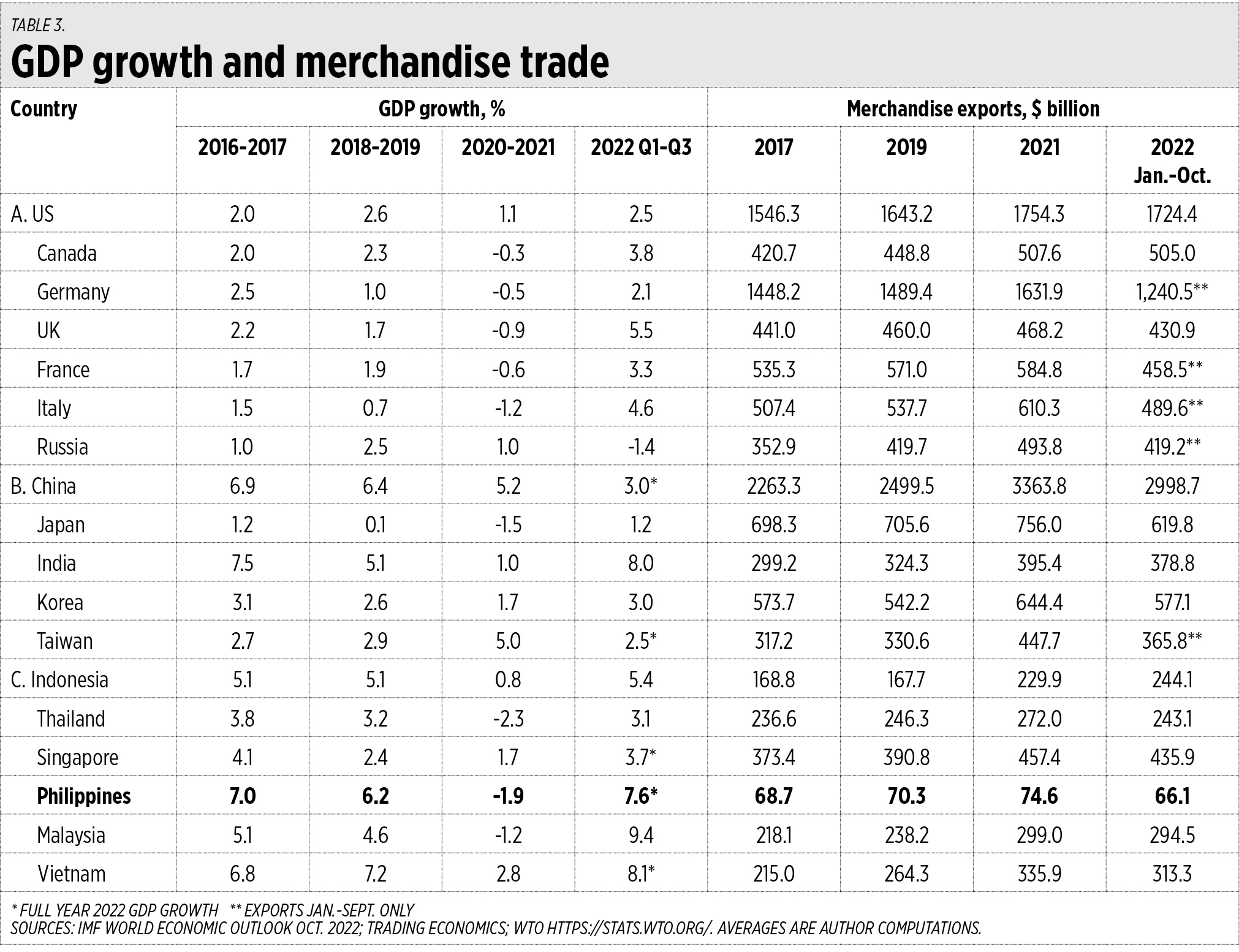
9. The decelerated growth of 3% in China implies some migration of investments to ASEAN. Among the fastest-growing economies in the world in 2022, three were from the ASEAN — the Philippines, Malaysia, and Vietnam. The Philippines economic team — the departments of Finance and Budget and Management, the National Economic and Development Authority, and Bangko Sentral ng Pilipinas — will be busy entertaining more domestic and foreign investments expanding here.

10. Europeans suffer decelerated exports while East Asians kept their momentum. Expensive energy for Germany, the United Kingdom, France, etc. means less competitive merchandise exports for them. The Philippines needs to join the pack of export powerhouses of the ASEAN (see Table 3).

This column projects a 7-7.5% GDP growth in the first quarter of 2023. I will explain the basis for this projection in the coming weeks.
--------------

See also:
BWorld 578, Ten predictions on energy markets in 2023, January 14, 2023
BWorld 579, Ten revenue facts about Top 1,000 corporations, February 02, 2023
BWorld 580, Ten themes in development economics (and the Ruperto Alonzo lectures), February 03, 2023.

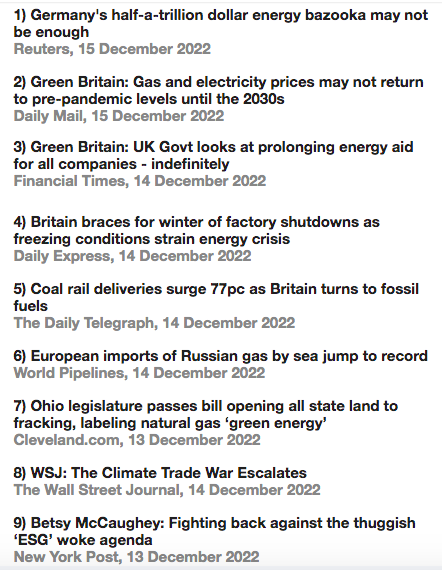
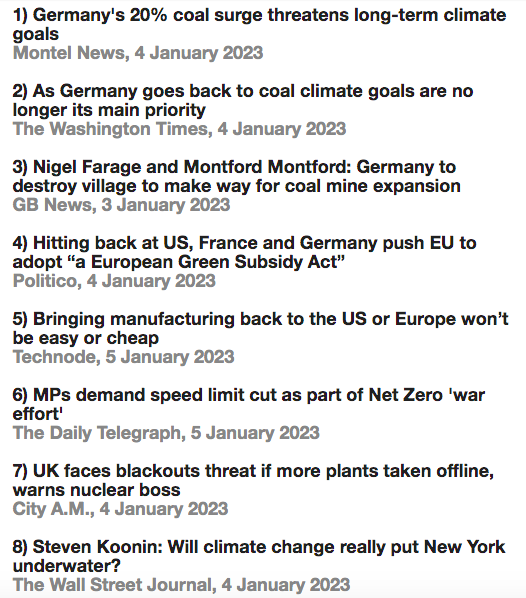
Deindustrialization 10, Net zero, ESG and carbon tax

A number of reports using the term "deindustrialization" in Europe late last year. 

Europe’s descent into deindustrialisation
Philip Pilkington  30 September 2022,
https://www.spectator.co.uk/article/europe-s-descent-into-deindustrialisation/

Europe’s non-ferrous metals producers call for emergency EU action to prevent permanent deindustrialisation from spiralling electricity and gas prices (9 pages)
September 2022
https://eurometaux.eu/media/qnhn5k30/non-ferrous-metals-ceo-letter-on-energy-crisis-06-09-2022.pdf 

Europe risks deindustrialization as soaring energy prices prompt corporate shutdown, exodus
Source: XinhuaEditor: huaxia 2022-10-06
https://english.news.cn/20221006/1abe4e909b8949d0a84f14d7437f37b2/c.html 

Europe facing gas insecurity, 'uncontrolled deindustrialization' through 2025
Tom DiChristopher  13 Oct 2022
https://www.spglobal.com/commodityinsights/en/market-insights/latest-news/natural-gas/101322-europe-facing-gas-insecurity-uncontrolled-deindustrialization-through-2025

The Deadly ‘De-Growth’ Craze
Stagnant societies eventually slide into oppression, chaos, anarchy and ruin.
Andy Kessler Oct. 30, 2022
https://www.wsj.com/articles/growth-world-economic-forum-sustainability-poverty-investment-esg-climate-protectionist-trade-energy-11667077994 

Europe May See Forced De-Industrialization As Result Of Energy Crisis
By Irina Slav - Nov 03, 2022
https://oilprice.com/Energy/Energy-General/Europe-May-See-Forced-De-Industrialization-As-Result-Of-Energy-Crisis.html 

Energy crisis chips away at Europe's industrial might
Clara Denina and Sarah Mcfarlane. November 3, 2022
https://www.reuters.com/business/energy/energy-crisis-chips-away-europes-industrial-might-2022-11-02/ 

EU to backtrack to de-industrialization due to energy crisis
By Al Mayadeen English 4 Nov 2022
https://english.almayadeen.net/news/economics/eu-to-backtrack-to-de-industrialization-due-to-energy-crisis 

Essential Geopolitics: Will Europe's Energy Crisis Accelerate Deindustrialization?
Dec 6, 2022
https://worldview.stratfor.com/article/essential-geopolitics-will-europes-energy-crisis-accelerate-deindustrialization 

Analysis: The hardest part is yet to come for gas-hoarding Europe
By Susanna Twidale, Marwa Rashad and Emily Chow  20 December 2022
https://www.reuters.com/business/energy/hardest-part-is-yet-come-gas-hoarding-europe-2022-12-19/

Worst of Europe’s Energy Crisis May Be Yet To Come
By Irina Slav - Jan 03, 2023
https://oilprice.com/Energy/Natural-Gas/Worst-of-Europes-Energy-Crisis-May-Be-Yet-To-Come.html 

Around 40% of German companies expect output decline in 2023, IW institute says
9 January 2023
https://www.reuters.com/world/europe/around-40-german-companies-expect-output-decline-2023-iw-institute-2023-01-09/ 

Reduced support on energy costs ‘will kill off small firms’
9 January 2023
https://www.thetimes.co.uk/article/reduced-support-on-energy-costs-will-kill-off-small-firms-qt2bqxc5s 

UK becoming less attractive for investment, manufacturers warn
By Andy Bruce 10 January 2023
https://www.reuters.com/world/uk/uk-becoming-less-attractive-investment-manufacturers-warn-2023-01-09/ 

-----------------

See also:
Deindustrialization 7, Other Europe, Sept-Oct News, November 08, 2022
Deindustrialization 8, Germany, Oct-Nov reports, November 30, 2022
Deindustrialization 9, Net Zero and Degrowth, Oct-Nov. reports, December 10, 2022.