Showing posts with label Negros Occidental. Show all posts

Thursday, March 23, 2017

BWorld 114, Brownouts, ancillary services and transmission charge

* This is my article in BusinessWorld last February 23, 2017.


Rotational and scheduled brownouts for several hours about once a month, then unscheduled short brownouts from time to time, have become a regular experience in the two provinces of Negros island. Despite the installation of many huge solar plants in recent years.
    
I am currently in Sagay hospital in Negros Occidental to visit my seriously sick father. Last night, there was brownout for about 10 minutes, the hospital’s generator set immediately takes over to supply electricity to their patients and staff.

The Facebook page of the Central Negros Electric Cooperative (CENECO) gives frequent advisory of power interruption that lasts for nine hours (8 a.m. to 5 p.m.) until this month.

Stories and testimonies of frequent brownouts in many cities and municipalities of Negros Oriental in 2016 are also reported in dumagueteinfo.com.

In June 2016, the Department of Energy (DoE) said that line congestion is building up in Negros Occidental due to many solar power plants operating in the province. The abrupt influx of solar power plants is causing the main line, transmission and interconnection lines to congest (Sun Star Bacolod, June 10, 2016).

This month, Negros Occidental Electric Cooperative (NOCECO) explained that one of the main reasons of higher electricity is the increase in the transmission charge from P1.0538/kWh in January 2017 to P1.1777/kWh in February 2017 or an increase of 0.1239/kWh. The transmission rate hike is due to the increase in the ancillary service charges of the National Grid Corporation of the Philippines (NGCP).

There are at least two issues here. First is the presence of more brownouts in Negros island despite its having the most number of installed solar power plants per sq. km. of land in the whole country, more than 300 MW.

Solar power is very unstable and intermittent, zero output at night and very low output when it is cloudy, or power fluctuates wildly if clouds come and go in minutes. So there should be more ancillary services or standby power plants, usually natural gas or diesel plants, that should quickly provide power when thick clouds come and when evening comes. Still, this causes power fluctuations that damage machines, engines and appliances running on electricity and the leadership of Negros chamber of commerce and industry have pointed this out to the DoE and NGCP last year.

Second, how is the NGCP regulated and accounted in its transmission charge pricing and assets management?

Power generation is deregulated and hence, the extent of competition among many players is the main regulator of the generation charge. Distribution charge is regulated by the Energy Regulatory Commission (ERC) because distribution utilities (DUs) like Meralco and the roughly 119 electric cooperatives (ECs) nationwide are all monopolies in their respective franchise areas.

So while there are 120+ distribution monopolies composed of private DUs and ECs, the NGCP is a single, national monopoly in power transmission.

There are 12 different charges in our monthly electricity bill. The top six in the table below, and these five charges with lesser rates: (7) universal charge, (8) cross subsidy charge, (9) lifeline rate subsidy, (10) senior citizen subsidy, and (11) feed in tariff allowance (FiT-All). No. (12) are value-added tax (VAT) and other government taxes, these are huge too but not included in the table because they are unrelated to the electricity system.

Of these 12 different charges, subsidies and taxes, the smallest is #10 while the fastest growing is #11, FiT-All: P0.04/kWh in 2015, 0.124/kWh in 2016, and set to rise to P0.23-P0.25/kWh this 2017, the ERC still has to decide on the Transco petition for FiT-All hike (see table).
Notice in the table above the following: (1) In 2013 vs. 2017, all five charges have declined in rates in 2017 except transmission charge which has remained practically the same at P0.91/kWh. And (2) In 2014 vs. 2015, a similar pattern where all five charges have declined in rates in 2015 except transmission charge which has even increased to nearly P1/kWh.

The possible explanations why the transmission charge by NGCP seems to be the odd man out among the top six charges are (1) rising cost of more ancillary services as more intermittent solar-wind power are added into the grid, (2) it passes its own system loss to the transmission charge, (3) it simply behaves like a typical monopoly, revenue-maximizing as consumers and other players have zero option of other service supplier/s.

Brownouts and expensive electricity, these are ironic events in our modern world. We should have stable and cheap electricity, no brownouts even for one minute except after heavy storms and typhoons that knock down electrical posts and power lines.

Government should step back in some heavy regulations like forcing intermittent solar-wind into the grid which can discourage some developers who can build stable and cheaper power like coal and natgas plants. And giving high price guaranty for 20 years to renewables like wind-solar is wrong and punishing the consumers. Technology changes very fast, the costs of solar and wind equipment are falling fast, so why lock the high price for 20 years? This is wrong.
--------------

See also:
BWorld 112, Asia Liberty Forum 2017 in Mumbai, March 01, 2017 
BWorld 113, Peace talks with CPP-NDF for another 30 years? March 04, 2017

Saturday, May 28, 2016

Energy 67, Helios solar power in Cadiz City, Negros Occ.

I am from Cadiz City, Negros Occidental. Our house is not at the city proper but in a barrio along the national road, same barangay, about 3 kms. from the famous, biggest solar power plant in the Philippines and SE Asia. Am here to visit my sick father in the  hospital. The other day, I went around and visited the facility, just outside.


The National Grid Corp. of the Philippines (NGCP) put up a sub-station there, so that power generated from the plant is directly fed into the grid. Solar, wind, biomass, run of river hydro are priority dispatch in the grid, based on the RE law of 2008 (RA 9513).


The area used to be a sugar cane farm. The plant's rated or installed capacity is 132 MW, quite big, occupying some 176 hectares, cost P10 billion. Perhaps the area is larger, if the buffer zone between the two fences is included. The usual ratio for solar is 2 hectares of land per 1 MW of installed capacity.


This is the view from St. Peter's The Garden memorial garden. My mother was buried here last year. Notice something -- no trees around the solar farm. Not one. At the background are several mountains, Mt. Silay, etc.


A view from outside the gate. The guard allows taking photos outside the perimeter fence. Again, not a single tree is allowed. Solar power's main "enemy" is shade -- from clouds and tall trees -- they immediately bring down solar output.


The view from a road going to/coming from Hda. Paz proper. Two fences, outside fence is ordinary wire, fence inside is electrified + there are roving guards.


Another view from a road going to Hda. Paz. Some locals there say that if it's a cloudless day, the heat reflected back by the solar panels can be felt by them. Others say they don't feel such extra heat.


Helios power was inaugurated last March 03, 2016. It was big news in Negros and in some national newspapers.


The personalities who graced the opening included Cadiz City Mayor Patrick Escalante, Negros Occ. Governor Alfredo Maranon, the  owners of the plant, French Ambassador in Manila, incoming Sen. Zubiri.

Again, I am not against solar, wind, biomass, etc. What I am against are the various subsidies, fiscal favoritism that are given to them but not to coal, natural gas, geothermal, big hydro.

Meanwhile, other environmentalists should notice the contradiction between their "plant trees to save the planet" campaign vs solar plant's "no tree/s allowed to save the planet."

-------------
See also:
BWorld 55, FIT-All, renewables and elections 2016, April 23, 2016
Energy 65, World Bank's anti-coal drama, May 08, 2016 
Energy 66, What companies receive FIT and by how much?, May 21, 2016


Sunday, May 31, 2015

Energy Econ 36, The Visayas grid and coal power plant in Negros

There was a report in interaksyon.com last April 6, 2015 on  P15.5-billion coal-fired power plant in northern Negros proposed. For me, it is good news for the two Negros provinces and the Visayas grid.  When that 150 MW coal plant starts operating a few years from now, it should help expand electricity supply for Negros Occidental and Negros Oriental provinces which currently are dependent on an old geothermal plant in southern Negros and coal plants from Cebu.

In the May 2010 population census nationwide, Negros Occidental including Bacolod City has 2.9 million  people while Negros Oriental including Dumaguete City has 1.3 million, or a total of 4.2 million people for Negros island. The average annual  population growth rate of the two provinces from 2000-2010   are 2.1 percent for western or Occidental Negros and around 1.3 percent for  eastern Negros.

Assuming a similar population growth rate for 2010-2015, this means that this May 2015, the Occidental and Oriental provinces will have a projected population of 3.34 and 1.39 million respectively, or a total of 4.73 million, a big number of people.

Currently, the people in the two provinces experience occasional power fluctuations with isolated "Earth Hours". Bacolod alone is expanding fast with lots of big malls, commercial centers and big subdivisions. The Silay-Bacolod airport may soon become an international airport. Its electricity need will be huge with those many big bright lights to guide airplanes landing and taking off at nights, serve the passenger terminal which must expand too.

There are three renewable plants in Negros island. First, the Palinpinon geothermal plant in Valencia, Negros Oriental. It was commissioned in 1984 or 31 years ago, has an installed capacity of 192 MW. Old plants tend to suffer from frequent breakdown and low capacity factor. Energy Development Corp. (EDC) which bought Palinpinon from Napocor also commissioned a new, 49 MW geothermal plant in September 2014.

Second, there is a new solar power plant in San Carlos City, Negros Occidental, 22 MW and was commissioned only in May 2014. But solar plants have low average capacity factor (actual power generation over installed capacity), only around 20 percent. At night, output is zero and on cloudy days, output is small. Thus, on average, that solar plant can produce electricity by 4-5 MW only.

Third, there is a bioethanol power plant also in San Carlos City. But it is opposed by so many people because of the foul smell, reaching several kilometers away. The plant is using sugarcane bagasse. Even many priests who are pro-renewables oppose it.

In short, the two provinces are deficient in power. They need some for big, base-load (can run 24/7 non-stop) power plants. They currently buy power from coal plants in Cebu so that they will not have daily brown outs.

Figure 1. Visayas grid power supply by fuel source and by island, March 2014.


There is huge supply of geothermal power in the Visayas. In particular, 723 MW in Leyte and 192 MW in  Negros (Palinpinon), total of 915 MW. Some of the geothermal output of Leyte are sold to energy consumers in Bicol and southern Luzon.

Biomass including bioethanol have installed capacity of 44 MW while hydro provide another 11 MW.

Cebu, the industrial and commercial hub of the Visayas regions, is powered largely by coal and diesel power plants. Without these “non-renewable” energy sources, it is not possible for this central Visayas island and commercial center to sustain its business dynamism.

Figure 2. Visayas grid coal and oil-based power plants as of 2013.


Source: DOE

While many people in Cadiz City, Negros Occidental, the future site of this 150 MW and first coal power plant in the island, are happy with this new development, some sectors are not happy with this news. Their main concern is danger to public health because of coal soot pollution plus threats of “man-made” climate change.

Public health is a valid concern but very often, the fear of fictional monster of coal pollution is much larger than any real pollution. The anti-coal activists and campaigners, often influenced or hoodwinked by Greenpeace activists, are saying that communities that are close to the coal power plant are in danger of massive sickness if not deaths.

If there fear and worries are correct, then there should have been tens of thousands of massive sickness in the municipalities of Naga and Toledo in Cebu, the host of the four coal  power plants with a combined installed capacity of 642 MW or more than 4x the projected coal power plant in Cadiz City.

In addition, there should have been hundreds of thousands more of sick and  dying people in Luzon who live close to coal power plants. Like western Pangasinan with 1,294 MW;  eastern Quezon (Pagbilao and Mauban) with 1,275 MW; northern Bataan with 652 MW; northern Zambales with 630 MW; eastern Batangas with 600 MW, etc. These five provinces plus Pampanga and Bulacan that host smaller coal  plants have a combined installed capacity of 4,531 MW of coal power, or more than 30x the proposed coal plant in northern Negros.

Figure 3. Coal power plants in Luzon, 2013.


Source is DOE.

What can cause more harm and danger to people’s lives are the following: (1) frequent fires due to frequent use of candles or “gasera” when electricity is often absent; (2) frequent road accidents and crimes when streets are dark at night because electricity supply is unstable and the price is high; (3) various respiratory diseases because air-con or electric fans are often out due to  insufficient electricity supply, and (4) poverty and joblessness because manufacturing, industrial and commercial centers are few, because there is unstable and  expensive electricity.

As the Visayas provinces and the Philippine economy in general grow faster, the need for more stable and cheaper energy sources also rise. Coal and natural gas can provide such energy need. The renewables like solar and  wind can help but they are intermittent and unstable power sources. When the wind does not blow, when it is night time, their energy output is zero. They are also expensive, they require mandatory feed-in-tariff (FIT) and other subsidies, which means higher electricity bill for the consumers, to make them appear “viable” and "affordable".

People should recognize the value of cheap and stable electricity supply. Emotionalism and exaggerated fear of coal pollution can cause unnecessary opposition to cheap and stable electricity.
-------------

See also:

Tuesday, April 14, 2015

Energy 35: Coal Power Plant in Cadiz City, Negros Occidental

The first coal power plant in Negros island (composed of two provinces, Negros Occidental and Oriental),150 MW and costing P15.5 B, has been proposed and construction is projected to start in the 4th quarter of this year. See the interaksyon story last April 06, 2015.

I posted that report in our community fb page (6,100+ members) that same day.

I anticipated negative reactions but not immediate harsh comments. Within minutes, the harsh responses came.  Little on the  issue but pure personal  attacks.


I asked that people should produce numbers, not emotions, in tackling the issue. I showed this table for instance, that it was precisely the coal power plants in the nearby island-province of Cebu that provide additional power and electricity to Cadiz and the rest of the two Negros provinces because the Negros' only big power plant, Palinpinon geothermal (installed capacity 192 MW, dependable capacity is lower as it is an old, 32 years old power plant).


I showed other tables to keep the discussion be focused on  the issue, and yet the personal attacks continued.


Later the moderators removed and deleted the thread. Maybe they saw the ugliness of those ugly comments and instead of reminding those people, or deleting their comments, they opted to delete the whole thread.  It's good that I kept the screen shots of those low life comments.

The other day, another member of the fb group and also a friend many years back, Joe Real, posted this article with his note,
"Imagine if the coal plant begins its operations in Cadiz City. There would be a sudden jump of respiratory diseases and damaged lungs especially of children and people are left on their own to carry the heavy burden of collateral damages."

Two members mentioned me and said that I should read that article. I reminded them that I  already started a discussion on  the issue but the moderators deleted the entire thread; that I am ready for a real debate on the issue, no personal attacks. The two members who mentioned me never replied.

Another member posted images/meme of "Toxic coal pollution", "water contamination", "No clean coal", etc. I reminded him that if people in Cadiz and the rest of Negros have electricity now, they can do fb and enjoy youtube, they should be thankful of coal power plants from Cebu. Then I asked the following questions:

(1) Naga and Toledo, Cebu, host 642 MW of coal power plants (see table above) for many years now. Are these health concerns exhibited or visible in Naga and Toledo, but not exhibited in other municipalities of Cebu away from the coal plants? Or not exhibited in Negros which has zero coal power plant at the moment?

(2) Many provinces in Luzon have coal power plants that are 4x, 8x larger than the proposed coal plant in Cadiz. Are these fear of "toxic coal pollution" and "water contamination" exhibited in the provinces of Pangasinan, Bataan, Zambales, Quezon, Batangas?


(3) Lapaz, Iloilo City, currently has 164 MW coal plant operating for several years now, Are these concerns of "coal toxic pollution" and water contamination exhibited in Iloilo City? 

They are building a 2nd coal plant in Iloilo City now, 150 MW, to be operational by June 2016. Iloilo city alone will have 316 MW of coal next year then. Electric cooperatives from Iloilo, Guimaras and Antique provinces have rushed securing a power supply contract already, rather cheap at only P5/kWh. See story

(4) From this Bloomberg report, April 9, 2015:
"Japan has 43 coal power projects either under construction or planned, representing combined capacity of 21,200 megawatts," 

Are those concerns of "coal toxic pollution" and water contamination not exhibited in Japan that they are building 43 more coal plants? 

No direct answer from the anti-coal camp. Meanwhile, another report from Foreign Policy, April 08, 2015.

"coal will be the only baseload option left to power about 30 percent or more of the Japanese electricity sector, a significant uptick compared with the pre-Fukushima period...

Coal accounted for about one-quarter of Japan’s electricity before the nuclear accident. Since then, Japan has increased the share of coal to about 30 percent..." 

I recognize that there is threat to pubic health, direct or indirect, short- or long-term, from ALL sources of energy, whether they are from fossil fuels like coal or renewables. Like this threat of wind towers.


For some people, they would rather embrace more brownouts, or have more candles (which invite frequent fires and huge threat to lives and properties) or more generators (which also run on fossil fuel, cause noise and air pollution and are expensive) than accept coal power. I asked question #4 above because Japan is the most strict in public health protection in Asia and possibly in the whole planet, yet they are building more coal plants.

People should be careful not to be hoodwinked by the campaigns and blackmails of the climate alarmism camp who silently campaign for global ecological socialism. To fight poverty and create more businesses and  jobs, having cheap and stable energy sources like hydro, coal and natural gas is a must, a necessity.
------------

See also:
Energy Econ 8: More Intolerance by the Anti-Coal Camp, September 27, 2012 

Sunday, December 08, 2013

Negros Occidental, Part 3

Bacolod City -- Arrived here yesterday in the provincial to attend the wedding of my beautiful niece, Nessa Oplas-Sy. This morning, I went to my hometown, Cadiz City to see again my parents, took some photos.


Out of the 84(?) provinces of the Philippines, I think Negros Occidental has the most optimal land use. One will hardly see even half-hectare of idle land. Cities, housing villages, coconut, banana, tree farms and sugarcane farms. Lots of it, Hundreds of thousands of hectares of sugarcane farms.


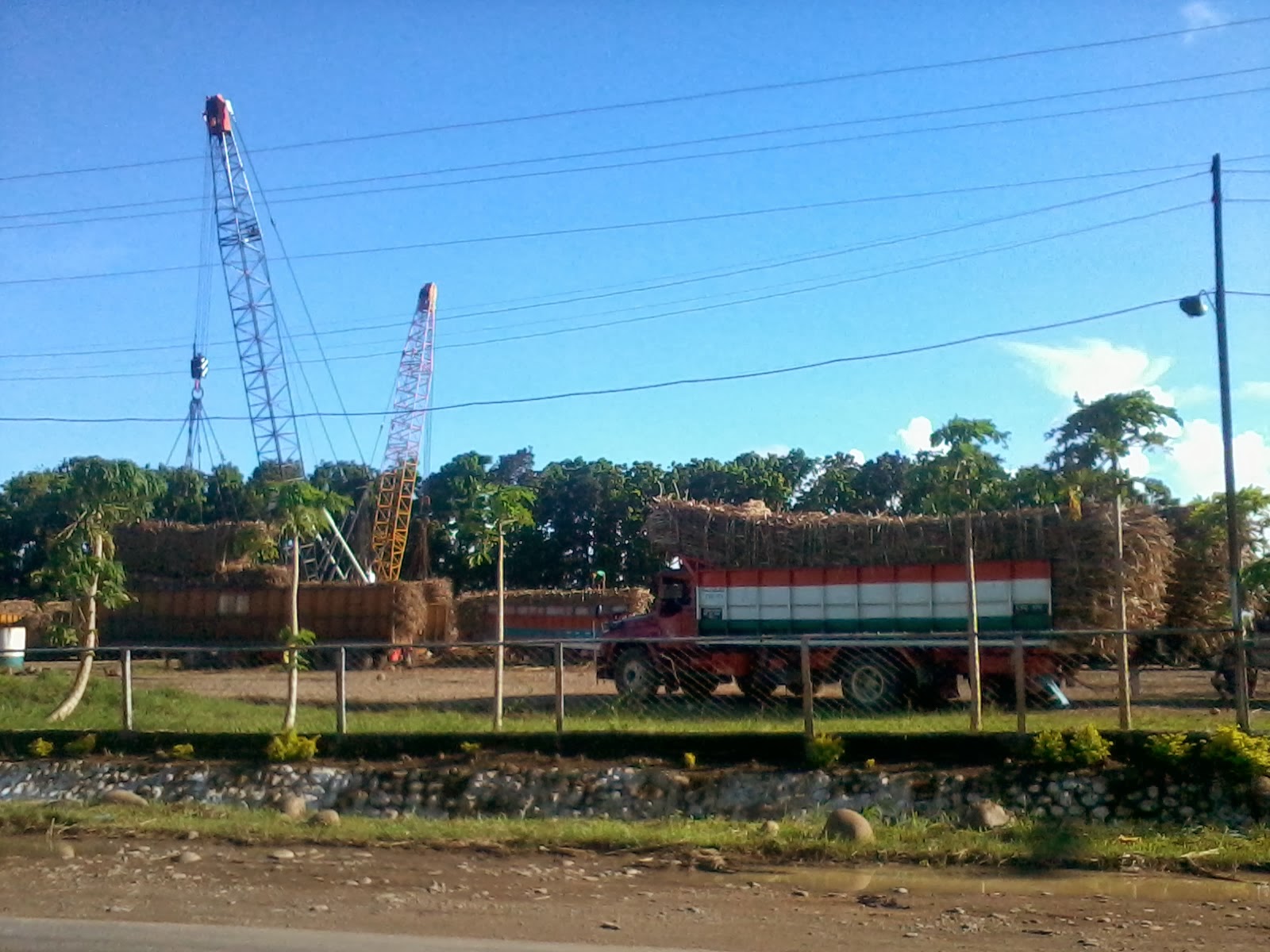
A transloading station of sugarcane trucks in Manapla, about 45 kms. north of Bacolod. The canes are unloaded from 6- or 10-wheeler trucks, weighed, then transferred to 18-wheeler trucks, to be brought to sugar centrals for refinery..


The province is the "sugarcane capital" of the Philippines. Its neighbor, Negros Oriental, has lots of sugarcane farms too, but not as extensive as those in the Occidental/east side.


Another transloading station near Caduhaan, Cadiz City.


There are lots of criticism about the sugarcane-dependent economy of the province. Some are valid, some are not. While it is true that huge tracts of land are owned by a few families, there are plenty of small land owners too, those who own from one to five or seven hectares.

With a huge population, more than two million people as of the 2010 census, more and more sugarcane farms are converted into wide residential and commercial areas.
----------

See also:
Provincial notes 1: Negros Occidental, April 25, 2011 
Provincial Notes 2: Sugarcane Economy of Negros Island, March 23, 2012

Monday, September 17, 2012

Energy Econ 6: Intolerance in Anti-Coal Hysteria, Cadiz Coal Project

Have you argued with fanatics, people who will use harsh words and tactics and will never change their position even if confronted with facts that do not conform with their ideals?

Below is another example of arguing with fanatics. Some, if not many of their words and arguments are generally tinged with high anger and intolerance. You do not agree with their arguments, they throw undesirable adjectives and words against you.

Last Wednesday, September 12, I posted below in the Cadizmycitymyhome facebook group. This is about the coal terminal and coal power plant project that is said to have been approved by the Cadiz City government already, in the province of Negros Occidental. I came from that city, I was born there, took my elementary and high school education there.

Observe the kind of language that the "No to coal no matter what" argument and proponents use. Again, this is a long exchange, from September 12 to 14. Then an update today, further below. This is 23+ pages long, get your snacks and enjoy the fireworks :-)
------------

Nonoy Oplas
I understand the majority sentiment against coal, fine. For me, I am pro-nuke, pro-geothermal, pro-coal, pro-natural gas, pro-shale gas. I am also pro-solar/wind, so long as no taxpayers' subsidies will be given to these renewables that will make our electricity rates become even more expensive.

But it is another thing to demand a "shut down all coal power plants in the country". As of 2010, 34.4 percent of the whole country was dependent on coal power and dependence from wind, solar and biomass combined was only 0.1 percent,
http://www.interaksyon.com/business/37648/fat-free-economics-coal-climate-and-government. Thank you.
FAT-FREE ECONOMICS: Coal, climate and government - InterAksyon.com

Tiny Bee Are you also pro-life, pro-health and pro-environment? With due respect......

No doubt, COAL is CHEAP and so is life maybe :)

Nonoy Oplas I am pro-life, pro-health, pro-environment, pro-trees, pro-dolphins and other bleeding heart concerns. But the main issue is transparency of the city govt or not. If they were not transparent, the project proponent did not follow the EIA and other requirements, then that coal project should not proceed, it should be stopped. If they follow the requirements, the project should proceed.

The same process should apply, that all power project proposals -- geothermal, nuke, natural gas, hydro, oil-based, wind/solar -- should comply with the EIA requirements.

Nonoy Oplas Please note that I will blog and publicize all succeeding comments in this thread. Both civil comments and personal attacks I will publish, no exception, no alteration. If we want transparency from the government, national and local, we should also practice transparency in our ideas, do not be afraid to stand for your ideas. My previous blog post about the debate in this group about the subject is here, about 15 pages long, http://funwithgovernment.blogspot.com/2012/09/energy-econ-5-coal-power-in-cadiz.html
Government and Taxes: Energy Econ 5: Coal Power in Cadiz, Negros Occidental

Tiny Bee Transparent indi pareho sang plastic! :)

Jeanette Bendijo Gamboa I just opened the link you have posted Nonoy Oplas, I think it is a good move nga gin collate mo tanan nga comments. even though we have different thoughts on this, at least you are presenting both side here.

Manong Nonoy Oplas and Toto batchmate Mai Escalante, are your engineers? I am, Tiny Bee, Jonas Delina, Sir Lar Collins Benitez and a lot of Cadiznons are. But it does not take to be an engineer to figure out your arguments. Absolutely, brownout gid ang gwa sang mga lugar sa Pilipinas kag sa Amerika kung i-shut down ang mga coal power plants, kay dira na nakawire ang mga power supplies nga gahatag energy sa pumuluyo mo! Subong nga kadamo damo na sang CFPP sa bilog nga kalibutan, nakita ta na ang effect sa environment kag sa health sang mga tawo. Pero indi dayon mashutdown kay dira mo na ginpasalig ang imo power! Amo gani ang isyu ta di indi PAG ITUKOD ANG COAL POWER PLANT SA CADIZ, para indi ta mag intra sa campaign nga IPA SHUT DOWN . Kay wala pa natukod TAPNA ON na! We are struggling for power shortage, that could be partly true, but surely we are not dying if have shortage. We will be dying if we got the plant on site.

Jeanette Bendijo Gamboa It is our government's responsibility to find ways for alternative energy, but absolutely not Coal. Isakto c Tiny Bee, when you bring Coal to Cadiz, it means you are not doing your work! Kay wala ka gali nangita lain nga energy sources? Kung wala investor, kundi ma stick ka sa fossil fuel kag mangita pa gid sang lain nga alternatives asta makakita ka investors!

amo lang ni ang analogy sina hu, kay ang imo ginhatag idea Mai Escalante kay tungod amo lang na ang investor nga makahatag sa aton alternative energy sa subong batunon ta na lang bisan lain sa lawas kag sa palibot basta mag tin ad kuno ang aton siudad,. Teh, pareho lang na sa gira, kung hatagan ka "PAN OS NGA TAE", kaunon mo na lang bisan pa kabalo ka nga mahilo ka, kay amo lang na ang available, kag shortage na sang pagkaon. indi ka na lang manguykoy sa duta basi may kamote ka nga makita, o basi pede ka pa manakot apan basi mas makaon pa kaysa sa "PAN OS NGA TAE" ! Ang mas malala pa, maayo lang kung ang nagpili sang "PAN OS NGA TAE" ANG MAKAON, INDI MAN. ANG MGA MGA TAWO SA PALIBOT YA nga wala na inform nga may choice gali sila!!!!! O basi ang nagpili sang "PAN OS NGA TAE " Para sa pumuluyo may ara FIVE STAR QUALITY NGA GINAKAON????? ABI BINAG BINAGA!!!!!!!!

Manong Nonoy Oplas, i have posted my comments, here, please please include it on your blog, para may ara gid thread nga dali lang makit an kag ma track.

Nonoy Oplas Yes, thanks. I can write my own ideas on any post as I own the blog, but I want my readers to see the other side, that is why I copy-paste exchanges there.

If people will say that "it is government responsibility to find ways for alternative energy", then if your government is lazy or corrupt, you're read, you will have no new power sources, back to frequent brownouts. Finding energy is everyone's concern. Some guys put up solar power in their roof and they become independent of the national or provincial grid, it's cool. So for those who oppose coal or oil-based power plants, it is their responsibility to bring in those they like, which is the renewables. No problem with me or other guys as I think their primary concern is to have new power sources as the number of people, houses, schools, shops, buildings, etc. is rising, not declining or flat-lining.

In reality, to wish for the renewables to provide sufficient power sources for the country, or for Negros and Cadiz in particular, is wishful thinking. These power sources have been there since the 90s, or the past decade, but the most that they can provide is 0.1 percent, or 1/10 or 1 percent, of the total power needs of the country.

Thursday, September 06, 2012

Energy Econ 5: Coal Power in Cadiz, Negros Occidental

Of all energy sources, coal power plants are the most demonized by the Greenies or environmentalist groups. See my previous discussion here,  Climate Tricks 11: Coal and James Hansen, RE Law and the WWF. And since many of those greenies are good at emotional campaigns, the public tend to get their bias.


1st row: Sual power, Pangasinan;
2nd row: Kepco power, Cebu; Pagbilao power, Quezon;
3rd row:  Masinloc power, Zambales; Mindanao power;
4th row: sketch of a power plant; old models often pictured as the "typical face" of a coal power plant.

There is an approved coal terminal, leading to the construction of a coal power plant in Cadiz City, Negros Occidental. This is my hometown, I was born there, finished my elementary and high school education there. My parents and two siblings are still there, along with many other relatives.

I belong to a facebook group called "Cadizmycitymyhome" and this power terminal is now a hot topic. Majority of those who registered their opinion on the subject are anti-coal in the first place, and there was little discussion on how the city government went through the process.

Below are the recent exchanges since yesterday, I copy-paste them here, zero alteration. Some discussions are in Ilongo. This is long, including the updates below, about 15 pages, so get your favorite snacks :-)
---------

TessBench 
Yes to Coal or No to Coal?

Matranillo  isip isip ,,,lalo na ang mga estudyanti,,yung malapit sa dagat...

Reginaldo  daw amo mana ginmitlang sg isa ka konsehal ho ang my sungay...

TessBench  Pili lang kamo green or black the choice is yours the consequence is ours!

Lar  Ayaw ko sa ma sungay :(

Nonoy  ba't ka pa mag isip, sa drawing pa lang, anghel na ang renewables, evil na dayon ang coal. More creativiity please.
I also posted this in another thread, our most expensive power rates in the whole of Asia will become even more expensive, thanks to the those "green power",
http://funwithgovernment.blogspot.com/2012/07/energy-econ-2-renewable-energy-and-high.html
Government and Taxes: Energy Econ 2: Renewable Energy and High Electricity Prices

TessBench  noy bisan butang nimo warning people still would choice the evil one take for example the cigarettes people still smoke .

Nonoy tobacco is a different thing, it is a self-imposed vice, and people own their bodies, not us, not the government, so let them do what they want so long as they don't engage in physical aggression.

Basically ang choices naton, (a) green power but unstable and more brown outs, and still expensive, (b) coal, stable power and cheaper. Ambot lang kon pirmi ang brown out sa Negros subong, or some big companies that can hire many people want to come in but are scared of the low power supply in cadiz or elsewhere.

TessBench Medado Palma kon sa bagay Noy i see ur point smoking is a personal choice but this case naton sa Cadiz sa coal, people are sometimes not given a choice but accept the government project whether they like it or not .

Nonoy Gani ang question lang da is the process. Did the city government make shortcuts or not? Did the coal power proponent follow the EIA and other requirements or not? If yes, then the city government and power proponent shd be made answerable. If No, then the project should proceed.

For those advocating green power, they should also invite those companies to put up solar, wind, biomass, etc. But since these power sources are highly unstable (the wind does not blow all the time, the sun does not show up all day and it's "hiding" at night), one would still need back up power and guess where you can get those back up power? from coal, or nat gas, where else.

Emay Mam Tess and sir Nonoy oplas i do agree with u too...but i guess the govt of cadiz want us too ponder on this things, papunta po tayo sa kaunlaran ng Lunsod ng Cadiz.Sana lng pakaisiping mabuti kung tama ba ito para sa mga taong bayan...

Nonoy If you want growth and development, you must have power or electricity, at the cheapest price and stable supply as much as possible. Supposed a big company would like to put up a huge theme park in Cadiz or nearby, that will create hundreds if not thousands of new jobs there. But if electricity supply is low and the price is high, that company will not come in. Plus the daily needs of each household, law-ay man kon gatuon mga bata, tapos mag brown out, ti balik kandila kag kingki mga tawo, not good, right?

Friday, March 23, 2012

Provincial Notes 2: Sugarcane Economy of Negros Island

I was born, grew up, studied up to high school, in Cadiz City, Negros Occidental. My parents and two siblings are still living there. Cadiz is on the northern most part of Negros Island, which is composed of two provinces, Negros Occidental, predominantly Ilongo speaking and the capital is Bacolod City, and Negros Oriental, Cebuano speaking and the capital is Dumaguete City.

My province is known for huge sugarcane plantations. As far as the eyes can see, one can see sugar plantation from the seaside to the foot -- sometimes up to 1/3 -- of mountains. Our house, like most houses in the province, is just beside a sugarcane farm. When we were young, if we needed to munch sugarcane, we just enter any part of a farm and get any type, any size, of a sugarcane. Or we would hunt spiders there. Life was cool.

Below is the new Silay-Bacolod airport. Silay is actually two cities away from Bacolod and the airport is built on a previously sugarcane farm. So when you land at, or take off from the airport, one will see wide sugarcane plots around it. Mt. Silay can also be seen from the airport terminal.


More photos of sugarcane farms below. At harvest time, when the soil is soft and muddy and the trucks cannot go in the middle of the farm, carabaos (water buffalo) would haul the sugarcane to a nearby road where the trucks are waiting.


Trucks that carry the sugarcane to a sugar milling company are usually large. While the most common trucks are still six-wheelers, many trucks now have 10 or 18 wheels. So one can imagine the heavy burden on public roads.


When the farms are prepared for another cycle of planting. Tractors are used to till the soil. Soil erosion is heavy in sugarcane farms because the soil is tilled yearly, and those tractors plow about 1 foot high of soil.


I'm not in the mood to inject numbers and statistics about the sugarcane economy, I just showed photos here. It's deja vu for me whenever I come home to visit my old and sickly parents. I like to sit in front of a car or a bus whenever I travel from Bacolod to Cadiz and back. The sight of those wide sugar plantations, something I cannot see anywhere in the Philippines, or in many other Asian cities or American cities that I have visited so far.

* See also Provincial notes 1: Negros Occidental, April 25, 2011

Monday, April 25, 2011

Provincial notes 1: Negros Occidental

(Note: I wrote this in my now inactive travel blog, http:travelpinoy.blogspot.com, last August 8, 2006. The photos I just added today)

Negros Occidental is the Philippines' 3rd or 4th most populous province outside of Metro Manila. And while many of the 80 provinces in the country do not have a single city yet, Negros Occ. has 13 cities.

The province is generally flat, but 2 huge mountains can be seen from a distance, especially from a plane preparing to land in Bacolod airport -- Mt. Silay on the left and Mt. Kanlaon on the right. Mt. Silay is an old volcanic formation that has remained inactive. It has a number of summits, which are bounded by many cities in the northern part of the province – the cities of Silay, Victorias, Manapla, Cadiz and Sagay. Mt. Kanlaon on the other hand, is an active volcano and communities and villages on its foot are occasionally threatened with forced evacuations whenever the volcano is rumbling. The mountain’s summit is bounded by a number of cities and municipalities of the 2 neighboring provinces of Negros Occidental and Negros Oriental.

(Photocredits: Mt. Silay, http://www.oocities.org/siba_ph/Silay2.html; Mt. Kanlaon, http://www.travelphilippinesnow.com/tag/mount-kanlaon)

Sugarcane plantations make the 2 provinces look green from above, especially from a plane. To unfamiliar eyes, those sugarcane plantations look like the wide rice plantations in Central Luzon and Cagayan Valley regions in mainland Luzon.

Until about 3 years ago, you will seldom see idle lands. Something like if you travel 70 kms. north of Bacolod, passing by the cities of Talisay, Silay, EB Magallona, Victorias, Manapla, Cadiz, and Sagay, the chances that you will see idle lands of at least half an hectare area for every 5 kms. was about 3%. That is, for every 5,000 meters say on the right side of the road, there are about 150 meters combined length of idle lands. Now, you'll see idle lands of about 5-7% for every 5kms. This might seem a near-doubling of idle lands, but compared to other provinces, in fact to all 79 other provinces, Negros Occidental still has the most optimal land use (or the least hectarage of idle lands).

Idle lands develop through a series of land conversion: originally from forest land to sugarcane land, to vegetable farms and fruit orchard, to temporarily idle lands, later to residential or commercial lands. With the on-going construction of an international airport in Silay City (about 16 kms. north of the current airport in Bacolod), plus the emergence of high-end real estate projects developed by Ayala Land in Talisay and Silay, speculation for more real estate projects in surrounding areas is higher.

Roads from Bacolod northwards are generally in bad shape. The main culprit are the hundreds of heavy trucks that carry sugarcane to various sugar milling companies. Among the biggest are Victorias Milling Co. (VMC) in Victorias City, and Philippine-Hawaiian Sugar Milling Co. in Silay City. A six-wheeler truck could be carrying around 12 metric tons (MT) of sugarcane + truck body weight of at least 2-3 tons. Ten-wheeler trucks could be carrying around 20+ MT sugarcane + their body weight, while haulers, those 18-wheeler long trucks could carry some 30 MT+ of sugarcane + their body weight.
-------

Addendum: April 25, 2011

I thought of re-posting this as a follow up to my earlier article, Back to our roots.

In relation to agrarian reform program in this country, or the forced land redistribution with no timetable, the sugar plantations in Negros and a few other provinces are perhaps the clear example that medium- to large-scale farming are often more preferable to micro- or small-scale farming of one hectare or less. Land cultivation and preparation for the next cropping are done by big tractors and machines, not carabaos (water buffalo) or hand tractors, increasing the pace of planting while reducing the cost of production.

I say "land redistribution with no timetable" because while forced land reform in Taiwan, Japan and S. Korea were successfully implemented in just 1 to 3 years many decades ago, agrarian or land reform in the Philippines is now almost 40 years, counting only from former President Marcos' PD 27 or land reform law in 1972, and no definite timetable yet of when it will finally be stopped and closed.

Going back to our roots

I was born and grew up until high school in a barrio (village) in Cadiz City, Negros Occidental province, in Western Visayas region. Negros island is divided into two provinces; Neg. Occidental or western side is mainly Ilongo or HiIligaynon-speaking, Negros Oriental or eastern side is entirely Cebuano-speaking. The capital cities of Occidental is Bacolod, of Oriental is Dumaguete.

The major economic activities in the two provinces are fishing and sugarcane farming. In Negros, you can look far away and as far as your eyes can see, up to the foot or midlands of big mountains, there are vast sugarcane farms and plantations.

There are many big sugar milling companies (or “sugar central”) in the two provinces. The most famous of which is Victorias Milling Co., midway between Bacolod and Cadiz City.

The nearest sugar central to our place is Lopez Sugar Corporation. The Lopezes here would be related to the Lopezes of the ABS-CBN TV network.

Huge trucks carrying heavy loads of sugarcane, from at least 10 tons to possibly 60 tons excluding truck body weight, are normal scenes in our roads. And they travel round the clock, morning till evening, either with cargo or empty.

The road system is heavily stressed with those heavy vehicles. Although most roads are strong enough to withstand them, some roads are heavily victimized by government corruption, substandard materials were used, so that after several months of road repair, huge cracks and potholes would re-appear.

Cadiz is the northernmost city of Negros island. A major livelihood for many city residents is fishing. Huge fishing boats and trawlers are parked in the city’s port and private docking.

Lower picture, very long fishnets are being repaired by workers on both sides of the road.

I like my birthplace, my family especially. They are my roots. But since moving out of my province after high school and studied at the University of the Philippines (UP) in the 80s, I have been going home less often.

Upper photo is my parents’ current house. Lower photo is the flower garden that my elder sister maintains. It is relaxing to see the house where I was born more than four decades ago. Well, this is actually a “new” house on the same location as the old one has been slowly replaced, from the living room to bedrooms to the kitchen. We are lucky that my other elder sister is rich enough to finance all the home improvement.

My mother is now 77 years old, my father is 83. Both are already weak and sickly. Sometimes the hospital would be their “second” home. This picture was taken last year. I brought my only child then, Elle Marie, who was 3+ years old.

Elle was holding a sugar cane, on a cargo truck. When we were young, we had few neighbors, a sugarcane farm is just a few meters away from our house. We would go in and out of the sugarcane field to play hide and seek, to find spiders, or simply to unload poo-poo. Now we have several new neighbors, but the sugarcane fields are still not far.

I went home a few days ago, last week, brought my wife and two daughters. Here, my mother and her 6+ months old granddaughter, Bien Mary. They are almost four generations apart.

Going back to my roots, my parents, siblings, relatives. Then leave them behind as the short visit is ending. We were preparing to leave in this picture, go to Iloilo to visit my in-laws. Elle Marie (held by my wife) is now 4+ years old.

I told my Papa and Mama that we will be coming home again this December. Seeing my parents getting older and weaker makes me sad. But life is a cycle.

Parents should think forward, “When my kids grow up and mature someday, will they be proud of us or consider us as their roots?” And kids should also think forward, “Have I been thankful and proud of my parents, my roots? Would I wish my own kids someday to treat me the way I treat my parents now?”

Building a just and peaceful society is all about personal and parental responsibility. It has little to do, sometimes nothing to do, with government responsibility. It’s about building solid roots that will bear solid and morally upright kids and branches someday.

I am proud and thankful of my roots. I will work hard so that my kids will be proud of their roots someday too.