Saturday, January 23, 2016

Free Trade 60, PH Constitution vs. services liberalization, Malaysia in TPP

A friend asked me what is in the Philippine Constitution that can prevent the country from joining free trade agreements (FTAs) like the Trans Pacific Partnership (TPP). I said that it's the constitutional prohibition or restriction of foreign equity investments in certain sectors (ie, zero FDIs allowed); in other sectors, foreign equity investments are limited to 40% max. Or the 60-40%, Filipino-foreign equity restrictions.

Industries with no or zero foreign equity allowed include the following:
1. Mass Media except recording
2. Practice of professions: Engineering, Law, Medicine and allied professions, accountancy, architecture, criminology, chemistry,...
3. Retail trade with paid up capital of less than $2.5M, cooperatives, etc. other industries.. ., utilities (water, electricity distribution,...) others.

So it is not prohibition on joining the TPP itself, but the TPP provides for goods and services liberalization among member countries. So Filipino multinationals like Jollibee, SM, San Miguel, etc. can easily enter the other TPP member countries but those countries' companies cannot easily enter here. 

The implication is that we must amend our constitution to remove the restrictions on foreign investments, the restrictions in the practice of profession. Filipino doctors can practice in the US, Canada, UK, etc., but foreign doctors cannot practice here. Filipino consumers and the public in general are deprived of more choices, more freedom, because of trade protectionism imposed by governments.

Meanwhile, I am reposting this well-written piece by a good friend, on Malaysia being a part of the TPP. The photo I got from the web and just added here, not part of the original article.
------------

TPPA: we should prioritise consumers
By Wan Saiful Wan Jan
Thinking Liberally, The Star, 19 January 2016

As we get closer to the parliamentary Trans Pacific Partnership Agreement (TPPA) debate next week, the anti-liberalisation campaigners have upped their ante to oppose the mega trade deal.

I disagree with their anti-liberalisation views but I admire their tenacity to mobilise a vocal campaign. The movement is spearheaded by Bantah TPPA. It is fascinating to watch how they work. They have been so efficient to the extent that many look at them for objective views.

But they are far from objective. Their sole purpose of existence is to oppose the TPPA and they will be silent on anything good. By being persistently vocal and by starting their campaign early they created the false impression that they are objective observers. Today they have a created a groundswell and you can expect politicians to follow their lead.

When Bantah TPPA started their campaign in 2013, I almost signed up too. As an advocate of unilateral liberalisation, I am ideologically driven to oppose the bilateral and multilateral nature of free trade agreements (FTAs).

I prefer unilateral liberalisation because it allows you drive your own reform agenda. The multilateral nature of the TPPA, just like all other FTAs, dilutes the impacts you can gain from liberalisation.

Wednesday, January 20, 2016

RIP, Bob Carter

I have met this man twice in 2010, in Chicago and Sydney, both for an international climate conference. In Chicago, I just listened to him during a coffee break. In Sydney, I told him that I'm a good friend of Willie Soon, Bob replied, "Ahh, all friends of Willie are also my friends" and gave me a firm handshake and a nice smile. Very friendly, warm and intelligent. Sad to hear this. RIP, Bob. 

Some reports today:

(1) "Professor Bob Carter (74) has been a key figure in the Global Warming debate, doing exactly what good professors ought to do — challenging paradigms, speaking internationally, writing books, newspaper articles, and being invited to give special briefings with Ministers in Parliament. He started work at James Cook University in 1981, served as Head of the Geology Department until 1998, and sometime after that he retired. Since then he’d been an honorary Adjunct Professor.

He was a man who followed the scientific path, no matter where it took him, and even if it cost him, career-wise, every last bell and whistle that the industry of science bestowed, right down to his very email address. After decades of excellent work, he continued on as an emeritus professor, speaking out in a calm and good natured way against poor reasoning and bad science. But the high road is the hard road and the university management tired of dealing with the awkward questions and the flack that comes with speaking truths that upset the gravy train. First James Cook University (JCU) took away his office, then they took his title. In protest at that, another professor hired Bob immediately for an hour a week so Bob could continue supervising students and keep his library access. But that was blocked as well, even the library pass and his email account were taken away, though they cost the University almost nothing." http://joannenova.com.au/.../bob-carter-a-great-man-gone.../

(2) "This is almost unspeakably sad. Bob was the very embodiment of the “happy warrior” in the global warming debate. He was a scholar’s scholar, with impeccable credentials (including a Ph.D. from Cambridge), careful attention to detail, and a deep understanding of and commitment to the scientific method. He endured the slings and arrows of the anti-science Left with seeming ease and good humor and often warned against resorting to similar tactics to answer them." -- Joseph Bast, http://blog.heartland.org/2016/01/dr-robert-m-carter-r-i-p/

(3) "Dr. Carter was a palaeontologist, stratigrapher, marine geologist and environmental scientist with more than 30 years professional experience. He earned degrees from the University of Otago (New Zealand) and the University of Cambridge (England). He held tenured academic staff positions at the University of Otago (Dunedin) and James Cook University (Townsville), where he was Professor and Head of School of Earth Sciences between 1981 and 1999.


Dr. Carter served as Chair of the Earth Sciences Discipline Panel of the Australian Research Council, Chair of the national Marine Science and Technologies Committee, Director of the Australian Office of the Ocean Drilling Program, and Co-Chief Scientist on ODP Leg 181(Southwest Pacific Gateways)." https://www.heartland.org/robert-m-carter


An old news report where Bob Carter argued for preparation  for global cooling.

"Is it unreasonable to be surprised that none of your writers, much less the government, has noticed that leading solar astrophysicists, such as Habibullo Abdussamatov from Pulkovo Observatory in St Petersburg, have for years been commenting on the declining activity of the sun?

These scientists are projecting a significant cooling over the next three decades, and perhaps even the occurrence of another little ice age."
-- Bob Carter, Townsville, Qld, Sept. 13, 2014, http://www.theaustralian.com.au/.../e94967f097e9131c672d3... 
---------------

See also: 
Climate Tricks 39: Many Attacks on Dr. Willie Soon, He Replied, March 03, 2015 
Climate Tricks 48, Denying climate cycles, January 13, 2016

Monday, January 18, 2016

Energy 54, Need for cheaper, reliable energy sources

These are sections 5 and 6 of my presentation, Climate change and the need for cheaper and stable energy sources during the EPDP Conference 2016 last week, January 12-13 at the New World Hotel in Makati.


VI. Summary and recommendations

1. Climate change (CC) is natural (nature-made, not “man-made”), it is cyclical (warming-cooling-warming-cooling), and has precedents (not “unprecedented”). CC happened in the past, happening now, will happen in the future. CC is as natural as day-night or wet-dry seasonal cycle.

2. Extreme weather, severe flooding and drought have precedents. It is dishonest to say they are only “recent due to more use of fossil fuels.”

3. New renewables “to save the planet”, cases in Germany and UK, cause new problems like expensive electricity, some investments running away.

4. Renewables are fine, provided there should be NO subsidies. People put up solar panels in their houses  or buildings, fine, they use their own money. It is  different  when people put up huge wind farms or  solar farms then charge expensive electricity to consumers.

5. There is zero climate basis  for renewables  cronyism, energy rationing and favoritism.

Recommendations:

1. Take advantage of low prices of fossil fuels like oil, natural gas and coal, to expand power generation.

2. Reduce government bureaucracies, both national and local, in the energy sector.  Abolish certain energy taxes like royalties on (Malampaya) natural gas, geothermal power.

3. RE Act of 2008 (RA 9513) should be drastically revised. Feed in tariff (FIT) and renewable portfolio standards (RPS) should be removed and discontinued.

4. Preparing for global cooling, government  should  build more dams, impound more flood water; or allow private sector ownership of dams via PPP. More people die because of too much water and flooding.

5. Do large-scale and continuing dredging of lakes, rivers and creeks. Spend public money here than in useless climate junkets and meetings.
--------------

Meanwhile, the $29 a barrel oil is already here, good. Oil consumers worldwide will benefit, from small-scale fishermen using small pumpboats to small farmers using small engine hand tractors and motorcycle/tricycle drivers, up to big bus lines, shipping lines, airlines and manufacturing plants.

A good analysis here:

"Most U.S. industries are consumers of oil and other fossil fuels, not producers. The U.S. is less of a net energy importer than it used to be, but it still consumes more fossil fuel than it produces. The fall in oil prices means that trucking companies are going to be able to buy less expensive gas for their fleets. Construction companies will be able to build office towers and houses more cheaply. Farmers will spend less to plant and harvest their crops. Intel won’t have to pay as much to run its microchip plants, nor Boeing to run its aircraft factories." 
--------------


See also:

IPR and Innovation 29, Civil society enforcement of patents, copyrights

Property rights, physical or intellectual, are good only if they are enforced. While the means of property rights protection is via government, national and local, there are other non-governmental, professional and civil society way of enforcing IPR. Some news reports here last year. 

(1) "The benefits of a strong regime of property rights apply just as much to intangibles as to land and goods. We long ago worked out how to make the ownership of cars and houses and factories work, but we are not always as effective at protecting the interests of the originators of an idea, the creators of a work of art or design, or the inventors of a scientific process. Yet the benefits from clear ownership of intellectual property (IP) are every bit as clear as those flowing from the ownership of land and buildings. Those of us who watched the ease with which the private sector beat the government in mapping the human genome is but one recent example of the galvanising effect IP can have on investment in R&D."

(2) "Imagine spending years on research, experiencing a breakthrough, developing a new tool, technology, or medicine, but knowing that your innovation may not be protected. Many innovators around the world face this harsh reality. Intellectual property creates value – both socially and economically- by creating jobs, driving economic growth, and enriching our culture. Yet, despite these things, intellectual property protections around the globe remain inconsistent."

(3) "Rather than looking to Washington for solutions, a coalition of thousands of advertising firms are looking to collaboration to combat digital piracy and counterfeiting in today’s globalized economy. This new initiative is part of an industry led and managed effort designed to restrict the activities of those that promote counterfeit or stolen products and hamper innovation.

Earlier this week, the Trustworthy Accountability Group (TAG), a coalition of advertising industry groups, launched the “Brand Integrity Program.” The initiative, supported by the Association of National Advertisers, the American Association of Advertising Agencies, and the Interactive Advertising Bureau plans to “attack ad-supported piracy, digital advertising fraud, malware, and other deficiencies in the digital communications supply chain.”

(4) "In order to realise the goal of an industrialised India, policymakers, the legal community and industry must prepare a synchronous blueprint to align the objectives of our nation building with a responsive IPR regime. Such a regime must lay down the minimum IP capability and process maturity standards for government institutions, industry, education system, judiciary and legal environment."

(5) With the strongest data protection laws in the Asia-Pacific region, Japan and the US have become leading centers for biologic research. There are plenty of reasons for others to join them in setting high standards. Relative to traditional chemical formulations, development of biologic medicines involves fewer barriers to entry. The sector is dominated by small, start-up companies. Today, many countries can foster a dynamic medicines sector, and firms in Singapore, Malaysia and elsewhere are among those leading the way."

(6) "Unfortunately, attacking patents is a misguided way to improve access to medicines in low and middle-income. Although it is a counter-intuitive conclusion, strong patent rights are a better way to achieve this goal.

In an international environment of strong patent rights, innovative drug makers would have every incentive to lower prices voluntarily to poor countries. Costs of manufacturing and distribution are a small percentage of prices charged for patented medicines in the United States. The reason the government recognizes patents is so the manufacturer can charge enough to earn a return on investment in research and development."


Nearly 3 years ago, I briefly debated Jeffrey Tucker, a famous anti-IPR libertarian anarchist. He wrote,

"If patents for inventions were part of the free market, to make and sustain them would not require legislation, constitutions, bureaucracies, filings, armies of attorneys, and years of litigation."

I countered that it is faulty thinking because:

"One, physical assets like cars,... are part of the free market, and they require legislation, constitution, bureaucracies.. And so IPRs are also part of the free market, they are property rights that need respect and enforcement.

Two, private property rights can be enforced by the private sector or civil society, with or without govt penalties. If thieves and shoplifters are caught inside a mall, they are apprehended by private security guards, they can be photographed and their faces plastered in the mall in a wall of shame...

The same way, thieves of IPRs like patent, trademark and copyright can be penalized by an industry association, a civil society org. If someone sells burgers wrapped with fake McDo or Burger King wrappers and trademark, and the consumers get good poisoning, who will they sue -- (a) the orig McDo/BK, (b) the IPR thieves like those sellers, or (c) IPR abolitionists like Jeff Tucker? Obviously (a) and (c) will not accept responsibility so (b) must be prosecuted for misleading the public and consumers."
------------

See also:

Sunday, January 17, 2016

Energy 53, Expensive electricity + mandatory renewables, Philippine case

This is section IV of my presentation, Climate change and the need for cheaper and stable energy sources during the EPDP Conference 2016 this week, January 12-13 at the New World Hotel in Makati.


The paper by Dr. Wali del Mundo of electricity prices in ASEAN countries was repeatedly used by various presenters, data for 2011. Data by The Lantau Group (TLG) that covers other Asian cities outside of the ASEAN was for January 2013, more recent. Both studies tell one thing -- PH electricity prices are 2nd highest in Asia, next to Tokyo. Subsidies by other governments (made their electricity prices lower) while taxes by the PH government (made electricity prices go higher) are among the explanations why this is so.

Indicators of energy poverty are (a) high use of biomass (firewood, charcoal, etc.) for cooking, and (b) low kWh/capita average consumption. In 2013, PH's was higher only than Cambodia and Myanmar.


Many people hate fossil fuels, then they are enamored by the bright nights of HK, Singapore, Kuala Lumpur, Bangkok, Seoul, other big Asian cities. Which happen to be highly dependent on fossil fuels  + nuclear power for their electricity production.

And many people do not realize that big government, big taxes and big bureaucracies are the problem, not the solution, for many things that pester them, like darkness and high electricity bills.


And because they love big government, they support even bigger government intervention in electricity pricing and energy dispatch.

I showed this as a case of clever political machination. The left hand working as "non-profit" (WWF) and lobby that FIT and RPS be implemented quick, and the right hand working as for profit wind companies (Alternergy and Merritt). Clever or vulgar?


Darkness is wrong. When many streets are dark at night because local government units (LGUs) are economizing on their city/municipal/provincial electricity bills, there are (a) more road accidents and (b) more crimes as criminals love darkness, give them anonymity. Pity the public, especially the poor who have no cars to ride in dark streets.

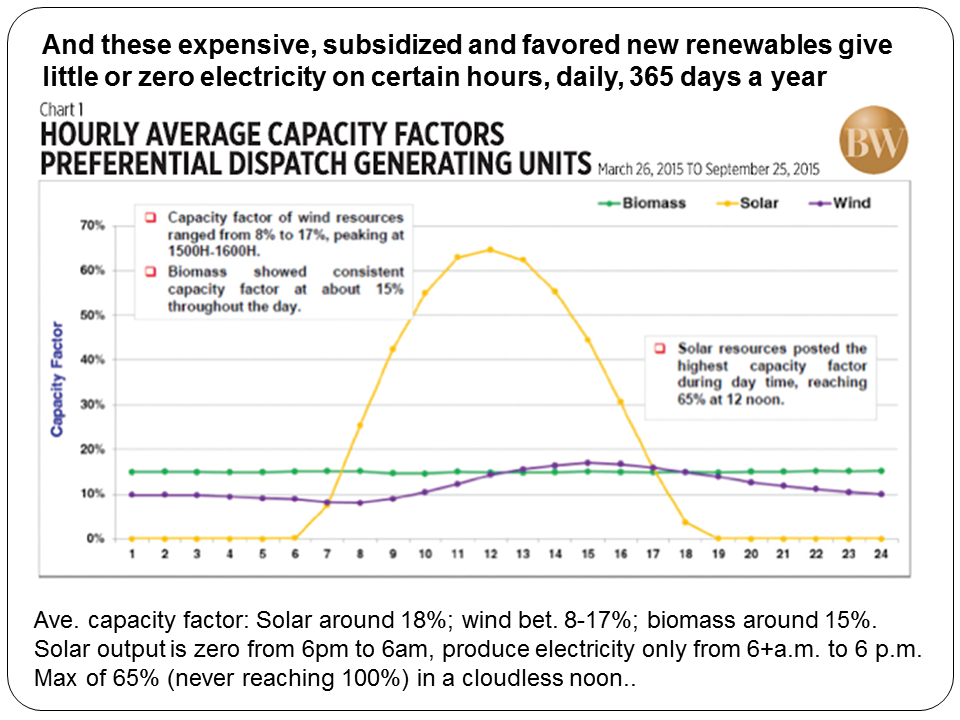
To glamorize and subsidize huge solar farms that give zero electricity at night is wrong.


Government-sponsored renewables cronyism is wrong, it should be stopped and the public should be spared of mandatory, obligatory expensive and intermittent energy. If people really want wind and solar power, they can do it and use their own money and savings, should be fine. The rest should not be forced to pay the subsidies to make this expensive electricity become "cheap and affordable."
------------


See also:

China Watch 22, On many rich Chinese leaving their country

China implosion, it will happen because people and nature hate heavy restrictions and dictatorship. This event will have huge impact on the rest of the world especially in Asia. Not soon, but a few decades now.

On June 5, 2014, Fortune made this headline, Why China’s rich are leaving and showed this table.

The top 3 reasons why rich Chinese leave their country, based on the Hurum-Visa survey are: (1) better options for their children’s education; (2) distressed about growing pollution problems; and (3) concerned about food safety in the country.

Other news reports here.

(1) “China's debt has soared to two and a half times its economy, Standard Chartered estimates…Total financial credit has surged to 251 percent of gross domestic product from 147 percent at the end of 2008, the bank said.”

Not clear if the report refers to public debt or of the entire economy and including private corporate debt. But there is a rise, from 147% of GDP in 2008 to 251% in 2013.

(2) "China's failure lies not in the structure of its dairy industry but in the structure of its economy.... That contamination incident happened partly because China's safety regulatory apparatus remains weak and its unfree press can't serve as a watchdog. Rule of law is too erratic—to put it kindly—to function as an effective check on bad behavior."
-- Joe Sternberg, July 16, 2014, http://online.wsj.com/.../joseph-sternberg-the-milk-of...

(3) "He even called on cadres to allow for a little dissent if necessary.
 We should push ahead with reform and opening up without hesitation,

"Xi said cadres should have the political will to try new initiatives, and in remarks that signal that his massive anti-corruption campaign would continue, he said cadres should set aside their personal feelings and even hire people who had opposing views."

Interesting development. Foreign direct investments (FDI) to and from China was negative, meaning FDI inflows were lower than outflows. Chinese businessmen and state-owned enterprises are investing more abroad -- mainly in the US, EU, Japan. This means what?

a. Labor costs, taxes, bureaucracies, corruption, etc. are rising fast in China, investors would rather do business outside, or
b. Strategic move to further internationalize China capitalism guided by socialist dictatorship. Or
c. Generation of pacifist, trade- and business-oriented communist leaders are rising. The hawks and war-mongers in the Communist Party are shouting their last Hurrah via more militarism and provocation of their neighbors to say they are not losing in the party.


(5) "According to a Barclays survey, which polled over 2,000 Chinese residents with a total net worth greater than $1.5 billion million, 47 percent of Chinese respondents said that they wanted to move abroad in the next five years, compared to a global average of 29 percent."

This news is consistent with the previous news report. Many rich Chinese want to experience more individual freedom, something that they cannot enjoy inside China, even if they are very close to the Communist party leaders.

(6) "Democracy is defined not only by people's right to vote in an election but also the right to participate in political affairs on a daily basis," Xinhua quoted Xi as saying. "Democracy is not a decoration … it's for solving people's problems."

Really? the China Communist Party will allow public participation in government? Allow elections? 


(7) "About 30 Chinese officials, including managers of state-owned companies, are known to have committed suicide this year. Among them were several high-profile cadres under investigation for graft... entrepreneurs and private company managers are under greater stress as the economy slows. Last year more than 80 businessmen committed suicide in a six-month period in the city of Wenzhou alone.

"Entrepreneurs complain that making a fortune paints a bull's-eye on your back. Hence the so-called "curse of the rich list." Unlike in most countries, China's most successful tycoons don't want to be ranked among the country's wealthiest individuals, since honorees tend to find themselves ruined or in handcuffs.

"China's culture of corruption and abuse of power is a major reason so many of the country's rich want to leave. A Barclays BARC.LN -1.07% survey released Monday found that 47% of Chinese with more than $1.5 million in assets are planning to emigrate, and this is consistent with past research. Developed-country programs that allow investors to essentially buy residency continue to attract waves of Chinese.

"Many of China's brainiest young people also want out. According to the state-run Xinhua news agency, the annual number of students who go abroad for study and don't return reached 70,000 in 2012...." 

My hypothesis:

(1) Greying communist party officials of China have their kids studying in the US, Canada, UK, Australia, etc. When they come back and become CP leaders soon, they will be tolerant of democracy, tolerant of political pluralism. And China's one-party system will implode and collapse.

(2) China internal dissent is larger than what we know or read in media. China's external bullying is partly a diversionary tactic, to create "external enemies" and hope to consolidate internally, to rally nationalism. Such internal dissent started in Tiananmen 27 years ago, or even earlier. The stabbings, massacres, riots in some restive regions, they look "scattered" and uncoordinated, but they may be wide and deep.

(3) If China implode someday, it will break up into several countries and governments, the main country may remain under the communist party. Similar to what happened in the former USSR, it broke up into many new and smaller countries, but the bulk of the country remained as Russia.
--------------

See also:
China Watch 18: Martin Jacques' Manila Lecture, November 20, 2012

China Watch 19: The Asian Infrastructure Investment Bank (AIIB), October 25, 2014

China Watch 20: Fortify PH Garrison? March 20, 2015

China Watch 21, Is a War Between US and China "Inevitable"? May 30, 2015

Hong Kong Democracy Vs. China Dictatorship, Part 3, October 14, 2014
China -ASEAN 3: Trade and Investment Relations, March 20, 2015
BWorld 11, China's stockmarket and central planning, July 18, 2015

Saturday, January 16, 2016

Energy 52, Renewables to "save the planet", Germany and UK cases

This is section III of my presentation, Climate change and the need for cheaper and stable energy sources during the Energy Policy Development Program (EPDP) Conference 2016 this week, January 12-13 at the New World Hotel in Makati. 


The cost of renewables rising for households despite their supply instability and very low capacity factor.

At this time of human progress, they are talking about possible blackouts in Germany or other parts of Europe? No thanks to intermittent power sources.


Also in UK, they are talking about energy rationing? At this time of human progress?

Reversal of renewables subsidies starting. Just following the law of economics and scarcity.

And that is why when there are wind towers, there are no houses, no hotels or shops or beach/mountain resorts near them. Wind farms can displace other nearby economic activities.

Government-sponsored renewables cronyism is lousy. They should be stopped and spare the public of expensive and intermittent energy. If people really want wind and solar power, they can do it and use their own money and savings, and not force everyone else to pay the subsidies to make this expensive electricity become "cheap and affordable."
--------------

See also:

Free Trade 59, TPP membership expansion in SE Asia

The Trans Pacific Partnership (TPP) Agreement is expected to become operational and implemented around 2-3 years from now, when all the 12 member-countries have ratified the deal. The idea of zero tariff for many products among members is attractive enough. Meaning companies located in any member-country can buy from, and sell to, other members at zero, free trade prices.

I support the TPP. I will also support TPP membership expansion in the future to include the Philippines, Thailand and Indonesia, among others. Governments-negotiated free trade agreements (FTAs) are often not real free trade as there are many conditionalities. But protectionism and trade nationalism is worse than having bilateral and regional FTAs, especially huge ones like the TPP.s

Below are some news reports about the subject.
------------

"The reduction in the trade barriers within the TPP (with or without Philippine participation) results in trade creation within the TPP and trade diversion from the non-TPP...

The model results show that TPP participation will lead to an overall welfare gain for the Philippines. But the gain can potentially be higher. The analysis in the paper only considers additional yearly FDI inflows of US$1 billion over a 10-year period. While these inflows will improve the economy’s position relative to the FDI frontier..."

Potential Economic Effects on the Philippines of the Trans-Pacific Partnership (TPP)
by Caesar B. Cororaton and David Orden
Revised February 2015

"Thailand is highly interested in joining TPP ...," Somkid Jatusripitak told a news conference in Tokyo. "Chances are high that Thailand will seek to join TPP."

Somkid, the country's economic tsar, said the government was analysing the impact of joining the trade deal, particularly on sensitive issues like agriculture and pharmaceuticals...."

"Indonesia should join the Trans-Pacific Partnership (TPP) as a way to promote structural reform. Such reform would include restructuring state-owned enterprises (SOEs), improving the investment climate, improving economic efficiency and productivity to create jobs for the nation’s surplus labor and promoting exports. The spectacular experience of East Asia indicates that East Asian countries have become more developed and prosperous during the past 60 years mainly due to their greater penetration into international markets through trade and incoming private investment." 

"Under the agreement, companies can gain substantial benefits from being located in TPP member countries and selling goods and services into other TPP member markets.

The most obvious change in a post-TPP world will be the reduction of tariffs. On the date of entry into force of the agreement, 90% of all goods tariffs in all 12 members will drop overnight to zero. The remaining tariffs will also drop, over time, with many eventually becoming duty free.

The tariff reductions mean that firms may no longer have to contend with tariff peaks—specific items or sectors where tariffs can easily reach 30, 50, or 150%. In many of these markets, companies hoping to export products have not been competitive. With the reduction in tariffs, new TPP markets should now be attractive to many firms." -- Deborah Elms, Dec. 10, 2015,

“The big winners on trade are likely to be the big winners on investment, especially over a 10-year period,” says Dr Gary Hufbauer, a senior fellow at the Peterson Institute for International Economics in Washington, DC.

In percentage terms, Mr Hufbauer expects Vietnam to be a big winner in both categories because it is coming from far behind the rest of the field. In addition, its tariffs on many imports – among the highest in the TPP trade area – will be lowered or eliminated. To get the maximum benefit from the TPP, Mr Hufbauer says Vietnam will need better technology and financial services, both of which will require FDI. “If Vietnam carries through on the reforms in the TPP, it will get a ton of investment,” he says.

"Japan, Vietnam and Malaysia are set to get a big economic boost from a sweeping Pacific trade agreement concluded in October, while the U.S. and other North American countries would see much smaller gains from the Trans-Pacific Partnership, according to the first detailed study of the pact."

"Being a part of the TPP is a significant component of our international trade strategy which has been in place over the past four years, the newly appointed Cabinet official said.
“Some estimated it may take another two years for the TPP to take effect, because there are provisions that lay down some conditions before it could take effect,” he said.

"The 12 nations agreed to a deal that, if implemented, would not only reduce or eliminate tariffs but rein in the advantages of state-owned enterprises and impose binding environmental standards.

Even though Beijing isn’t part of the deal, Obama administration officials say the rules will still challenge China to reform its economy in other ways. The TPP, endorsed by many former military officers, would also boost Washington’s ties with its allies in the region a time when China is flexing its economic and military muscles."


"Thailand, the Philippines and Indonesia have actually expressed interest to be part of the Trans-Pacific Partnership Agreement (TPPA), said the International Trade and Industry Ministry (Miti).

Miti said this in its written response to issues raised by Dr Jomo Kwame Sundaram recently that countries such as Thailand and the Philippines had opted to distance themselves from this treaty."
------------

See also: