Last April 27, I was one of several guest speakers in a virtual meeting by Climate and Freedom coalition. It's a small group, off the record meeting. Below I share 4 of 11 slides I discussed that day. Enjoy.


-------------
Last April 27, I was one of several guest speakers in a virtual meeting by Climate and Freedom coalition. It's a small group, off the record meeting. Below I share 4 of 11 slides I discussed that day. Enjoy.
-------------
Year 1 of Marcos Jr.: Inflation and interest rates
July 11, 2023 | 12:02 am
My Cup Of Liberty
By Bienvenido S. Oplas, Jr.
https://www.bworldonline.com/opinion/2023/07/11/533308/year-1-of-marcos-jr-inflation-and-interest-rates/
(2nd of 4 parts)
There were two pieces of good news reported by the Philippine Statistics Authority (PSA) last week.
One, that the inflation rate further decelerated to only 5.4% in June 2023, from 6.1% the previous month. It was also 6.1% in June 2022.
Two, the unemployment rate further declined to only 4.3% of the labor force in May 2023, from 4.5% the previous month and 6% in May 2022.
The underemployment rate was also down to only 11.7% of the labor force in May 2023, from 12.9% the previous month, and 14.5% in May 2022.
The Inter-Agency Committee on Inflation and Market Outlook (IAC-IMO) headed by the Secretaries of the Department of Finance (DoF), the NEDA, and the Department of Budget and Management (DBM), is producing good results from their efforts.
Doing market-oriented reforms at home, keeping taxation policies stable and predictable, then announcing these in face-to-face meetings with investors in key cities abroad, these are among the useful innovations made by the economic team of the Marcos Jr. administration.
A report last week in BusinessWorld caught my attention: “Rate cuts eyed if inflation falls below 4%” (July 7).
Bangko Sentral interest rates increased fast last year, from 2% in April to 5.5% in December, it is now 6.25%. The big jump in interest rates failed to cool down prices until early 2023, implying that the monetary policy has not been really effective in stabilizing prices.
The main inflation generator last year, especially in the second half (H2) or July-December, was transport (high oil prices) followed by alcoholic beverages and tobacco (ABT), then food and non-alcoholic beverages. Since oil is a public good, a necessity by almost everyone, people would endure high inflation but not let go of their cars or motorcycles or trucks.
In the first half (H1) of 2023, the main inflation generator is ABT followed by food, then restaurants and accommodation/hotel services. Transport inflation has receded due to lower oil prices. This implies that people are going out more to eat, drink, smoke, and party. If so, this may slow down inflation deceleration but will perk up GDP growth.
I now compare inflation rate of various countries, also interest rates by central banks or monetary authorities (CB/MA). In H1 2023, Bangladesh, India, and the Philippines have had among the highest inflation rates and interest rates in Asia. The US and European countries have had the biggest jump in interest rates, from zero in April 2022 to 4%, 5% in June 2023 (see the table).

The high inflation in ABT, food, restaurants, and accommodation this year could be an explanatory factor why the Philippines’ GDP growth in the first quarter of 6.4% was the highest among the major economies (top 50 largest GDP size) in the world. People were going out more, spending more, which expands consumer demand and supply, which expands overall GDP.
The decline in unemployment rate and underemployment rate in May this year is further proof that consumer and business confidence is high in the country. People are doing more entrepreneurial activities, hiring others or hiring themselves — they should be backed up by low interest rates.
On this consideration, the BSP may consider reducing the interest rate sooner and not wait for the inflation rate to reach below 4% by October. More domestic businesses should expand fast as consumer confidence is high, and high interest rates can discourage more loan takeout for business expansion.
The Marcos Jr. administration overall is doing good when it comes to economic achievement in year one. Even if inflation stays at 4-5% in the coming month, so long as the unemployment rate is 4.5% or lower, so long as the GDP quarterly growth is 6% or higher, that would be a tolerable trade off.
Meanwhile, the Program in Development Economics Alumni Association (PDEAA) of the UP School of Economics will hold its homecoming on Aug. 19, Saturday, at 4 p.m., at the school auditorium.
Confirmed guest speakers are DoF Secretary Benjamin Diokno (7th PDE batch) and DBM Secretary Amenah Pangandaman (33 PDE batch). Graduates of PDE are encouraged to attend this educational and entertaining homecoming event.
------------
See also:
BWorld 617, Energy realism: Raising consumption and economic growth, July 04, 2023
BWorld 618, Year 1 of Marcos Jr.: Budget deficit and unemployment, July 08, 2023
BWorld 619, Energy realism: G7, BRICS, and other big Asian economies, July 09, 2023.
I have written a number of papers in my column re water.
Dredge Laguna de Bay for potable water use
February 21, 2022 | 9:38 pm
https://www.bworldonline.com/opinion/2022/02/21/431344/dredge-laguna-de-bay-for-potable-water-use/

More water and investments, less political whims
July 29, 2020 | 6:36 pm
https://www.bworldonline.com/editors-picks/2020/07/29/308308/more-water-and-investments-less-political-whims/
Thank you, Metro Manila water concessionaires
March 9, 2020 | 10:21 pm
https://www.bworldonline.com/opinion/2020/03/09/282859/thank-you-metro-manila-water-concessionaires/

More water and investments, less virus
March 18, 2020 | 9:54 pm
https://www.bworldonline.com/editors-picks/2020/03/18/284395/more-water-and-investments-less-virus/
Thank you Maynilad, Manila Water
December 22, 2019 | 9:13 pm
https://www.bworldonline.com/opinion/2019/12/22/270637/thank-you-maynilad-manila-water/
(Tables here not showing, reposted with the tables,
https://funwithgovernment.blogspot.com/2019/12/bworld-397-thank-you-maynilad-manila.html)
Water politics and power price control
December 11, 2019
http://bworldonline.com/water-politics-and-power-price-control/
https://funwithgovernment.blogspot.com/2019/12/bworld-394-water-politics-and-power.html
MORE smart cities… with sufficient water
May 6, 2019 | 12:58 am
https://www.bworldonline.com/editors-picks/2019/05/06/229188/more-smart-cities-with-sufficient-water/
Reason over populism in infrastructure development
June 26, 2019 | 10:02 pm
https://www.bworldonline.com/editors-picks/2019/06/26/238839/reason-over-populism-in-infrastructure-development/
(Table not showing, reposted here with the numbers, https://funwithgovernment.blogspot.com/2019/07/bworld-343-reason-over-populism-in.html)
Water surplus vs water shortage
March 14, 2019 | 10:03 pm
https://www.bworldonline.com/opinion/2019/03/14/219856/water-surplus-vs-water-shortage/
(Tables here, https://funwithgovernment.blogspot.com/2019/03/bworld-303-water-surplus-vs-water.html)
Integrated PPP vs Hybrid PPP: The case of Kaliwa Dam
November 7, 2018 | 10:17 pm
https://www.bworldonline.com/editors-picks/2018/11/07/197877/integrated-ppp-vs-hybrid-ppp-the-case-of-kaliwa-dam/
(Table shown here, https://funwithgovernment.blogspot.com/2018/11/bworld-265-integrated-ppp-vs-hybrid-ppp.html)
Other blog posts, not BWorld column:
Water price control, Duterte attacks and his shameless fanatic
December 11, 2019
https://funwithgovernment.blogspot.com/2019/12/water-price-control-duterte-attacks-and.html
Water politics and stocks of MWC, AC, MPIC, DMCI
December 15, 2019
https://funwithgovernment.blogspot.com/2019/12/water-politics-and-stocks-of-mwc-ac.html
Ayalas, MPIC, ABS-CBN, even SM under attack by the President
January 23, 2020
https://funwithgovernment.blogspot.com/2020/01/ayalas-mpic-abs-cbn-even-sm-under.html
July 6, 2023
https://www.bworldonline.com/opinion/2023/07/06/532516/energy-realism-g7-brics-and-other-big-asian-economies/
------------

I compared the economic and energy performance over the past 25 years — 1997 to 2022 — of four groups of countries: the G7 industrialized countries, the competing economic bloc BRICS (Brazil, Russia, India, China, South Africa), other big Asians (OBAs) like South Korea and Saudi Arabia, and the ASEAN-6.
The three indicators of comparison are: GDP size in Purchasing Power Parity (PPP) values, primary energy consumption (PEC), and power or electricity generation. The results are interesting.
One, 25 years ago the G7 countries, led by the US, were larger than BRICS in all three indicators. Today it is the reverse, BRICS, led by China, have overtaken the G7.
Two, all G7 countries except the US and Canada experienced significant declines in PEC, they seem to have embraced slow deindustrialization in hard pursuit of decarbonization and “net zero.” Their PEC has contracted 11% over 25 years vs. 123% growth in BRICS, 156% in OBAs, and 215% in ASEAN-6. And the power generation of G7 has increased only 6% after 25 years vs. 229% in BRICS, 265% in OBAs, and 372% in the ASEAN-6.
Three, within the ASEAN-6, Vietnam has overtaken the Philippines in all three indicators. Their PEC was only one half of the Philippines’ 25 years ago, now it is twice that of the Philippines (See the table).

The Philippines really needs to expand and modernize power generation, transmission, and distribution systems. We should keep the pace of the BRICS, OBAs, and ASEAN, not the G7. Our power generation is less than half of Vietnam’s — even if all conglomerates and corporations in the power sector will double their output in the next five to 10 years, it will greatly help but will not be enough given the high growth momentum and targets for the Philippine economy.
Yesterday I attended the Pandesal Forum on the subject “Achieving Philippine Energy Security through Strategic Policy Reforms” and the lone speaker was Secretary Raphael “Popo” Lotilla. The event was hosted by Wilson Lee Flores.
Among the points discussed by Secretary Lotilla were the following:
(a) President Ferdinand Marcos, Jr. is very serious about energy issues, they keep him awake at night;
(b) nuclear power in the Philippines is on the table, the President already mentioned it as early as in his first State of the Nation Address last year;
(c) high electricity prices in the Philippines compared to neighbors in Asia is partly because our neighbors subsidize their electricity, directly or indirectly, like Vietnam which asked their government to subsidize $2 billion last year, and Indonesia which, as a big coal producer and exporter, has cheap domestic coal;
(d) renewable energy’s share to total power generation will keep rising, 50% by 2040, with natural gas power as backup;
(e) the National Grid Corp. of the Philippines (NGCP) audit is proceeding, Congress is asked by the Energy department to review the NGCP franchise, it is the only corporation in the Philippines granted by Congress to pay only a 3% franchise tax in lieu of all other taxes;
(f) there is stranded energy, excess energy supply in some islands that cannot be shared or exported to other islands due to NGCP transmission congestion;
(g) there are reforms in electric cooperatives sought by local governments via corporatization or bringing in private corporations, or being registered with Philippine Cooperative Authority.
On high electricity prices, the Energy Regulatory Commission (ERC) has been adjusting rates down — the ERC-approved rate is lower than what was applied for in the power supply agreement between distribution utilities and generation companies.
While this is understandable as the ERC is trying to help mitigate high consumer prices, plus there is a policy where neither party can withdraw from the approved rate, there is problem in this modification of contract because this already went through competitive bidding.
One option is to decouple the generating plant from the energy supply contract. It becomes the supplier’s problem to source energy from one or more generators. It will also address the problem of capacity utilization or forcing plants to load follow at inefficient levels. With no plant linkage, there is no cost basis to evaluate, only the integrity of the bidding process. So, fuel costs become the supplier’s problem and safeguards can include financial penalties covered by L/Cs that can be drawn in case of default.
Meanwhile, there is a piece of good news — the energization of a remote health center in Barangay Laiban, Tanay, Rizal which serves over 3,000 individuals, done by Meralco under its community electrification program that covers low-income households. Good job, guys.
---------------
See also:
BWorld 616, Financing sustained growth: NAIA privatization, July 02, 2023
BWorld 617, Energy realism: Raising consumption and economic growth, July 04, 2023
BWorld 618, Year 1 of Marcos Jr.: Budget deficit and unemployment, July 08, 2023.
Enjoy these ironies and hypocrisies.


Year 1 of Marcos Jr.: Budget deficit and unemployment
July 4, 2023 | 12:03 am
My Cup Of Liberty
By Bienvenido S. Oplas, Jr.
(Part 1 of 4)
https://www.bworldonline.com/opinion/2023/07/04/531968/year-1-of-marcos-jr-budget-deficit-and-unemployment/
The Ferdinand Marcos, Jr. administration turned one year old last week on June 30. This column will produce a four-part assessment of the economic performance of the Marcos Jr. administration leading to the second State of the Nation Address (SONA) on July 24.
The goal of this informal exercise is to assess if the first year performance so far would help the Philippines achieve fast growth — create more jobs, expand the production of more goods and services, further industrialize and modernize the Philippines in the medium- to long-term.
Eight economic sectors, two per article, will be assessed this month: the budget deficit, unemployment, inflation, the interest rate, GDP growth, agriculture, trade, and investment.
CASH OPERATIONS REPORT
Last week, the Bureau of the Treasury (BTr) released the cash operations report for May 2023. The January-May 2023 data are available, so I will compare the numbers with performance in the same months of 2018 to 2022. The results are generally good.
One, revenues this year have significantly improved, reaching P1.59 trillion from P1.44 trillion last year. This is important for two reasons: there was no tax hike, and lockdown-era tax cuts still remained in place. So, an improvement in economic activities, not a tax hike, expanded the tax base.
Two, expenditures have mildly increased to P1.92 trillion this year from P1.89 trillion last year. While allocations for local government units have declined this year, National Government disbursement remains high as there is spending that continues to remain bloated like the military and uniformed personnel (MUP) pension. This fund must decline significantly if we must control the annual deficit, financing, and borrowing.
Three, the budget deficit has declined to only P326 billion this year from an average of P529 billion/year in the last three years 2020-2022, so this is good news. Financing or borrowing has mellowed to P1.17 trillion this year, higher than 2022 but lower than in 2020 and 2021 (see Table 1).
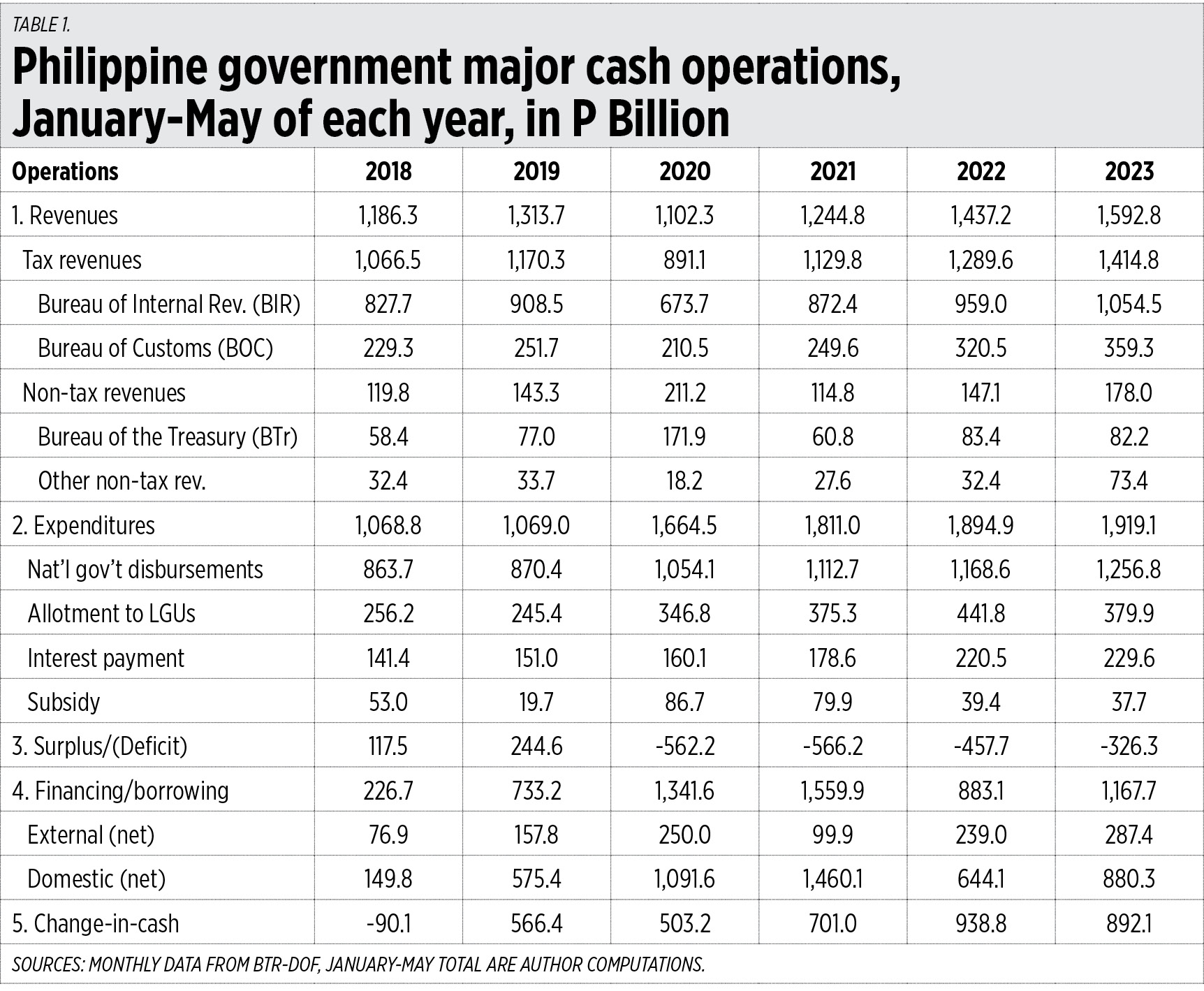
Interest payment is high, already P230 billion in the first five months of 2023 alone. This is a reflection of the huge increase in public debt during the lockdown years of 2020-2021 and this is not good. We should aim to reduce the annual budget deficit, reduce the need for borrowing, find new revenues like the large privatization of some government assets, in order to retire more public debt while controlling the rise in spending.
DECLINING UNEMPLOYMENT
Next is the labor market. In Table 2, I group countries into three: group A are G7 member countries, group B are the big North and South Asian economies, and group C are the ASEAN-6 or the six large economies of the regional bloc.
As of April 2023, four of the G7 countries, plus India and China, and Indonesia in the ASEAN-6 countries had unemployment rates of 5% and above of the labor force. The Philippines’ unemployment rate has significantly declined to only 4.5% which is almost half the 8.7% registered in April 2021, so this is good news.

More Filipinos now have jobs and, hence, have money to spend and buy, which will create more consumer demand and invite more business expansion and innovation.
So far, considering these two indicators — budget deficit and unemployment rate — the Philippines under the Marcos Jr. administration is doing well. These are consistent with the economic team’s high growth target of 6-7% in 2023 and 6.5-8% in 2024-2028. Meaning if both the deficit and unemployment rate continue their downward trends, the high growth targets are achievable, and, better yet, may be surpassed.
We should target high employment, high productivity, and high economic ambition. Go for high revenues and high investments, and a low deficit and low borrowings. Aim for becoming an upper middle-income country — with a per capita income of $4,046 to $12,535 per year — by 2028 or earlier, vs. the current level of $3,623 in 2022.
This is achievable if we have a single-track goal: more growth, expanded production, more economic and business competition. Aim for a larger economic pie, not “well-distributed” shares in a small economic pie.
---------------
See also:
BWorld 615, The law of diminishing marginal utility and public policy, July 01, 2023
BWorld 616, Financing sustained growth: NAIA privatization, July 02, 2023
BWorld 617, Energy realism: Raising consumption and economic growth, July 04, 2023.
These are ironic, if not comedy, stories for an industrial country. Enjoy.
---------------
UK Grid Puts Coal Plant On Standby While Ordering Wind Farm to Cut Output
By Charles Kennedy - Jul 06, 2023
https://oilprice.com/Latest-Energy-News/World-News/UK-Grid-Puts-Coal-Plant-On-Standby-While-Ordering-Wind-Farm-to-Cut-Output.html
Billionaire Ratcliffe Sees UK Energy Policy Wrecking Industries
UK government made ‘daft’ decisions on nuclear: Ratcliffe
Competitive energy is critical for manufacturing investments
By Sabah Meddings and David Hellier
July 6, 2023
https://www.bloomberg.com/news/articles/2023-07-06/british-billionaire-ratcliffe-slams-uk-energy-policy-as
Wind Lobbyists Push UK Government For More Subsidies
July 6, 2023
https://finance.yahoo.com/news/wind-lobbyists-push-uk-government-150000778.html

Revealed: Brits are paying the highest electricity bills in the entire world
BY:MICHIEL WILLEMS January 14, 2023
https://www.cityam.com/revealed-brits-are-paying-the-highest-electricity-bills-in-the-entire-world/
Sky-High UK Energy Bills Shouldn't Be The Norm
By City A.M - Jul 07, 2023
https://oilprice.com/Energy/Energy-General/Sky-High-UK-Energy-Bills-Shouldnt-Be-The-Norm.html
Britain’s energy failure risks killing off what is left of our manufacturing base
Sir Jim’s latest lambast provides yet another wake-up call to sleepy ministers
BEN MARLOW 7 July 2023
https://www.telegraph.co.uk/business/2023/07/07/britain-energy-failure-risks-killing-off-manufacturing-base/
The Tory civil war over climate policy is heating up - and there is no peace deal in sight
James Murray 03 July 2023
https://www.businessgreen.com/analysis/4119365/tory-civil-war-climate-policy-heating-peace-deal-sight

Why The U.S. Has Become The Blackout Capital Of The Developed World
By Alex Kimani - Jul 02, 2023
https://oilprice.com/Energy/Energy-General/Why-The-US-Has-Become-The-Blackout-Capital-Of-The-Developed-World.html
--------------
See also:
Deindustrialization 13, More wind-solar, more expensive electricity, May 11, 2023
Deindustrialization 14, Net Zero slowly on the retreat in Europe, May 25, 2023
Deindustrialization 15, Germany turning from Greens to AfD, June 22, 2023
Energy realism: Raising consumption and economic growth
June 29, 2023 | 12:02 am
My Cup Of Liberty
By Bienvenido S. Oplas, Jr.
https://www.bworldonline.com/opinion/2023/06/29/531213/energy-realism-raising-consumption-and-economic-growth/
(Part 1)
This column will produce a series of articles on energy realism, not alarmism, to support sustained economic growth for developing countries, especially the Philippines. New global data are now available from the Energy Institute (EI), which launched the Statistical Review of World Energy 2023 on June 26. The report has been published by British Petroleum since the 1960s until 2022.
We start with consumption of primary energy — commercially traded fuels, fossil and nuclear, plus modern renewables for electricity generation.
I compare GDP per capita at purchasing power parity values at constant prices, and primary energy consumption in gigajoule (GJ) per capita. One GJ is equivalent to 277.8 kWh in electricity, or 0.16 barrel of oil.
I grouped the selected countries below into three. Group A consists of G7 member-countries, group B is made up of the big North and South Asians, and group C consists of the ASEAN-6 countries. I chose a 20-year gap — 1982, 2002 and 2022, with 2019 as peak GDP levels before the global lockdowns of 2020-2021 that slammed many economies into deep recession.
The results over the past 40 years, 1982 to 2022, are interesting.
One, only the US has doubled GDP per capita among G7 countries. Only Japan has expanded GJ per capita; the rest have experienced a decline especially the UK.
Two, group B countries expanded their GDP per capita many times — India 5.5x, Taiwan 6.5x, South Korea 7.4x and China 24x. Their GJ per capita consumption also expanded many times — Taiwan 3.2x, India 3.9x, South Korea 5.6x and China 6.3x. Higher energy consumption raises productivity and income.
For ASEAN-6, it’s the same trend as for group B countries. Singapore has very high GJ per capita. In 2022 it was almost 5x that of the UK and Italy, and Singapore has very high GDP per capita, more than 2x of G7 countries except the US. Vietnam has expanded its energy consumption 12.3x and income per capita has expanded 7.1x.
The Philippines remains to have the lowest energy consumption per capita in ASEAN-6 in 2022 — only 51% of Thailand, 39% of Vietnam, 26% of Thailand and only 13% of Malaysia. The mothballing of the Bataan Nuclear Power Plant in 1985 — 620 MW of reliable, dispatchable electricity source with no alternative — that led to large-scale blackouts in 1990-1992 is one of the major factors. One result is muted growth. Per capita income expanded only 2x over four decades (see table).

Another factor is that the Philippines legislated an energy-alarmist law, the Renewable Energy Act of 2008 (RA 9513), which pushed hard intermittent, unreliable, nondispatchable on-demand sources like wind and solar energy. While the installed megawatt capacity of the Philippines is rising high mainly from wind and solar energy, the actual MWh electricity generation remains low. That’s because wind and solar energy produce no electricity when the wind does not blow and when it is nighttime, or produce very little energy even at daytime when there are thick clouds or when it’s raining.
The 26-page paper “Full Cost of Electricity ‘FCOE’ and Energy Returns ‘eROI’” by Lars Schernikau, William Hayden Smith & Rosemary Falcon in the Journal of Management and Sustainability offers good advice on economic and energy realism for policy makers in the Philippines and other developing countries.
“Energy policy and investors should not favor wind, solar, biomass, geothermal, hydro, nuclear, gas, or coal but should support all energy systems in a manner which avoids energy shortage and energy poverty,” according to the paper. “All energy always requires taking resources from our planet and processing them, thus negatively impacting the environment. It must be humanity’s goal to minimize these negative impacts in a meaningful way through investments — not divestments — by increasing, not decreasing, energy and material efficiencies.”
Amen to that.
Meanwhile, there have been developments in the Philippine energy sector as reported in BusinessWorld: “ERC says 48 power distributors applying for rate adjustments” (June 20); “NGCP says investment in substation upgrades reached P6.47 billion”(June 20); “DoE expects offshore wind rules to help bring down power rates” (June 22); “Emergency power procurement pricing allowed to vary from approved tariff” (June 26); “ERC asks SC to void decision halting power deal” (June 26); and “Reserve power market commercial launch expected by September” (June 27).
The ERC move asking the Supreme Court to void the halting of the power deal of a San Miguel energy company is good. The establishment of reserve power market is also good. Modern blackout economics in the Philippines is largely explained by the absence of long-term power reserve contracts by the only remaining private monopoly nationwide, NGCP. So having an institutional reserve market is a move in the right direction.
One reform that must be done to complement this reserve market is the abolition of electricity price control via primary and secondary price caps in the wholesale electricity spot market (WESM). Or at least adjust it high. Peaking plants do not run 24/7, 12 months a year. They run only for a few months and weeks with tight power supply and thin power margins so they must be rewarded with a higher price to avoid blackouts, potential or actual. That is how real capitalism should work. We should have it back in WESM.
-------------
See also:
BWorld 614, FDI in the Philippines and the energy mix, June 30, 2023
BWorld 615, The law of diminishing marginal utility and public policy, July 01, 2023
BWorld 616, Financing sustained growth: NAIA privatization, July 02, 2023.

