Sunday, June 17, 2012

Rotary Notes 3: TRF, Global Grants and Civil Society

* This is my article yesterday in the online magazine TL. The photos at the bottom are not part of the original article.
---------

http://www.thelobbyist.biz/perspectives/less-gorvernment/1321--sustainable-humanitarian-projects-without-government-support


Providing wide and sustainable humanitarian projects to the poor and needy via civil society and voluntary organizations with zero government support is highly possible. It has happened, it is happening and will continue to happen.

Such civil society organizations (CSOs) range from civic groups like Gawad Kalinga and Rotary Clubs, religious and church groups, villages, business and professional associations, corporate foundations, sports clubs, and so on.

I will give examples from Rotary because there are really huge projects going on there. I am referring to the new initiative of the Rotary International (RI), the Global Grants (GG). This is a new initiative, taking lessons from thousands of humanitarian projects in the past from many rotary clubs from many countries.

GGs’ general characteristics are. One, they are meant to finance sustainable projects for the needy people, meaning after the term of the Club President who initiated the project has ended, the project is still there and is able to generate certain funds for its continuation year after year.

Two, minimum project cost is US$30,000, no more projects worth $5,000 or $20,000. A club in a poor country finds a partner club/s in a rich country, their respective RI Districts pouring additional funding, and a worthwhile project involving public health, water and sanitation, education and literacy, economic livelihood, peace and conflict resolution, will get at least $30,000 of funding that are quickly paid so long as all the requirements are complied with.

In a training seminar last June 09, 2012 on “The Future Vision Plan” by RI District 3830, the first speaker, Immediate Past District Governor (IPDG) of RI District 3810, Tranquil Salvador III, gave several success stories in the Global Grants (GG) in his District, comprising Rotary Clubs in Manila, Pasay, Cavite, Mindoro, other nearby provinces.

1. GG #25075, “Philippine Medical Mission”, $37,500.00.

Project components: (a) Maternal and child health, (b) disease prevention and treatment, (c) basic education and literacy. A club to club partnership between RCs Cavite and Louisiana, USA. The local club gave only $100, the minimum club counterpart, the respective districts where the two clubs belonged gave their respective DDF, plus donations from other Rotarians. Status: Paid and closed.

2. GG #25199, “School Renovation at Calabarzon”, $44,696.00.

Project components: (a) basic education and literacy, (b) water and sanitation, (c) disease prevention and treatment. The local club, RC Cavite Ecozone gave only $100, but its partner RC abroad, plus the DDF of both districts gave a lot. Status: Paid and closed.

3. GG #25761, “Donation of Mobile X-Ray Machines”, $85,000.00.

The project is mainly for disease prevention and treatment in poor communities, hence mobile machines and clinic. The main recipients are the Philippine General Hospital (PGH) and the Baguio General Hospital (BGH).

4. GG #25040, “Supporting Health of Needy People in the Philippines”, $143,000.00.

The project addresses (a) disease prevention and treatment, (b) maternal and child health, among others. It is a multi-year, on-going project.

There are many other success stories of wonderful projects funded by GGs in each district (there are 500+ RI Districts worldwide). I only mentioned a few above. The impact on the poor, the less or un-educated, the sick, the old, etc., is huge. Project implementation is direct people to people, no government bureaucracies in the middle (barangay to municipal/city to province/congressional politicians and bureaurats) that can hijack such projects towards their personal political interests. There are also no additional taxes, mandatory fees and contribution from the citizens, rich or poor, to be coercively collected as all funding come from voluntary donations and various fund raising activities.

GG funds, $30,000 to $143,000 or more, are quickly released if all the requirements are complied with. Project and fund management is made more transparent, all transactions and proof are paperless and visible on the web, an external auditor aside from internal monitoring will be needed. Any irregularities can easily be checked due to both internal and external controls.

How about those found mishandling or stealing the money? Will they go to prison? Possibly yes, if criminal charges will be filed against them. But normally, just exposing the names, faces and club affiliation of those people is enough punishment. Rotary is a voluntary organization of relatively successful professionals and businessmen. No one put a gun on members’ heads to join it, pay annual dues, attend regular meetings and spend extra for the meals, attend club projects and district activities. Members came and joined on their own, voluntarily. So it is a highly collegial, peer system of camaraderie. If one will commit fraudulent acts on money that are voluntarily donated, the idea of losing one’s face, of losing professional and business integrity and network in such a big and international organization, is a severe form of punishment.

And this is one beauty of voluntary, civil society organizations. The traditional schemes of reward and punishment under the government system of coercion and politics, like sending people to jails if they are not politically connected, or getting scot free if they have wide political connections even if they are outright thieves, does not strictly apply.

The state of civil society, being largely a voluntary action and organization of mature and responsible citizens, is the path that we should take, not the state of more government coercion and politics.

Friday, June 15, 2012

Fat-Free Econ 13: P2 Trillion of Election Spending and Taxes

This is my article today in TV5's news portal,
http://www.interaksyon.com/article/34803/fat-free-economics-p2-trillion-of-taxes-new-debts

The main preoccupation of governments almost anywhere is to spend-spend-spend, tax-tax-tax. Since tax revenues are often not enough, they resort to borrow-borrow-borrow. And a vicious cycle of over-spending and over-borrowing, of fiscal and governmental irresponsibility, is set into motion, acquiring its own life, sustained year after year, administration after administration.

This is seen in many countries in Europe, North and South America, and Asia, including the Philippines. Our government’s gross debt stands at 40 percent of GDP. While this looks bad, there is good news to it somehow, because it used to be 60 percent of GDP about a decade ago.

The PNoy administration has hinted that its proposed budget next year will reach P2 trillion, up from this year’s P1.82 trillion. This means the government will need nearly P2 trillion of taxes and fees from us, the difference to be sourced from new borrowings, what else.

Many of us would wish that with what is going on in Europe and the US - where a huge public debt burden is dragging the rest of the economy into financial uncertainty - the Philippine government should exercise fiscal restraint and limit spending to what existing revenues can support so that there will be little or no need to contract new debt

Our problem is that next year is another election year. Politicians in power, from national to local, would spend and spend just to buy and bribe votes, and worry about the spike in debts and possible tax hikes later. Such is the tragedy of governments and democracy.

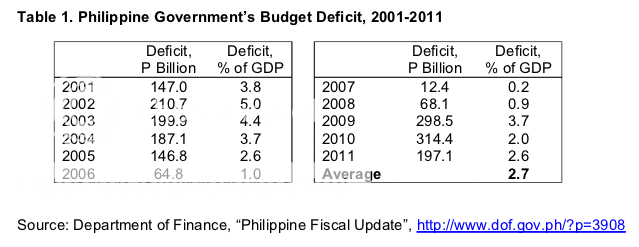
Below is the over-spending record of the national government over the past 11 years. Budget deficit means expenditures are larger than revenues, a typical attitude of living beyond one’s means and charging the difference to new borrowings.


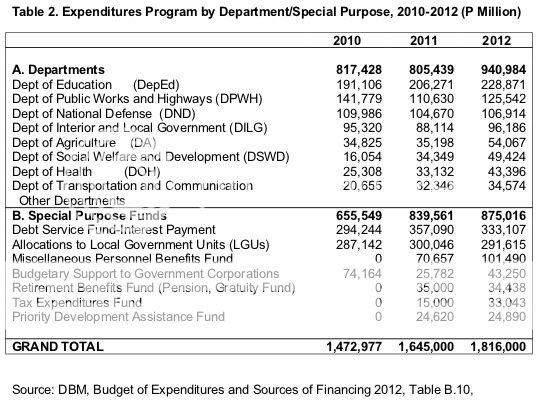
The main culprit for such overspending and the need for new borrowing, is government debt itself. Interest payment constitutes 20 percent of the annual budget. Here is a quick view of the biggest departments and expenditure items this year and the past two years.


DepEd, DPWH, DND and DILG, interest payments, internal revenue allocation of LGUs and various benefits to the million-plus national government personnel - they are the largest expenditure items this year.

Coming up very fast in terms of high growth in spending are DA, DOH and DSWD. When the local government code was enacted in 1991, these three agencies were among those whose several functions were devolved and decentralized to the LGUs. Thus, their share in national government spending has declined 20 percent 10 years ago. Recently though, there was a trend of “recentralization” as national government spending for these three departments has been rising fast.

The bulk of new spending in 2013 would include expanding the conditional cash transfer (CCT) program of the DSWD, from P34 billion this year to roughly P45 billion next year. The DSWD budget is projected to rise from P49 billion this year to P67 billion next year. Since the CCT is mainly a dole out program with some “conditionalities,” it is clearly a big tool for electioneering and legal vote-buying next year. The administration will of course object to the term “legal vote buying” but that’s what it really is.

More CCT actually means that previous government programs to "fight poverty" were ineffective or outright failures. Education and books for the poor, healthcare and medicines for the poor, housing and water for the poor, irrigation and credit for the poor, etc. These are supposed to have improved the condition of the poor, but they did not. So they invented this direct cash transfer to the poor. Soon with the RH billl, the government will also have condoms and IUD for the poor. What’s next, iPads for the poor?

Perhaps a big question to ask is, Is there room to retain, if not shrink, government spending in the next few years?

If the government is serious in controlling the burden of public debt and interest payments, the answer is “yes.” But since the government is not serious, or even dishonest in controlling the debt problem, its answer is “no.”

Many advocates of more and bigger government say that the Philippine government’s spending is actually “small” compared to many countries around the world, like its neighbors in Asia. See the numbers below.


What is wrong with the above numbers for the Philippines and other governments?

Our numbers represent only spending by the national government that are financed by taxes and mandatory fees. Spending by the local governments – barangays, cities/municipalities, and provinces – as well as spending by government corporations (PCSO, PAGCOR, etc.) are not included here.

If these expenditures are included, it is safe to estimate that overall and consolidated Philippine government spending would reach about 24 percent of GDP. That is not “small.” It comprises nearly one fourth of the total production of goods and services in the economy.

Reducing the fat in government spending and fiscal irresponsibility is a tough job to do and campaign for ordinary mortals (a.k.a. average taxpayers in the private sector). But we have to start somewhere. We need to help educate the public that more and bigger government spending, regulations, restrictions and taxation, are not good, are not productive. They siphon resources from private pockets and savings to politicians and bureaucrats’ spending whims.

Many social and economic services are better served and met by assigning more personal and parental responsibility to the people, not more government responsibility. The latter is a convenient excuse to justify endless government waste and greed. We have to learn to say “no” to such wasteful government advances and coercion somehow, somewhere.
--------

See also:
Fat-Free Econ 1: Macroeconomics for Micro Concerns, March 08, 2012
Fat-Free Econ 2: Determinants of Private Consumption Expenditures, March 14, 2012
Fat-Free Econ 11: GDP Growth and Private Sector Role, June 02, 2012
Fat-Free Econ 12: Privatizing PAGCOR, June 08, 2012


Fiscal irresponsibility 17: Cut Spending and Borrowing, September 19, 2011
Fiscal Irresponsibility 25: Spain Panic, More Eurozone Woes, June 06, 2012

CSOs and State 15: Old Debate on Competition and Markets

Many civil society organizations (CSOs) leaders remain unfriendly to the idea of moving society from more government to less government via more CSOs and voluntary groups. Below is one of the debates I've had with some friends more than eight years ago. I think a number of arguments remain relevant, hence posting them here. A bit long, get your popcorn. :-) 


Exchanges on Competition and the Market

June-July 2004

Hey Vince, folks, If GMA will do or support this -- fewer bureaucrats and higher pay for those who will be retained -- I say halleluiah for her! Enough of "more taxes" moves. I say "less tax rates" and there will be larger tax base.

Expenditures cut through merger, corporatization, if not outright abolition, of some govt. agencies, will inspire taxpayers that the money they surrender to govt. (nay, govt. automatically expropriates) is wasted less and less. Will the group possibly support these developments, or it will keep its focus on tax admin reforms?

-- Nonoy

Noy, I would dare say that the group effort will stay focused on tax administration reform. But I do agree with you, enough of the "more taxes" approach, it merely masks the problems in tax administration.

-- Vince
P.S. Why am I not surprised at your response to this article?

ha ha ha, right Vince -- you know my advocacies are very clear: small government, small bureaucracy, small taxes; more and freer markets and trade. so my reaction to news reports like these are highly predictable.

I have a new org. Vince, folks -- Minimal Government. Among our major advocacies are (a) flat 10% individual income tax (vs. the current 6-tiers, from 10% to 32%), and (b) a lower, 16% of net corporate income (vs. the current 32%). These smaller taxes will be compensated by fewer line departments, bureaus, and state universities and colleges, smaller bureaucracy.

So, somewhere we shall complement each other's advocacies. The group on tax admin reforms, us and other orgs. and individuals on tax rates and policy reforms. Pero mahirap magbago ng utak pre, when people's minds are "statist" -- that the state should intervene, regulate, subsidize, etc. in almost all aspects of our lives.

-- Nonoy

Folks: Today, I speak purely as a taxpayer and not as a reform BIR advocate.

I am tired of new taxes (or at least proposals for new taxes). I think the government should not be able to impose new taxes unless it can show: 1) that it can improve collection of existing taxes; 2) that it can plug leakages on the collection side; 3) that it can plug leakages on the expenditure side; and 4) that the first three are not enough to narrow the budget gap to manageable levels. Otherwise, any time there is a revenue shortfall, the government will resort to new taxes. If the figures coming out of the office of the Ombudsman or the World Bank are accurate, anywhere from P240-P400 billion is lost EVERY YEAR through "leakages" in the BIR. As far as I know, these leakages are still rampant and SOP. I am aware of several firms that are at the moment being extorted for money by BIR examiners. Despite vigorous, and largely successful efforts, by Parayno to clamp down on tax loopholes, extortion by BIR officials seems to go on unabated. Another P20 billion or so is lost in the procurement process. One can only guess how much is lost through inefficient government service or substandard delivery of goods and services.

Imposition of new taxes increases the burden on the taxpayer, while relieving pressure on the corrupt BIR official and pork barrel-gorging politician. New taxes are a means to subsidize the corrupt lifestyles of the tax collectors and politicians.

And that's plain and simple, WRONG!

-- Vince

Thursday, June 14, 2012

Labor Econ 9: On 4-months Maternity Leave

Many politicians and legislators want to impose various mandatory price discounts by private manufacturers and sellers to certain sectors, mandatory benefits by employers to their employees. The politicians get the political credit, at no cost to them. Such is the case for drug price control, senior citizens' discount, persons with disabilities discount. And now, a proposal to make the paid maternity leave raise from two to four months. See this news below.

http://www.interaksyon.com/article/33757/video-4-month-maternity-leave-proposed-in-congress?fb_comment_id=fbc_389859737726687_4429087_390430657669595

VIDEO: 4-month maternity leave proposed in Congress


MANILA, Philippines - From 60 days of maternity leave, a bill filed by the mother-son tandem of Representatives Gloria Macapagal-Arroyo (2nd District, Pampanga) and Diosdado Macapagal-Arroyo (2nd District, Camarines Sur) would extend the period to 120 days.
House Bill 6128 seeks to give mothers more time to breastfeed their children. The United Nations Children's Fund (UNICEF) and World Health Organization (WHO) say it would be ideal if mothers could breastfeed their babies for at least six months after birth.
"This will give mother and child quality time for bonding while at the same time ensuring the child's proper growth and development," the Arroyos said....

This is another idiotic bill by the mother-son tandem in Congress. If this becomes a law, many companies will adjust, like paying women lower pay in anticipation of prolonged paid leaves, or they will hesitate hiring plenty of women. And the women themselves, the supposed beneficiary of this measure, will be disadvantaged. It is not legislators Gloria and Dato Arroyo who will pay for the extra 2 months of paid maternity leave, companies will.

Let the companies and employers decide the kind of benefit packages they give to their employees, men and women alike, government should get out. Some rich companies will give four or six months paid maternity leave, some struggling companies can give two or three months paid leaves. Some companies will even give paid paternity leaves for their male employees while most companies don't.

Government should step out of making these mandatory benefits. Allow them to give benefit packages based on their income and profitability. Struggling companies should not be arm-twisted by the government to give certain packages that can drive these firms to lay off workers, if not move towards bankruptcy.

A company hiring people and giving them stable jobs is a benefit to workers already. Companies are also scared of losing their hard-working personnel, so they offer various benefits other than those mandated by various labor laws, to keep these hard working and efficient staff. Now if workers and employees are not happy with their current employers, then they can consider getting out and become self-employed with some micro- or small-scale entrepreneurship. When their enterprise has improved, they can start hiring other people and give their workers certain benefits that they can afford.

When the employers or employees violate the stipulated contract between them, that is where government via DOLE can come in, to enforce contracts, to promulgate the rule of law.

A lady living in Vancouver, Canada, also replied to this news report saying that in Canada, maternity leave is one year and they get full benefits. That they pay high taxes but they can see where the money goes, that they have free medical care, roads are well maintained, school system is not bad.

Cool. Things are nice and well in Canada, it should be attracting hundreds of thousands, if not millions, of migrants each year, and its natural population growth is also high and not suffering from greying population, there is baby boom as mothers can easily produce more offspring with lots of subsidies and support from the government.

But I think this is not happening. While the government gives lots of welfare and subsidies, the government also takes a lot from the people, which makes life somehow hard for them.

Many governments in the developed world also make it difficult and costly for couples and households to get a nanny for their kids with oodles of regulations and restrictions. This is what my German friend told me. He can afford to pay the minimum wage for a nanny, even higher. But then he also has to pay extra -- unemployment and social security insurance, health insurance, pension contribution, etc., so that it becomes very expensive to hire a nanny.

The lady from Canada said that while the CIC imposes various requirements to protect the rights of the nannies, it is the Philippine government through the POEA that makes it almost impossible -- via red tape and certain bureaucracies --  for a nanny to be able to work in  Canada.

I think she is right here. The POEA can be one hell of an intrusive bureaucracy that imposes various restrictions and regulations for prospective employers as if its bureaucrats are the ones to be hired abroad.

On another note, former party-list Congressman, socialist labor leader, a friend in facebook, Rene Magtubo, posted in his facebook wall,
In the old world, poor people work as slaves without pay for their masters in order to eat and to live. Today, in the modern world, slavery is condemned. But yet poor people are enslaved to work in order to eat and to live in a pay dictated by their employers. Is there a difference?

I replied,  Get out being an employee. Be self employed. The carinderia owners, tricycle operator-drivers, palengke vendors, they have no employers but themselves.


While it is easy to blame and attack the capitalists and the entrepreneurs, it is hard to become one. To be an entrepreneur, one has to deal with (a) suppliers of raw materials/intermediate goods, (b) consumers and clients, (c) creditors or banks, (d) office/shop rental, electricity, water, (e) employees, (f) competitors, current and future, (g) national government bureaucracies, (h) local government bureaucracies. Each year, sometimes each month or each day.

To be an employee, one has to comply only with the demands or requirements of your employer or boss and that's it, get the salary  and other benefits mandated by various labor laws.

That is why to be an entrepreneur is not for everyone. And corporate expansion, or corporate bankruptcy, is a reality for all. There is only one institution that does not go bankrupt -- government. Administrations and political parties can lose or decline, but government and its various bureaucracies can never go bankrupt. And that is how populist politicians in government thrive, like the Arroyo mother-son tandem proposing idiotic bills.
--------

See also:
Labor Econ 4: Minimum Wage Law is Wrong, July 05, 2011

Wednesday, June 13, 2012

Climate Tricks 9: Ignore Skepticism, Flat-lining Temps

Here are some updates on the climate front. The trick of the warmists is to ignore literatures that are skeptical of their claims, like the flat-lining, or even declining, global temperatures.
----------

(1) From NTZ,

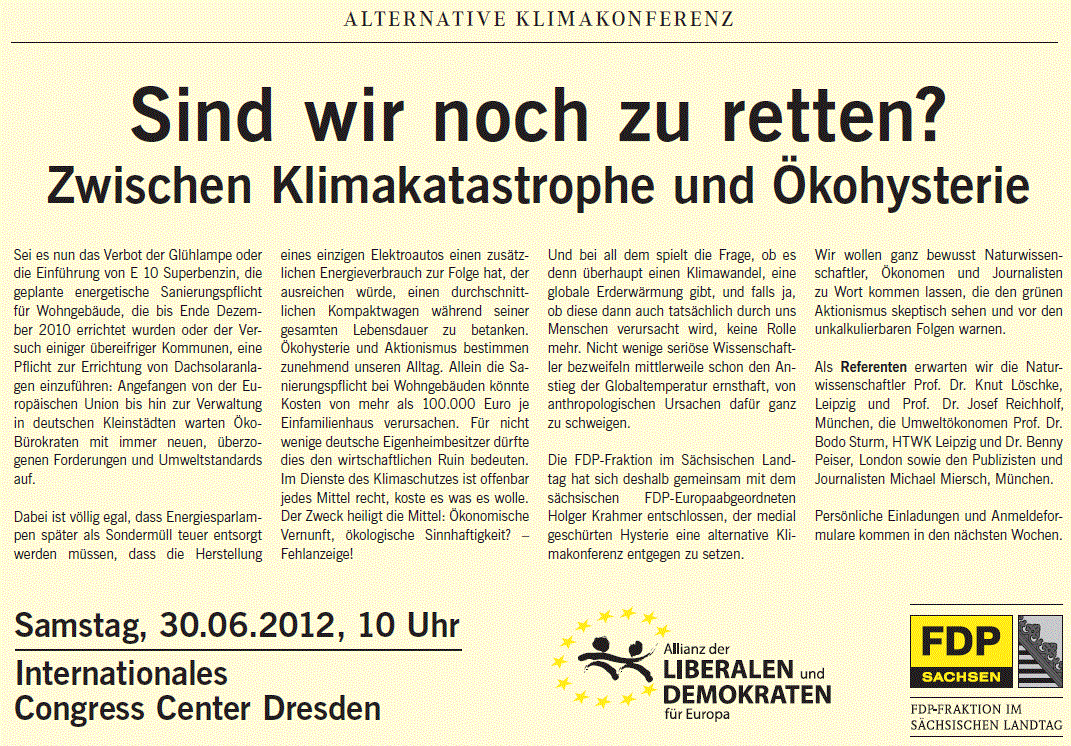
Watershed Conference…German Coalition Government FDP Party To Hold FIRST EVER Skeptical Conference

Hell must have frozen over!
Climate science skepticism in Germany now has spread from a few once marginalized groups over to the junior member of Germany’s coalition CDU-FDP government, the Free Democrats Party (FDP). Hat tip: Ã–kowatch.
Coalition government FDP party invitation questions climate dogma – announces skeptical climate and energy conference.
The FDP is holding a skeptic conference at the end of this month. This is the first time any political party in Germany holds a “skeptic” conference, and thus marks a watershed event in Germany when it comes to climate science skepticism. Make no mistake – it’s a clear signal....


(2) From ICECAP, Joe D'Aleo, 
Records and Extremes -- Updated


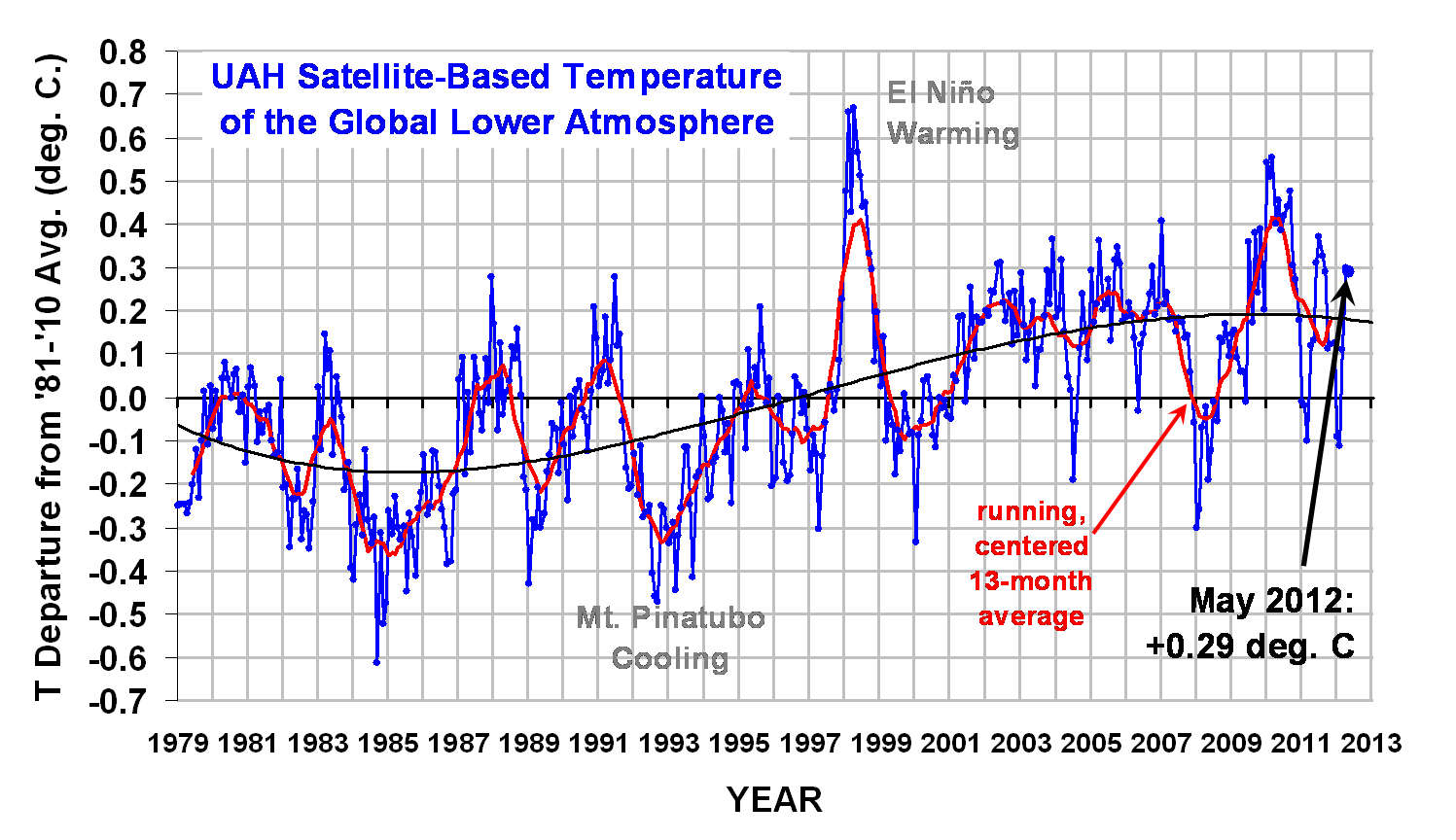
Looking back over the last century, you can explain global temperatures by ENSO and volcanism and the ocean multidecadal cycles that favor a particular ENSO state. Here is the plot since 1979 of all data sets with ENSO and volcanism indicated.


El Ninos bring a short term warming, La Ninas a dip in global temperatures. The warmn mode of
the Pacific from 1977 to 1998, led to a net warming. Major volcanoes produce a cooling as we
saw in the early 1980s and early 1990s, lack of volcanism (like we have seen since the middle
1990s) means more solar radiation at the surface and enhanced warming.


(3) From Dr. Roy Spencer,
UAH Global Temperature Update for May 2012: +0.29°C
June 4th, 2012
The global Average lower tropospheric temperature anomaly for May 2012 (+0.29 °C) changed little from April (+0.30 °C), with some warming to near-average temperatures in the tropics being balanced by a little cooling in the Southern Hemisphere (click on the image for the full-size version):

On IPR Abolition 15: Motorcycle Patents

I watched with awe photos of a new motorcycle, patented of course, from my friend Jules Calagui's fb photo album. It's the Yamaha 125 cc Moegi motorcycle. It can run up to 80 kms in one liter of gasoline, wow! Gimme, gimme, gimme.


The initial price should be high, to compensate for the high costs of all R&D that went into this motorcycle. Fuel efficient, light, can be fast too.


From one review, Yamaha Y125 Moegi Motorcycle Concept Unveiled:
This hybrid motorcycle is made of aluminum, with a mono-cylinder engine that can propel the bike to speeds in excess of 50 mph. The 4-speed transmission makes sure this is possible, but its lightweight is the main factor – a stunning 176 pounds. The fuel consumption is incredibly low, just 188 mpg, thus it perfectly fits resident communities. It’s just a low possibility to notice this concept on the highway, but the city limits can easily be explored riding a Yamaha Y125.

More patented or patent pending, motorcycle designs and parts. Upper right photo below, is Ducati's "frameless motorcycle". Lower left photo, another Yamaha hybrid motorbike, not sure if the patent has been granted already, but from a review I saw in July 2009, its patent was still pending.


Innovation and creativity, producing and manufacturing something new and revolutionary. These are being rewarded by the intellectual property rights (IPR) and patent system. Because not all ideas are the same, the same way that not all dogs, not all birds, not all people, are the same. Mediocre and idiotic ideas are plentiful, they do not need protection. Bright ideas are scarce, they need protection.

On a lighter note, some funny (except the lower left photo) motorcycle designs -)


* See also:
On IPR Abolition 9: Seed Patent and Explosion of Seed Varieties, June 14, 2011
On IPR Abolition 10: Debate with Mises Blog IPR Abolitionists, June 14, 2011
On IPR Abolition 11: Trademark and Brands, September 05, 2011
On IPR Abolition 12: Patent, Mini-Monopolies and Trademark, September 20, 2011
On IPR Abolition 13: Protecting Bright Ideas from Mediocre Ones, March 07, 2012
IPR Abolition 14: Mises Group and Anti-IPR Propaganda, April 19, 2012

Tuesday, June 12, 2012

Independence Day, Andres Bonifacio and Liberty

Today, June 12, is Philippine Independence Day, a national holiday to celebrate the Philippines' independence from Spain on June 12, 1898. Of course we never really got independence from the Spaniards as the Americans immediately took over as the new colonizers in 1898.

Below, the three key personalities of the Philippine Independence movement against Spanish colonization. Top row, Andres Bonifacio, the father of the revolutionary movement, Supremo (supreme leader) of the Kataas-taasang Kagalang-galang Katipunan ng mga Anak ng Bayan (KKK) or simply the Katipunan.

Second row, Jose Rizal, the national hero. An intellectual, physician, wrote two books sarcastic to the Spanish colonizers, "El Filibusterismo" and "Noli me Tanghere", executed by the Spaniards.

Third row, Emilio Aguinaldo, considered the first Philippine President in 1898 in a declaration made in Kawit, Cavite. He and his Magdalo faction of the Katipunan ordered the execution of Andres Bonifacio in May 1897.


Last June 01, 2012, Prof. Michael Charlestone "Xiao" Chua of De La Salle University (DLSU) History Department (but he graduated from UP, also pursuing his PhD there) gave a talk to the club, "Undress Bonifacio: Paghubad sa Mito ng Bobong Supremo" (Undress Bonifacio: Exposing myths of a stupid supreme leader), held at Metro Club, Rockwell, Makati.

I thought that Michael would look down on Andres Bonifacio, he did the opposite. He said that unlike common conceptions (or misconceptions) and beliefs about the man, Andres Bonifacio was:

1. Not the typical bolo-wielding leader in many monuments around the country. Rather, the person there was a typical Katipunan rebel who revolted against Spain.

2. No ordinary worker-leader, he was a middle class worker in an British company and could speak, read and write English;

3. Was an intellectual, he read many books about the French Revolution, Napoleon, American Revolution, Rizal's two books, other literatures.

4. The first Philippine President when he reorganized the Katipunan from a secret rebel group to an open revolutionary government with himself as the Supremo, set the date of simultaneous armed uprising against Spanish forces. This was around August 28, 1896. 


I learned many things from Prof. Chua's talk. It so happened that our club's name is RC Taguig Fort Bonifacio, a former AFP camp called Fort (Andres) Bonifacio. From his talk, I was convinced that Bonifacio was indeed the first President of the Philippines and not Emilio Aguinaldo.

Group photo after his talk. Standing, from left to right: me, PP Niel Antonio, President Norlan de Leon, Prof. Chua, PN Eric Lucero, Basil Semilla and Prof. Chua's colleague at DLSU.
Sitting, from left: Secretary Meann de Leon, PE Rose Antonio, Prof. Chua's staff.


Prof. Chua also showed various writings by Andres Bonifacio that were relegated by mainstream education about the Philippine Revolution. For instance, for Bonifacio, to love the country, the community, oneself, is not so much to launch a revolution, but in doing one's work with honor and dignity. Honesty, dignity, integrity, these were some of the central teachings of Bonifacio and other Katipunan leaders then. These could be traced to their being FreeMasons. My Mason friend, Ozone Azanza, says that it is very basic and simple to become a Mason -- be a responsible father and husband, able to provide the needs of the family, has humility and personal integrity. Amen to that.

I would add that somehow these are also among the important teachings in Rotary although following the "Four Way Test" remains the prominent teachings and motto of Rotarians.

Advancing the philosophy of freedom and liberty, individual freedom and national independence, more personal responsibility and integrity, are among the important teachings of the anti-colonialism independence movement then which remain to have high relevance today. Personal  independence from colonizers, politicians and the high priests of coercion and deception. They remain an important challenge for liberty minded writers and propagandists.

PhilHealth Watch 11: Is PHIC an Insurance Company?

The Philippine Health Insurance Corporation, PHIC or simply PhilHealth, is a government-owned and controlled corporation (GOCC) created mainly to provide "universal healthcare" for the Filipinos. But the healthcare that it provides and subsidizes since its creation in 1995 is only for "inpatient" or hospital confinement for at least 24 hours. Thus, if a Philhealth member-patient goes to a hospital emergency room (ER) to have a check up say of fever or minor wound, then goes home after, the patient will not get any Philhealth subsidy or ER bill deduction.

Philhealth intends to provide outpatient benefits to all members by around 2016. In some areas I think, Philhealth subsidizes outpatient services but only for a very limited number of patients, sort of an experimental phase.


A fellow free market writer, Benson Te, posted this yesterday in his blog:
----------

Does your Philhealth Contribution Help the Poor?
June 11, 2012.

There has been this politically correct idea which attempts to rationalize private sector contribution to the Philippine national health universal coverage as having a charity effect of helping the underprivileged or the needy.

Let us examine if this claim is valid.

First what is PhilHealth?

From Wikipedia.org, (bold original)
The Philippine Health Insurance Corporation (PhilHealth) was created in 1995 with the aim of placing a renewed emphasis on achieving universal coverage. It is categorized as a tax-exempt, government-owned and government-controlled corporation (GOCC) of the Philippines, and is attached to the Department of Health. It states its goal as insuring a sustainable national health insurance program for all.
So the essence of Philhealth’s function is supposedly a “national health insurance program”

But does Philhealth’s concept of insurance match with the real definition of insurance?....


Is Philhealth an insurance company?

No it isn’t. There is NO equal sharing of risk and thus is NOT qualified as an insurance company in the conventional terms.

Instead, Philhealth is a health coverage WELFARE program (verbally embellished by the term "insurance") funded mainly by taxpayers and complimented by an employment MANDATE (or as a form of tax on BOTH the employer and the employee).