Sunday, May 24, 2015

Bus Thieves and the PNP, Part 2

Here is a continuation of my tweet exchanges with some PNP offices after I lost my wallet to bus theft/thieves four days ago. I noted in Part 1 that "I think the PNP national and regional offices are trying to be responsive to citizens' online reports and complaints." 


I am happy that the three PNP offices were responding to my concern.


I did not go back to Makati Central Police Station anymore. I think there is no need for a blotter report as these tweet exchanges are sufficient, they involve three PNP offices -- PNP national hotline, NCRPO and Makati Police. And as I stated and tweeted above, I was not asking for an investigation because the facts are hazy: I don't even know how many (1, 2 or more?) bus theft/thieves that night, I don't even know their faces, height or built, I don't know where they got off after, I don't even remember the Manila busline that I took, etc.

I only complained why the PNP Makati would refuse taking a report from a Makati resident simply because I discovered or noticed the crime done unto me when I was already in Cubao area. For me, katamaran  lang yon eh. After the PNP National and regional offices have intervened, PNP Makati softened and asked me to come back and make the blotter report. Thanks for the invite Sirs, I appreciate it nonetheless.

And thanks once again to  PNP hotline, PNP NCRPO, PNP Makati, for responding to such citizen complaint.

On another note, I  think the PNP, national and regional offices, should improve their intelligence gathering of bus robbery and even bus hold ups. I am sure there are many other victims who did not bother to report to the PNP via police stations/precincts, or via social media like twitter.

They should be more pro-active, get more info about those criminals. Like I heard from some friends who were also victims of bus robbery in the past, that for north-bound buses, the criminals usually do the hold ups between Ayala Ave, or Magallanes to Estrella in Makati, get off at Estrella. Why there? Because there are no policemen or MMDA officers in Estrella bus unloading areas.

To get public respect and support, the PNP should make our streets, buildings, buses, jeepneys, etc. more safe from criminals. The frequent complaint that I hear or read, and which I also agree with, is that the PNP is busy apprehending non-criminals like motorcycle drivers on slippers or not wearing helmets. And the real criminals are more free doing their public harassment and robbery. I sincerely hope that the PNP can turn their attention and guns on the real criminals. That is what they are hired and paid for from our taxes.
------------

See also: 
Car plates and power trip, Part 2, July 06, 2011

Saturday, May 23, 2015

BWorld 3, UHC via Health Voucher System

* This is my article yesterday in BWorld.


THERE ARE MANY claims and complaints that (a) the health condition of Filipinos is “deteriorating” because of rising inequality, and (b) because government health spending is not big enough. Thus, the goal of universal health care (UHC) for Filipinos will remain an illusion.

Are these statements true and correct? Two charts below will provide some answers to these questions above.

LIFE EXPECTANCY
If people evade or survive various infectious diseases, if they can deal more effectively with non-infectious diseases, then they can live longer, work and enjoy life longer. (see Figure 1)

Figure 1: Life expectancy in Asia, 1970 and 2010 (in years)


On May 14, 2015, I attended the Department of Health (DoH) consultation with civil society organizations, on the proposed DoH 2016 budget. This chart was among those presented by the DoH. Its budget has been increasing rather fast, rising by almost P10 billion a year from 2010 to 2013, then by around P18 billion a year from 2014 to the proposed 2016 budget. (see Figure 2)

Figure 2: DoH Budget, 2010 to Proposed 2016 (in billion pesos)


DOH BUDGET
Only the Department of Social Welfare and Development (DSWD) has a comparative huge jump in the annual budget as the DoH, because of the expansion of the conditional cash transfer (CCT) program. The big annual increase in DoH budget is also tied to the CCT program as the DoH has significantly expanded PhilHealth coverage and subsidy to the poor, particularly those who are CCT beneficiaries. So it is a DSWD-DoH “tag team” that has been given high priority by Aquino administration.

The huge increase in the proposed 2016 DoH budget is mainly to increase the MOOE by P11.75 billion, and it is targeted to finance expansions in (a) Subsidy for health insurance premium payments of indigents and senior citizens, P6.72 billion, and (b) Implementation of the Doctors to the Barrios and Rural Health Practice Program, hiring of UHC implementers, P2.83 billion. (see Figure 3)

Figure 3: Budget increase from 2015 to proposed 2016 (in billion pesos)


Going back to the two questions above, (a) are Filipinos’ health conditions deteriorating, and (b) is government health spending not big enough?

No to both questions. The fact that Filipinos’ life expectancy keeps rising means that less people are dying in each age bracket. They live and work longer on average than their parents and grandparents.

Note also that Figure 2 shows only increases in the DoH budget. Other agencies and departments also have rising health spending, like the following: (a) Philippine General Hospital (PGH) which is under the UP budget; (b) AFP and Veterans Hospitals, which are under the DND budget; (c) PNP Hospital which is under the DILG budget, and so on.

Furthermore, almost all provinces and big cities have their own provincial or city hospitals. The luckiest of them all is the city of Manila: it has six city-owned hospitals, three DoH hospitals and the UP PGH. Ten government hospitals in one city, four national and six local, while some cities do not even have a single hospital. So when people talk about “health inequality,” government itself is a major contributor to it.

The voices of “more public health spending” never die out, they even rise every year. But is government direct provision of health care the most appropriate way to achieve UHC?

HEALTH VOUCHER SYSTEM
Here is a counter-offer. The DoH will still get huge money from taxpayers and Congress. It will still be the lead national agency in ensuring UHC. But there will be some difference in these mechanisms.

One, DoH will no longer be the direct provider of health care via its hospitals, free or subsidized medicines package, and indirect subsidy to poor people via PhilHealth enrolment. Instead, all hospitals will be private, all DoH hospitals will be privatized (not abolished).

Two, DoH will be giving health vouchers to all households nationwide, rich and poor alike as all households are taxpayers, whether via direct income taxation or indirect consumption taxation (VAT, excise tax on fuel, etc.). Say a flat rate of P15,000 per person per year, regardless of age. So a household with four members (parents + 2 kids) will get a P60,000 health voucher per year. The household can buy a private health insurance, HMO or hospital, that will take care of them for one year based on certain health packages, including the annual general checkup.

Lousy and insensitive insurance firms will lose customers and go bankrupt. Competition among players and vouchers for the poor that are as good as cash will empower them, and arrogant insurance firms cannot easily disrespect them. Richer households who want bigger insurance coverage will simply buy a higher annual package and they just pay the balance between the higher cost minus the vouchers issued by the DoH.

Three, if none of the family members gets sick for the year, the balance between the value of voucher minus the cost of annual general check-up can be converted into cash by the household.

This is important. Why? The households will have the incentives to take good care of their bodies. Young kids can tell their parents like “Papa/Mama, please do not smoke or drink too much, so you don’t get sick often, so we can have extra cash at the end of the year, then you can buy us more food or more clothes and toys.”

At the moment, people are “rewarded” with government subsidies if they get terribly sick and hospitalized . If they do not get sick for one whole year, they do not get any subsidy despite the huge tax money at the DoH and its various hospitals, national and regional offices yearly.

The voucher system with redeemable cash reverses the incentives system. If people get sick, they can still be covered by the health voucher; but if they take good care of their health and do not get sick, they can have cash at the end of the year.

This is a win-win situation for both the DoH and the public. The DoH will still get its huge annual budget including its share from the huge sin tax, the public will get the money via health insurance and/or redeemable cash.

Bienvenido Oplas, Jr. is the president of Minimal Government Thinkers, Inc., a Manila-based think tank advocating free market economics.
------------

See also: 
BWorld 1, PH Economy and Politics, Is there a Disconnection? April 24, 2015 

BWorld 2, Benefits of Trade Liberalization for the Philippines, May 16, 2015

Friday, May 22, 2015

Free Trade 48, WTO DG Azevedo in Manila

Yesterday, I attended a Roundtable Discussion with the Director General  of the World Trade Organization (WTO), Roberto Azevedo. Main organizer was the Department  of Foreign Affairs (DFA), but the  one that did Secretariat work was the T/A Trade Advisory and Trade Lawyers Group. Venue was the ADB so key ADB officials like  ADB President Nakao and VPs were there.

Below I will repost tweets and RTs made by Trade Lawyers @TradeLawyersPH. I am also posting some photos during the cocktails after the forum. Thanks to Gene Gregorio, Trade Lawyers for the photos. Not one of  them  from my camera phone.
-------

Opening Remarks by Amb. Conejos: DG is a charmer.

@WTODGAZEVEDO speaks on future prospects of trade and how @wto supports growth and development

Standing still on trade agreements can actually mean losing ground.

The Philippines now ranks with India on technology services.

The Philippines has been a champion of trade.

The panel: World Customs Organization (WCO) Secretary General Kunio Mikuriya, ADB Pres Takehiko Nakao, Chamber of Commerce of the PH President Jose Yulo, and Fed.  of Free Farmers (FFF) Pres. Raul Montemayor.


WCO Kunio Mikuriya: WTO is serious negotiation; WCO is pragmatic implementation.
on ASEAN Integration: We support connectivity. Customs is about connectivity.

Raul Montemayor: Trade is not the sole answer to food security. The strategic approach is to help farmers become more productive.

Jose Yulo: WTO should come to the aid of the losers of free trade.
on free trade: With free information exchange, "every one will get the piece of the pie

Open Forum

Dr. Roehlano Briones comments on disciplined food security.

Prof. Frederico Macaranas asks, what's the best case scenario for environmental sustainability in trade & services?

(1) @WTODGAZEVEDO on food security & environmental sustainability: No one bullet that will shoot all issues.

(2) The aim is to make gradual, progressive nd marginal steps to the right direction.
----------

Mr. Azevedo's speech yesterday is posted by the WTO here.

Some cocktails photos.
Below, from  right: Dr. George Manzano of the Univ.  of Asia and the Pacific (UAP), Gene Gregorio, Dr. Roehlano Briones of the PH Institute for Development Studies (PIDS), me.


Another photo with Gene. To my right are Tony Abad of Trade Lawyers and his buddy, sorry, forgot his name.


Another photo with Kristine Alcantara, one of three founding partners of AAA Law office (Abad, Alcantara, Aquino). Not in the photos is Gretchen Aquino.


Thanks again Tony, Kristine, Gretchen, for the invite. My longer article will be published in BusinessWorld, next week. Cheers.
------------

See also:

IPR and Medicines 33, Geneva Network's Forum in Singapore

Our friends and allies, Geneva Network (UK-based) and Southeast Asia Network for Development (SEANET, Malaysia-based) held a forum yesterday morning in Singapore on the TPP, Health and IPR. 


Background of  the forum:

This week, trade negotiators from some of the world’s most powerful economies are meeting in Guam to thrash out the final stages of the Trans Pacific Partnership.  This free trade agreement – which in Asia includes Singapore, Malaysia, Japan, Vietnam and Brunei – stands to become a significant milestone in the deeper integration of the global economy.

Despite the economic potential of the TPP, one of its cornerstones – stronger intellectual property rights – remains controversial, with health NGOs claiming it will impact public health by raising the price of medicines.

To what extent are such fears justified? Why is intellectual property in this trade agreement important for the future of medical innovation? And what does the TPP mean for health in the Asia region?

The speakers yesterday were:
(1) Prof Elizabeth Siew Kuan Ng, Faculty of Law, National Univ. of Singapore (NUS)
(2) Philip Stevens, Director, Geneva Network, UK
(3) Bill Claxton, Carcinoid & NeuroEndocrine Tumour Society
(4) Andrew Spiegel, Global Colon Cancer Association, and 
(5) Mo Mayrides, Associate VP, PhRMA, USA. 

Moderator was Dr. Debora Elms, Executive Director, Asian Trade Centre, Singapore.


I am reposting below tweets by  @SEANET_asia yesterday. All photos here are also from SEANET. Come, follow SEANET on  twitter and facebook, thanks.

(1) Prof Elizabeth Ng begins by introducing the countries involved in #TPP and how negotiation will impact the countries.

No one should begrudge that patent owners deserve adequate protection of returns from investment of considerable resources.

TPP Provision : Patent term extension, data exclusivity, including biologics and patent linkage.

It's often argued that stronger IP foster econ growth, but counter agreement is flow of FDIs is not solely on property rights.

What are challenges to incorporate in regional system?

1. Restriction on trips flexibilities eg: data exclusivity
2 : Lack of skilled patent examiners and other skilled workforce.
3. Access to medicine for the poor : price increases and lack of access to affordable generics.

#ASEAN #TPP countries - how do you further enhance corporation with AEC happening when only 4 ASEAN countries are involved?

The tension between patent protection and access for public health is unlikely to abate.

it is understandable the pharma industry feels justified to seek stronger patent protection

Protection and access must be appropriately calibrated in order to achieve balance between public interest and private interest.

(2) Philip Stevens from @genevanetwork : It's unlikely that there will be changes to the provisions on data inclusivity for chemical drugs.

If #IP protection increases in Malaysia, companies will set up R&D facilities.

No one has done cost benefit analysis on the impact heightened #IP provisions on the availability of medicines in developing countries.

There is a positive relationship between trade liberalisation and better health outcomes.

How? Economic liberalisation increases incomes - allows people to get better nutrition and sanitation.

(3) Bill Claxton of Carcinoid & NeuroEndocrine Tumour Society discusses how innovative medical care has improved his life.

As a patient advocate, I have become increasingly impressed with how pharmaceutical companies support patient groups.

#TPP we need to protect innovators and incentivise their efforts.

Clinical trial can't work for rare diseases. Many trial fails because of trial designs.

If you look at the debate of 5/7/12 yrs for data protection - it won't make a huge difference in rare disease community.

We are looking for a balance between protection and access between public interest and private interest.

(4) Mo Mayrides, Assoc VP of PhRMA representing industry views on #IP in the #TPP

I don't see how the #TPP would deny governments the right to public health access.

(5) Andrew Spiegel from Global Cancer Association who traveled from Philadelphia to attend the panel this morning

Patients that are diagnosed with colon cancer are living longer and more comfortably as a result of innovative biological drugs

Biologics have had tremendous impact on medicine, but there is still a long way to go

Investments will not occur in medical technology if there is no #IP protection

The scary part is if innovation stops, we would rather medicine get delayed into market than not being made all.

Open Forum, questions:

(a) Biggest barrier to #TPP is American public opinion. Do all patient advocacy groups align w your perspectives?

Andrew : Declaration of support among patient advocacy groups on #IP protection, 100 groups signed and delivered to President Obama

Bill Claxton:Patient groups are not well informed on this issue. It is possible to get a consensus view.Patient advocacy is an emerging area.

Dr Elms : Hypothetically, there is some time for patient groups to get mobilised by end of the year.

(b) Question ; How long does it take for medicine to be made and the cost?

Mo : Study from Tufts University - Cost is 2.6 USD Billion and takes 2-6 years to develop. Takes 7- 8 years before any return on investment.

Critics will say the cost is overblown. But costs have gone up in recent years.


I was supposed to attend that forum yesterday. Geneva Network's Director Philip Stevens invited me. But before I purchased my plane ticket last Saturday, an invite came from T/A Trade Advisory and the DFA, WTO chief in Manila, a "by invitation only" roundtable discussion, updates about the multilateral trading system, same day. I chose the later, no cost to me and the SG organizers.
-------------

Thursday, May 21, 2015

Bus Thieves and the PNP

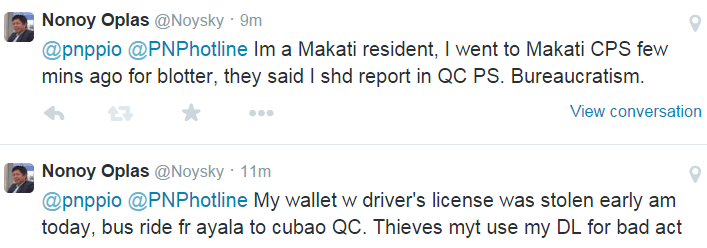
Yesterday morning, I left the office in Makati around 2:20-2:30am. I was going to our farm in Bugallon, Pangasinan. I took an an aircon bus going to QC around 2:30 am, I briefly slept. When I woke up somewhere in Cubao Farmers Plaza, I was shocked to see that my wallet is gone, my pant's right front pocket was slashed. First time in my life that I was victimized by bus thieves.


I posted this in facebook, courtesy of bus wifi. I was supposed to cancel my trip as I have no more money to pay for the bus fare to Pangasinan. But I called up the farm caretaker and asked if he has money, he said yes, so I I talked to d bus conductor, 5 Star bus, that my payment will be upon arrival. He saw my slashed pant, he agreed. 

My cp was in my left front pocket, it was not slashed. I think I slept for only 10 mins. The theft/thieves was/were quick I didn't feel it. I was tired n sleepy coming from  the office. Just small cash in my wallet but I must get a new drivers license, bank ATM, HMO and SSS cards. Asar lng.

I went back home in Makati around 10:45pm. Then I went to Makati Central Police Station around 11:30pm. Purpose is to have a police blotter of the loss of my wallet and driver's license. I was told by the attending officer, SPO3 Gutierrez at the Investigation Division I think, that I should report for blotter at QC Police because I discovered the loss when the bus was already in Cubao area, QC. I explained that I was not asking for an investigation, just to have a blotter report that my driver's license was stolen and might be used for other bad activities by the criminals. The officer insisted that they should not record it.

Sabi ko, I'd rather tweet this to the PNP. "Ano'ng tweet?" he asked, I explained that the PNP has a twitter account. I'd rather report there than travel again to QC especially that it's midnight now. PNP bureaucratism minsan, tamad lang sila mag record, tapos sabihin "we serve and protect."

A friend, Norman, made this observation.

Happy you were not harmed, my friend. Di ko ma-gets yung refusal nung police sa Makati na i-blotter yung kaso mo. Pwede rin naman ilagay niya na rin sa blotter nila even as he suggested na i-report mo din sa QC. Wala naman mawawala. Simple lang naman ang pag-blotter. He would at least have "served" you. Sa totoo lang, hindi ko nga alam ano ang kinahihinatnan ng mga blotter-blotter na yan. To me, it's just a pakitang-tao na serbisyo actually. Ganun pa man, di pa rin magampanan ng maayos ng iba sa kanila. There's really something wrong with the mindset of our police force. 

Here's my tweet to  the PNP last night.


This morning I am happy to see that the PNP replied to my tweet-report, better and more transparent than blotter report in a city police station.


I think the PNP national and regional offices are trying to be responsive to citizens online reports and complaints. 


I will make a follow up blog post later. 

To my friends who liked, commented in fb, thank you all. Yes, am happy that I was not harmed. If I woke up while he/they were slashing my pant and if I reacted adversely, he/they might have stabbed me, and that's a bigger problem.

Tuesday, May 19, 2015

Pol. Ideology 62, Marx and Hayek on Property Rights

Nearly six years ago, I presented this paper in a seminar on "Freedom and Property" in Manila, sponsored by the Friedrich Naumann Foundation for Freedom (FNF) Philippine Office.


Yeah, I recalled my UP student activism days in the 80s, when the Maoist Nat-Dems were the dominant leftist groups, but our small group dissociated with their ideology as we read more Marx and Lenin, not Mao Tse Tung :-) I re-read portions of "Das Kapital"  and "The Communist Manifesto" in making that presentation.


Recognizing the mistakes of Marx' analysis contributed why I abandoned the Marxist ideology. And later embraced the philosophies of Adam Smith, Friedrich Hayek, Mises, etc.


Property Rights Alliance's (PRA) annual IPRI Reports are good materials in the study of how countries and economies respect or disrespect private property ownership and control, both physical and intellectual property.


My first published article in BusinessWorld was in November 2007. (This year I have two articles already in that newspaper, a 3rd article coming up this Friday :-))


The full text and presentation is available in my slideshare page.

I posted this paper because next week, I will be a reactor to a mainly socialist paper presentation on "Alternative Economic System", with a largely socialist audience. No problem with me, I don't evade any debate, civil debate. Excitng.


See also: 

Agri Econ 20, On NFA-BOC Campaign for Expensive Rice

For consumers, cheap is preferred to expensive, more is preferred to less, it's a no brainer. For many Filipinos, they want cheap rice. And cheap rice is readily available from our neighbors Vietnam and Thailand, and soon, Cambodia, Laos, possibly Myanmar.

Nature, not politics and governments, determines who has better resources for growing rice. (1) Rice land area, Thailand for instance has almost 3x that of PH's. (2) Exposure to strong typhoons, TH and VN get perhaps only 5 storms a year vs. PH's 20, of which half make actual landfalls and cause direct damages; (3) Irrigation, they have the huge Mekong River, Ton le sap river, others as they are in one big landmass, vs PH's archipelago.

If politics and populism is set aside, we should be better off, a lot better off, if we have free trade in rice. The National Food Authority (NFA)  should get out of its marketing function. Doing regulatory function should already keep their hands full of work.

A friend from UP and now NFA Administrator, Renan Dalisay, posted this photo yesterday in his fb wall with this note,

Hit the ground running with the new BOC Commisioner Bert Lina discussing how to tighten coordination with NFA to curb rice smuggling. ‪#‎nfatungosapagbabago ‪#‎bantaybigas ‪#‎sulongbigas


From right: Renan, Sec. Kiko Pangilinan, new BOC Commissioner Bert Lina, don't know the 4th guy. Posting this photo without Renan's permission but I think he won't mind, he believes in transparency and freedom of information by the public.

I commented at Renan's wall that the NFA and Sec, Kiko's offices should focus their energy to liberalize rice trading as rice prices in Thailand and Vietnam can be up to 1/2 of PH prices. They should institutionalize free trade of rice and not glorify expensive rice.

Am sure the BOC and NFA will protest the title of this paper, which is understandable. But I think they should also recognize that rice smuggling happens because there is huge demand for cheap rice. The current implicit policy of the PH government is to make cheap rice from  our neighbors become expensive via rice protectionism: rice import quota, rice tariff of up  to 50 percent I think, bureaucracies to get import license, etc. Then government turns around and subsidize expensive rice to make it "cheaper" and announce it to the public.

I am not defending smuggling of rice or other imported commodities. But I am not defending or supporting the government too in its rice protectionism policy. 

IRRI's Dr. Bruce Tolentino, other Filipino economists from PIDS, UPSE, etc. have shown the numbers that protected, expensive rice is wrong and anti-poor. Rice protectionism is a 1960s or earlier medieval policy that is continued and defended by the government and some NGOs until today. Why persist on that wrong policy? Why are rice consumers disempowered to choose and buy cheap rice?

Another thing, that huge NFA debt, about P155 billion as of March 2014 I think. The DOF, DBM and NEDA have already shown that such NFA debt is unsustainable, walang pera ang NFA to pay those debts, all it does is ask money from Congress every year while further building up the debt. Soon, that huge NFA debt will be passed on to the DOF, and DOF will ask for more taxes as the debt stock has increased by a huge amount, need more taxes to pay for principal + interest, annually.

NFA should get out of endless loss-making and passing that debt to all taxpayers someday. It is a lousy arrangement. NFA should stop subsidizing rice to make it "cheap" because cheap rice from our neighbors are readily available.

Administrator Renan, Sec. Kiko, other government agri officials, ibaba nyo na ang presyo ng bigas. Remove politics from rice trade. People will remember you. thank you.
------------

Saturday, May 16, 2015

BWorld 2, Benefits of Trade Liberalization for the Philippines

* This is my article for BusinessWorld Weekender, May 14, 2015.


TRADE LIBERALIZATION means giving the consumers of the importing country more choices, more freedom, where to buy different goods and services at lower prices and/or at better qualities, which help improve their personal/household welfare and work productivity. Liberalization and free trade also give domestic producers, from farmers to manufacturers, more choices, more freedom, to buy different capital goods and raw materials, from hand tractors and motorcycles to machines and industrial robots at lower prices and/or better qualities. Then their agricultural and industrial productivity, including their export competitiveness, is enhanced and strengthened. 


Free trade, therefore, is not only “one-way benefit” for exporting countries and “misery and economic dislocation” for the importing countries. Free trade means net gains (gains outnumber the losses) for everyone engaged in voluntary exchange.

Yet we hear and read until today various voices and complaints about free trade and trade liberalization, like the coming ASEAN Economic Community (AEC) integration. They argue that we should not have liberalized at an accelerated pace, and that we should postpone further liberalization and economic integration unless certain social issues like labor, children, and gender rights are fully protected.

On hindsight, two questions can frame their opposition. (1) Is the Philippines (and other ASEAN economies) better off if the government heeded the protectionist view? And (2) How much exports revenues would have been lost or gained if we did not undertake accelerated, unilateral trade liberalization?

‘GRAVITY MODEL’

There are several trade theories that can guide researchers and readers to answer these questions. Like the classical theory of comparative advantage, and the more sophisticated Heckscher-Ohlin theorem of factor endowment as basis for trade.

It is difficult though to get macro data to plug as dependent variables to get the estimates of potential trade flows, net gain or net loss, using the above theories. We turn to the “Gravity model of trade” to answer the two questions above. A small group of Economics students from my alma mater, the University of the Philippines School of Economics (UPSE) (Alan Arcin, Zaldivar Natavio, Sarah Ugot, and Philip Pandan) assisted me in providing the answers to those questions.

Newton’s law of gravity says gravitational force between the two bodies is positively related to their mass and inversely related to their distance. Meaning, the bigger the mass between two objects, the greater will be the gravitational pull, and the larger the distance between two objects, big or small, the weaker will be the gravitational pull.

Gravity model of trade would be the econometric models for trade between and among countries. The basic model for trade between two countries can take this form,


Where F is trade flow, G is a constant, M is the economic mass of two countries, and D is the distance between them. The subscript i and j represent the importing and exporting countries.

We used GDP sizes to represent M and trade costs to represent D. It is projected, from Newton’s Law, that high GDP sizes increase the volume of trade between countries and high trade costs decrease it.

For a better fitting model, we used other explanatory variables per capita income (PCI) of both countries and control variables such as common borders, language, and membership in regional trading arrangements.

The regression model we used takes this equation, adapted from Achakzai (2010):


Where:
TRDij is the trade flow between countries i and j, and is the dependent variable.

GDP is gross domestic product,

PCI is per capita income (GDP/Population ratio) of countries i and j,

DIST is distance between countries i and j.

The last three are dummy variables:

CONTIG is contiguity, has value of 1 when countries i and j share a common border and 0 otherwise;

CSL is common spoken language, 1 when the population of countries i and j speak a common language and 0 otherwise.

UNI is whether country i has been unilaterally liberalized, 1 when country i underwent unilateral liberalization and 0 otherwise.

With 1,016 data in year 2010 for the ASEAN 4 -- Indonesia, Malaysia, Thailand and the Philippines -- estimation results below show that all variables are significant at 95% confidence interval. The R-squared at 0.528 and Root MSE at 2.299.

The regression results show that each of the six explanatory variables significantly affects trade flow. Here is the simplified interpretation of the regression results:

• A percent increase in GDP leads to a 0.68% increase in trade flow.

• A percent increase in PCI leads to a 0.79% increase in trade flow.

• A percent increase in distance leads to a 0.94% decrease in trade flow.

• If country i is unilaterally liberalized, trade flow increases by 0.67 percent.

• If countries i and j share a common spoken language, trade flow increases by 0.42%.

• If countries i and j share a common border, trade flow increases by 1.84%.

Plugging the values in the regression results, a table accompanying this article shows how low the exports revenues (column 2) of the Philippines would have been if it did not undertake accelerated, unilateral trade liberalization policy. Generally the same results were obtained for Indonesia, Malaysia, and Thailand. It also estimates foregone export revenues (column 4).

If the Philippines and other ASEAN countries adopted protectionism and rejected unilateral trade liberalization, it would have resulted in low amount of trade flows. For instance, Philippine exports to Hong Kong would be only 2% of actual exports, and exports to Singapore would be only 9% of actual exports. And a significant amount of exports would not have been realized if the Philippines did not join unilateral liberalization of the region.

So the answers to the two questions above, (1) Are we better off if the Philippines (and other ASEAN countries) heeded the protectionist view, is NO. And (2) How much exports revenues would have been lost or gained if we did not undertake accelerated, unilateral trade liberalization, the figures vary depending on the trade partners, ranging between 2-3 percent of Philippine GDP in 2010.

Among the implications of these numbers are the following.

One, the numerical values generated are large, they are not “insignificant,” they are sufficient to warrant recommendation of this policy to many developing countries.

Two, non-tariff barriers (NTBs) like various import licensing erected by the Philippines and other ASEAN and developing countries for certain sectors need relaxation if not removal. More trade means more material growth, more jobs for their people.

Three, where there are more trade flows in goods, more trade in services follow. Like banking, insurance, business process outsourcing (BPOs), tourism, mobility of skilled and semi-skilled labor. Trade in services needs further liberalization too.

Bienvenido S. Oplas, Jr. is president of Minimal Government Thinkers, a Manila-based think tank advocating free market economics, and a fellow of South East Asia Network (SEANET), a Kuala Lumpur-based regional think tank advocating free trade in the ASEAN.
-------------

See also: 
BWorld 1, PH Economy and Politics, Is there a Disconnection? April 24, 2015
AEC 12: Workshop on Trade Liberalization at the APF 2015, Kuala Lumpur, April 27, 2015
Free Trade 47: TPP, RCEP and IPR, May 11, 2015