Friday, March 13, 2020

Asian stocks and the virus, Part 2

As of today, the top 3 worst performing stockmarkets in Asia Pacific: (a) Last 52 weeks: TH, PH, ID; (b) Year to date (Ytd, Jan 1 to Mar 13): TH, JP, PH. TH being the worst affected is understandable bec of its high business exposure with China -- investments, trade, tourism. But PH? I think largely because of govt-created hysteria.

Starting tomorrow midnight, March 15 Sunday, Metro Manila lockdown ordered by President Duterte will be implemented. No flights, buses, boats from all provinces going to and from M.Manila. No flights from the Visayas, Mindanao, Bicol, etc., but flights from China allowed. Magaleeeeng sila Duterte and gang.

I am a unhappy and angry at all these hysteria. Duterte officials who advised and pushed him with this Metro lockdown are either paranoid ids__ or trigger happy Martial law lovers.

How many have died so far in PH bec of Wuhan virus? Less than 5? yesterday when M.Manila lockdown was announced, there were only 52 cases nationwide, today 64 total. But it doesn't mean that all of them will die, majority will recover, so why all these hysteria?
------------

See also: Asian stocks and the virus, March 02, 2020

BWorld 417, TNVS and transport competition

* My column in BusinessWorld on March 5, 2020.


Technology- and app-based transport network vehicle service (TNVS) is cool. It is transparent between the passengers and service providers. Passengers know the fare even before they book and confirm a ride. And after they confirmed the ride, they will know the plate number, driver’s name, etc. of the vehicle that will pick them up. On the part of the drivers, they know the names of their passengers, their cell phone numbers, where they are waiting and their destination, cool.

Today I made an experiment to compare prices and estimated pick-up time or travel time. Which means I have installed all the apps of the various TNVS players in my cell phone, but I did not really book a ride with any of them.

Pick-up area was a shop in Bagtikan St., Makati City, destination was SM Makati, Hotel Drive. I conducted this experiment on Feb. 4, 2020, from 8:43 to 8:46 a.m. and here is what I found. (See Table.)


So who’s the “winner” that passengers like me would choose?

I would say all. It depends on passengers’ needs. If they want comfort in an air-con ride because they are wearing formal or corporate dress, or do not want to be exposed to heat and dust, or are carrying heavy bags, they will get a regular taxi, or a GrabTaxi or GrabCar and pay more. If passengers are not picky and just want the cheapest and fastest way to reach their destination, then any of the three motorcycle taxis will do. Note that innovator Angkas has a higher fare because it has brand awareness already whereas the two new players, JoyRide and Move It, have yet to make a brand name familiar to passengers so they must attract them with lower fares.

There should be more TNVS deregulation, give more options and choices to passengers, and there are three possible ways to achieve this.

One, expand the number of players, both cars and motorcycles TNVS, so long as existing rules and Constitutional provisions are followed. It was reported that Uber wants to come back to the Philippines — good. And there should be a fourth or fifth player among motorcycle taxis. Let there be fierce competition among them to attract passengers’ loyalty.

Two, remove the cap or maximum number of cars and motorcycles for all players, expand the supply of vehicles. If this happens, many people will leave their cars and motorcycles at home and stop worrying about traffic congestion and where to park and not risk being clamped or towed by the MMDA (Metropolitan Manila Development Authority) or LGUs. Finding safe pay-parking fast is among the big headaches for many motorists now. Sometimes travel time is shorter than finding a parking slot, especially in BGC Taguig area.

Three, if government cannot remove the cap, then it should optimize the utilization of that cap. In TNVS cars for instance, the LTFRB (Land Transportation Franchising and Regulatory Board) has put a cap of 65,000 vehicles but it is not optimized this as only 55,000 slots have been opened while 10,000 slots have yet to be awarded. And of these 55,000 cars, some have become inactive and their slots are not quickly filled by new aspiring drivers with their own cars.

Price and fare competition will be assured by the three measures above. Passengers then have to be assured of good safe service — that they will not be involved in accidents, sexual harassment, or driver bullying. In the same way, drivers should also be protected from bullying or criminal passengers.

Companies and TNVS players should announce to the public the kind of training they give to their partner drivers. Like requiring them to undergo and complete exercises in training center/s — learning how to drive in potholed, muddy and pebbled roads, wet and slippery roads, navigating roads when there are accidental oil spill, etc. Passengers will be more at ease with drivers who are better trained.

Government regulators like the LTFRB should recognize established brands who want to join and expand competition. Normally these established brands are the ones more careful not to be involved in accidents and shenanigans because they have been there for many years. A few accidents or sexual scandals involving their vehicles and drivers can erase the goodwill they have earned over many years.

Government should allow and expand competition among players, be competition-friendly. But when frequent accidents or trouble occur among certain player/s, government should come down hard to penalize violators or less-responsible players. Government then should be accidents unfriendly.
----------------

See also:

Wednesday, March 11, 2020

Covid reflections, Part 2

When President Duterte declared a state of national health emergency last Monday, there were only 10 cases nationwide, today 30+ total.  Then Albay Cong. Salceda proposed lockdown of entire Metro Manila for one week – close NLEX, SLEX, Cavitex, other connecting roads, no provincial buses, no domestic flights from Manila. Very irresponsible. I even proposed that we go out of MManila, drive far away in the provinces as oil prices are dropping fast and local tourism is needed.

Last time there were about 25 deaths due to lambanog poisoning in Laguna, there was not even municipal or Brgy health emergency. 25 deaths of mostly able bodied men, vs 1 Covid death of a 70+ man.

DOH+Salceda vs DOT. The former hypes the hysteria many times, the latter tries to calm and limit the hysteria. The overrated legislator from Albay, Cong Salceda proposes lockdown of M.Mla. Between the two, I side with DOT.


As of last today, PSE is the 2nd worst performing stock market in Asia ytd (Jan 1 to March 11). TH -20.9%, PH -18.7%, ID -18.2%,... Then "classless society" nationwide this week declared by the President, etc. More hysteria means econ dislocations, more poverty. 

The RITM ER is swamped by so many scared people, coughing or not. Now private hospitals' ER are swamped too. My only consolation is that a few Duterte officials refuse to join the hysteria, like Sec. Mon Lopez of DTI and Sec. Berna Puyat of DOT (both fellow UPSE alumni). We should go out to provinces and help domestic tourism and agribusiness, not hysteric lockdown proposal from an overrated Congressman. Schools should be allowed to suspend classes or not, not nationwide order of classless society. Now some people are scared to go to the provinces because if a lockdown will be ordered arbitrarily by a mentally unstable President, they cannot go back home.

Below, two of my fellow BWorld columnists also refuse to join the hysteria/

1. Andrew Masigan, posted yesterday:

Mass hysteria is self generated over the corona virus. There are a lot of panic mongerers out there .... Truth is, infection rate is less than 1% and death rate among the 1% is just 4%. No need to panic, just take the precautions. Fanning the flames of panic does more damage than good.

2. Calixto Chikiamco, also posted yesterday:

I don't agree with the decision to suspend classes until March 14. There has been no evidence here or elsewhere in the world that schools are transmitters of the disease. Data suggests that children are relatively immune to the COVID-19.There is evidence, however, that religious gatherings provide a fertile ground for transmission. That has happened in South Korea and in Singapore. Perhaps masses can be streamed in the meantime. I'm also not sure what suspending classes until March 14 means - if it's to slow down the disease, the government doesn't have the test kits to monitor progression or non-progression. The Philippines is already last to nearly last in the PISA rankings on science and math. Mass promotion will ensure we will be "kulelat" in rankings. As in Japan, cancellation of classes may be a political act, to show that the government seems to be doing something.

In 2 weeks, this Covid will be 2 months old, 3 months if we count 1 month since Dec 2019 that CN did not recognize the problem. And so far only 3 countries are badly affected or badly scared -- CN, KR and IT? The other 190+ countries are still not affected that much? See also some proposals -- govt shd expand more, pay for healthcare plus allowances or living wages of all affected patients. Not far away will be proposals for Covid tax. Big tax to fund big hysteria.

See also: Covid-19, Some reflections, February 29, 2020

BWorld 416, Drug price control and the nanny state

* My article in BusinessWorld, March 3, 2020.


Upon the prodding of the Department of Health (DoH) since last year, President Rodrigo R. Duterte issued Executive Order (EO) 104 last month imposing another round of drug price control, on top of drug price control policy imposed in July 2009.

The new EO reeks of seemingly illegal provisions.

One, RA 9502 or the Cheaper and Quality Medicines Act of 2008, Chapter 3, Section 7, provides for maximum retail price (MRP). Nothing in the law or its implementing rules and regulations (IRR) provides for maximum wholesale price (MWP), and EO 104 targets MWP.

Two, criteria to recommend or impose MRP under RA 9502 are detailed and strict and EO 104 ignored and disobeyed them all and created its own criteria. Drug price control in 2009 also suffered the same arrogance of disobeying the law (see Table 1).


It is safe to say that both EO 821 (2009; Prescribing maximum retail prices for selected drugs and medicines that address diseases that account for the leading causes of morbidity and mortality) and EO 104 (2020; Improving access to healthcare through the regulation of prices in the retail of drugs and medicines) were driven by the politics of envy, because certain innovator drugs are top-selling or most prescribed, their success should be confiscated via price control.

Three, the DoH formula or methodology are meant to favor certain manufacturers with drugs not affected, and certain drug retailers, but not the patients. In some molecules for instance, zero benefit for patients, no significant reduction in retail price even if wholesale prices have been slam dunked by price control.

The politics of envy by a nanny state should not be the guidance in making public policy. The main function of government, the DoH in this case, is to ensure that patients and healthcare professionals have choices among many medicines available, and those medicines are safe, not counterfeit or substandard.

The most expensive medicines are those that do not work, like counterfeits and substandards. A patient’s disease mutates to something more dangerous because it is not treated. And a patient who buys expensive medicines but avoids hospital confinement or surgery and still gets well actually got cheaper medicines. The goal is to get well at the shortest time possible and lowest cost alternatives possible.

Meanwhile, the business and investment uncertainties created by this EO are big. It mainly attacks the innovator companies and their innovator drugs. These companies have the option to pull out their affected molecules so that patients will get “cheap but not available” revolutionary drugs. Available perhaps in Malaysia, Thailand, etc. but no longer in the Philippines. With this COVID-19 scare, we need more innovator drugs, not less. We need those innovator and risk-taking companies more, not less.

EO 104 has about 2-1/2 months before implementation. There is still time for the DoH, legislators, and the Office of the President to withdraw this seemingly illegal and philosophically bankrupt EO. The DoH should focus on having more innovator drugs and molecules in the country, not less, to deal with more dangerous, infectious, and mutating diseases.
----------------

See also:

Monday, March 02, 2020

Asian stocks and the virus

Data as of last Friday, Feb. 20, 2020, markets.wsj.com. I was curious -- the year to date (ytd, ie from Jan. 1 to Feb 28) stocks, TH, ID and PH have worse performance than CN Shanghai, Shenzhen and HK?


Some friends offered various explanations.

1. Albert: China propped up its market. Massively.

2. Peter: You can't really compare the 2 markets directly. The Chinese markets are so much bigger and more important. They have capital that is a lot more patient and more importantly local as well. If you look at our regional counterparts its as if we are completely in sync. The main reason is that our Equities markets are all really small, so a few funds pulling out is all the diff that is needed. Seriously just a billion or two (dollars) can lower the indeces in these markets. It's got to do the liquidity since a lot of these companies are also family or gov't owned so they'll never sell. With a small float, there is more volatility. Hence the big drops as funds pull out their money from emerging markets.

3. Ramon: China also added billions of dollars in liquidity (a QE of sorts) to stall the decline.

4. Bernard: Governance issue: Duterte rants vs water companies (MVP group, Ayala, DMCI) and ABS-CBN quo warranto.

5. Josef: Mas matinding virus si Duterte kaysa COVID19.

And this story,

China gives relief to shield trillions of yuan in bad debt
PUBLISHED MAR 2, 2020, 9:10 AM SGT UPDATED 9:24 AM

Today, Asian stocks have somehow recovered, hope this will continue. I think now that this Covid scare is overrated, hysteria fanned. When the dust would settle, I think it would appear that it's no different from the usual annual flu season in the northern hemisphere that kills thousands of people.

Energy 133, Oil prices decline with Covid scare

Over the last 10 years, we have generally stable world oil and gas prices since 2015 until today, with one price spike in gas in 2019. And world oil prices are falling fast in recent days, WTI now only $44.76 per barrel, natural gas only $1.81 per million BTU. Data from Trading Economics.


Supply-demand dynamics: global oil demand is rising about 1 million barrels per day (mbpd), oil supply by OPEC + Russia declines, this should lead to higher prices but did not happen. Why?
Because of US oil producers and Trump. They just keep the drill baby drill policy, even with ongoing Covid scare. Good job, President Trump.


Meanwhile, coal prices went down deep in 2015-2016, up in 2017-2018, declined and stabilized again since 2019 while copper did in 2017.

---------------

See also:
Energy 130, US crude oil and natgas productionoduction, October 31, 2019 

Sunday, March 01, 2020

BWorld 415, World trade and the virus

* My article in BusinessWorld, February 27, 2020.


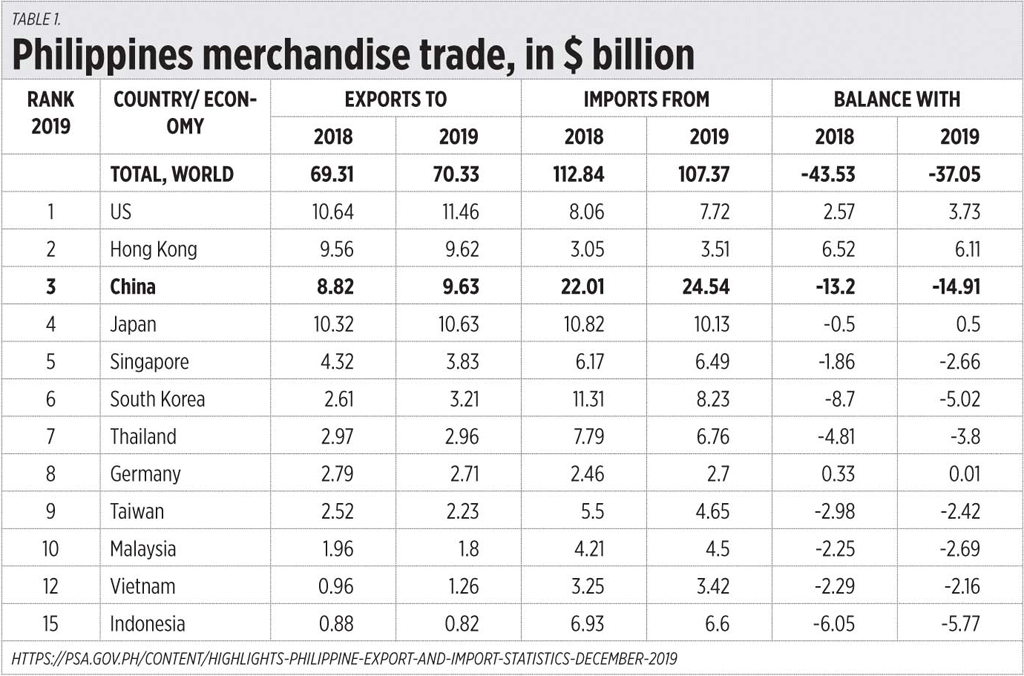
The Philippines’ average merchandise trade deficit in 2018 was $3.6 billion a month, went down to $3.1 billion a month in 2019. The US and Japan remain the Philippines’ main exports market while China remains our main source of imported goods.

While we have generally balanced trade with the US, Japan, and Germany, that cannot be said of the rest of our Asian neighbors including our ASEAN partners. Our biggest trade deficits are with China, South Korea, Indonesia, and Thailand (see Table 1).


The main reason for this is that while tariff rates with our Asian neighbors are declining — with zero tariffs within the ASEAN — the non-tariff measures (NTMs) are increasing. The challenge for freer trade should focus on these NTMs.

In global trade, data from the World Trade Organization (WTO) show that the top three players are also the biggest economies in their respective continents — China, the US, and Germany. But the US suffers the biggest trade deficit overall, with an average deficit of $2.6 billion/day in 2018, while China and Germany have an average trade surplus of $1 billion/day and $0.8 billion/day, respectively.

In the ASEAN, our five neighbors belong to the top 30 world exporters and importers in 2018. Meanwhile, the Philippines ranked No. 47 in exports and No. 34 in imports (see Table 2).


We now go to the spreading coronavirus. China, the exports powerhouse, is also ground zero of SARS-CoV-2 (severe acute respiratory syndrome coronavirus 2) which causes Coronavirus Disease 2019 (COVID-19), and the economic dislocations there in the first two months of 2020 are huge, with many big cities looking like ghost towns and having minimal economic activities including near-zero manufacturing.

China’s exports are other countries’ consumer goods or raw materials and intermediate goods, even capital goods, for their manufacturing, agriculture, and services sectors. The same way that China’s imports are other countries’ exports of mining, manufacturing, agriculture products.

Trade diversification, and investment and tourism diversification are already happening — but at a slow rate. For instance, Philippine companies that relied heavily on imports from China have to adjust and substitute imports from Vietnam and other ASEAN neighbors whenever possible.

While COVID-19 will take care of the Philippines’ huge trade deficit with China, our ASEAN neighbors must relax or reduce their NTMs vs Philippines exports to them.

In the new report, the International Trade Barriers Index 2019 produced by the Property Rights Alliance in Washington, DC, out of 86 countries covered, the Philippines ranked 78th or near the bottom. We scored high in NTMs (meaning we do not have many NTMs) but we scored low in tariffs, services restrictions, and trade facilitation.

The Philippines should not reciprocate with high NTMs against its Asian neighbors, rather everyone should reduce their respective NTMs. And the Philippines should address its problems and bureaucracies in services restrictions and trade facilitation. That is the way to freer trade and a more prosperous world. More prosperity will give us more resources to address COVID-19 and emerging or future communicable diseases.
---------------

See also:

UPSEAA lecture 5, Iggy Sison and Del Monte pineapple farming

Last Thursday, I attended another UPSE Alumni Association (UPSEAA) Boardroom Lectures, the speaker was fellow UPSE alumni, Ignacio "Iggy" Sison, the Chief Corporate Officer of Del Monte Pacific Ltd (DMPL). The lecture was held at their office in BGC, Taguig City.


Iggy discussed their firm's many sustainability projects, details here,
https://www.delmontephil.com/sustainability

Here Iggy getting the Certificate of Appreciation from UPSEAA President, Jeffrey Ng. Both are from batch 1986, along with VP Leni Robredo.

Towards the end of his lecture, Iggy showed photos of their wide pineapple plantation in Bukidnon, their big tractors, pesticide sprayer, drone, etc. Successful corporate farming, science-based including having plant geneticists and agronomists, having economies of scale. They don't own even a single hectare, the whole 26k+ hectares are under long term lease from many small landowners in the province. This points to a future corporate rice and corn farming, veggies and animal farming in the country.

I own a 2nd hand, small rotor tractor in Pangasinan for rent. A hand tractor works faster than carabao tilling by at least 5x, a rotor tractor works at least 5x faster than a hand tractor. Rotor operator says the small plots make the work slower, he has to make slow turns on edges, reverse, forward to another edge. An hectare of rice field is sometimes divided into 10 small plots, depending on elevation. That's small or micro farming.

Corporate farming will change these, huge straight plots for many hectares, use big rotor tractors that can work at least 20x faster than a hand tractor, farming costs go down, harvest and productivity go up, rice prices can significantly go down even without rice imports from TH, VN.

Not that I will go into corporate farming, am just a micro entrepreneur. But I will support big rich guys and companies going into corporate farming. Like what Del Monte does -- lease long term from small landowners, hire them, give them good pay, private but free education for their kids, private but free hospital, community services, etc. Win win for all, except perhaps for local and national politicians who will be unhappy to see more self reliant citizens, less dependent on them.


Sugarcane farming in Hda Luisita, Tarlac, even in my province Negros Occ., they are not in the corporate farming league, more of individual proprietorship and partnership, and not integrated to direct customers. Sugarcane goes straight to sugar milling companies, where profit is larger,

Another fellow UPSE alumni but not in the UPSEAA viber group, Reuel R. Hermoso, commented in my fb wall where I discussed Iggy's lecture. He wrote:

... Over the years, we've seen how the interest of younger people in agriculture seems to have waned. CARP with its land-to-the-tiller slogan looks good on paper and for the generation that actually tilled the land. But that generation is starting to die out, and their children are no longer interested in farming. It's the succession issue that DAR seemed to be trying to address but really couldn't because they were bent on their land distribution targets -- support through market access, R&D/extension, credit and financing, farming inputs, machinery, and infrastructure were there but were never enough to meet the beneficiaries' requirements.

It's really an uphill battle for many of them -- as well it should be. If the market is the basis for agricultural production, then naturally the less efficient, less productive ones will be left biting the dust. Majority of them will have to slide down to subsistence farming, and we don't like that. It doesn't help our poverty reduction targets, especially rural poverty.


In the end, I think corporate farming will be the only way to go. I just got back yesterday from Tugueguerao, and Dr. Arnold Elepaño (Dean of the College of Agricultural Engineering in UP Los Baños) and I made a side trip to the Isabela-La Suerte Rice Milling Corporation in San Manuel, Isabela. They have arguably the most modern rice processing facilities in the country, with a control room where just a couple of folks manage the flow of palay feedstock through the dehusking, sorting, silo storing, and eventual bagging of rice. They want to involve themselves in the upstream of farm production, because the present scale and volume of production is just too small for the level and amount of throughput that their system could optimally handle -- and it's HUGE. As in, boilerplate capacity is good as advertised! And with rice farming systems in this country still basically stuck in the mid-20th century, they have to literally grab the old carabao by the horns and pull it into 21st century, with upscale mechanization for tillers, transplanters, harvesters, and combines. I won't be surprised if AI/robotics are on the horizon.

Thanks for the great lecture again, Iggy.
Photos above from UPSEAA fb page.
---------------

See also:
UPSEAA lecture 1, Robina Gokongwei-Pe, July 20, 2019
UPSEAA lecture 2, DTI Sec. Mon Lopez, July 21, 2019 

UPSEAA lecture 3, Tito Ortiz, July 22, 2019 

UPSEAA lecture 4, Johanna Chua, August 4, 2019.