Wednesday, March 06, 2019

BWorld 299, Capitalism and freedom in Asia

* This is my article in BusinessWorld last Friday, March 01, 2019.


“The over-all speed of advance will be increased by those who move fastest. Even if many fall behind at first, the cumulative effect of the preparation of the path will, before long, sufficiently facilitate their advance that they will be able to keep their place in the march.”

— Friedrich Hayek,
Chapter 5, The Constitution of Liberty (1960)

Colombo, Sri Lanka — The annual Asia Liberty Forum (ALF) 2019 conference is held this week February 28 to March 1 in this South Asian country. To discuss and promote capitalism and free market policies may look ironic in a country that is officially named “Democratic Socialist Republic of Sri Lanka.” Yet this country has more pro-market policies than many supposedly capitalist Asian economies.

The ALF is mainly sponsored by the Atlas Network in the US, and co-sponsored by a local free market think tank or institute in the host country. In Sri Lanka, the local host is Advocata Institute, a newly-formed and dynamic institute. Among the co-sponsors are the Friedrich Naumann Foundation for Freedom (FNF, Germany) and Action Institute (US).

On Day 1, February 28, one of the cool plenary discussions was “The Future of Capitalism and Freedom in Asia.” Speakers were Prof. Razeen Sally (National University of Singapore), Prof. Pratap Bhanu Mehta (Vice-Chancellor at Ashoka University, India), and Fraser Howie (Author and Independent Analyst, Singapore), Dr. Christer Ljungwall (ENC Center for Global Affairs, Sweden) and Dr. Ganeshan Wignaraja (Lakshman Kadirgamar Institute of International Relations and Strategic Studies, Sri Lanka).

The theme was inspired by the economist Milton Friedman’s 1962 book, Capitalism and Freedom, wherein he argued that economic freedom is both a necessary and sufficient condition for political freedom.

When I arrived on a midnight at Bandaranaike International Airport, 30-plus kilometers from Colombo’s city proper, I was surprised to find a huge airport, with thousands of passengers arriving and departing in that late hour. Perhaps as busy or busier than Manila’s three international terminals combined.

To see the challenge of more capitalism and market-oriented policies in Asia, I checked some macroeconomic data, focused on the six South Asian and six ASEAN economies with similar populations. I excluded Singapore, being an outlier as it is a very developed economy, also Thailand (69.3M), Myanmar (54.3M), Malaysia (32.4M).

Sri Lanka has a modest GDP size and its per capita income of $4,073 in 2017 is actually higher than that of the Philippines’ $2,989. But it does not attract much foreign direct investments (FDI) compared to socialist Vietnam or even Cambodia (see table).


So, many Asian economies are still ideologically and economically challenged to optimize their potentials under capitalism, market-oriented and globally-integrated policies – what Singapore, Hong Kong, South Korea, Taiwan, and Japan have achieved.

The fetish on anti-inequality, forced equality and anti-private property, a soft and implicit advocacy for socialism that Friedrich Hayek has warned, should be secondary to the goal of fighting poverty via more free enterprise, more economic freedom.

It is good that Atlas continues the global and continental discussions on the subject, and it is equally kind for FNF to help the free market groups, institutes and individuals in Asia. My participation in the ALF is made possible by the support of FNF from 2016 (Kuala Lumpur), 2017 (Mumbai), 2018 (Jakarta) to this year in Colombo. FNF also sponsored my participation in almost all EFN annual conferences and meetings in many Asian cities from 2004 to 2017.

A key staff member of the FNF in organizing the annual EFN conferences before and now co-sponsoring the ALF is its Project Director, Pett Jarupaiboon. Pett is a cool, warm, behind-the-scenes guy who ensures that things run as smoothly as possible. Now Pett is leaving the FNF next month to pursue another career and finish a PhD program.

Hats off, Pett and FNF. You are doing good in helping Asia and its billions of people realize the value of economic freedom and, over the long term, attain more wealth and prosperity.
----------------

See also: 

Tuesday, March 05, 2019

Climate Tricks 77, Stop human reproduction to 'fight' CC

This is one more proof that extreme climate alarmism can make people become idiots, and they proudly announce the idiocy.

Some reports two weeks ago:

Ocasio-Cortez: People Maybe Shouldn’t Reproduce Due To Climate Change
"Is it okay to still have children?"
By RYAN SAAVEDRA   February 25, 2019

Ocasio-Cortez asks if climate change means we should stop having kids
By Bob Fredericks February 25, 2019 | 2:37pm

ALEXANDRIA OCASIO-CORTEZ ASKS: IS IT STILL OK TO HAVE KIDS IN FACE OF CLIMATE CHANGE?
BY NICOLE GOODKIND ON 2/25/19 AT 10:34 AM

Alexandria Ocasio-Cortez says it is 'legitimate' for young people to ask if they should have children because of the threat of climate change
By EMILY GOODIN, U.S. POLITICAL REPORTER FOR DAILYMAIL.COM
PUBLISHED: 20:12 GMT, 25 February 2019 | UPDATED: 05:10 GMT, 26 February 2019

Democrats unwilling to stand up to Ocasio-Cortez, 'tell her no,' Rush Limbaugh says
By Victor Garcia | Fox News   Published February 25

Ocasio-Cortez: Probably time to stop having kids because 'there's scientific consensus that the lives of children will be very difficult'
By Thomas Lifson  February 25, 2019

Nation Breathes Sigh Of Relief As Ocasio-Cortez Comes Out Against Having Children
February 25th, 2019

Alexandria Ocasio-Cortez To Green New Deal Haters: ‘I’m The Boss. How ‘Bout That?’
charles the moderator / 1 week ago February 24, 2019
----------------

See also: 
Climate Tricks 74, People should eat insects to fight CC? October 29, 2018 
Climate Tricks 75, Brazil President Borsonaro is 'threat' to the planet? November 16, 2018 

Climate Tricks 76, Greenpeace deception model, December 23, 2018

Monday, March 04, 2019

BWorld 298, Trump-Kim summit, implications for ASEAN and China

* This is my column in BusinessWorld last February 27, 2019.


The second Trump-Kim Summit in Vietnam this week, February 27-28, points to many good and optimistic scenarios not only for both US and N. Korea but also for the ASEAN, East Asia and the rest of the world.

The first Trump-Kim summit last June 2018 was held in Singapore. Mr. Kim Jong Un (KJU) and N. Korea officials saw there that even a small country with just 5.7M people, very poor until the early ‘60s when it was kicked out of the Malaysia federation, and no nukes but market-and globally-integrated can become so prosperous and politically-respected worldwide.

KJU went to Vietnam (VN) last Monday or two days before the summit and had talks with officials there. VN is indeed a perfect venue for the summit and for KJU to learn lessons for at least six reasons.

(1) VN is politically socialist, a one-party state but economically capitalist, (2) VN was very poor until 1975 when the devastating Vietnam War ended then managed to grow fast via market-oriented reforms like privatization of many state enterprises and trade liberalization, zero tariff with ASEAN neighbors, (3) VN was a former US enemy and later embraced the US as economic and military partner, (4) VN has no nukes yet politically secure, (5) VN is not far from Pyongyang, perhaps only 4 hours by plane, and (6) VN is an ASEAN member like Singapore, the association is 3rd biggest consumer bloc in the world (about 650M consumers) with many friends all over the world.

Let us go back a few decades and see what N. Korea has missed all these years by being a hermit-like economy. A mid-point 1995 is included below because that’s the year where (1) Vietnam normalized ties with the US, and (2) WTO was created that year and global trade has improved. Data are from the World Bank’s World Development Indicators (WDI) and the IMF’s World Economic Outlook (WEO) but both institutions do not have data for N. Korea. The multiples are computed from the GDP size (see table).


So what N.Korea missed: (1) Fast growth of S. Korea for 3.5 decades, economy expanded about 140x from 1960 to 1995, (2) From 1995 to 2010 or just 1.5 decades, China economy expanded 8.2x while VN economy expanded 5.4x, and (3) sustained growth until 2017, China and Vietnam economy expanded 2x in seven years.

So while N.Korea denuclearization will be the center of the Trump-Kim meeting, a second most important topic will be the transition of N. Korea to VN-like economy. And in the process, to reduce dependence from China which has growing toxic relations with many neighbors like Japan, Taiwan, S. Korea, India, Vietnam and Philippines.

Speaking of this topic, Stratbase-Albert del Rosario Institute (ADRi) organized a forum on “Corrosive Capital? The Political Economy of Chinese Foreign Investments in the Philippines” last week February 21 at the Tower Club, Makati. The speaker was Alvin Camba, a PhD Sociology candidate at Johns Hopkins University. Reactors were Dr. Rene de Castro of DLSU and myself.

Alvin said, “Current iterations of Chinese foreign capital is corrosive, bypasses and transforms pre-existing procedures, concentrates profits in specific groups, and strengthens and generates new patronage networks.”

I agree with that assessment. I cited the case of the Kaliwa Dam project, originally an integrated PPP but later converted to hybrid PPP by the Duterte administration upon the lobbying of China capital (China Eximbank) and contractors. Now Filipino taxpayers are indebted to China by at least P18B in this project alone when there should be no foreign loan if the original integrated PPP scheme was allowed.

I am not familiar how China companies, private and state-owned, deal with N. Korea enterprises but from various reports of how China’s Belt and Road Initiative (BRI) has trapped several poor countries to huge debt, it is safe to assume that N. Korea economy is controlled and restricted by China.

So a successful N. Korea transition to VN-like economy will see a good and promising outlook for the region and the world in at least three ways: (1) Soon Starbucks, McDonald’s, Marriott, Google, Apple and other American brands, also Toyota, Hyundai, Samsung and other Asian and global brands will be in N. Korea and its 26M consumers. (2) S. Korea with 51M consumers can then reduce its defense spending and use more public resources for inter-Korean industrialization, and (3) a N. Korea-ASEAN FTA may not be farfetched as KJU has become more familiar and comfortable with VN and Singapore.
-----------------

See also: 

Inequality 37, Freebies forever

Free education until university, free healthcare via UHC, free cash transfer, free condoms and pills, free housing for the poor, wow. Next will be free iPads, free flat tv, free cars for the poor. The PH is turning socialistic, legislators and politicians do not have to think, just promise "free ____ for the poor", endless and no timetable. Consultants and academics (so many of them now) provide the studies to support and justify all freebies. Taxpayers are bottomless milking cows, and if they protest they are heartless and greedy for wanting to keep more of their earnings.

See these two reports:

(1) New department eyes ₱1-trillion budget, squatter housing focus
February 25, 2019 | 10:26 pm

“’…we are envisioning to have a budget of P50 billion per year for 20 years; because to construct 2 million housing units, we need P1 trillion more or less. In the next four to 20 years, we are targeting that,” Mr. Del Rosario explained.”

(2) House adopts Senate version of proposed cash transfer law
February 25, 2019 | 10:24 pm

“The cash transfers will be provided for a maximum of seven years, but may be extended upon the recommendation of the National Advisory Council….
If enacted, the DSWD will grant the following cash transfers to beneficiaries: at least P300 per month per child enrolled in day care and elementary school and at least P500 per month for a 10-month school year for those in junior high school.

Students enrolled in senior high school are entitled to a cash transfer not lower than P700 per month. Currently, education grants range only from P300-500. The education grant may be given to up to three children, aged 3-18 years old, in every household.”

Education socialists, healthcare socialists, ecological socialists, housing socialists, they expand fast. Save the planet, save the poor, save the dolphins -- but what they don't admit is "save our pockets, we need endless bureauacracies, pork barrel and endless consulting rackets."

The UHC will never have enough money. P200 B a year, P500 B a year, won't be enough. When a service is given for free or highly-subsidized, expect that demand will be larger than supply. Always, 101%. Healthcare, education, ecological and housing socialists will always demand "trillions more... forever."

Meanwhile, we may have exagerrated the role of politicians. We have underrated the role of consultants and academics, the role of multilaterals (UN, WB, IMF, ADB,...), the role of big NGOs, the role of mainstream media -- in justifying all sorts of freebies forever. The politicians happily listen to them then legislate all sorts of freebies, all sorts of taxes to finance their freebies. Income tax, consumption tax, franchise tax, property tax, vehicle tax, travel tax, oil tax, coal tax, tobacco tax, alcohol tax, sugar tax, soon bacon tax, candies tax, burger tax,...

Pwede pakuya-kuyakoy, painom-inom, sugal-sugal regularly and do little or no work. Or work 6 days a week but also drink and party 6 nights a week with zero savings. Only very few things are personal and parental responsibility, they are now state responsibility. Tamad or masipag, magastos or matipid, pare-pareho lang kakain, may free education till college, may free housing, free healthcare, ayos na ayos. Lots of incentives for people who declare themselves as poor. 
---------------

See also:

Sunday, March 03, 2019

BWorld 297, The economics of coal power

* This is my article in BusinessWorld last February 25, 2019.


Most anti-coal activists would resort to disinformation and deception to advance their ecological leftist agenda and in the process, deprive energy consumers of the opportunity to have cheaper, stable and reliable 24/7 electricity, badly needed to sustain fast growth and generate more jobs for the people.

One paper spreading fake news is an opinion piece, “Consumers should not pay the price for risky coal deals” by Sara Jane Ahmed published in BusinessWorld last week, February 20, 2019. I quote three of her statements.

(1) “Coal has become toxic… In India, China, Malaysia, and, most recently, Vietnam, a trend of cancellations and delays involving new coal plants has emerged.”

Coal remains attractive not only for the four countries mentioned but other major economies in the world, including “greenies” US, Germany, Australia and Japan. Until 2017, these four developed countries were reliant on coal power from 31% to 61% of their total electricity generation. For India, China, Malaysia and Vietnam, coal reliance was 45% to 76%. In the Asia-Pacific overall, coal supplied 60% of total electricity production.


The real “toxic energy” would be candles and gensets because of frequent blackouts. Candles mean more fires and destruction of property while gensets running on diesel mean more air and noise pollution.

(2) “SMC Global Power Holdings Corp., plans to forge ahead with the construction of a 300-megawatt (MW) coal plant in Negros Occidental…. insurance and reinsurance companies… will no longer insure coal.”

San Miguel Energy sees the power deficiency in Negros so its main insurance for building a coal plant is that its output will be quickly used by the 5M consumers (4.4M in 2015) as electricity demand keeps rising.

The main source of electricity in Negros is geothermal from Palinpinon, Negros Oriental (by EDC). Before and even after the many solar farms were constructed in Negros, regular and rotating blackout was the norm.

Luckily there are saviours somewhere — the coal plants from Cebu (Toledo and Naga). Negros imports energy from Cebu which has similar population as Negros but power generation is nearly 2x that of Negros. An anti-coal ideologue opposing a new coal plant in Negros but silent about coal plants in Cebu and Iloilo that give lights to Negros.


(3) “coal as it becomes “stranded”… happening with increasing regularity to coal plants, including those from our neighboring countries, which are becoming obsolete in the face of cheaper renewables…”

Dr. James Roumasset, a famous environmental and energy economist from the University of Hawaii and frequent visitor and writer in Philippines economics events, made this observation:

“If stranded costs are really happening with regularity, it’s because of uneconomic mandates and subsidies favoring renewables. In California, this is called the “missing money” problem. But a more accurate term would be “stolen money.” Those “progressive policies” rob from the IPPs and poor consumers and give (a far lesser amount) to rich consumers who can afford panels and to politically well-connected renewable providers.”

The Arangkada Philippines Project (TAPP) in its paper, “Seven Big Winner Sectors: Power” made a good Recommendation #12, “Develop a power plant on an isolated island such as Semirara with a supply of indigenous coal and deepwater access to international coal sources… close the loop of Bicol, Samar, Leyte, Cebu, Negros, Panay, Semirara, Mindoro and Batangas.”

Amen to that. We should have 24/7 electricity even if the Sun does not shine, even if the wind does not blow, even if a bad El Niño would reduce water supply in hydro dams.
-----------------

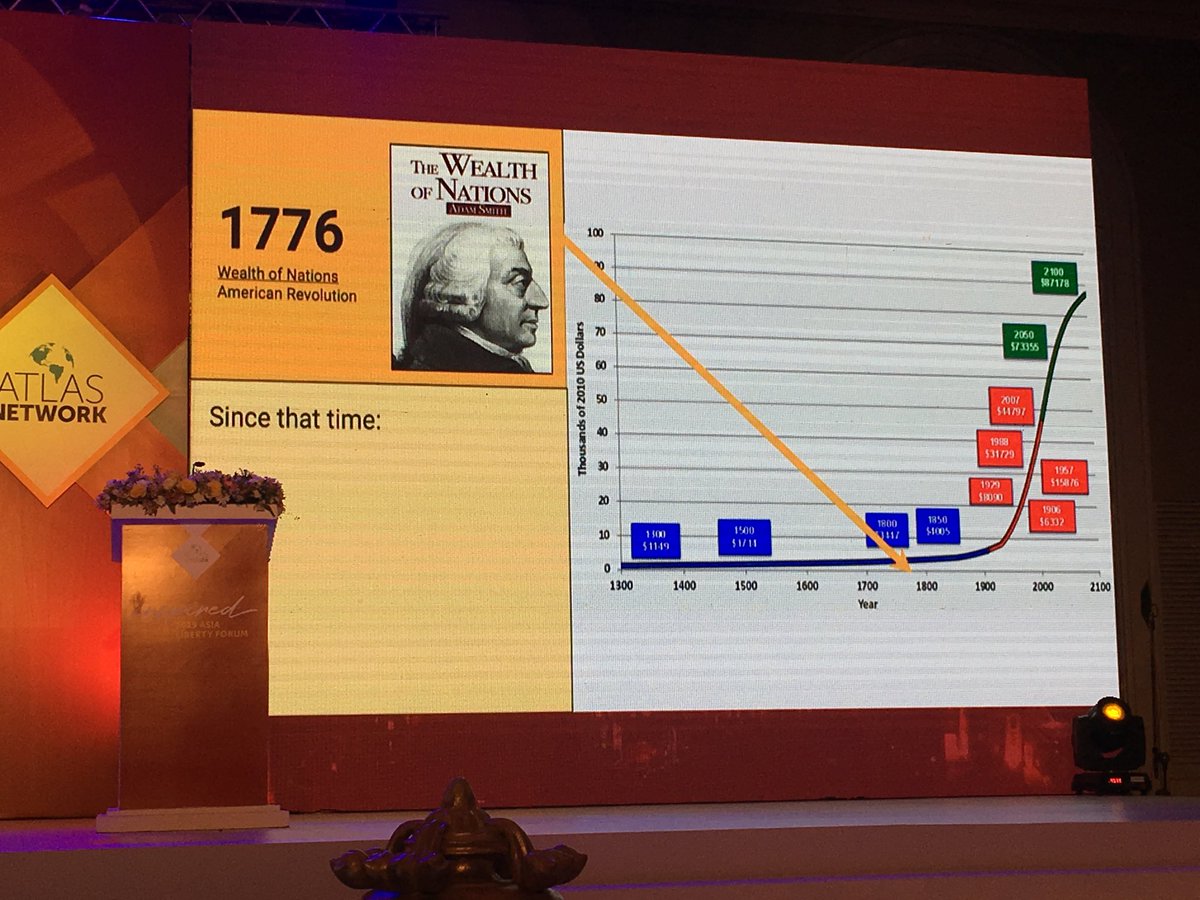
ALF 13, Some presentations in conf 2019

Unlike the EFN conferences that were focused on many public policy issues, ALF conferences don't have much on public policy as many panels are on fund-raising, setting up a new think tank, strengthening existing ones, etc. EFN events assumed that most participants have stable think tanks or known free market scholars and individuals already.

So below are some of the few pics and ppt slides presented in different panels, Sri Lanka conference last February 28 to March 01.

From Tom Palmer presentation, Cornerstone talks.


From Prof. Rohan Samarajiva (Chair, ICTA, Sri Lanka and Lirne Asia), "Are we afraid of opening up?" I was surprised to hear that socialist Sri Lanka allowed 100% foreign ownership of telecoms.


More players, more competition, more choices for consumers.


From Philip Stevens, panel on IPR for innovation and economic development.


From Rainer Heufers of CIPS Indonesia, same panel.

---------------

See also:

Friday, March 01, 2019

BWorld 296, Mandatory fare discount as socialistic policy

* This is my article in BusinessWorld last Friday, February 22, 2019.


“Socialist governments make a financial mess. They always run out of other people’s money. They then start to nationalise everything, try to control everything by other means.”

— Margaret Thatcher (TV interview February 5, 1976, 3 years before she became UK Prime Minister)

MODERN day socialists and populists in governments, explicit and implicit, are aware of the limits of governments giving all sorts of endless, no timetable subsidies, discounts and other welfarist programs. So they invented a new form of welfarism — forcing private corporations to give mandatory discounts (restaurant food, medicines, fare in public transportation, etc.) to people, rich and poor no distinction. Politicians and governments get the credit while corporations get the financial burden as those forced discounts cannot be used for tax deduction.

There are two existing laws that force and coerce private corporations to give mandatory 20% discounts on fare, medicines, all-year round: (1) RA 9994 “Expanded Senior Citizens Act of 2010,” and (2) RA 9442 (2007) “Amending RA 7277 ‘Magna Carta for Disabled Persons.’” Both laws do not allow the fare discounts, medicines discounts, food discounts, etc. for tax deduction. Only the private corporations will shoulder the full cost in the form of lower revenues.

Now there are bills in Congress, House Bill (HB) 8885 and Senate Bill (SB) 1597 “Student Fare Discount Act,” both passed on third reading, forcing all public transportation operators to give all Filipino students from elementary to tertiary, technical and vocational, a 20% mandatory discount all-year round including weekends and holidays, and covers all means of transportation — buses, jeepneys, tricycles, taxi, TNVS, TNCs, trains, airplanes and passenger ships.

HB 8885 has two compensatory and relief provisions for public transportation operators: (1) tax deduction from gross income for the same taxable year, and (2) reduction or exemption from some regulatory fees and charges. SB 1597 has none.

A bicameral committee meeting will be set after the May elections and guess what bill will prevail when the DoF comes in? Very likely the Senate version because the DoF just wants tax-tax-tax and dislikes tax deductions.

Fare control and price control without tax deduction are wrong and socialistic because they distort pricing by private enterprises. In the case of mandatory fare discounts say for airlines, poor students may travel and avail the discount only once or twice a year. Rich students (and senior citizens) can travel 10, 20 times a year or more and avail more discounts while earning more air mileage.

The price distortion can be represented by the graph here. If there are no laws on mandatory and forced discounts, the equilibrium price or fare will be at point A and buslines, taxis, airlines, shipping lines can make money subject to competition.

With mandatory 20% discount, the demand curve shifts to the right, there will be more travels by students, senior citizens and persons with disabilities (PWDs) as their fare goes down to point B. Some or many transportation companies will risk going bankrupt if they will endure this, so they have to raise the price for the regular passengers to point C so that the composite or weighted average fare can go back to point A.


So the mandatory price discount has created a new inflationary pressure, higher prices and fares for non-students, non-senior citizens and non-PWDs.

Mandatory discount is fare control, price control and profit control. The government wants to control how much revenues the corporations can make. Private enterprises adjust and raise the price for everyone else.

A good way to avoid this price distortion is to junk these two bills but this is impossible now because they have been passed on third reading. A compromise is to adopt the House version, the cost of all student fare discounts will be credited for tax deductions and reductions of other regulatory fees and charges.

In case DoF will prevail and the Senate version will be adopted, then ordinary passengers will endure the cost of higher fares and they can demonize the DoF for causing another round of consumer inflation via higher fares — in buses, taxis, TNVS, airlines, shipping lines.
----------------

ALF 12, Conference 2019 at Hilton Colombo, Sri Lanka

The Asia Liberty Forum (ALF) started yesterday at Hilton Colombo, Sri Lanka. Packed ballroom at the opening ceremony. 


Some tweets below, lifted from #AsiaLF19:

“In a short space of time @advocatalk has established itself as THE liberal voice on economic affairs in Sri Lanka.” .@razeensally, an advisor to Advocata Institute, discusses the role of ideas in 

“No one has benefited from ideas of economic liberty as much as the asian region” - @razeensally delivers welcome remarks kicking off.

Tom Palmer - how economic freedom created wealth ... and dramatically reduced poverty.

“Poverty is what you get when you fail to produce wealth. In contrast wealth is not what you get when you fail to produce poverty.”- @tomgpalmer during his cornerstone talk.

“Capitalism has problems. But it also is the greatest idea that humanity has ever had. It allows people to escape poverty.” -Roy Spencer of @ConsciousCP during his cornerstone talk.

“We all know the saying of whether you give a man a fish or teach him to fish. But what happens if the government says fishing is illegal? Before you can teach to fish you have to be allowed to fish.” -@dhananath of @advocatalk during his cornerstone talk.

Laurence Todd of @IDEASMalaysia discussing enforcement of contracts in MY and Asean.


“Think Tanks can lead the conversation and act as a middle person between the small businesses and government, since their voices aren’t alway heard.” -@AiraAriana of @IDEASMalaysia during a concurrent session on Removing Barriers to Entrepreneurship.

Last night, below. We were batch mates in the Mackinac Leadership Conference in Midland, Michigan, early April 2004. Then we also attended the Atlas Liberty Forum in Chicago a week after, nearly 15 years ago. Lisa Roberts and Parth J Shah. Lawrence Reed is not here in Colombo so I asked Brad Lips to join us.


Rainer Heufers of @cips_id speaking, "Charting a course of Economic Freedom in Asia".


More pics to follow...
--------------

See also: