Showing posts with label foreign investments. Show all posts

Saturday, May 13, 2017

BWorld 130, Mobility of goods, capital, and people in Asia

* This is my article in BusinessWorld on May 09, 2017.


One big issue that failed to land on front pages during the ASEAN Prosperity Summit last week is the creeping protectionism, not through rising tariffs but rising non-tariff barriers (NTBs).
  
Malaysian Prime Minister Najib Razak pointed out during the Summit that NTBs and non-tariff measures (NTMs) from 2000 to 2015 have surged by nearly four times to 5,975 from 1,634. This despite the zero tariff regime for intra-regional trade and the creation of the ASEAN Economic Community (AEC) or the regional single market.

While ASEAN was created initially for defense cooperation against regional communist revolutions in the ’60s and ’70s, it has evolved into a platform for freer movement of goods, people and services, and capital or investment. It was a good development and it should be pursued.

This coming November, the Philippines will host the ASEAN partners’ meeting composed of ASEAN + 6 (China, Japan, South Korea, India, Australia, and New Zealand) + Russia and US. Mr. Putin, Mr. Xi, and Mr. Trump and other leaders will be coming to Manila.

The US exit from the Trans Pacific Partnership Agreement (TPPA) and China-Japan leadership in the Regional Comprehensive Economic Partnership (RCEP) are important developments.

By how much have Asian economies improved based on freer mobility of goods, services, investments, and tourism? Here are some basic data (see table).


Those that have expanded by more than seven times in just 15 years are the following:

1. Vietnam: 11.2x in exports, 10.6x in imports, 9.1x in investments, and 10.6x in tourism receipts.

2. Myanmar: 7.2x in imports, 12.1x in investments, 12.9x in tourist arrivals; also high expansion in tourism receipts.

3. Cambodia: 14.2x in investments, 10.3x in tourist arrivals, and 24x in tourism receipts.

4. Laos: 9.3x in imports, 10.4x in tourist arrivals and 36x in tourism receipts.

5. China: 9x in exports, 7.5x in imports, almost 6x in investments, and 7 to 7.5x in tourist arrivals and receipts.

6. Japan: 7.4x expansion in international tourist arrivals.

7. India: 7.5x in exports, 12.3% in imports, and 7.8x in exports.

The Philippines also experienced modest growth in all the above indicators but not fast enough to create more jobs and businesses to its 104 million people. We should take hard lessons from our two small neighbors with huge economic achievements, Singapore and Hong Kong.

Singapore with only 5+ million people and just 3 1/2 hours by plane south of Manila, has 6x more exports, 11x more FDIs, attracts more than 3x foreign tourists and more than 4x in tourism receipts than the Philippines.

Hong Kong with only 7+ million people and less than 2 hours by plane north of Manila, has 8x more exports, 32x more FDIs, attracts nearly 7x foreign tourists, and nearly 8x in tourism revenues.

What small economies Singapore and Hong Kong have that the Philippines lacks are two important policies: free trade (zero tariff, minimal NTBs) and stricter rule of law (the law applies equally to both rulers and ruled, applies equally to unequal people).

So while we have improved our GDP size and material wealth via freer trade, freer movement of people and capital, we need to free up more.

We should allow more islands and provinces to have their own industrial zones to attract more investments and foreign trade. To have their own international airports and seaports to attract more investments and more tourism.

More modern infrastructure, simpler rules, and freer trade will help the Philippines attain what our developed neighbors have already achieved. Drastic reduction in NTBs and the removal of rice quantitative restriction (QR) and protectionism for instance. And less politics, taxes and bureaucracies, more respect for the law by politicians and bureaucrats.

Bienvenido Oplas, Jr. heads Minimal Government Thinkers and a Fellow of SEANET. Both institutes are members of the Economic Freedom Network (EFN) Asia.
---------------

See also: 

Friday, December 02, 2016

BWorld 93, ASEAN multinationals

* This is my article in BusinessWorld last November 23, 2016.


Until the 1980s, when people talk about multinational enterprises (MNEs) -- also known as multinational companies (MNCs) or transnational corporations (TNCs) -- they refer mostly to multinationals from the US, Canada, Europe, and Japan. Three decades after, that has significantly changed.
  
The rise of MNEs from developing and transition economies, especially those coming from China, Hong Kong, South Korea, Taiwan, Brazil, India, and several ASEAN countries become more prominent each year although multinationals from the industrial west remain very large and dominant.

This is consistent with global trade and capital liberalization where economies and sectors that show huge factor endowments and potentials for global growth attract both trade and investment flows. Developing countries with huge populations like China, India and the Philippines, and developing economies with highly skilled workers and innovative and aggressive companies like Hong Kong, Singapore and South Korea, are able to slowly put their MNEs in the global map.

The United Nations Conference on Trade and Development (UNCTAD) produces the World Investment Report (WIR). Its WIR 2016 disclosed the figures for 2014 of the world’s biggest nonfinancial MNEs, both in developed and developing countries.

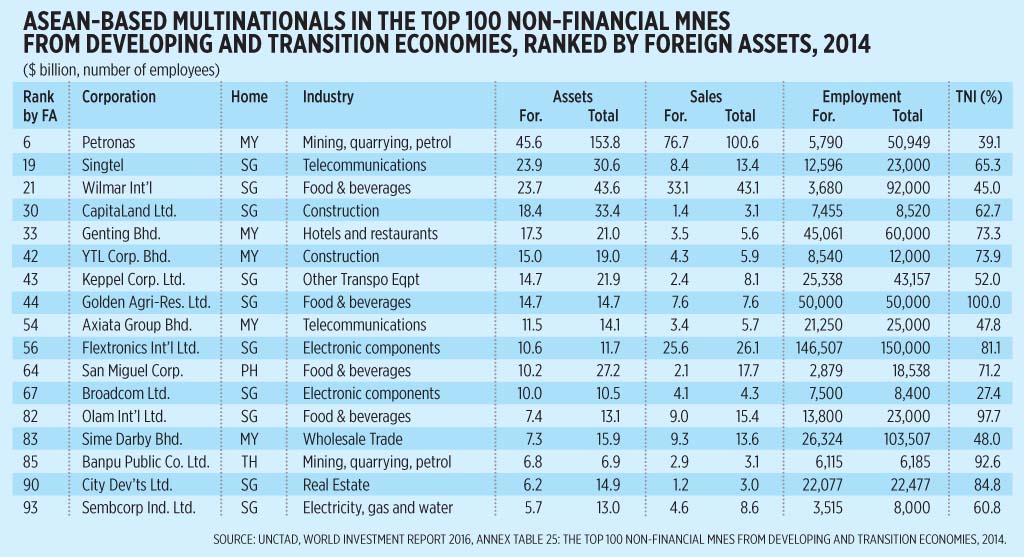
Below are the biggest MNEs from the ASEAN. The Transnationality Index (TNI) is calculated as the average of the three ratios: foreign assets (FA) to total assets, foreign sales to total sales, and foreign employment to total employment (see table).

  
There are at least two things that are prominent in the above table.

First, 17 ASEAN-based MNEs have made it to the top 100 MNEs from the developing world: 10 from Singapore, 5 from Malaysia, 1 each from Thailand and the Philippines. The TNI of these 17 companies are generally high, 11 of them have TNI of 60% or higher.

Second, San Miguel Corp. is dynamic enough to have plenty of branches and subsidiaries in the region and other parts of the world. It is indeed the #1 brand from the Philippines that has high regional footprint, and known even in some industrial economies in the west.

But there seems to be a mistake in the UNCTAD table, saying that SMC’s TNI is 71% when it looks like having only 30% or lower.

Other big MNEs from developing Asia are the following:

1. Hutchison Whampoa Ltd. (Hong Kong, Transport and storage) with FA of $91B.
2. Hon Hai Precision Industries (Taiwan, Electronic components) with FA of $73B.
3. China National Offshore Oil Corp. (China, Mining, quarrying and petroleum) with FA of $71B.
4. Samsung Electronics Co., Ltd. (South Korea, Communications equipment) with FA of $56B.
5. Tata Motors Ltd. (India, Motor Vehicles) with FA of $30B.

The subject of Philippine multinationals will be among the topics to be tackled in the coming BusinessWorld ASEAN Regional Forum this coming Nov. 24, 2016 at Conrad Hotel, SM MOA Complex. It is a regional conference with the involvement and sponsorship of many big corporations in the country.

Among the speakers will be CEOs and managers of big Philippine MNEs, and MNEs from abroad that are operating in the Philippines. This two-way exchange of ideas and experiences will be very productive for small and medium enterprises (SMEs) in the country that aspire to have regional footprints, and later barge into the continental and global list of successful and big MNEs.

After all, Facebook, YouTube, Twitter other big brands now were nonexistent until about 13 years ago. Endless innovation, consumer-friendliness and access to more markets abroad have allowed them to leapfrog from small start-ups to huge, multibillion-dollar global companies.


Bienvenido S. Oplas, Jr. is the president of Minimal Government Thinkers and a fellow of SEANET. Both institutes are members of the Economic Freedom Network (EFN) Asia.
-----------

See also:
BWorld 71, Free trade and higher income, July 11, 2016
BWorld 72, Economic integration and disruption, July 25, 2016 
BWorld 86, Philippine industrial policy, October 15, 2016
BWorld 91, Free trade means faster growth in manufacturing, November 14, 2016
BWorld 92, Climate action and Asian energy realities, November 19, 2016

Friday, July 08, 2016

BWorld 69, Foreign direct investments and Pres. Duterte

* This is my article last week in BusinessWorld.


Investments, local and foreign, are like pools of water flowing down. They go where they are allowed and welcomed, not where they are restricted and barred. So government and national policies set the tone and signal if they welcome, partially disallow, or explicitly restrict investments.

Foreign investments are particularly very mobile and flexible. They can come and go in major cities in the world in very short period like within hours or minutes, such as investments in the stock markets and commodities.

Foreign direct investments (FDIs) are for long-term engagement. Once they have decided to come or skip a country or economy, there is little flexibility left because the sunk cost of putting up a factory, hotel, or power plant is huge. It is this type of long-term foreign and local investments that a developing economy like the Philippines should attract and welcome, not restrict and discourage.

The Philippines is not exactly a good haven for FDIs mainly because of the restrictions and the unwelcoming tone of our Constitution where many sectors are outrightly banned to FDIs (media, hospitals, universities, electricity distribution, etc.) or allowed but only up to 40% maximum in total equity investments. Socialist Vietnam has overtaken the Philippines more than two decades ago in attracting FDIs while late-comer Myanmar is trying to catch-up with us, attracting some investors restricted by the latter (see Table 1).


Notice in Table 1 the huge jump in FDIs under the past Benigno S. C. Aquino III administration, almost double compared to the amount attracted by the earlier Gloria Macapagal Arroyo administration.

In terms of accumulated and net inward stock (inflows less outflows of capital) of FDIs, the past Aquino administration has more than doubled the stock in just five years, from $26 billion in 2010 to $59 billion in 2015. Cambodia and Laos have also experienced this more than two times expansion in FDI stock in just five years, but at a lesser magnitude or volume of capital.

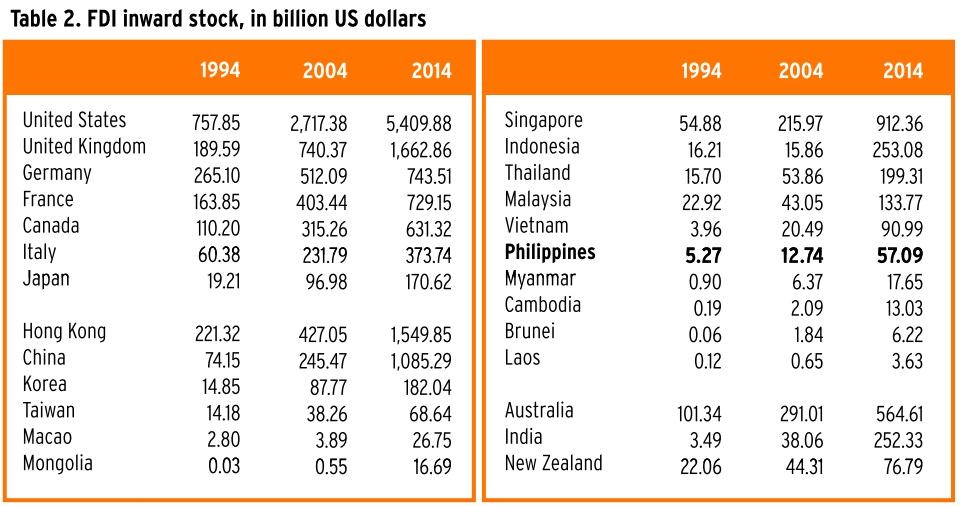
Note also the huge volume of FDI stocks in our neighbors in the region, especially Hong Kong, China, Singapore and Indonesia (see Table 2).


Expanding the country’s productive capacity via increased infrastructure will be one of the panel discussions in the forthcoming BusinessWorld Economic Forum, July 12, 2016 at Shangri-La BGC. The role of foreign investments, finance, and technology cannot be underestimated especially in high capex sectors like telecommunications and power generation.

The speakers in the afternoon panel on that day will be Mr. Ernest L. Cu, President & CEO of Globe Telecommunications; Mr. Eric Francia, President & CEO-Ayala Corporation Energy Holdings, Inc.; and Mr. Erramon Aboitiz, President & Chief Executive Officer, Aboitiz Equity Ventures, Inc.

There are a few big challenges for the new Duterte administration to sustain the momentum of high interest in the Philippine economy by foreign investors.

One is to remove the restrictive provisions of the Constitution and allow 100% foreign equity ownership except in land, something that he promised during the campaign period. This will require changing or amending the 1987 Constitution.

Two, to reduce business bureaucracies, local and national, that discourage many foreign investments even in sectors that they are allowed like power generation. This is already included in the 10-point agenda that his economic team has announced middle of this month. This needs serious implementation and not ningas-cogon, short-term practice.

Three, to reduce or remove various uncertainties that can discourage investments, even if foreign investments are liberalized tomorrow. These uncertainties include the agrarian reform program, which is always extended, and anti-mining, anti-coal power pronouncements.

And four, to erase from the country the terrorist and extortionist groups engaged in kidnap for ransom activities. This is a big turn-off for foreign investors and visitors planning to come to the country.


Bienvenido S. Oplas, Jr. is a Fellow of SEANET and President of Minimal Government Thinkers.
-------------

See also: 

Monday, December 28, 2015

Investment Lib. 3, Free mobility of capital complements free trade

The benefits of free trade and trade liberalization, unilateral or bilateral or multilateral, is maximized if it is coupled with investments liberalization. Allow freer movement of goods and commodities, then allow freer movement of capital and labor, entrepreneurs and workers, employers and employees.

Vietnam (and China) is a good examples of this. It is socialist, true; the Communist Party is a political monopoly, but it allows freer trade of goods and freer mobility of capital. See these news reports for instance.

1. The lifting of ownership limit in Vietnam is not absolute of course, but still a good development overall.

"The announcement gave few other details, although it said industries such as banking that are covered by separate rules would keep ownership limits at 30 per cent."

2. "The city is extremely business-friendly. I asked a local man who works for an American company how hard it is for foreigners to invest and go into business in Hanoi. “The Vietnamese government makes it easy,” he says. “Just present them with a business plan, tell them what you want to do, and you’re good to go.” The same goes for small businesses. All you have to do, he says, “is rent the space, pay the taxes, and that’s it.”

3. "Foreign investors of a number of high-tech investment projects in Vietnam have decided to increase the investment capital and expand their production activities to timely grab the opportunities that FTAs create when they come into effect.

LG Group is another case. Its initial investment capital was $300 million to build a factory in Hai Phong. However, it then decided to increase the capital to $1.5 billion. Samsung in its export-oriented investment strategy announced its increase in investment capital by $3 billion in November 2014.

Since members of the TPP do not include China, India and Thailand, who are the direct competitors of Vietnam in the textile industry, Vietnam will have price related competitive advantage over these countries due to tax preferential treatment that TPP countries grant to Vietnam. It is expected that with the TPP, Vietnam’s textile export turnover will reach $30 billion in 2020 and $55 billion in 2030." http://www.thanhniennews.com/.../why-vietnam-is-the-most...

4. "Indonesia is now offering a tax reduction of between 10 and 100 percent for up to 15 years to firms investing a minimum of Rp 1 trillion ($71.5 million) in certain industries, the finance ministry said in a statement on its website on Monday.

The tax break can be extended for an additional five years if companies obtain permission from the finance minister. Previously, the tax break was up to 10 years and if companies qualified, they could obtain 100 percent relief.

The ministry said “pioneering” industries are those that “have wide relevance, give added value and high externality, introduce new technology and have strategic value for the national economy.”

They include maritime transport, telecommunications, downstream metal production and agricultural processing. The new incentives went into effect on Aug. 16." http://www.globalexpandia.com/.../indonesia-extends-tax.../

5. "openness to trade almost always results in high attractiveness to foreign investments and all the opportunities they bring -- technological, financial, managerial, and market access. Clear examples are HK, Singapore and Chile. Also the socialist economies China and Vietnam that allowed certain degrees of economic freedom and the market system." 
http://www.bworldonline.com/weekender/content.php?id=112142


Other studies:

1. OECD paper in 1999, "Open Markets Matter: The Benefits of Trade and Investment Liberalisation", 12 pages. http://www.oecd.org/trade/benefitlib/1948792.pdf

2. ERIA (Economic Research Institute for the ASEAN) paper in 2008, "Investment Liberalization and Facilitation: Contribution to the ASEAN Economic Community Blueprint", 15 pages.
http://www.eria.org/.../pdf/PDF%20No.1-2/No.1-2-part2-7.pdf

3. Another papper from ERIA , April 2015 by Dr. Pons Intal, "AEC Blueprint Implementation
Performance and Challenges: Investment Liberalization", 27 pages.
http://www.eria.org/ERIA-DP-2015-32.pdf

4. The major concerns of foreign investors in many countries.
A presentation by Dr. Rafaelita Fita Aldaba, 2012, "INVESTMENT FACILITATION AND LIBERALIZATION IN THE AEC: CHALLENGES FOR THE PHILIPPINES",
http://aric.adb.org/.../Investment%20Facilitation%20and...

Until 2012, the US was a major source of FDIs in the ASEAN. By 2013, capital from the US declined significantly. Investments from Japan, intra-ASEAN, UK and Netherlands are big. Data from ASEAN Investment Report 2013-2014, http://www.asean.org/.../asean-unctad-launches-asean...

"According to the World Bank, Vietnam already attracted 8.9 Billion in FDI in 2013 and is moving to relax its foreign ownership rules. Vietnam’s Prime Minister, Nguyen Tan Dung recently, signed a decree lifting their 49% foreign ownership limit on publicly listed companies. Once the decree becomes effective later this year, 100% foreign ownership in most public companies will be allowed except for some sectors covered by specific laws or related to national security. The move will make Vietnam among the most open to investment in the region, positioning it to be even more attractive to foreign investments.

The limits set by the country’s constitution on foreign equity in real estate and in key industries has set-up a half-open and restrictive business environment that has frustrated the influx of much needed FDI. PNoy and his many allies in both Houses of Congress still has the remainder of the 16th Congress to make one final push for economic reforms that will go beyond myopic political cycles." -- Prof. Dindo Manhit, ADR Institute, http://sparkbyadri.com/
------------

See also:
Investment liberalization,  trends and lessons, July 26, 2015
Investment liberalization 2, G7 and East Asia economies, August 06, 2015

Sunday, November 08, 2015

Free Trade 56, Trade, investments and taxes in APEC countries

The Albert Del Rosario Institute (ADRi) has published my new paper, in time for the Asia Pacific Economic Cooperation (APEC) Summit this coming November 18-19 here in Manila. My special thanks to ADRi President, Prof. Dindo Manhit.


I put a number of tables in that paper, data sources from the World Bank, UN Conference on Trade and Development (UNCTAD), World Trade Organization (WTO), Alas Oplas & Co. CPAs (AOC), Bangko Sentral ng Pilipinas (BSP) and the Philippine Statistics Authority (PSA).


Foreign direct investments (FDI) inward stock is a good indicator of how much FDIs have accumulated in a country net of outflows through time.


FDI net inflows is a better indicator than plain inflows because a country may get huge amount of FDI inflows but also suffering from huge outflows so that the net inflow is actually negative. Like the US, Russia, Hong Kong, Taiwan, Japan, S. Korea and Malaysia, at least for the the years 2012-2014.

 APEC countries are marked red here.


Trade bureaucracies as a form of non-tariff barrier (NTB).


My Concluding notes

1. To have more trade and investments, governments should learn to step back from too many regulations and taxation. 

2. Corporate income and other taxes in the Philippines in particular should decline in the face of rising tax competition among ASEAN countries. 

3. Non-tariff barriers (NTBs) like import licensing and SPS measures should be relaxed and reduced. 

4. Global capitalism is about integration and competition, complementation and substitution, happening simultaneously. 

5. Markets in a competitive environment always result in innovation and business creativity. 

6. Governments should focus on their core and basic function – lay down fair rules for all players, be an impartial judge or referee in cases of disputes, protect private property ownership, enforce the rule of law, contracts between and among people.

The 12-pages paper is also posted in slideshare.
-----------

See also:

Saturday, August 22, 2015

Business 360-28, FDIs in South and East Asia

* This is my article in Business 360 magazine in Kathmandu, Nepal, August 2015.
---------

Foreign direct investments in South and East Asia

Foreign investments are among the key ingredients for developing countries to hasten their growth and development. Two prominent proof of this are small territories, small population, but big economies Hong Kong and Singapore. They started as very poor economies in the 1950s and 60s respectively and their openness to global trade and investments very early have allowed them to maximize the financial, technological and managerial resources that foreign businessmen and professionals could share.

There are two main avenues for foreign capital to enter an economy. Via foreign direct investments (FDIs) and via portfolio investments like the stock market.  Here we will discuss only FDIs and leave the latter to future topics in this column.

The UN Conference on Trade and Development (UNCTAD) has released the World Investment Report (WIR) 2015 in late June 2015. In the report are a number of very interesting data, some of which will be discussed here.

Cumulative values of FDI inward stock, net of capital outflows, is an important indicator of foreign investments in an economy. Here are the numbers.


South Asian economies overall were not able to maximize the potentials of FDIs all these years. India has the biggest FDI inward stock in the region, but comparing what it got with small population, small territories Hong Kong and  Singapore, the investments  it has attracted looked modest.

Nepal in particular needs to be more open to foreign investments considering the small amount it has attracted with just half-billion dollars as of 2014.

Socialist economies China and Vietnam that allowed certain degrees of economic freedom and the market system were able to maximize the potentials and benefits of FDIs. Vietnam’s FDI stock has expanded 23x in just two decades while China’s has expanded by 15x.

Other South East Asian economies were also able to expand their FDI stock rather fast. Aside from Vietnam’s 23x expansion, Singapore and Indonesia expanded 16x, Philippines 11x, and Thailand 9x.

We now check the value of FDI inflows over the last three years. The numbers for Afghanistan, Nepal and Bhutan are not good, the low values they got in 2012 further shrank in the next two years. Thus, the share of FDI as percent of gross domestic capital formation (GDCF) or simply total domestic investments, has been declining.

Bangladesh, Sri Lanka and Maldives have retained the average inflows per year while India and Pakistan have ramped up the FDIs they are attracting.


Some important lessons that South Asian economies can learn from their neighbors in North East and South East Asia would be the following.


One, being open to global trade and investments would mean being open to the various opportunities that  other economies in other parts of the planet can share. Global business is about integration and competition, about complementation and substitution. There are lessons to be learned, opportunities to be opened, so that business risks can be minimized and better handled.

Two, as shown in the numbers above, Hong Kong and Singapore are very good proof and examples that openness to global investments and trade can bring in more investments than one can imagine and hope for.

Three, there is a need to reverse the recent decline in FDI inflows especially in Nepal and Bhutan. More than high profit, foreign businessmen are concerned with the security of their investments, that these will  not be confiscated or nationalized even in periods of domestic political upheavals. Having the rule of law, respect of private property ownership, and ensuring the economic freedom of entrepreneurs, local or foreign, small or big, are important ingredients to attract investments, both foreign and local.
------------

See also:

Thursday, August 06, 2015

Investment Liberalization 2, G7 and East Asia economies

Mobility of investments and capital across islands, countries and continents is part of human nature. A country or island for instance with plenty of beautiful white sand beaches will naturally attract investors who will put up modern resorts and hotels, that will attract more visitors from other countries, giving lots of jobs and other business opportunities to the locals and new migrants.

The UN Conference on Trade and Development (UNCTAD) released in late June 2015 its World Investment Report (WIR) 2015. The annex tables of that report are found here.

My sister's auditing firm published the 2nd issue of its monthly Business and Economic Update last month. Among the contents of that report are the tables below, original global data are taken from the WIR 2015.

Here, it shows that from 2012-2014, there was consistent net outflows of foreign direct investments (FDIs) in the G7 except UK and partly, Canada. Then in Hong Kong, Taiwan, S. Korea and Malaysia. 

http://alasoplascpas.com/publication-economic-02-Net-Inflows-of-FDI.php 

Numbers below show the ratio of FDIs over gross fixed capital formation (GFCF) or simply domestic investments. It is interesting to see how Germany and Japan have very small share of FDIs. This somehow gives an idea of their investment protectionism policies.


The most open economies to global trade and investments, Hong Kong and Singapore, have the highest FDI share to total national investments.  And an FDI share of 2.5 to 14 percent seems to be the average, possibly a healthy mixture, including the 10.5 percent for the Philippines. 


Until 2012, the bulk of FDIs in the PH came from the US, HK and Japan. By 2013 until mid-2014, capital from the US withrew, from HK declined significantly, from Japan retained, and a surge of FDIs from British Virgin Island.

http://alasoplascpas.com/publication-economic-02-FDI...

In portfolio investments like the stock markets, Japan, China, India and Hong Kong received significant inflows while many in the ASEAN experienced net outflows overall except Vietnam.

In merchandise exports (X) as a share of their GDP, Hong Kong and Singapore are run-away leaders, followed by Vietnam, Malaysia and Thailand. In non-merchandise, services exports like tourism receipts, Macao is a clear leader because of its huge gaming and casino facilities.

Personal remittances by their nationals who are working abroad, India, China and the Philippines (and Mexico) are the world leaders. The Philippines is #1 in the ASEAN.

http://alasoplascpas.com/publication-economic-02-Global...

Meanwhile, from another source, these numbers are interesting. Until 2012, the US was a major source of FDIs in the ASEAN. By 2013, capital from the US declined significantly. Investments from Japan, intra-ASEAN, UK and Netherlands are big. 


Source: ASEAN Investment Report 2013-2014, http://www.asean.org/.../asean-unctad-launches-asean...

Favorite destination of FDIs in the ASEAN are the services and manufacturing sectors. Data also from the ASEAN IR 2013-2014.


The above numbers and figures are additional reminders that the Philippines need to amend its Constitution and remove protectionist provisions that restrict or limit the entry of foreign investments in some sectors, while outrightly banning/prohibiting FDIs in other sectors.

It is not wise that government dictates that these areas are only for local investors and those areas, foreign investors can be allowed. Investments, local or foreign, automatically creates local jobs. If Filipino workers are prevented from being hired by foreign  investors here because the latter are restricted or banned on certain sectors, then many Filipino workers are hired by foreign investors in foreign lands.
-----------

See also: 
Free Trade 35: EU-FNF Forum on 'FDI Engine for Job Growth', May 15, 2014 
BWorld 12, Investments, APEC and economic liberalization, July 25, 2015 

Investment liberalization, trends and lessons, July 26, 2015

Sunday, July 26, 2015

Investment liberalization, trends and lessons

Capital, like labor and technology, simply wants to be mobile across islands, provinces, countries and continents. They are like migratory birds and large fishes/mammals, they go to areas that are hospitable to them, allow them to survive and flourish.

Economies that are more open to global trade tend to attract more foreign direct investments (FDI), like Hong Kong and Singapore, but Japan has a different story.


Data is from UNCTAD, World Investment Report (WIR) 2015, http://www.unctad.org/fdistatistics. This table is from a paper produced by my sister's auditing firm. I will blog about it soon here.

Meanwhile, here are some reports and papers on the subject.

News from CNBC, June 29, 2015, Vietnam is liberalizing further its foreign  investments policy, except that
"The announcement gave few other details, although it said industries such as banking that are covered by separate rules would keep ownership limits at 30 percent." 

A paper from Econ. Research Institute for ASEAN and East Asia (ERIA) in 2008, "Investment Liberalization and Facilitation:..", 15 pages, http://www.eria.org/.../pdf/PDF%20No.1-2/No.1-2-part2-7.pdf

A new paper from ERIA, April 2015 by Dr. Pons Intal, "AEC Blueprint Implementation...", 27 pages, http://www.eria.org/ERIA-DP-2015-32.pdf

“In conclusion, it is worth noting that investment liberalization is only one of many factors that determine the investment attractiveness of a country, as we have seen. A number of them are also within the purview of the AEC. Thus, implementing those measures (e.g., regulatory improvement through the National Single Window) should  generate greater synergy between them and investment liberalization, which should result in an improved investment climate.”

And a good OECD paper in 1999, "Open Markets Matter...", 12 pages, http://www.oecd.org/trade/benefitlib/1948792.pdf

The major concerns of foreign investors in many countries, from a presentation by Dr. Rafaelita "Fita" Aldaba of PIDS then, 2012, "INVESTMENT FACILITATION AND LIBERALIZATION IN THE AEC: CHALLENGES FOR THE PHILIPPINES", http://aric.adb.org/.../Investment%20Facilitation%20and... 


Meanwhile, a note and  warning from this  article,


"billions of dollars of Chinese investment in countries such as Angola, Sudan, and Venezuela, which fare quite poorly in the pertinent international rankings. Moreover, there are numerous reports of Chinese companies paying bribes to secure a major port deal in Sri Lanka, to try to obtain a major broadband telecommunications deal in the Philippines, and to secure lucrative oil and gas opportunities in Kazakhstan...." July 26, 2015. http://thediplomat.com/.../chinese-outward-investment.../

Foreign investments should be liberalized. It is unfair for employees and those looking for new work that the number of investors and job creators in the domestic economy is limited and restricted mainly to local investors. What usually happens is that if they cannot be hired by foreign investors in the home country, they are hired by foreign investors in foreign countries through the process of migrant employment, like our OFWs. So there is no sense keeping the investment protectionism policy.
--------------

See also: 
Free Trade 35: EU-FNF Forum on 'FDI Engine for Job Growth', May 15, 2014 
BWorld 12, Investments, APEC and economic liberalization, July 25, 2015

Saturday, July 25, 2015

BWorld 12, Investments, APEC and economic liberalization

* This is my article yesterday in BWorld Weekender.

MANILA WILL HOST the annual Asia-Pacific Economic Cooperation (APEC) Summit this coming November 18-19, 2015, or less than four months from now. Presidents and Prime Ministers of the 21 member-countries including the three largest economies in the world, US, China and Japan, will be coming to Manila for two days to discuss and sign certain agreements related to trade, investments and related concerns.

The Philippines’ trade and investments in the face of ASEAN integration just five months from now was also discussed last July 15 at the Tower Club in Makati City, sponsored by the Albert Del Rosario (ADR) Institute.

The convenor and main speaker was Dr. Epictetus Patalinghug (UP College of Business Administration, and a Trustee of ADR Institute). Discussants were Dr. Gilbert Llanto (President of the Philippine Institute for Development Studies/PIDS), Dr. Ramon Clarete (UP School of Economics/UPSE Prof. and former Dean), Mr. Donald Dee (Honorary Chairman, Philippine Chamber of Commerce and Industry/PCCI), and Atty. Wilfredo Villanueva (Head of Tax and General Counsel, SGV & Co.).

In his presentation, “The Role of Exports and Foreign Direct Investments in Industrial Development,” Dr. Patalinghug said that the five striking resemblance among highly successful economies were: (a) Openness to the global economy, (b) Macroeconomic stability, (c) High saving and investment, (d) Market allocation, and (e) Leadership and governance.

He also showed this summary of Philippine economic history. (See Table 1)

That is an objective and correct assessment. And it is not unique to the Philippines or its neighbors in the ASEAN, but rather the general trend for the rest of the world. If we check the economic integration and liberalization of the four newcomers to the ASEAN, namely Cambodia, Myanmar, Laos and Vietnam (CMLV), their pace of liberalization in trade and investments on average was much faster than the Philippines.

Let us focus on investments; in particular, foreign direct investments (FDIs). The UN Conference on Trade and Development (UNCTAD) released the World Investment Report (WIR) 2015 last month and that paper shows many interesting data. (See Table 2)


There was significant expansion in FDI inward stock (ie, net of FDI outflows) in many APEC member-economies. In particular, the expansion from 1994 to 2014 (two decades) were as follows:

* Americas: Peru 18x, Mexico and Chile 10x, US 7x, Canada 6x.

* North Asia: China 15x, S. Korea 12x, Japan 9x, HK 7x, Taiwan 5x.

* Southeast Asia: Vietnam 23x, Singapore 17x, Indonesia 16x, Thailand 13x, Philippines 11x, Malaysia 6x.

Australia, New Zealand and PNG did not experience significant FDI expansion.

Russia and Brunei are the “outliers” with 114x and 103x expansion, respectively, mainly because they have very low base in 1994. Russia has emerged from partial disintegration where a number of central Asian economies (Georgia, Kazakhstan, Tajikistan,…) separated from the former USSR. APEC was formed in 1989 but Russia, along with Vietnam and Peru, joined it only in 1998.

In terms of FDI stock/GDP ratio, three economies that have undertaken unilateral trade liberalization (meaning no or little trade negotiations) stand out: Hong Kong, Singapore and Chile, with ratio of 535%, 296% and 80%, respectively.

Some important lessons from the above numbers and discussion:

One, openness to trade almost always results in high attractiveness to foreign investments and all the opportunities they bring -- technological, financial, managerial, and market access. Clear examples are HK, Singapore and Chile. Also the socialist economies China and Vietnam that allowed certain degrees of economic freedom and the market system.

Two, global capitalism is about integration and competition, complementation and substitution, happening simultaneously. Business risks will always be there. Companies and people need to keep their radar for adaptation and familiarization of those risks, while keeping the pace of innovation at regular or higher levels.

Three, for the Philippines, its FDI stock/GDP ratio of 20% is the lowest among its neighbors in SE Asia, but this is not something to look down or commiserate. Some richer economies have rates lower than 20% like Taiwan, Japan, S. Korea and China. Nonetheless, this should be one reminder that the country needs to amend its Constitution to remove protectionist provisions that restrict or prohibit foreign investments in many sectors of the Philippine economy.

Four, more than low taxes and/or high profit, foreign businessmen are concerned more with the security of their investments, that threats of confiscation and political harassment are zero or kept to the minimum. Respect of private property, rule of law, and economic freedom by the people, producers and consumers alike, domestic and foreign entrepreneurs alike, are important factors to attract, retain and expand investments in the economy.

Bienvenido S. Oplas, Jr. heads the free market think tank, Minimal Government Thinkers, Inc., and also a fellow of the South East Asia Network for Development (SEANET), a regional center that advocates trade and investments liberalization.
-----------

See also: 

Wednesday, October 15, 2014

Business 360 19: Investments and Inequality in Asia

* This is my article for this business magazine in Kathmandu, Nepal, October 2014 issue.
----------

Accumulated savings become investments. And these in turn expand economic output and create new jobs, or expand the productivity of those  who already have jobs. Such is the beauty of continued investments and savings accumulation.

In many recent social literatures though, including those coming from the multilateral institutions and foreign aid bodies, there is growing disapproval if not outright  contempt, of rising inequality within and among nations as they grow  faster, as they attract more investments and expand economic production. Thus, the repeated call for “inclusive growth”, previously called as “growth with equity” or “broad-based growth”.

To improve social equality within countries, some governments have erected various  restrictions to foreign  direct investments (FDIs). The Philippines for instance has that restriction in the 1986 Constitution itself, where in some sectors, foreign investments is totally prohibited while in some sectors, it is allowed up to 40 percent.

Such restrictions make some foreign investors find other ways to come in and do business. Like having local dummies, so foreign money is able to penetrate even  in sectors that is explicitly reserved for the local investors. But many foreign investors do not like that arrangement as it lacks transparency, and they cannot report to their shareholders and regulators in both home and host countries that they have invested in companies that are supposed to be 100 percent locally-owned.

The next route for foreign investors is via the stock market. Not all of such market capitalization is foreign-owned of course, there are also many local investors in each country. Here are the figures for major Asian economies.


Source: WB, World Development Indicators 2014, http://wdi.worldbank.org/table/5.4

North East Asia except N. Korea is generally developed. The economies there are able to attract plenty of domestic and foreign investments that create plenty of higher productivity jobs.

South East Asia generally are emerging economies, except Singapore which is already a developed economy, and the three catching up economies of Laos, Cambodia and Myanmar.

South Asia though remains not so friendly to the stock market system, except India. Nepal in particular is the least friendly or least attractive to investors in the stock market.

In terms of FDIs in South Asia, the levels remain very low on average, except for Maldives.

Figure 2. Average FDI Inflows to South Asia, 2000-2011, Percent of GDP


There is a need to encourage more investments, local and foreign, in stock market and FDIs, to Asian economies. Investments not only refer to money. They also include tools and machineries, technology and processes, research and development, managerial skills and marketing initiatives.

Social and economic  inequality is inevitable as people have different goals and ambitions in life, different network and exposure in business, use different technology and managerial styles. 

What is important is that opportunities should be available for the people so they can manage their lives and career. The business climate in Asian economies should become more friendly, more accommodating to investors, local and foreign. People can decide to be hardworking or lazy, be ambitious or complacent, if different jobs have become more available in their countries and communities.

The important subjects of growth and investments, inequality and justice, will  be discussed for two days this  coming November  6-7, 2014, during  the  Economic Freedom Network (EFN) Asia Conference 2014 to be held in  Hong  Kong. The event will be jointly-sponsored by the Friedrich Naumann Foundation for Freedom (FNF) and the Lion Rock Institute (LRI). FNF is a German political foundation spreading the ideas of (classical) liberalism, free market, human rights and rule of law while LRI is Hong Kong’s first free market think  tank.

This writer will attend this important conference. It is hoped that more participants from Nepal and South Asian nations will be able to come and hear the healthy and productive exchange of ideas and experiences among other participants from North- and South-East Asia, as well as their friends and network from  the US, Canada and Germany.
----------