Showing posts with label traffic. Show all posts

Saturday, December 17, 2016

Transport Econ 19, On taxi fare contracting

This Christmas season, if you're in a hurry to an important meeting or Christmas party/reunion and wanting to get a taxi and no Uber or Grab car around, don't wait for the taxi driver to do "mangontrata" (contracting). Unahan nyo na, kayo na mangontrata and get a ride faster instead of standing long in the streets or be late to your meeting/party. Photos below I got from the web, none from my camera.


Why? At least 3 reasons...

1. Unlike employees, managers, those taxi (and jeepney) drivers don't have 13th month pay, Christmas bonus, etc. from their employers -- the taxi passengers. So giving them a tip through own kontrata is a way to give them extra income that can be counted as their 13th month pay.

2. Airlines, shipping lines can raise their fares during the holiday season. They have fare deregulation there. Land transpo including taxi don't have fare deregulation, they are stuck with existing rates. Buses too cannot raise their fare but they can adjust by packing in more passengers to increase their income, taxis cannot do that.

3. There is double standard in the taxi business. Airport taxis (white/Bayan ko and yellow) have high rates; their owners are cronies that is why the LTFRB allow them to charge higher. Giving a tip "by force" because of pangontrata is a way to allow those taxi drivers to earn more, bigger, during this season. The important thing is you reach your destination safely.

Market solution to some market problems. For me, I still take the bus or jeep, hehe. No fare surge, no haggling in fares, etc.

Here's what one of my friends used to do before Uber and Grab became famous. In a busy street where there are many people hailing a taxi, taxi drivers become selective, supplier's market. My friend would wave P200 or P300 bills, empty taxi chooses him first, driver rolls down the window and asks, "Sir/boss, san po kayo?" When my friend says the destination is not far, driver signs him to come in.

So, it's my friend who makes the pangontrata, not the taxi driver. Whatever money he waves, he gives it all, at least he reaches his destination faster. Both parties are happy, win-win formula :-) 


Not all taxi riders are employed, true. Some are employers themselves, nasira or coding lang ang kotse, hehe. Besides, one does this only in some rare instances where getting a taxi is difficult. And if indeed poor, better take the jeep or bus, no price surging, no fare contracting, just a bit inconvenient moving from one vehicle to the next.
------------------

See also:

Saturday, July 30, 2016

BWorld 75, How to profit from urban congestion

* This is my 2nd article in BusinessWorld special Anniversary issue last Monday.
------------

Worsening traffic congestion in Metro Manila and other big cities in the Philippines has led people to believe that this will negatively affect people’s health, temper, and eventually, the economy. Thus, the solution is to decongest heavily urbanized cities and spread out development and modernization to the peripheral cities and provinces.

This subject was partly tackled during the first BusinessWorld Economic Forum last July 12, 2016 during the panel discussion about succession and transition. Among the speakers were Ernesto M. Pernia, Socioeconomic Planning secretary; Kevin L. Tan, senior vice-president & head of Megaworld Lifestyle Malls, Megaworld Corporation; Bienvenido V. Tantoco III, president of Rustans Commercial Corporation; Nina D. Aguas, CEO of Insular Life; and Wilfred Steven Uytengsu, Jr., president and CEO of Alaska Milk Corporation.

Although the focus of the discussion was about how companies prepared for smooth corporate succession, the speakers also provided a wider perspective and tackled some national issues and transition. All agreed that Metro Manila is very congested and that developments should be driven to less urban and rural areas. Mr. Tan in particular highlighted that many real estate developers are going out of Metro Manila because there are more developments in several provinces and big cities, more BPOs, other businesses.

If we look around the world, each country has one or more political and/or financial capital and these places experience congestion where the demand for certain services outpaces the supply. This happens because congestion is natural and part of human nature’s demand for socialization and interaction. It is faster and easier if the office, the kids’ school, the bank, grocery store, car repair shop, etc. are just a few kilometers away instead of dozens or hundreds of kilometers.

Let us check the degree of congestion of the Philippines compared to other ASEAN nations, and from two small, highly congested neighbors. A 50-year gap, 1964 to 2014, table is constructed. The per capita income in purchasing power parity (PPP) valuation over a 30-years gap is also shown.


What the above table shows are the following:

1. Highly-congested Singapore, Macau, and Hong Kong also have very high per capita income. There are many explanations for this and the efficiency gains of having almost everything nearby is definitely one of them. Brunei is a different case, small population but relatively big land area rich with energy resources for export, like natural gas.

2. Less-congested Cambodia, Myanmar, and Laos also have low per capita income of only $5,100 or less. Again, there are many reasons for this and the inefficiencies and inconvenience of being far from various economic units like big banks, big grocery stores, etc. should be one of those reasons.

3. The Philippines is second most congested country in the ASEAN after Singapore. Its population has more than tripled over the past 50 years.

Let us check the numbers for Metro Manila. From 636 square kilometers originally, the megacity now has a land area of 644 square kilometers (owing to reclaimed areas at the CCP-SM MOA) and a population of 12.877 million, as of the August 2015 census. Based on these numbers, its population density is 19,995 persons/sq. kms., comparable to that of Macau.

But one report says World Bank data shows that Metro Manila has a 1,300 square-kilometer land area as of 2010. Or a population density of 9,906 people per sq. km. in 2015, still higher than those in Singapore and Hong Kong.

So if congestion is natural for people, how can we optimize and benefit from the presence of many people per square kilometer of land?

ACDimatatac-301. More land reclamation. The 800 or so hectares in the CCP-SM MOA-Entertainment City have created lots of businesses and jobs for Filipinos. The planned additional reclamation projects in Manila Bay should proceed, and at a fast rate.

Aside from creating new lands in the sea, there is also a need to remove huge volume of silt, mud, and solid wastes in river beds of the Pasig, Las PiƱas, and Marilao rivers that drain into Manila Bay. These smelly solid wastes cannot be brought to dumpsites where most LGUs declare a “not in my backyard” (NIMBY) policy.

2. More skyways, elevated interchanges and U-turns, tunnels. Traffic congestion is an engineering problem with engineering solutions. Such solutions should veer away from hiring more traffic officers and officials, avoid having more stoplights. Instead, officials should build more hard infrastructure that can provide service to the public and motorists 24/7 for decades to come.

3. More trains, LRT/MRT, running along C5 and C6, above ground and underground, extending north and sound, east and west, of Metro Manila. In Tokyo, Seoul, and Singapore, it is common to see multi-level train stations and shops underground. Public Private Partnership (PPP) schemes are already existing to encourage more private funding and construction of these projects.

4. More low-cost medium- and high-rise residential condos. This immediately frees up space for more urban forestry and public parks, unlike in horizontal low-cost housing. Multiple regulations and taxation by both national and local governments should also decline. These are costs that are ultimately passed on to condo unit buyers and renters, that make vertical housing less affordable to the poor and lower middle class.

People and businesses respond to incentives and disincentives. If there are many disincentives and inconvenience in taking (often multi-ride) public transportation, then more people will drive their cars or motorcycles, which contribute to heavy traffic congestion. Government taxation and regulations that distort the market for urban transportation, housing, and other services should be reduced.

Bienvenido S. Oplas, Jr. (@noysky on Twitter) is a Fellow of SEANET and President of Minimal Government Thinkers.
----------------

See also:
BWorld 72, Economic integration and disruption, July 25, 2016 
BWorld 73, Transco and the big beneficiaries of feed in tariff, July 27, 2016

BWorld 74, Pres. Duterte's anti-corruption programs and Transparency Intl., July 30, 2016

Monday, July 20, 2015

Transport Econ 15, On having 2 cars or more

Heavy traffic in many areas of Metro Manila is a daily reality. Here for instance, Roxas Blvd. in Pasay near the Baclaran Church. I took this one Saturday morning last month, I was on a pedestrian  overpass.

Because almost everyone experiences heavy traffic, then almost everyone has a proposed solution how to solve it, which is not really a bad thing. What makes things bad is when  some people would propose solutions that will impose more restrictions on the rest of society. Like (a) prohibiting people from driving and using their own cars one day a week (aka plate "number coding" ban). Or (b) prohibiting certain modes of transportation and ride sharing (air-con vans, some provincial buses).

One solution proposed by some people and represented by these old, abandoned cars, is that we "bury our irrational desire for more private vehicles, have more space for mass public transportation," and "moderate our greed for cars."

People respond to incentives and disincentives. When government imposed that we cannot drive/use our car, our own private property, one day a week, some people who can afford started buying a second car, or at least a motorcycle.

Again, if you live in UP Village, or Filinvest QC, and you are going to Makati CBD or Ortigas , if you take the public transpo, it's four rides one way: (a) tricycle from house to Commonwealth ave or Philcoa, (b) jeep to MRT station, (c) MRT ride, then (d) jeep or van to destination. Coming home, the same four rides, or eight rides a day. It may be cool if one is wearing shorts and rubber shoes, but if wearing barong or corporate attire, carrying a laptop and other important docs, or big cash, would you dare taking those 8 rides a day? Most likely not. 

So people endure driving their cars even in heavy traffic. But other people should not blame the hapless middle class motorists who refuse to be harassed with 8 rides a day. That's unfair. Those who wish to endure it, fine. Those who don't want to, we should not call them "moderate their greed for cars," and "greed" is defined as having two or more cars. 

When the MMDA and LGUs prohibited people from driving our own cars one day a week, that is already wrong. But people comply with this ruling, and some buy a 2nd car for coding day of the main car, or when the other car is in a repair shop. But why call them "greedy" for having a second car?

Not that I own two or more cars, I own only one, an old one. But I will debate people who say that owning 2 or 3 cars are greedy. What do they know of the circumstances why some households have opted that way, an expensive way?

If parents also have to bring the kids to school before going to work, that makes 4-5 rides one way, or 8-10 rides a day or more. This is not nice nor cool. Thus people have to drive their cars. Then there are households with special needs, like bringing a sickly child or grandpa/grandma to regular medical check ups, then the couple must drive to work too, they will need 2 cars at least. Maski luma or bulok basta may air-con and functioning. To condemn them of being "greedy with cars" despite their special condition is wrong and irresponsible.

One solution to reduce traffic in Metro Manila and other major cities in the country is to allow various forms of ride-sharing and car pooling, government agencies like LTFRB, MMDA and LGUs should step back from more prohibitions, more regulations, more bureaucratism. People simply want to take one ride from house to work whenever possible. If air-con vans, if Uber system can provide this, why over-regulate and prohibit them?

On the earlier proposal by environmentalist lawyer billed as "Akin ang Tondo, Sa Iyo Ang Cavite" -- dividing roads in Metro Manila, 1/2 or 2/3 to cars and buses, 1/2 or 1/3 to bicycles and pedestrians. 

For me, this is a lousy proposal. You do not mix cars with bicycles and even pedestrians in Edsa, a very congested and major road. Not everyone is careful, whether the cyclist or motorist or pedestrian. If one or more people die in an accident in Edsa, say a novice bicyclist who suddenly swerves to the lane for cars, or a novice or sleepy or drunk motorist who swerves to the bicycle lane, who is to blame? The bicyclist, the motorist, the government, or Tony Oposa and his supporters?

Do NOT mix them in Edsa, it is a stupid idea. Bicycles and pedestrians should have their own lanes, elevated from the main road, so that cars and buses cannot easily swerve onto them.
-------------

See also: 
Transport Econ 11: On Fare-Contracting Taxi Drivers, December 13, 2013
Transport Econ 12: Bus Rapid Transit (BRT) and Tricycles, April 21, 2014 

Transport Econ 13: On Prohibiting S. Luzon Provincial Buses to Enter M.Manila, August 30, 2014 

Transport Econ 14: On the MRT and LRT Fare Hike, January 06, 2015

Monday, April 21, 2014

Transport Econ 12: Bus Rapid Transit (BRT) and Tricycles

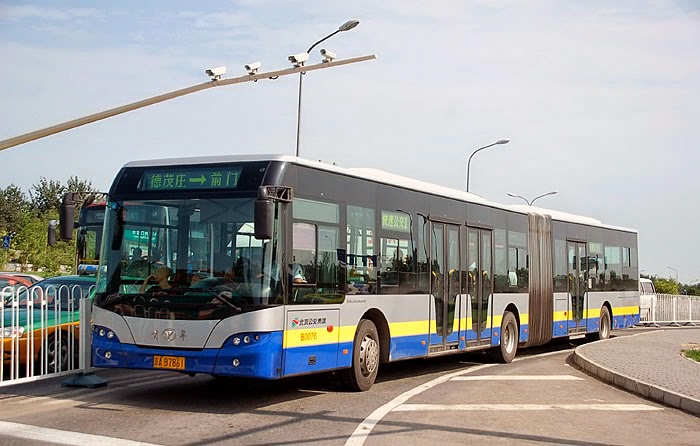
There is another proposal by the Department of Transportation and Communication (DOTC) to introduce a bus rapid transit (BRT) system in Metro Manila, Cebu City and Davao. Photos below of various BRTs in other countries I got from the web.

In the metropolis, the key features of the system, according to this report from rappler, DOTC eyes bus rapid transit, more walkways, car-less cities.

·         Bus-only lanes that make travel time faster because buses are not delayed by other vehicles on the road.
·         Dedicated lanes are in the center of the road to keep buses away from busy curb-sides that can also cause delays.
·         Fare collection is done at the station instead of on board the bus to eliminate delays caused by passengers paying the driver or conductor.
·         Buses will be given priority at intersections.
·         Platform for boarding will be level with the bus floor for quick and easy boarding.

The DOTC is putting up a 28-kilometer BRT worth P4.65 billion. The system will run from Manila City Hall to Fairview in Quezon City, passing through Quezon Avenue and Commonwealth Avenue.

There is one big problem in this proposal. Because of poor peace and order problem (government failure to maintain peace and order, corrupt police, etc.), people live in gated villages with their private security. These villages and subdivisions are normally far out from where the trains and the proposed BRT will be.

Assume for the sake of argument that the BRT is already in place along Quezon Avenue to Commonwealth Avenue, also in Edsa. For people coming from Las Pinas or Paranaque or Fairview/QC, this is what they will go through:

(1) ride tricycle from village to secondary or primary road
(2) ride jeep or bus from there to MRT/LRT/BRT station
 (3) ride train/BRT to Makati or Ortigas or Manila
(4) ride jeepney or fx van to final destination.

Four rides from house to office. Or it can be three rides, assuming that #2 above is eliminated. Going back home, another three or four rides in reverse sequence as above. if you are wearing a formal corporate dress, carrying a laptop and important documents, or some big cash, would you leave your car at home and endure the above 8 rides a day, 5 days a week?


Some would say Yes, but many middle class and rich people would say No. And that is why people bring their cars everyday and endure the traffic congestion, endure the difficulty in getting paid parking, just to maintain their poise, or at least not risk being held up or snatched somewhere along those 6-8 rides everyday.

 A good example is Commonwealth Avenue in Quezon City., the country's widest road with 8 lanes both sides. On each side of that road from Philcoa to Fairview, there are dozens and dozens of private villages and informal settlements. If one lives in any of those villages or settlements and go to Ortigas or Manila or Makati, elsewhere, the above 8 rides a day apply. This makes going to work via public transpo -- even with an expanded MRT, even with a proposed BRT in operation -- very inconvenient, costly and time consuming. Try riding a tricycle with your corporate attire and personal/office documents, 5x a week, worse during rainy season, and you will understand why that "carless city" even for many middle class is just fiction, like Batman and Spiderman fiction stories.


The other DOTC proposal is to have more bike lanes. It looks and sounds fine, but then again, not everyone is physically or mentally fit to ride a bicycle. Or not everyone is willing to endure direct sunlight plus buses/trucks pollution, or endure the rains and street flooding during the wet season.

The quick solution to the above 6-8 rides a day, 5x a week, are those air-con vans. They serve like school buses, picking up passengers from their house or at least village gate, to final destination in Makati or Global City, Ortigas, Eastwood, Manila, etc. It is convenient and generally safe too. But it can be costly too, and the queueing at designated terminals at residential areas, then terminals at office areas, can be long and tiring. Why? Because the number of legal, “non-colorum” vans is limited.

The DOTC’s Land Transport Franchising and Regulatory Board (LTFRB) has made getting a franchise for each aircon van very costly, up to P150,000 per unit, I heard, exclusive of bribes just to hasten things. It is deliberate on the part of LTFRB to make things very costly, very bureaucratic and time consuming, so that van operators will be forced to kneel before them, or go "underground", ie, "colorum" vehicles. And harassment and extortion of colorum vans is even higher, daily or weekly. Result is that supply of legitimate, "non-colorum" vans is limited. Passengers suffer.

Transport problem is a market problem with market solutions. No different from people getting hungry at lunch time but have no time to cook food on their own, so carinderias, cheap and expensive restos, fast foods, just show up to fill this market demand.

Government comes in usually to bureaucratize things, make things more expensive, more complicated and time consuming.

The DOTC and LTFRB should recognize that they are mainly the source of the transport problem, not the solution. Their bureaucratism and extortion mentality restricts if not kills more realistic market solutions to market problem of public transpo. But since those guys are dishonest, along with many other government agencies, national and local, they will never recognize that they are the problem.
------------

See also:
Transport Econ 8: Removing MRT and LRT Fare Subsidy, March 08, 2013
Transport Econ 9: MMDA Bureaucratism, May 27, 2013 
Transport Econ 10: MMDA and Car Ban, July 18, 2013 

Transport Econ 11: On Fare-Contracting Taxi Drivers, December 13, 2013

Sunday, February 16, 2014

Big Infrastructure Projects, Metro Manila, 2014-2016

Some big infrastructure projects in Metro Manila will start tomorrow, especially the extension of the skyway  that will connect the South Luzon Expressway (SLEX) to North Luzon Expressway (NLEX). Our house is not far from this project, so somehow we will be affected by the heavy traffic, but am not complaining.


That map is from http://www.mymanila.net/. Copied from MMDA I think. Here are the details of those projects. I re-arranged the list starting with Makati, where I live :-)

Project
Impacted Cities
Impacted Streets
Buendia Underpass
Makati City
Buendia, Makati Avenue and Paseo de Roxas
Magallanes Flyover Repair
Makati City
SLEX, EDSA, Pasong Tamo Ext.
Lawton - Sta. Monica Bridge
Makati City
Lawton, Kalayaan, JP Rizal
Pasig City
Sta. Monica
Taguig City
8th Ave.
NLEX - SLEX Skyway
Quezon City
NLEX, Balintawak, EDSA, A. Bonifacio, Sgt. Rivera, G. Araneta, Del Monte Ave, Quezon Ave, E. Rodriguez Sr., Aurora Blvd.
Manila City
Paco de. Sta. Mesa, Quirino Ave., Pedro Gil
Makati City
San Andres, Ocampo, Buendia, Pasay Road, Skyway, SLEX
C5 McKinley On-ramp
Taguig City
C5 Northbound through Upper McKinley Road
NAIA Skyway
Pasay City
NAIA Road, Roxas Blvd., Old Domestic Road, Andrews Ave., Aurora Blvd., Sales, SLEX
EDSA - TAFT Flyover
Pasay City
FB Harrison, Roxas Blvd., Taft Ave., EDSA
LRT/MRT Common Station
Quezon City
EDSA, North Ave., West Ave., Mindanao Ave.
EDSA / North Ave. / Mindanao Ave. / West Ave. Interchange
Quezon City
EDSA, North Ave., West Ave., Mindanao Ave.
ITS North Terminal (TriNoMa)
Quezon City
EDSA, North Ave., Mindanao Ave.
ITS South Terminal (FTI)
Taguig City
East Service Road, FTI Area
LRT East Extension
Marikina City
Marcos Highway, Imelda Ave., Sumulong Highway

These infra projects are important. They should have been started yesterday, not today. The traffic congestion will worsen. I remember when the Ortigas interchange was being constructed, about two  decades ago. Lots of whining, complaints from the public, some even suggested not to pursue it because of the heavy traffic that was created, up to 4 or 6 lanes were affected. We have benefited, greatly, from that infra since then. The huge infra projects starting tomorrow will definitely reduce our productivity somehow, with more time spent on the road than in the offices or factories or schools, but the increase in productivity by 2016 or 2017, when they are done, will be tremendous. Tiis lang tayo sa ngayon.

I also support the plan to collapse school sked to only four days a week, at least in Metro Manila. With a resident population of about 12 million, becomes 13-14 million on weekdays as some people who live in nearby provinces (Bulacan, Rizal, Laguna, Cavite) would troop to the metropolis to work or study or for entertainment, there is no other sustainable choice for public infra but go vertical: more skyways, more tunnels, more interchange, more elevated U-turns. Traffic is an engineering problem with engineering solutions.

One implication here is that the Metropolitan Manila Development Authority (MMDA) and the Department of Public Works and Highways (DPWH) should shrink their manpower, or at least stop further hiring. Any rise in their budget should be used only for actual infra projects, things which do not need 13th month pay, sick leave and vacation leave with pay, holiday leaves, even threat of labor strikes, to continue functioning.

What about the people currently working in those government agencies, or other people aspiring to work with them? Faster mobility of people and goods would mean more business activities, more job creation and expansion in many private enterprises.

Good thing about the skyway is that it is privately-funded and hence, will not require more tax money to be constructed. When the project is done, maintenance will also not come from taxes but from tollway revenues. Government can actually shrink in certain infra projects. Government will refocus its resources, to protect contracts between and among people and enterprises, enforce the rule of law. 
-----------

See also:

Sunday, August 11, 2013

Fat-Free Econ 45: Newton's Laws of Motion and Traffic Congestion

* This is my article yesterday in interaksyon.com.
---------

British physicist and mathematician, Sir Isaac Newton (1642-1727) was known for his contributions to classical mechanics and physics. His famous theory, which I remember from high school, is the so-called “Newton’s Laws of Motion.”

Having done research on various social and economic issues for many years, it dawned upon me that Newton’s three laws can be applied to society as well, especially on how the government attempts to solve the daily traffic congestion in Metro Manila and other big cities in the country.

Below are Newton's Laws of Motion and my re-interpretation when they are applied to Philippine society.

The first law -- A body at rest (or in motion) will remain at rest (or in motion) unless an external force is applied on it -- as applied to society: Bureaucracy in command-and-control will remain in that state unless the distortion they created is applied on them. 

A new government policy banning provincial buses from entering Manila and Makati is a clear example that the bureaucracy is terribly detached from the needs of many provincial passengers. The government simply left tens of thousands of bus passengers stranded along Roxas and Macapagal boulevards with no alternative to get to their destination quicker. For those able to catch in-city public utility vehicles (PUVs) had to spend extra, making public transport costlier, more time consuming and more inconvenient. This was despite government efforts to leave their cars and take public transportation so traffic and air pollution are reduced.

Many government officials live in Metro Manila, not in the provinces. For those who live outside, even if they take the bus, there are red plate cars waiting for them at the bus stations. The bureaucracy is holed up in command-and-control thinking because they have exempted themselves from the distortions and inconvenience of the policy they imposed on the rest of society.

The second law -- The acceleration of a body is directly proportional to and in the same direction as the force acted on it, and inversely proportional to its mass -- as applied to society: The acceleration of bureaucratic policy is directly proportional to the central planning philosophy applied on it and inversely proportional to its intellectual mass

The government tendency to blame private players car owners, bus and van operators and drivers, and even passengers, thus policies restrict them. Note here the recent proposal to expand the car use prohibition (a.k.a, number coding) from one day a week to two days. The command-and-control philosophy gives them the illusion of being right despite the paucity of rational and scientific studies to support whatever new restrictions they wish to implement. Government agencies do not see themselves and their policies among the major causes of traffic congestion.

The third law -- For every action, there is an equal and opposite reaction -- as applied to society: For every government intervention, there is an equal and opposite distortion.

When government prohibits provincial buses to enter key areas in Metro Manila to "reduce traffic,, passengers are first inconvenienced, as shown by the long lines of inconvenienced passengers from Cavite and Batangas on the first day of the ban. But soon, many of these passengers will buy second-hand cars or new motorcycles and drive to Metro Manila, and this will worsen traffic congestion. 

Newton also developed another theory, the "Law of Universal Gravitation," which states thus: Every point mass in the universe attracts every other point mass with a force directly proportional to the product of their masses and inversely proportional to the square of the distance between them. 

Applied to society: Every untested idea in government attracts another lousy proposal with a force directly proportional to the product of their bureaucratic sizes, and inversely proportional to the square of any rationality remaining in them.

This bureaucratic gravitational force is huge because the numerator is big while the denominator is small. As government makes commuting more time consuming, costlier and more inconvenient (the 2-3 rides become 3-4), more people will either cramp in Metro Manila or buy more cars or motorcycles to get to their destination quicker, or slower (due to more traffic) but more conveniently and safer.

An alternative the government should consider is that instead of segregating between Metro Manila and provincial buses, bus companies should be allowed to choose their routes; for example, from Cavite to Fairview or Monumento to Bulacan or C5 to Pasig-Marikina.

These buses can pick up and unload passengers along Edsa or C5. Make the bus-train commute more convenient and cost-effective, and many people will leave their cars at home.

In addition, many jeepneys and tricycles will die a natural death, without creating a new law, administrative order or local ordinance. And we shall have less traffic.

Let us encourage less, not more, government restrictions and prohibitions. Government should focus on going after the real criminals, like bus hold uppers, terrorist bombers, murderers and kidnappers, rapists and molesters. Transporting provincial passengers to their offices or schools in Metro Manila is not a crime.
--------------- 

See also:

Friday, March 08, 2013

Transport Econ 8: Removing MRT and LRT Fare Subsidy

The MRT line from North Avenue in QC to Taft Avenue in Pasay is the most congested among the three urban train systems in Metro Manila. At rush hours, it is relatively common that passengers in midway stations are “bypassed” once, twice or even thrice and wait for the next train as the trains are so packed with so many passengers.

  
There is a new program by the Department of Transportation and Communications (DOTC) to help decongest the trains. They are fielding buses that will pick up passengers at North Avenue station only and stop only at the last three stations -- Ayala, Magallanes and Taft Avenue. The fare is the same, just P15. The fare in normal air-con buses for this route is at least P35. The government says this is a temporary measure until they are able to get new trains.


Ok, what is wrong with this scheme? Or the MRT/LRT fare subsidy in the first place?

One, government gives fare subsidy to commuters of Metro Manila, but not to commuters in other parts of the country, say the cities in Davao, Cebu, Bacolod, Iloilo, Baguio, Tuguegarao. This is another example of Manila favoritism by the Manila-based government.  Thus, it contributes to tax distortion. Taxpayers from many cities and provinces in the country who do not benefit from the subsidized train fare contribute to the fund.

Two,  it promotes bus line cronyism. Give handsome subsidies to the favored bus lines while slapping lots of bureaucracies, fees and penalties to other bus lines taking the same route. Thus, it distorts bus line competition.

Three, it distorts or defeats moves to decongest Metro Manila. The implicit message of the MRT/LRT subsidy and other government programs is this: "You in the provinces, come to Manila. We give MRT and LRT fare subsidy, housing subsidy and free relocation, lots of government hospitals and PhilHealth cards, etc."

Most subsidies violate the rule of law. The latter says the law (like tax-funded subsidies) should apply to all, no one is exempted and no one can grant an exception. So if government should subsidize commuters in M. Maninla, it should also subsidize commuters nationwide, and this is impractical and impossible.  In most cases, government itself is the single biggest violator of the rule of law. We are not talking about the laws against corruption and plunder, robbery and murder.

Thursday, June 21, 2012

Fat-Free Econ 14: Traffic, Car-pooling and LTFRB

This is my article today in TV5's news portal,
http://www.interaksyon.com/article/35395/fat-free-economics-traffic-car-pooling-and-ltfrb
---------

Traffic congestion is an engineering problem with an engineering solution, or a market problem with market solution. Government regulation needs to be kept to the minimum as it often creates more problems than solutions.

One major cause of traffic congestion is the big volume of private vehicles on the roads. And one major reason why people drive their cars in going to work or bringing their kids to school, is because the public transport system is inefficient in many places. If one will take three to four rides from house to office, and take the same number of transfers going back home, many people who have cars would rather drive their vehicles than endure such inconvenience and high fare costs.

One transport innovation that was invented in many private elementary and high schools is car-pooling via school bus or vans. These well-marked vans, accredited by the government and the private schools, would pick up young students from their house to their school and back. It frees the parents and guardians of precious time, fuel and car maintenance in driving the kids to school and back. The kids are also able to socialize with each other inside the vans.

This system can apply to university students and working people. House-to-house pick up of passengers and bring them to a few drop-off points near their universities or offices.

Presently, the government, through the Land Transportation Franchising and Regulatory Board does not recognize or approve this scheme The closest scheme that they allow is the garage-to-terminal or terminal-to-terminal system. This means that people who live in gated villages or in faraway subdivisions, still need to be brought to the buses’ or vans’ terminal by car, tricycle or jeepney.

If the school bus type of car-pooling will be applied, many university students and working people will not be driving their cars or motorcycles everyday. If car-pooling is made more convenient, then many people will gladly leave their cars at home and just sleep or do something else while inside the vans. And road congestion, parking congestion, will be significantly reduced. They can use their cars on weekends or in evening activities.

This new scheme will require new changes on the public transportation system. One, transport branding (bus or van line A, B, C, etc.) will be encouraged and these companies will become more transparent and more accountable to their passengers and clients, as well as to government law enforcement agencies.

Two, route monopoly and oligopoly – by tricycles, trisikad/kuliglig, jeepneys and buses – as assigned by the LTFRB - and the municipal/city government in the case of tricycles – will be disbanded.

Three, fare regulation will be abolished too. Competing brands or bus/van lines will offer good quality units at reasonable fares in order to attract more clients. There will be no need for the government to mandate certain fares as the passengers themselves will decide which bus/van line will offer them the cheapest or more reasonable fares based on certain quality of services (new vans, wider seats and legroom, etc.).

Four, the procedures, taxes and fees to get a bus/van line franchise should be kept to the minimum. Offering a service to the public like car-pooling is not a criminal activity and hence, should not be penalized with circuitous processes, multiple taxes and fees, and bureaucratic red tape.

It is possible that certain public transportation modes (tricycles and jeepneys), the LTFRB and local government units, will not support this scheme, at least initially. People are rational; if demand for tricycles and jeepneys will decline while demand for vans and buses will increase, then operators will get those vans and join the competition.

It is the LTFRB that will most likely offer the stiff opposition because their regulatory powers to (a) give franchise to individual jeepneys and vans, (b) set route monopoly or oligopoly, and (c) set fares will be diluted if not abolished.

Fare setting should be depoliticized and debureaucratized. Companies that offer better services like more modern and more comfortable vehicles, more courteous drivers and fare collectors, drivers who obey traffic rules and have minimal to zero involvement in major accidents, can charge higher fares. Those who have older and less comfortable vehicles can charge lower fares.

The commuting public, support groups like NGOs, media and local politicians, can convince the LTFRB and LGU bureaucracies, to drop their opposition. The scheme is working well for private school car-pooling, it can work in car-pooling for working people and university students.

This does not mean zero role for the government transportation agencies like the LTFRB and DOTC. If public transportation providers violate their contracts with their passengers – say hiring reckless drivers or not maintaining their vehicles in good condition, resulting in some major accidents causing injuries if not death to passengers – government comes in to enforce contracts, to promulgate the rule of law.

Public transportation is a “contract” between passengers and public utility operators and drivers. Those that offer bad service (including frequent incidence of passenger hold-up) or unreasonable fares will lose their passengers and they will go bankrupt naturally. Those that offer good and safe service even at higher fares will keep their passengers and their business will naturally expand.

Less government intervention and monopolization, and more economic freedom, more competition among private enterprises, is the best way to lessen traffic and pollution.
--------

See also:
Transport Econ 1: Public Transpo Regulation, December 19, 2007
Transport Econ 2: Small-Scale Monopolies, April 22, 2010
Transport Econ 4: Tricycles, November 15, 2010