Wednesday, September 11, 2013

IDEAS 3: Wan Saiful's Presentation in Manila

Wan's talk last Monday night here in Manila was great. Will post photos in my next blog post. Audience were mainly my clubmates in Rotary, plus friends in the free market movement here in Manila.


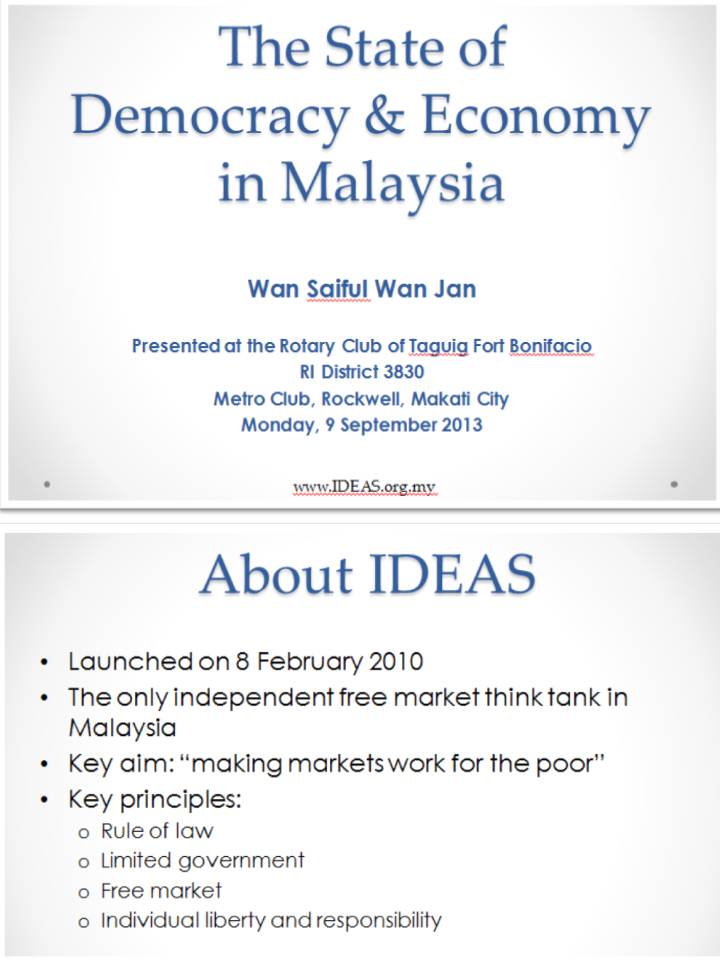
It's good that Wan briefly introduced what the Institute for Democracy and Economic Affairs (IDEAS) is. He said that often people look at free marketers as not too concerned with high inequality and the poor, so they made it clear that their goal is to "make markets work for the poor."

Both the administration and the opposition in Malaysia know that IDEAS is free marketer and hence, not exactly their ideological ally. But they see IDEAS as truly independent, receive no money or funding from the government, so they entertain the 3rd party engagement of IDEAS in various policy discussions. 

Wan showed also a map of Malaysia. You may also view the presentation in slideshare, here.


One principle in Malaysia before was the New Economic Policy (NEP). When Prime Minister Razak Najib came, he introduced the New Economic Model (NEM) and it is pretty liberal and free market leaning, to correct or reduce the distortions of heavy state involvement and welfarism in Malaysia. Wan gave examples of how Malay-bias the government policy is, at the disadvantage of non-Malays like the ethnic Chinese and Indians in the country.


The 13th General Elections (GE13) result last May however, has threatened the liberalization reforms that PM Najib wants to introduce. And even though the elections were conducted rather unfairly. When IDEAS released the result of their findings of the elections, their website crashed for more than a week due to heavy online traffic, people downloading the report, reading articles and interviews of Wan and other think tank leaders.

Monday, September 09, 2013

Pol. Ideology 48: Hobbes, Locke, Rousseau and Social Contract Theory

A friend, one of the few real political science academics who can dabble in political theory and discuss things in their facebook walls or blogs, Amado “Bong” Mendoza  (http://bongmendoza.wordpress.com/) of the UP Pol. Science Department, posted the following in his facebook wall yesterday.

I like Bong's discussions about these three classical thinkers of the social contract theory, so I am reposting them here. "Social contract" is an agreement, explicit or implicit, between citizens and the State and how freedom and power are to be divided and implemented between them. I made a few comments to Bong's discussions. I added the years of those three classical thinkers plus Adam Smith. Photos (top, Hobbes and Locke; bottom, Rousseau and Smith) are from wiki.
---------


1. Thomas Hobbes (1588-1679). In the beginning, there was no state or public authority. Since there was no state, there was no law. Since there is no law, nothing is right or wrong. Everyone is free to do as she pleases. 

Consequently, life was nasty, short and brutish. Civilization was not possible in this so-called state of nature. However, since human beings were rational, they agreed to leave this world of delusion, of fake freedom and submit to the Leviathan's authority.

The implied social bargain is that submission to authority will result in a life so much better than that in the state of nature.

How is this discussion connected to the current abuse of public money by the Philippines' political class and its minions? One can argue that the rape of the public treasury sends us back to the barbaric state of nature.

2. John Locke (1632-1704) saw the social bargain to get out of the state of nature as one between each and every person who becomes a citizen of political society.

The people are the ultimate sovereign and government is its public servant.

There is a separate contract between the people and government. As public servant, the government is contractually obligated to protect the life and property of its citizens.

Failure to do so is a simple breach of contract.

However, if government itself (or key officers of government) actively defrauds its citizens of their lives (extra-judicial killings) and their property (plunder of the public treasury), this act is high treason.

Papa John warned that the sovereign people have the right to rebel against a grossly abusive "servant."

3. Jean Jacques Rousseau (1712-1778). Of the three social contract philosophers, Rousseau is the most controversial and less straightforward. He talked about people being "forced to be free" since they apparently do not know what's best for them.

And yet Papa Jean was concerned with, like other political philosophers, ensuring the freedom of the individual was compatible with the authority of the state.

The growth of human population has led to increased human interaction and interdependence. Beginning with his solitary noble savage, Papa Jean saw the emergence of inter-dependent societies that required ordering by political authority.

The noble savage is undoubtedly free. The status of the individual in inter-dependent communities is unclear. Papa Jean suggested that the latter have actually degenerated into class-divided societies where the rich impose unfreedom on the poor.

Rousseau is clearly dissatisfied with this set of affairs. He argues that the key to the reconciliation of individual freedom with state authority is the idea of the general will: the collective will of the citizenry taken as a whole. The general will is basis of law and is willed by one and all. In following the law, each citizen follows his own will and is thus free.

All of the discussion above may be Greek to us but Papa Jean made some practical points. He was not in favor of political parties because they represent narrow particular wills. He was also not in favor of representative democracy or government. In the determination of the general will, each citizen must directly manifest his preferences without being filtered by a representative.

Papa Jean was in favor of direct democracies which must be of necessity small in scope.

Will there be a need for pork barrel allocations in Papa Jean's direct democracies?

If so, what are the chances that they will be plundered?
--------

The following are my comments to Bong’s postings and his reply:

On #1, Hobbes:

Saturday, September 07, 2013

Fat Free Econ 47: Pork Scam vs. Public Debt Scam

* This is my article yesterday in interaksyon.com.
----------

MANILA - The government is setting aside P330-plus billion a year in interest payment alone for our public debt, and many people are not angry with that huge transfer of money from average taxpayers to rich lenders. The people are angry (and rightly so) of the alleged P10 billion pork barrel scam.

Let us compare the numbers and see why public anger is disproportionate to the money that is siphoned off from their pockets.

At the heart of public anger and discontent over the Napoles pork barrel scam is the huge lump-sum money allocated to legislators in both the Senate and House every year. This is a separate item in the National Expenditure Program (NEP) and beyond the amount allotted to various national agencies, government owned or controlled corporations (GOCCs) and local government units (LGUs).

Table 1. Priority  Development Assistance Fund (PDAF), in billion pesos


Source: DBM, NEP 2012 and 2014

Note the big jump of legislators’ pork barrel from the Arroyo to the PNoy administrations, 2010 vs. 2011 PDAF fund. 

The alleged P10 billion pork barrel fund that was coursed through Janet Lim-Napoles (JLN) over many years does not seem to be itemized. Below is an itemized table covering 2006-2011 but totaling only P3.13 billion.

Table 2. Amount dispensed to some legislators in the Napoles pork barrel scam


Source: Philippine Daily Inquirer, August 30, 2013

The public is angry because almost none of this amount went to clear projects that benefitted the poor, but were simply divided among the legislators (they allegedly got 70 percent), JLN and bogus NGOs, and some implementing agencies and COA auditors that allowed such irregular distribution of funds without publicizing it. It was the internal whistleblowers who divulged the scam and the legislators involved.

While the public fund siphoned to corrupt legislators and the JLN camp was indeed big, the amount is loose change -- in short, barya -- compared to the amount of money that leaves the public coffers yearly just to pay the interest on our public debt. Most people are not aware of the magnitude of such payment: around P332 billion a year on average from 2012 to 2014: P312.8 billion in 2012, P332.2 billion this year; and P352.6 billion next year.

Table 3. Principal and interest payment of Philippine public debt, 2012-2014


Source: DBM, Budget of Expenditures and Sources of Financing (BESF) 2014,Table B.20

Interest payments in 2010 and 2011 were also huge, P294.2 billion and P321.6 billion, respectively. So annual interest payment is about 14 times the size of the annual lump-sum pork barrel of legislators, and 32 times the share of the Napoles camp.

Table 4. Principal and interest payment of Philippine public debt, 2010-2011
 

Source: DBM, BESF 2012, Table 18

Another way of looking at it is that from 2010 to 2014, for every P100 in various taxes that we pay -- personal income tax, corporate income tax, excise tax and value-added tax (VAT) passed on to us consumers, documentary stamp tax, import tax, travel tax, vehicle registration tax, etc. -- about P23 of it is used to settle the interest alone on the country's debts. And only P77 will be used for salaries, offices, subsidies and projects of various government agencies -- local and national -- assuming that such services and subsidies are indeed necessary or are efficiently provided at the least cost possible.

Table 5. Interest payment as percent of tax revenues, 2010-2014


Sources: Interest payment, Tables 3 and 4 above; Tax Revenues 2010-2012, DOF, Fiscal Update Tax Revenues 2013-2014, DBM, BESF 2014, Table C.1
IDEAS 2: Wan Saiful Talk in Manila, September 9

The CEO of the Institute for Democracy and Economic Affairs (IDEAS, http://ideas.org.my/), Mr. Wan Saiful Wan Jan, will speak on "The State of Democracy and Economy in Malaysia", this coming Monday, September 9, 2013, 7:30pm, at Metro Club, Rockwell, Makati City. Hosted by our Rotary Club of Taguig Fort Bonifacio, RI District 3830. This is free, open to the public, people will just pay for the meals they will order.

Wan is a friend way back in 2008. I met him first in Atlanta, USA that year during the Atlas Liberty Forum. Then Atlas VP Jo Kwong gave me a travel grant to attend that conference. 

IDEAS is a big, dynamic and the only free market think tank in Malaysia. Wan is well sought in Kuala Lumpur, meeting with Cabinet Ministers and Parliamentarians on certain issues.

Wan will attend a regional conference in De La Salle University (DLSU), Manila next week, September 10-11, and since he is arriving early, I asked him to give a talk at our Rotary Club, he quickly said Yes. Wan can touch on many topics -- Sabah, petroleum economy, a heavily state-owned economy, etc. All the big TV and radio stations, big newspapers are owned by the government. Imagine that GMA7, ABS CBN2, TV5, Inquirer, PhilStar, etc. are all owned by Malacanang?

Malaysia held its first ever open, general elections only last May. The administration has faced for the first time too, a serious opposition challenge. Needless to say, the entire government machinery was mobilized to ensure that the administration would win, they did.

Below is a recent paper by Wan.
------------


The first time I heard the phrase 1Malaysia was a few weeks before Dato’ Sri Najib’s blog (www.1malaysia.com.my) was launched. The 1Malaysia concept will forever be linked to Najib, even after someone else replaces him as President of UMNO and Prime Minister. After all, this is his brainchild.

At the event to launch the 1Malaysia logo on 27 June 2009, Najib said the following: “When the 1Malaysia concept was introduced, many people asked what is the meaning and substance of 1Malaysia. I found that in principle most Malaysians accepted the 1Malaysia concept. But while they accept the 1Malaysia concept, they want to know what is the meaning of 1Malaysia.”

This speech, even though delivered four years ago, is still true today. There are many people out there who would say very positive things about 1Malaysia, but if you ask them what 1Malaysia actually means, you will find that there is no one definitive answer.

PWD Discount 1: Who are Persons with Disability?

In a complaint email last Tuesday by James Auste, head of the Cancer Warriors Foundation (CWF), why Mercury Drugstore did not give sell him his medicines for more than one month, he was answered by Atty. Edsel Manuel of Mercury. The latter gave me permission to blog his comments, thanks Atty. Manuel.

--------------

Is one suffering from Chronic Illness a Disabled person? This has been discussed with the National Council for Disability Affairs (NCDA) 2 years ago and was answered in the negative.

First, Republic Act 9442, amending RA 7277, the Magna Carta for disabled persons, provides that the 20% discount for the purchase of medicine shall be for the exclusive use and emjoyment of persons with disability, thus:

CHAPTER 8. Other Privileges and Incentives
“SEC. 32. Persons with disability shall be entitled to the following:
(c) At least twenty percent (20%) discount for the purchase of medicines in all drugstores for the exclusive use or enjoyment of persons with disability;”

Second, the Implementing Rules and Regulations of RA 9442 states that the granting of said 20% discount is subject to the guidelines of the Department of Health (DOH), thus:

“IRR OF REPUBLIC ACT NO. 9442,
6.1.d Purchase of Medicine – at least twenty percent (20%) discount on the purchase of medicine for the exclusive use and enjoyment of persons with disability. All drug stores, hospital, pharmacies, clinics and other similar establishments selling medicines are required to provide at least twenty percent (20%) discount subject to the guidelines issued by DOH and PHILHEALTH.”

Third, the DOH-Administrative Order No. 2009-0011 has made clear in its “Rationale” and in the “Definition of Terms,” particularly on the “Disability Types,”  the phrase “Chronic Illnesses with Disabilities” or “disability due to chronic illness,” thus:

Wednesday, September 04, 2013

Pork Barrel 7: Presentation at Adamson University

This afternoon, I spoke at Adamson University on a big college conference, held at the university's theater, probably about 200-300 students in the audience. I am thankful to Ms. Pauline Brillantes, a young faculty member at the Department of Social Sciences, for inviting me to their big college event.


Since the audience are university students, I could introduce some basic conceptual framework and they would be able to follow. My presentation was 21 slides long, showing 16 of them here. The full presentation is at slideshare, here.


--------

See also:

Tuesday, September 03, 2013

Senior Citizens Discount 5: Supreme Court Flip-Flopping on the Law

A fried from Mercury Drugstore, Atty. Edsel Manuel, gave a long reply to the complaint of Mr. James Auste, head of the Cancer Warriors Foundation, why his demand to get a 3-months supply of his medicines from Mercury was denied. The email exchange was posted in our DOH Advisory Council for RA 9502 (Cheaper Medicines Law of 2008) email loop. Atty. Manuel's long reply covered several topics, from the law on mandatory discounts to persons with disabilities (PWDs) or RA 9442, to the expanded mandatory discounts to senior citizens or RA 9527 (enacted February 2004) and RA 9994 (enacted January 2010), to pricing by big drugstore chains.

Below, I am posting portions of his reply related only to RA 9994. I will reserve my further comments about this law in my next blog post on the subject. I thank Atty. Manuel for giving me permission to blog his long reply. Photos here, I got from the web.


(S)ince the enactment of senior citizen and PWD discounts, drugstores have been crying afoul and have been literally crying a river in Congress and Senate.  If this 20% discount is viable and reasonable to drugstores why on earth will drugstores complain? And with the burden shared to manufacturers and suppliers, why are they complaining also? This means that there is something wrong with the law.

The first giver of 20% discount is RA 7432 or the original senior citizen law. This law is the most fair that even without the implementing rules being issued, Mercury Drug has initiated the giving of 20% discount believing in the just and fairness of the law as the cost of the discount was treated as tax credit. 

However, the anticipated fairness of the law was saddened by the issuance by the Bureau of Internal Revenue of Revenue Regulation No. 2 series of 1994, by treating the grant of the 20% discount as tax deduction instead of tax credit; and the expected propriety of the elderly was frustrated by the abuses made by unscrupulous persons. We were able to convict in Valenzuela court a person who used fake senior IDs and the discounted medicines he illegally acquired were sold to other establishments.

Appeal to the Executive branch of the government turned to be futile thus, the company sought the intervention of the Judiciary.  

From 1994 until the company won the case with the Supreme Court in 2005, the company had suffered substantial reduction in sales,  profit, and drain in the company’s cash flow, not to mention the litigation costs  incurred . 

It has been decided in numerous decisions of the Supreme Court that tax deduction is not fair- is not a just compensation for the loss revenues brought about by the discount. (Commissioner of Internal Revenue v. Central Luzon Drug Corporation G.R. No. 159647, April 15, 2005, 456 SCRA 414; Bicolandia Drug Corporation  v. Commissioner of Internal Revenue, G.R. No. 142299, June 22, 2006, 492 SCRA 159; Commissioner of Internal Revenue v. Bicolandia Drug Corporation, G.R. No. 148083, July 21, 2006, 496 SCRA 176; Commissioner of Internal Revenue v. Central Luzon Drug Corporation , G.R. No. 159610,(June 12, 2008] 

To quote the Supreme Court, thru Justice Panganiban, 

“Be it stressed that the privilege enjoyed by senior citizens does not come directly from the State, but rather from the private establishments concerned.  Accordingly, the tax credit benefit granted to these establishments can be deemed as their just compensation for private property taken by the State for public use.” (Commissioner of Internal Revenue v. Central Luzon Drug Corporation G.R. No. 159647, April 15, 2005, 456 SCRA 414)

That light we saw from the Supreme Court in redeeming the company from injustice did not continue to flame-up because the Legislature enacted RA 9527 or the Expanded Senior Citizen Act of 2004, which changed the original tax treatment of the discount from tax credit to tax deduction.

With the enactment of the Expanded Senior Citizen Act of 2004, the small drugstores filed a Petition with the Supreme Court questioning the constitutionality of the tax deduction provision of the law.

Surprisingly, the Petition by the small drugstores was dismissed by the Supreme Court, in deviation from their previous ruling by upholding the  tax deduction scheme, but questioning the business decision of drugstores in pegging a small mark-up. 

The Supreme Court enunciated thru Justice Azcuna

“it is unfair for petitioners to criticize the law because they cannot raise the prices of their medicines given the cutthroat nature of the players in the industry. It is a business decision on the part of petitioners to peg the mark-up at 5%. Selling the medicines below acquisition cost, as alleged by petitioners, is merely a result of this decision. In as much as pricing is a property right, petitioners cannot reproach the law for being oppressive, simply because they cannot afford to raise their prices for fear of losing their customers to competition.” (Carlos Super Drug vs. DSWD, G.R. No. 166494, June 29, 2007)

As evident from the above ruling, the Supreme Court teaches drugstores to increase their prices to counter the effect of tax deduction, but this has been rendered inutile by the enactment of RA 9502 or the Cheaper Medicine Law in June 6, 2008, where prices of medicines have been limited to the dictated price of the government. 

Where now will the drugstores put themselves? Again, woe to drugstores! Additional salt to wound is that the drugstores are being punished if they will not give discounts and the aggressive complaints of seniors and pwds as if drugstores are the dictator of prices….
-------------

See also:
Senior Citizens Discount, Part 2, November 03, 2010 
Drug price control 5: Mandatory discounts and acronym politics, March 21, 2011 
Senior Citizens Discount 3: Sharing of Mandatory Discounts on Medicines of Senior Citizens, December 14, 2012 

Senior Citizens Discount 4: Distortion in Consumers' Perception of Drug Prices, February 04, 2013 

Drug price control 5: Mandatory discounts and acronym politics, March 21, 2011 
Welfarism 25: Centenarians and Populist Legislators, May 30, 2013

Monday, September 02, 2013

Mining 32: Output Contraction in 1st Half 2013

* This is my article in Mining Week yesterday.
--------------

The continuing policy instability in the mining industry has one clear result, the continued decline in mining output, both metallic and non-metallic.

The National Statistical Coordination Board (NSCB) released this week the 2nd Quarter 2013 macroeconomic data. The economy’s gross domestic product (GDP) was able to grow 7.7 percent in 2nd Qtr 2013 compared to its year ago level. The main contributors to such high growth in the expenditures and demand side were investments or capital formation, public and private, followed by government consumption, then private household consumption.

By industrial origin, the main contributors to high GDP growth were construction and manufacturing, followed by financial intermediation and real estate. And the sectors that suffered output contraction were agriculture and mining, with growth rates of -1.1 percent and -2.7 percent respectively, in 2nd Qtr 2013.

The NSCB data also shows sectoral breakdown of output. For mining, current prices of metallic mining output showed another two-digit percentage decline. From -16.8 percent in the 1st half of 2011-2012, to -13.4 percent in the 1st half of 2012-2013. Contraction was prominent in gold, nickel, other metallic and non-metallic mining.


The main contributors to an increase or decrease of output are (a) quantity output measured in metric tons, and (b) value of output measured in pesos, which is partly a result of currency appreciation or depreciation of the importing country of our raw mining products. Thus. it is possible that quantity output has remained the same or even slightly increased, but their peso value once exported has declined due to the peso appreciation compared to the US$, Japanese Yen, Chinese Yuan, the Euro, and other major global currencies.

Mining output in constant prices, ie, the effect of inflation has been removed, still showed output contraction, -2.4 percent in the 1st half 2013 compared to their year ago output. The high output growth of chromium and copper mining was negated by high output contraction by other metallic and non-metallic mining.


Mining is a huge job creator in the provinces and rural barangays. And aside from direct job creation, taxes and fees paid to the national and local governments, large-scale mining also provides various direct social and economic services to the employees and residents of the mining permit areas.

The continuing policy instability in the mining sector are in the form of (a) proposed higher taxation, (b)  occasional mining moratorium, and (c) reversal by some local governments of a mining permit given by the EMB-DENR.

Such policy instability if not outright  contradictions are not good. They contribute to more business uncertainty and hence, discourages both existing and potential players, especially from big and responsible mining companies from the west.

Government should focus on promulgating the rule of law. Of ensuring that mining, environmental and taxation laws and regulations are strictly implemented and followed by both large and small-scale mining, by both local and multinational companies. Enforcing the laws strictly only to large scale mining while allowing small scale mining to get away with certain violations of mining, environmental and taxation laws is both wrong and unfair.
--------------

See also: