Monday, March 10, 2014

More Photos, Forum on Electricity on the Go

Here are more photos from the ETC applicants Datigan batch which organized the forum on "Electricity on the Go: An Assessment of EPIRA" last Thursday, March 06, 2014, at the College of Engineering Theater, UP Diliman, Quezon City.


Atty. Debora Anastacia T. Layugan, Director of Market Operations Service, Energy Regulatory Commission (ERC).


Ms. Maria Teresa "Maitet" Diokno of the Center for Power Issues and Initiatives (CPII) and the Freedom from Debt Coalition (FDC).


During the open forum. I reiterated that many of the electricity angsts of the public were not created by the Electric Power Industry Reform Act of 2001 (EPIRA). For instance, (1) Meralco monopoly is not created by EPIRA but by the Constitution (utilities reserved solely for Filipinos) and Congressional franchising. (2) Multiple taxation of power (royalties on natural gas, local taxes, excise tax, VAT, other taxes that all contribute to expensive electricity, were not created by EPIRA but by various tax laws, national and local. (3) Bureaucracies that make it difficult for new players and generating companies (gencos) to come in resulting in limited competition were not created by EPIRA but by various regulations, enacted by Congress or the various agencies (DOE, DENR, BIR, LGUs, etc.).

In short, calls to repeal EPIRA and go back to government centralization and monopolization of power generation and transmission are misplaced and wrong.


Awarding of Certificate of Appreciation. Signed by Christian Dave Gonzales (right), Batch Head of Datigan 13-B, Khim Carla Bautista and Alyanna Mae Volpane, Project Heads of Electricity on the Go.


The audience. Though held at the College of Engineering, they were mostly Economics majors.


Saturday, March 08, 2014

Energy Econ 15: Electricity Angsts, Presentation at UP Diliman

The other day, I was one of three speakers in a forum on the Electric Power Industry Reform Act of 2001 (EPIRA) at UP Diliman. The two other speakers were Maria Teresa "Maitet" Diokno of the Center for Power Issues and Initiatives (CPII) and Atty. Debora Anastacia Layugan of the Energy Regulatory Commission (ERC).


I knew that Maitet, a fellow UPSE alumni, would be talking critically and negatively about the EPIRA as I have read one of her articles on the subject. And it's good that she spoke ahead of me. She said that the law promised many things but has not delivered. Like bringing down electricity prices but we have more unaffordable electricity rates now.

This table shows that electricity rates are more affordable now, at least in 2013 vs 2012 prices, generation charge. Our monthly electricity bill is composed of about nine items: generation charge, transmission charge, distribution charge, supply charge, metering charge, system loss charge, universal charge, lifeline subsidy, and taxes. Generation charge comprises about 50 percent of the total bill.

I discussed the immediate cause of the power rate hike last December -- a combination of planned/scheduled shutdowns and unplanned/unscheduled shutdowns of several power plants running on natural gas and coal, two of the cheap sources of electricity. Some power plants that run on nat gas had to run on diesel, or oil-fired power plants were tapped, to prevent brownouts.


Thursday, March 06, 2014

Tax Cut 17: BIR vs. Physicians

The Bureau of Internal Revenue (BIR) made this paid advertisement that appeared in several national newspapers last weekend I think. 


Posting below some comments by doctors expressed in facebook, posted on my friend Dr. Jed Inciong's fb wall, except those from change.org petition and Dr. Calimag. My own discussion at the end. Other posters/images are also posted in fb, copy-pasting them here.
-----------

(1) Change.org Petition (around March 2, 2014, initiated by Minerva Calimag)

The medical profession and all physicians are always portrayed as tax evaders by the BIR. The recent BIR Ad that appeared in the Manila Bulletin is certainly discriminatory of the medical profession. Many of us physicians pay our taxes diligently...should the indiscretions of a few be invoked to penalize the entire medical profession? Many physicians also work in the countryside and they are often overworked and compensated less...this overgeneralization on the part of the BIR certainly maligns the medical profession. We demand that the BIR retract this Ad and issue a public apology in all newspapers for this act.

(2) Butch Tamesis, March 4, 2014

This picture shows the PHYSICIAN in general as a burden to the TEACHER, a representative of the MASA. I wonder if the BIR has really thought about this carefully? BIR is actually inciting the masa to revolt against the doctors and blame them as the cause of their poverty. PAMPABIGAT KAMING MGA MANGGAGAMOT SA MGA MAHIHIRAP! 

Does BIR honestly believe this? I will not repeat what my colleagues have said already against the BIR, but just enlighten you about my sentiments. 

In plain language, I am saddened by your portrayal of me as a burden to the society. After so many years of hard work, and sacrifice to help Filipinos (in general), I now live comfortably, able to sustain my family's needs. And this is how you treat me, as a burden to society!? My parent's left me with a wonderful name, a name I am constantly taking good care of. After my father died, the clinic he left was in shambles as his practice had diminished since he got sick. My sisters and I slowly picked up the pieces and built it back to its old glory. The taxes we pay the government ( yearly business tax, machinery tax, real property tax, tax on improvement, garbage tax, sanitation tax, fire and hazard tax), monthly SSS, Philhealth, Pag-Ibig contributions, VAT (not ours anyway since we collect it for the government) is so much that we barely have savings for the clinic on infrastructure improvements.

My clinic is a medical clinic, not a business enterprise, and yet the instruments to make my skills viable is taxed so much that I have no way of recovering the cost unless I charge my patients for its use. A lot of times I don't charge my patients since they cannot afford it. Medicines I prescribe are also taxed exorbitantly by government (i thought the government is pro people?). Electricity and water, and my gasoline expenses have been constantly going up. I am forced to buy electric fans and air conditioners to make my patients comfortable. That adds to my cost of electricity. And you Commissioner Henares and the BIR look at me as a burden to society???!

I have nothing else to say to you, no threats, no dirty finger, no nothing. At my senior age, I am no longer as violent as I was when i was younger since I saw the futility of being a hot head. I am done with that. But I would HUMBLY and RESPECTFULLY ask you to take a second look at this disgusting picture you have portrayed my profession to be. Please take it back because it slaps every physician (guilty or not) on the face. Prosecute these erring physicians, businessmen, lawyers, etc. but please, do not generalize because even JOSE RIZAL OUR NATIONAL HERO IS ALSO GETTING THE HEAT.

My comment comes from the heart, and I feel it every time I read it. Considering the amount of time I spend treating and caring for my patients, sometimes to the point of giving them free consult (in the clinic, by text, or by phone call anytime of the day,or by email) and medicine if they cannot afford it, I get this distasteful ad from BIR. I cannot NOT take it personally!

And the comments of some people against the doctors also hurt. But it does not matter. What matters most is one, our guilty colleagues must change their ways, and two, BIR must also take it back.


(3) Jed Inciong, March 3, 2014

Much like the persecution of jews in Nazi Germany. Our Doctors are being made "whipping boys" and scapegoats for a flawed income tax collection system. Our physicians are being portrayed as contemptuous cheaters.

All said, it pains me to admit I may have made the wrong choice to stay and practice medicine here in my beloved "Inang Bayan" katangi-tanging Pilipinas!
Ninais na manilbihan sa mga kababayang nangangailangan, kahit na higit na mas malaki ang kikitain sa ibang bayan. Dahil sa pagmamahal sa Bayang tinubuan!

Wednesday, March 05, 2014

4th ICCC in Chicago, May 2010

Less than four years ago, I went to Chicago to attend the 4th International Conference on Climate Change (4th ICCC), May 16-17, 2010, mainly sponsored by Heartland Institute. My previous note on this conference is here, Chicago, 4th ICCC, day 1.

Was able to have a photo with Dr. Henrik Svensmark (below, middle), a Danish physicist at Denmark climate research office, also among the pioneers of the Sun-Climate theory. Also in the photo is a friend from Germany, Wolfgang Muller.


With world famous climatologist, Dr. Roy Spencer of the Univ. of Alabama in Huntsville (UAH). He was among the keynote speakers in the 2nd and 4th ICCC. Fantastic theory on CO2, Cloud Feedback and Climate, among others.


With Steve Goreham (left), author of the book, Climatism, and Steve McIntyre (middle) of Climate Audit in Canada.


Portion of the audience, about 500+ people registered and showed up.


Our group, some members of the Civil Society Coalition on Climate Change (CSCCC) headed by the International Policy Network (IPN, London) then. From left: Barun Mitra of Liberty Institute-India, Jose Luis Tapia from Peru, Margaret Tse from Brazil, Julian Morris of IPN (now with Reason Foundation in the US), Martin Krause from Argentina, me.


2nd ICCC in New York, March 2009

On March 6, 2009, my plane landed in New Jersey airport (route was Manila-Narita-Detroit-NJ, Delta Air). I saw small mounds of snow on the tarmac, other parts of NJ and New York. Days before that, there was a winter storm, dumping lots of snow. Some remnants of the snow. No, I did not shovel it, it was only for piture-taking :-)


That was in front of the house of my friend from UP, Leandro "Jojo" Chan who hosted me in his house in NJ for one day. The next day, March 7, I moved to my hotel in NYC, New York Marriot Marquis Hotel. Thanks again, Jo. 

This week or exactly five years hence, same Eastern US, see this news...

WASHINGTON - The eastern and central United States were gripped by a deep freeze on Tuesday, with record low temperatures in the wake of a deadly storm expected to moderate in the coming days.

The late-winter storm left behind frigid temperatures after pushing freezing rain and snow from the Mississippi Valley to the Atlantic coast on Monday.

"Tuesday will likely be the coldest morning from New York City to Washington, D.C., until next winter," the AccuWeather forecasting service said.

Temperatures across the eastern and central United States were about 30 Fahrenheit (15 Celsius) below normal, it said.

The National Weather Service said the mercury plunged to minus-1 F (minus-18 C) at Washington Dulles International Airport, tying a monthly record.

Baltimore Washington International Airport posted 4 F (minus-15.5 C), breaking a record for March set in 1873, it said....

Five years ago this month, I attended the 2nd International Conference on Climate Change (2nd ICCC) in NYC, March 8-10, 2009. The theme was "Global Warming: Was it Ever Really a Crisis?". I was able to have a photo with Vaclav Klaus, then President of Czech Republic and was among the keynote speakers at the conference, also author of the book "Green Planet in Green Shackles." 


Also a photo with Dr. Willie Soon, a Malaysian-American astrophysicist at the Harvard Smithsonican Center for Astrophysics. From left: Barun Mitra of Liberty Institute, India; Willie Soon; Jose Luis Tapia from Peru, me, and a participant from Africa, I did not know him, he just joined us in a photo op with Willie.


Of the 800+ participants and speakers, only Barun, me and Xingyuan Feng (from China) were Asians. And Willie, though he grew up in the US. I was the only South-East Asian, only Filipino there.

With Joseph "Joe" Bast, President of Heartland Institute in Chicago, the main sponsor of the conference.


And Alex Chafuen, President of the Atlas Economic Research Foundation, Washington DC.


Meanwhile, from WUWT yesterday,  


See also:: 

Sunday, March 02, 2014

CSOs and State 18: Civil Society as Lobbyists for More Government? Cigarette Warning Bill

There are moves again to have a new law, mandating and forcing tobacco manufacturers to put warning signs in their cigarette packs like "Smoking Kills".

While I believe that tobacco use is harmful for one's body, while I have no affection for tobacco companies, I do not believe that we need a new law on this.

Notice that in many things in health care and other sectors, people keep asking for new laws, or amending old laws to make the regulations and restrictions more strict. The more that people ask from government, the latter will give more than what they need. like more pork barrel for legislators, more cyber spying law, more mandatory contributions, more taxes.

Notice in particular: health insurance monopoly, gobyerno. Drugs pricing and mandatory discount, gobyerno. Condoms and pills, gobyerno. Sin tax, gobyerno. food labelling, gobyerno. Cigarette warning, gobyerno. Civil society is unimaginative, they see no meaningful role for themselves except to lobby for more government legislation, regulation and coercion?

Some if not many of the "heroes" and "champions" of the RH law, sin tax law, PhilHealth expansion law, both in Congress and Senate, are among the scoundrels and big time thieves in the pork barrel scandal. Now the civil society organizations (CSOs) that pushed hard these bills into laws are now indebted ("utang na loob") to these legislators. It will be a bit awkward for them to demonize these corruption-tainted legislators on the pork barrel robbery and plunder issue.

Another round of political indebtedness, lobbying and pleasing these legislators so they will pass another law, from cigarette warning to more CCT, etc. The role of civil society has been heavily downgraded to plain lobbyists for more government intervention and coercion. Baligtad dapat, it should be the reverse. Civil society is towards more citizen empowerment and self-reliance, not more dependence on government.

A friend commented, “Will civil society empowerment encourage and compel cigarette firms to put these pictures on their packs? “

No, you do not expect cigarette manufacturers to put those "smoking kills" warning in their products voluntarily. The same way that some of those KTV and other girlie bars will disallow prostitution inside their premises voluntarily, even if there are explicit laws, national and local, that prohibit prostitution. The same way that certain importers do not engage in smuggling voluntarily, even if there are explicit laws that prohibit and explicitly penalize smuggling. The same way that some LGUs and police tolerate jueteng and other "illegal gambling", or tolerate "illegal drugs" even if there are explicit laws that prohibit those games and drugs.

Aren't people disappointed enough with "more government" that there are many prohibitions already in society and yet those prohibitions are implicitly tolerated, or were dealt with kids gloves, in exchange for large-scale bribes and corruption? Prostitution, jueteng, drugs, gun running, smuggling, plunder, massacres, political murders.

Civil society should better go to the public directly, produce information materials and explain clearly via posters, cartoons, comics, lectures, etc. that smoking is bad, that heavy smoking kills.

Now if people still keep smoking after being informed, what can you do? They own their body, their lives, let them do what they want with their body. Should government + civil society put lots of spies to discourage and penalize people if they smoke, if they over-drink, if they over-drugs, if they over-eat and over-sit, as all of these lead to bad health outcomes? Not good.

More and more, we are moving to a society of more regulations, more prohibitions and bans, more central planning thinking, more corruption and robbery, more public disappointment. There are many unsolved murders, rapes, abduction, robbery. Government becomes less concerned with them as government is busy implementing new prohibitions -- you cannot drive your own car on certain days of the week, you cannot drive your motorcycle without helmet or with helmet but has no DTI sticker, you cannot put up a bake shop or barber shop unless you get permits from the barangay to sanitation office to the Mayor to BIR, you cannot hire a nanny unless you also give or pay for her SSS, PagIBIG, PhilHealth, and so on.

We should go the reverse. Less prohibitions in society, less role for legislators and need for new legislation, less taxes and pork barrel. Let there be more civil society, less uncivil society that relies on coercion and force, the government. Do we need a new law that will penalize people if they do not give any assistance to victims of heavy flooding, storm surges/tsunami, volcanic eruptions, other natural disasters? Last time I checked, volunteerism and fast civil society response to such calamities was alive and kicking, even if there is no law, not even a bill in congress, that penalize people for being "unhelpful."

ALL legislations are coercion and in effect, prohibitions. In this case, it is prohibited, it is banned, it is not allowed, to sell any cigarette, nga-nga, tabako, etc. with manufactured packaging to be sold unless there is explicit warnings that "tobacco kills", "tobacco is harmful to your body", or graphic photos, etc. There are penalties in the law for violating such prohibitions and bans.

If civil society is seen as citizens movement towards self-reliance and self-empowerment, away from dependence from the state and politicians, civil society leaders can initiate projects without legislation. Like those fast mobilization to help victims of heavy flooding and other calamities even without any law mandating and coercing people to help.

And those legislators and scoundrels involved in corruption and plunder, as much as possible, civil society should ignore and isolate them. Instead of writing to them warm letters like"Dear Hnorable Senator ____, Please support our bill providing this, subsidizing that..."

While we care for the people, we shoud stop deluding ourselves that more government prohibitions will solve many social ills. Too often, more prohibitions create more opportunities for extortion and corruption, more problems than solutions. That is how more people are disappointed with government, they expect a lot, they are disappointed a lot. CSOs should shift the focus of expectation, from government aka uncivil society to civil society, to people themselves.

The less that we need legislators, the less that we need new legislations or new laws, the easier for us to demand drastically shrinking the Legislature, whether a bicameral Congress or unicameral Parliament. But that will not happen if in most social and economic concerns, people demand "Congress should pass a law on ___". They become unwitting lobbyists for more legislators, and many politicians love that. They feel their high importance, there is high demand for their presence, they receive lots of "Dear Honorable Senator/Congressman/woman ____, please support our bill to regulate and prohibit X, to subsidize and expanding spending on Y, to raise taxes and fees to finance X and Y,..."

The role of civil society is to enable people to become more self reliant, more responsible for themselves, their households and communities. To become less dependent on uncivil society that relies on coercion, government.
--------

Saturday, March 01, 2014

Drug Price Control 38: Presentation at USC, Cebu, March 2010

* Note: This is an expanded version compared to the one I originally posted last Thursday. The discussion on game theory below is explained as many readers may not be familiar with this applied math theory used in Economics and other social sciences.

Upon the invitation of a friend, Prof. Frank Largo, who was the Chairman of Economics Department then, University of San Carlos (USC), Cebu City, I spoke at his university in March 2010. I forgot to blog about it here, posting now.


My title was a play of words on right and left. Private property rights can be subverted by leftist pricing policy.


I was one of four speakers then. The three other speakers were (from left) Dr. Sophia Mancao of DOH Region 7, Mr. Juanito Luna of Prosel Pharmaceuticals Inc. in Cebu, and Prof. Yolanda Deliman, Dean of College of Pharmacy, USC.


My presentation, below.


Thursday, February 27, 2014

Free Trade 34: ASEAN's Bilateral and Regional FTAs

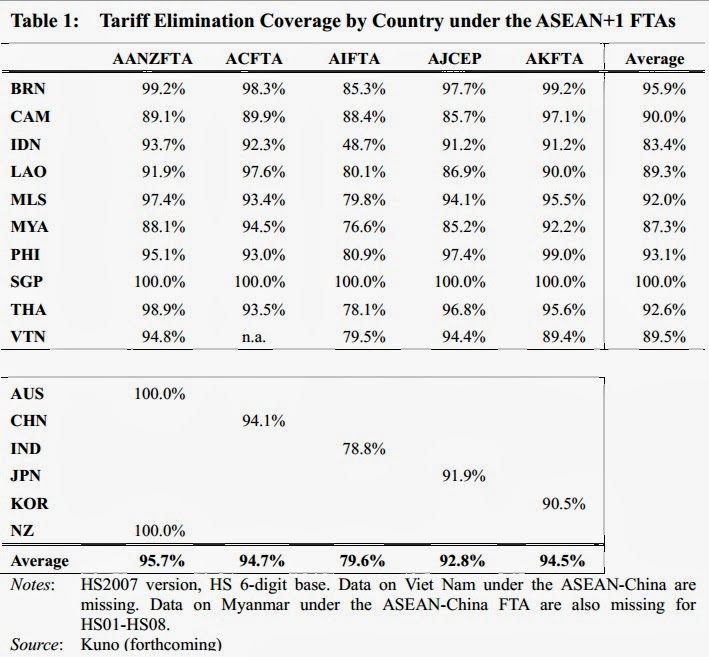
There are a number of good trade data on Asia-Pacific free trade agreements (FTAs), from an Economic Research Institute for ASEAN and East Asia (ERIA), Discussion Paper ERIA-DP-2013-02,  “Taking ASEAN+1 FTAs towards the RCEP:  A Mapping Study” by Yoshifumi FUKUNAGA and Ikumo ISONO . Thanks to Aiken Tafgar for the heads up.

One such data is this. 


Where: FTA - free trade agreement;
CEP - comprehensive economic partnership
Thus, AANZFTA - ASEAN-Australia-NZ FTA
ACFTA - ASEAN-China FTA
AIFTA - ASEAN-India FTA
AJCEP - ASEAN-Japan CEP
AKFTA - ASEAN-Korea FTA

So aside from ASEAN + 3 (CJK) and ASEAN + 6 (CJK + I, A, NZ) multilateral FTAs, there are bilateral FTAs with ASEAN taken as a bloc or one economy.


Indonesia protectionism is still high; India too, and surprisingly, Malaysia too. Here's another table, when or what year they intend to have zero tariff (ie, 100% trade liberalization with their bilateral partners). CLMV means Cambodia, Laos, Myanmar, Vietnam, considered 4 "laggards" in trade liberalization, although Vietnam does not appear to be a trade "laggard" these days.

Below, more revealing data on protectionism hidden under "depends on FTA" Case example is Indonesia. Wow! It should be CLMI (cambodia-laos-myanmar-indonesia) instead of CLMV. Not to mention the many non-tariff barriers.


Many protectionist groups often cite the north-south or rich-poor countries divide in opposing free trade policies, but what if the trade issues concern our neighbors in the ASEAN? Or other Asia-Pacific countries like India, Korea and Australia?
--------

See also:
Free Trade 30: BIPOR and APTIR, January 03, 2013
Free Trade 31: FTAs, EPAs and the Heckscher-Ohlin Theorem, January 10, 2014 

Free Trade 32: Hong Kong's Unilateral Trade Liberalization and John Cowperthwaite, February 12, 2014 

Free Trade 33: ASEAN Economic Community 2016, February 16, 2014