Monday, August 31, 2020

Agenda One News, Part 6

Last Friday August 28, I was a guest again of Cito Beltran in his famous program, "Agenda" in One News PH, Cignal TV. I was the third and last guest in his episode that day, the topic was "Keeping the economy afloat."

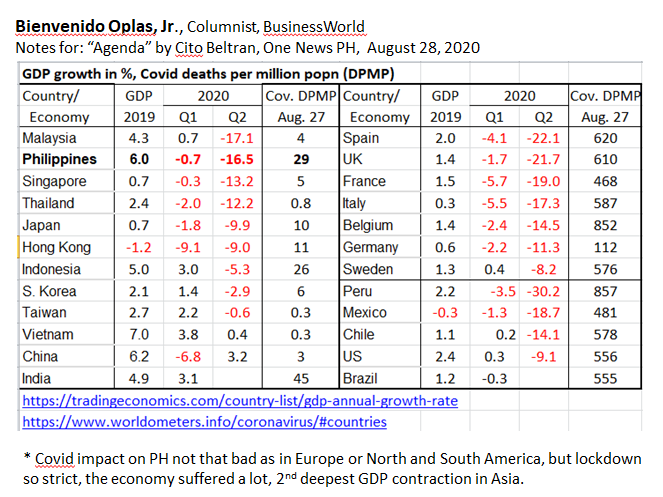
Again, I pointed at the strict, prolonged, indefinite, no timetable lockdown and restriction on people and goods mobility as the main cause of the economic contraction and business hardships.

I prepared some macroeconomic and public finance data for my notes during the interview. I sent the three slides to Cito too. 

The interview is here, my part starting at 1:08 hour,
https://www.youtube.com/watch?v=0xxKiIc7YXs&feature=youtu.be
and https://www.facebook.com/watch/live/?extid=xvbw2G5hUwsKl9Dq&v=2699987343547519&ref=watch_permalink.

Thanks again for the invite, Cito.
-----------------

See also:
Agenda, One News, Part 3, August 30, 2019 
Agenda, One News, Part 4, February 11, 2020 
Agenda One News, Part 5, July 28, 2020.

Sunday, August 30, 2020

BWorld 450, Tax competition, not exemption

 * My column in BusinessWorld, August 27, 2020.

Governments around the world have to grapple with raising new revenues because their lockdown policies have crippled the businesses and people that pay them regular taxes while they expanded public borrowings. Raising tax rates would appear very insensitive — the likely direction is to cut taxes to help ailing businesses and this might lead to a new round of tax competition among neighboring countries and economies.

The Philippines, through the Department of Finance (DoF) has proposed a drastic reduction in the corporate income tax (CIT) under the Corporate Recovery and Tax Incentives for Enterprises Act (CREATE) bill. The current 30% will become 25% in the year of its legislation, then there will be a 1% per year reduction starting 2023 until it reaches 20% in 2027. Very good move by the DoF, among the few instances where I support them.

Five major East Asian economies have CIT of 16.5% to 20% — HK, Singapore, Thailand, Taiwan, and Vietnam. When the Philippines attain the 20% CIT by 2027, these economies may cut their rates further. Indonesia had a CIT of 25% until 2019 and brought it down to 22% this year — the law was made before the pandemic.

The Philippines’ high CIT and withholding tax for dividends, interest, and royalties, are among the disincentives for the entry of foreign direct investments (FDI) which is the lowest among the country’s more mature and developed neighbors. Our FDI inward stock (net of inflows less outflows through the years) was only $88 billion in 2019 (see the table).

The DoF has noted the country’s low tax efficiency. In CIT, our 30% collects only 3.7% of GDP or an efficiency of only 12.3%, vs Thailand’s 20% that collects 5% of GDP or 25.2% efficiency, or Vietnam’s 20% that collects 7.3% of GDP or 36.5% efficiency.

When it comes to VAT efficiency, the country’s 12% collects only 4.3% of GDP or 35.7% efficiency, vs Thailand’s 10% that collects 4.1% of GDP or 59% efficiency, or Vietnam’s 10% that collects 6.1% of GDP or 61% efficiency.

Aside from lower CIT, the CREATE bill has two other important provisions — lengthen the net operating loss carry over (NOLCO) from three to five years, and maintain the 5% gross income earned (GIE) up to nine years with the sunset period changed from two to seven years to four to nine years. Corporate losses this year can be carried up to the next five years under the NOLCO to reduce tax liabilities of companies, assuming they have survived these horrible, strict, indefinite and no timetable lockdowns which have crippled if not killed thousands of SMEs already.

Speaking of discouraging or disallowing tax exemptions, there is one sector that has a horrible lobby, the electric vehicles (EVs, those e-cars, e-UVs, e-bikes, e-trikes…). They want their EVs to have exemptions or reductions on import tariffs, excise tax, and VAT; they also want exemptions on import tariff and VAT for their charging equipment. Plus various non-fiscal incentives.

When the government wants more revenues and you exempt some sectors from tax, this means you will have to hike taxes of other sectors — bad. The TRAIN law imposed higher excise tax rates for petroleum products and the regular cars, UVs, but the EVs want zero tax — how horrible and crony-like could that be?

Meanwhile, the Department of Health — initiated drug price dictatorship policy has wreaked havoc on the financials of innovator pharma — the companies that produce new medicines, new vaccines — while favoring the non-innovator, generic, and local pharma. Criteria #4 of EO 104 imposes price controls on innovator, more effective, more-prescribed medicines hoping that there will be product pull out so that the less effective, less-prescribed medicines by local pharma will be left to make more money.

Some lessons and conclusions that can be derived from the above discussions are the following: One, improve revenue efficiency via lower tax rate with little or few exemptions in CIT, withholding tax, VAT, others. Two, ignore the EVs tax exemption lobby, and slap them with existing import and excise tax rates as regular vehicles. Three, price controls for one group of manufacturers and favoritism for another group is plain cronyism. And, four, have the rule of law always, the law applies equally to unequal people and sectors. Tax hikes or tax cuts or zero taxes on one sector should apply to all other sectors or sub-sectors.
----------------

See also:
BWorld 447, Nuclear energy and PSA death statistics, August 08, 2020 
BWorld 448, Growth, mobility and vaccines, August 15, 2020 
BWorld 449, Energy reserves and security, August 25, 2020.

Saturday, August 29, 2020

Weekend 74, CNN as the US' "Baghdad Bob"

 This report few days ago from CNN (aka in 2016 as the Clinton News Network) is funny.


The next two photos from different sources and posted in the American Thinker blog.


CNN has turned itself into America's Baghdad Bob

By Andrea Widburg 
https://www.americanthinker.com/blog/2020/08/cnn_has_turned_itself_into_americas_baghdad_bob.html

Muhammad Saeed al-Sahhafk, AKA Baghdad Bob, was Saddam Hussein's minister of information.  As troops neared and then entered Baghdad, al-Sahhaf gave daily press briefings during which he announced the most outrageous lies about the wars.

For example, Baghdad Bob insisted that American troops were committing suicide "by the hundreds" and that none had entered Baghdad.  Meanwhile, Americans were a few hundred yards away from him, and the audience could hear the sounds of their fighting.  On April 8, four days before Americans captured Baghdad, al-Sahhaf was still insisting that U.S. troops "are going to surrender or be burned in their tanks.  They will surrender.  It is they who will surrender."

This was reposted in 
https://www.zerohedge.com/political/cnn-has-turned-itself-americas-baghdad-bob

And these two from Babylonbee,


https://babylonbee.com/news/cnn-hires-this-is-fine-dog-to-report-on-riots/


https://babylonbee.com/news/14-cnn-headlines-from-the-last-6000-years-of-human-history/

A related fun (but real) story -- that the 2020 US Presidential elections would be the first where there will be no debate between the two opposing candidates. Funny Nancy.

Pelosi: There shouldn’t be any Trump-Biden presidential debates 
AUGUST 27, 2020 RYAN MORGAN 
https://americanmilitarynews.com/2020/08/pelosi-there-shouldnt-be-any-trump-biden-presidential-debates/
-----------------

See also:
Weekend Fun 71, Father's day, Husband's day, June 21, 2020 
Weekend Fun 72, Airline mergers, July 04, 2020 
Weekend Fun 73, Russia vaccine, ECQ, August 15, 2020.

Friday, August 28, 2020

UPSEAA Lecture 6, Ferdie Constantino and SMC infra

This is a delayed post about the lecture by a fellow UP School of Economics (UPSE) alumni, Mr. Ferdinand "Ferdie" K. Constantino, the Chief Finance Officer and Treasurer of the largest business conglomerate in the Philippines, San Miguel Corp. (SMC). Ferdie gave a talk at the UPSE Alumni Association (UPSEAA) last September 13, 2019 held at the SMC HQ in Ortigas. This photo I grabbed from his fb page when he received the UP Alumni Association (UPAA) distinguished award in 2019.

Unlucky for me, I wasn't able to hear his lecture because it was raining so hard that afternoon till evening, traffic was horrible, I didn't drive and I took the bus. The bus took 1+ hour traversing Ayala Ave alone in Makati to reach Edsa, then another heavy traffic in Edsa. When I arrived at SMC, people were already leaving, Ferdie was still there, we have a short chat, I was served nice dinner, plus San Miguel beer of course.

Ferdie's topic that day was SMC infrastructure. 2019 saw traffic congestion worse than previous years and Ramon S. Ang (RSA), SMC's President and COO already proposed an elevated tollway in Edsa. Really a radical idea considering that Edsa is always full of vehicles and there is an MRT railroad in the middle.

Ferdie said he shared info that they give to their investors, the ppt they cannot send by email to non-investors, ok with me. He sent me the SMC Annual Report 2018. It's old to write now, I checked the Annual Report 2019, it's available, https://www.sanmiguel.com.ph/files/reports/SMCAR_2019_0723A_finalweb.pdf.


This somehow summarizes their biggest infra projects. Skyway stage 3 is very important, it will help decongest Edsa and other roads in Metro Manila because vehicles from the south (Calabarzon, etc) going to the north (Central and Northern Luzon) and vice-versa can just travel at SLEX - NLEX direct. 

MRT 7 is also important because it will serve so many passengers from Fairview, QC and bordering municipalities of Bulacan (via Commonwealth Ave., Regalado Ave., etc) down to Manila. Partial operation by 2021. 

The SLEX–TR4 from Sto. Tomas, Batangas to Lucena City in Quezon province.

SMC has other big projects. Foremost is the New Manila International Airport in Bulacan, P740+ billion or 3/4 of a trillion, huuuuuge. The Concession Agreement was signed with government last September 18, 2019.

They are also building a new passenger terminal in Boracay airport. Plus another radical proposal -- build a bridge from Panay mainland, Malay, Aklan to Boracay island. RSA and Ferdie should be sipping something extraordinary which makes their minds think of really radical, game-changing infra projects -- using private money 100%, no cost to taxpayers.

SMC also into power generation, they are in fact the biggest genco in the country, bigger than Aboitiz, FirstGen, Ayalas, Meralgo Gen (MGen), etc. Their new projects are a new unit of Masinloc Power Plant in Zambales, Battery Energy Storage System project. 

Also in water distribution, the Bulacan Bulk Water Supply Project that supplies potable water to 12 out of 24 Bulacan municipalities.

The other day I saw this report, 

SMC investing P121.8 billion in 2 vital infrastructure projects 
Richmond Mercurio (The Philippine Star ) - August 26, 2020 - 12:00am 
https://www.philstar.com/business/2020/08/26/2037813/smc-investing-p1218-billion-2-vital-infrastructure-projects


“The two projects are the South Luzon Expressway Tollroad 5 (SLEX-TR5), a 420-kilometer project from Lucena in Quezon to Matnog in Sorsogon, and the Pasig River Expressway, a 19.40-km road project that will connect Metro Manila’s eastern and western sections.

SLEX-TR5 is a P26.38-billion investment in a build-operate-transfer scheme with a concession period of 30 years, while the Pasig River Expressway will require an investment of P95.4 billion under a 30-year BOT scheme.”

I quickly pm’d Ferdie to express my big surprise and support. SLEX to Matnog, the last town of Luzon island in the south, facing Samar-Leyte islands. Wow as in wow.

But aside from Ferdie the big mind finance guy, Ferdie is also a friend with a big heart. Last January I approached Ferdie to seek donation for our batch '80 40th anniversary, Cadiz City High School, Negros Occidental. We graduated in 1980, 500+ of us from 12 or 13 sections, I was the class Valedictorian, my classmates and batchmates looked up to me to seek some donations from my friends in Manila. Ferdie was #1 in my list and without any fanfare, quickly said Yes. Ferdie sent several dozen cases of beer in cans. Huuuuge celebration and happiness of my batchmates when the beer finally came on our HS reunion day, 2 days of fun and camaraderie. 

Thank again Ferdie, thanks SMC. Mabuhay kayo.
---------------- 

See also:
UPSEAA lecture 3, Tito Ortiz, July 22, 2019 
UPSEAA lecture 4, Johanna Chua, August 4, 2019 
UPSEAA lecture 5, Iggy Sison and Del Monte pineapple farming, March 01, 2020.

Tuesday, August 25, 2020

BWorld 449, Energy reserves and security

 * My article in BusinessWorld, August 19, 2020.

During the media briefing by the Independent Electricity Market Operator Philippines (IEMOP) last week, Aug. 11, data on electricity supply, demand, reserves and prices for the Luzon-Visayas grids from March to early August this year were shown, covering the various  COVID-19 lockdown periods (ECQ, MECQ, GCQ).

I compared the year-on-year (yoy) data and the good news is: One, while average demand in April-June declined by -14.7% (which correlates with the -16.5% GDP in the second quarter), the decline in July was only -3.5%. Two, average prices at the Wholesale Electricity Spot Market (WESM) in April-June declined by -70.8% and continued with a July decline of -58%.

The bad news, however, is that electricity demand in July (10,135 MW) was lower than June (10,174 MW), meaning the month-on-month (mom) economic activities are still flat or negative. The -58% decline in the July price was due to increased power supply compared to both July 2019 and June 2020.

And that is why we should have an ever-rising power supply, to stabilize if not reduce electricity prices, and ensure more power stability and predictability. Not restricting or killing some power supply to promote energy cronyism.

I refer to the endless lobbying to promote the intermittent, unstable, unreliable renewables especially wind and solar. The lobbyists promote more use of batteries to solve intermittency problems — fine, but this will lead to higher prices because those huge batteries are not cheap.

A persistent narrative why countries should go for quick energy transition from fossil fuels and nuclear is the fear of “imported fuel supply insecurity” and hence, the need to rely on domestic, indigenous renewables. For the Philippines in particular, the scare mongering centers on “supply insecurity of imported coal” as we have indigenous natural gas (but this will soon be depleted).

Is imported coal supply insecure and dangerous?

If one uses emotion and climate alarmism, the answer is “yes.” But if one uses reason and hard facts, the answer is “no.”

I checked the proven reserves worldwide for coal, gas and oil, and the computed Reserves-to-Production (R/P) ratio. This ratio shows the number of years that those remaining reserves would last if yearly production were to continue flat. The proven reserves of coal is nearly three times the reserves for gas and oil, and two countries with huge coal reserves are not far from the Philippines — Indonesia and Australia (see the table).

Other major producers are: a.) Natural gas: Qatar with 12.4% share, R/P 139 years; and Turkmenistan, 9.8% share, R/P 308 years; b.) Oil: Iraq with 8.4% share, R/P 83 years; Kuwait, 5.9% share, R/P 93 years. Countries in the table with 500+ R/P ratio means they have very small production and consumption relative to their reserves.

The Philippines in 2019 has a total installed power capacity of 25.5 gigawatts (GW), of which 41% comes from coal, 17% is oil-based, 15% hydro, 13.5% natural gas, 7% geothermal, and 7% variable renewable energy (VREs, solar+wind+biomass).

But in actual electricity generation, out of 106.0 terawatt hours (TWH) in 2019, 55% came from coal, 21% from natural gas, 10% geothermal, 11% from hydro and oil-based, and only 3% from VREs (source: DoE Power Statistics 2019).

So while the pro-VREs and anti-coal lobbyists want to kill coal as soon as possible, they enjoy 24/7 electricity mainly from coal power plants because their beloved wind-solar can contribute only about 2% of total power generation.

The VREs lobby also silently promotes natural gas. They are silent about the fact that global gas reserves and security are much lower than coal reserves as shown in the table above. And while they are loud in opposing carbon emission of coal plants, they are silent about methane emission of gas plants. Both CO2 and CH4 (methane) are greenhouse gases (GHGs) but the latter has a bigger, about 28 times, potential as GHG.

California currently has continuing power instability with actual blackouts. It has the US’s biggest concentration of solar-wind farms, which explains why it has the US’ highest incidence of blackouts. In 2008-2017, California had 4,297, Texas 1,603, New York 1,528, Michigan 1,369…

The Philippines should never follow the example of California. The Philippines should have market- and customers-based power generation mix, not environmentalists- and politics-based power development.
--------------- 

See also:
BWorld 446, More water and investments, less political whims, August 07, 2020 
BWorld 447, Nuclear energy and PSA death statistics, August 08, 2020 
BWorld 448, Growth, mobility and vaccines, August 15, 2020.

Friday, August 21, 2020

Energy 136, California blackouts and wind-solar

Thanks to Benny Peiser and The Global Warming Policy Forum (http://www.thegwpf.org/) for these news clips of what's happening in California energy. I repost the titles and links of 19 reports and stories below. Enjoy.
---------------- 

Green Policies Won’t Keep California Truckin’
The state’s new electrification mandate for trucks will threaten working-class jobs and widen income inequality.
By Joel Kotkin   July 29, 2020 
https://www.realclearenergy.org/articles/2020/07/29/green_policies_wont_keep_california_truckin_500462.html

Even as California reduces its reliable sources of power, notably nuclear and national gas, it is mandating a statewide shift to all-electric medium- and heavy-duty trucks starting in 2024, with the goal of reaching 100 percent of all new sales, wherever feasible, by 2045. On top of other electrification mandates for light-duty cars and buildings, the new truck rule will further increase the state’s demand for electricity and raise rates, already among the nation’s highest. Since 2011, electricity prices have increased five times as fast as the national average. In 2017 alone, they increased at three times the national rate.

(1) Recall Deja Vu: CA Rolling Blackouts are Back 
It’s not easy being green
By Katy Grimes, August 15, 2020 10:06 am 
https://californiaglobe.com/section-2/recall-deja-vu-ca-rolling-blackouts-are-back/

So why are California’s utilities cutting power, and imposing rolling blackouts again?
It’s political. And it’s corrupt.
The state is awash in ultra cheap natural gas, yet in California, our corrupt government finds ways to create an energy shortage, and charge rate payers the highest rates in the country.
This is one reason California electricity costs more than twice the national median—thanks to a government-created shortage.

(2) Why California’s Climate Policies Are Causing Electricity Blackouts 
Michael Shellenberger   Aug 15, 2020,05:25pm EDT 
https://www.forbes.com/sites/michaelshellenberger/2020/08/15/why-californias-climate-policies-are-causing-electricity-black-outs/#6f18d85a1591

But the underlying reasons that California is experiencing rolling black-outs for the second time in less than a year stem from the state’s climate policies, which California policymakers have justified as necessary to prevent deaths from heatwaves….

And yesterday, California had to impose rolling blackouts because it had failed to maintain sufficient reliable power from natural gas and nuclear plants, or pay in advance for enough guaranteed electricity imports from other states.

(3) What Is The Cause Of The Recent Power Blackouts In California? 
August 16, 2020/ Francis Menton 
https://www.manhattancontrarian.com/blog/2020-8-16-h7249j4l4p0o64aod9n6qltzirnm6i

California actually has installed electricity generation capacity of almost 76 GW.  That sounds like wildly more than you would ever need.  But the problem is that of the 76 GW of capacity, some 27 GW is solar, and 6 GW is wind…

As you can see, the solar generation hit zero somewhere between 7 and 7:30 PM.  The wind generation hovered somewhere between 1 and 1.5 GW through the evening hours.  The word “useless” is hardly sufficient to describe the situation….

(4) California’s Blackout Warning 
Anti-fossil fuel mandates are leading to electricity shortages.
By The Editorial Board  Aug. 16, 2020 3:38 pm ET 
https://www.wsj.com/articles/californias-blackout-warning-11597606724

California last experienced rolling blackouts in 2001 amid energy market manipulation by speculators. This time the cause is energy market manipulation by anti-fossil fuel politicians. Democrats have mandated that renewables account for 60% of state electricity by 2030, which has forced power providers to invest in renewable energy sources now to meet the deadline. The result is something of a Rube Goldberg physics experiment.

(5) California grid operator warned of power shortages as state transitioned to clean energy
Growing shortfall as solar power goes offline in early evenings
By PAUL ROGERS | progers@bayareanewsgroup.com | Bay Area News Group
PUBLISHED: August 17, 2020 at 6:00 a.m. | UPDATED: August 17, 2020 at 5:28 p.m. 
https://www.eastbaytimes.com/2020/08/17/california-blackouts-expose-problems-in-states-transition-to-clean-energy/

People turn on air conditioning and other devices around 5 p.m. as the heat peaks and they come home from work. Electricity demand surges, just as the sun is setting and solar power is drying up.

Rothleder said that the ISO, which functions as a kind of air traffic controller for the grid, makes up for that lost solar power by importing electricity from dams and power plants in other Western states and also by relying on natural gas-fired power plants still operating in California.

(6) ‘Gaps’ In Renewable Energy Led To Blackouts For Millions Of Californians, Gov Newsom Says 
Governor Gavin Newsom Announces He Will Sign Moratorium On Executions In California
CHRIS WHITE TECH REPORTER   August 17, 2020  8:57 PM ET 
https://dailycaller.com/2020/08/17/california-blackouts-renewable-energy-california-gavin-newsom/

Newsom said Monday that the transition from fossil fuels is a “moral and ethical imperative as it relates to the kind of world we’re going to leave, the kind of state and nation we’re going to leave for our kids and grandkids.”

Sierra Club and other activists met informally with Newsom’s administration in 2019 to discuss dramatically slashing the state’s oil production, The Los Angeles Times reported in April of that year.

(7) Democrats Say California Is Model For Climate Action But Its Blackouts Say Otherwise 
Michael Shellenberger Contributor   Aug 17, 2020,01:26pm EDT 
https://www.forbes.com/sites/michaelshellenberger/2020/08/17/democrats-say-california-is-a-climate-model-but-its-blackouts-say-otherwise/#6e780b8e6fc8

The underlying reason blackouts are occurring is because California lacks reliable, in-state supply. And the reason for that is California has been closing both natural gas and nuclear power plants.

"People wonder how we made it through the heat wave of 2006,” said Berberich. “The answer is that there was a lot more generating capacity in 2006 than in 2020.... We had San Onofre [nuclear plant] of 2,200 MW, and a number of other plants, totalling thousands of MW not there today."

(8) Green California has the nation's worst power grid
by Steve Goreham  | August 18, 2020 12:00 AM 
https://www.washingtonexaminer.com/opinion/op-eds/green-california-has-the-nations-worst-power-grid?

As part of global warming efforts, officials want all citizens to switch their natural gas stoves and furnaces to electric models. More than 30 California cities have enacted bans on gas appliances, including the major cities of San Francisco and San Jose. Almost 10% of the state population now lives in an area covered by restrictions against gas appliances in new residential construction.

California also wants residents to transition from gasoline- and diesel-powered cars and trucks to plug-in electric models. So, when those blackouts occur in the future, not only will your lights and air conditioners fail, but you won’t be able to cook your food or drive your car either.

Sunday, August 16, 2020

Interview at Turbo Time by Mike Potenciano and Raymond Tribdino

Last night I was one of two guests of "Turbo Time" in One News PH, Cignal TV, hosted by race car champion Mike Potenciano and Malaya IT Editor Raymond Tribdino.

The interview here,
https://www.facebook.com/OnePHonCignal/videos/2642894872615970/UzpfSTEwMDAwMDE3NzgyMDU5MDozODA2MjM4NDU5MzkyMDQ0/.

Since I was asked to discussed the PH economy and transportation lockdown, I prepared three tables as my notes which I shared with Mike before the program started.


Mike and Raymond asked me towards the end what proposal would I make to the government, my usual argument -- open up the economy. Significantly relax the lockdown. 

Thanks again for the invite, Mike.

Btway, I was invited by Mike when our common friend, banker Raoul Abreu, sent him the links to my interview by Cito Beltran late last month and Mike said he wanted to invite me. I also learned later that we have another common friend, Dr. Jed Inciong, who was my former Rotary clubmate and Ninong/Godfather to my second daughter Bien Mary. Mike and Jed were classmates in LSGH, I think also in BS Biology in UP Diliman.
------------------

See also:
Interview with ABS-CBN on huge public debt, July 25, 2020 
Agenda One News, Part 5, July 28, 2020 
Interview at BusinessWorld Live, One News, August 07, 2020 
Interview at DZBB and Agila TV, August 15, 2020.

Saturday, August 15, 2020

BWorld 448, Growth, mobility and vaccines

* My column in BusinessWorld, August 13, 2020.

For countries and economies that have GDP data for second quarter (Q2) 2020 so far, the Philippines has had the deepest contraction of -16.5% in Asia. The same virus that affected all countries in the continent has produced very different results in economic performance — Why?

The answer is not the pandemic itself, but in the response and degree of restrictions and lockdowns imposed by country governments.

Google produces the “COVID-19 Community Mobility Reports.” Download the Excel, you will get big data, more than one million rows of data for many countries and states. The reports cover six areas measuring percent changes in mobility of people from the baseline day, the median value from the five‑week period Jan. 3 – Feb. 6, 2020. These areas are Retail and Recreation (R&R), Grocery and pharmacy, Parks, Transit stations (TS), Workplaces, and Residential. In the table below, I chose only two for brevity purposes: R&R which covers restaurants, malls, libraries, museums, movie theaters; and TS that covers public transportation like buses, trains and taxis.

For Q2 2020 covering the period April 1 to June 30, I chose the midpoint date of May 15 as reference in Google mobility changes. Then I added the latest data for Aug. 7, the degree of restrictions of which will be reflected in Q3 2020 GDP data a few months from now. I also added the latest data for COVID-19 deaths per million population (DPMP).

From the Google data, it seems that the Philippine government has imposed the most draconian, most dictatorial lockdown policies in the whole world, which largely explains for the steep GDP contraction. Despite our DPMP being among the lowest in the world, only 1/5 of the world average of 95 DPMP (see the table).  

Now we suffer from endless, indefinite, no timetable lockdowns and mobility restrictions, until credible and safe vaccines become available.

There are at least two important issues when it comes to COVID-19 vaccines here. One is the seemingly gung-ho preference of President Rodrigo Duterte for vaccines from China, known globally for producing risky counterfeits of successful products and brands; or a vaccine from Russia. And, two, a need for a vaccine insurance system to encourage early entry in the Philippines of COVID-19 vaccines from globally reputable, research-based biotech and pharma companies.

Unlike medicines which are given to sick people, vaccines are given to healthy people to prevent future sickness from particular diseases. Vaccines under development normally take many years to be declared safe and effective. The COVID-19 vaccines are rushed and thus, there is the potential for vaccine-related side effects or adverse events in the future.

In the Dengvaxia case, both the innovator company and the previous administration were demonized and it has become a precedent, a big lesson why other innovator companies will be hesitant if not scared to bring COVID-19 vaccines to the Philippines.

One solution is to create a COVID-19 vaccine insurance fund that will serve as an indemnity fund for people who might suffer from any adverse events in the future. The fund will not come from taxes but from a certain percentage, say 1% to 2%, of the total procurement cost of the Department of Health (DoH) from various vaccine producers and suppliers, and the DoH will hold and keep the fund. In case some people someday claim and prove that they suffered adverse reactions from a vaccine, there is already a fixed amount set aside by the DoH. The amount may or may not be enough, but the patients will get compensation. No more filing of cases in court and things will be simplified.

Market-based vaccine and health insurance, not taxes and politics-based insurance. We need more of this, especially with the ongoing PhilHealth scandals involving billions of pesos of taxpayer money.
-------------- 

See also:
BWorld 445, Virtue signaling in energy, August 02, 2020 
BWorld 446, More water and investments, less political whims, August 07, 2020 
BWorld 447, Nuclear energy and PSA death statistics, August 08, 2020.