Showing posts with label Business 360. Show all posts

Wednesday, April 08, 2015

Business 360-24: Reducing Construction and Electricity Permits

* This is my article for the monthly magazine published in Kathmandu, Nepal, April 2015 issue.
-----------

Simplifying Construction and Electricity Permits

In March 2013 issue of Business 360, this column wrote about “Reducing Construction and Electricity Bureaucracies”. The basis of the discussion was the result of the WB’s Doing Business 2013 Report. Nepal was among the developing countries that did not score well in that annual report.

Societies develop and modernize mainly because of innovation introduced by private enterprises and individuals in a competitive environment. And innovation  is often stifled by unnecessary regulations, and by monopolies or oligopolies that are protected by existing regulations that discourage, or even outrightly prevent, the entry of new players.

Thus, reducing various business bureaucracies is one important policy that any government, local or national, can undertake to encourage more entrepreneurship and job creation. Which effectively fights poverty, high unemployment and high prices of various commodities.

The Doing Business annual report covers several areas of entrepreneurship like starting a business, getting construction permit, getting electricity, registering property, getting credit, protecting investors, paying taxes, international trade, enforcing contracts, and resolving insolvency. It shows the number of procedures to get certain permits, how many days or hours, and the cost to enterprises in complying with those taxes, permits and regulations.

This article will cover two of those areas, (a) dealing with construction permits and (b) accessing electricity.

When I was in Nepal in January this year, I noticed that there were no cranes in building tall structures with 10 storeys or higher. This means hard and difficult labor for the construction workers, having to  carry heavy materials by stairs or by pulley. Electricity was also erratic and unreliable, brownouts are frequent, reaching up to 18 hours a day in many areas of Kathmandu.

Below is a summary table of those two areas for Nepal. Two Asian countries are also included, Malaysia and Hong Kong. Malaysia  is chosen because it has similar population size as Nepal,  30 million and 28 million, respectively in 2014. Hong Kong is also chosen because it is a good free market benchmark for many economies around the world.


Sources:  WB, Doing Business 2013, and  Doing Business 2015: Going Beyond Efficiency

There have been improvements in Nepal in these two areas, shown by higher global rank covered by the Report. It’s global rank has improved from 97th in 2013 to 91st in 2015 in construction permits, and from 96th to 85th in accessing electricity.

It is really costly to access electricity in Nepal. A household wanting to have electricity in their new house will have to  shell  out up to 1,285 percent of per capita income, although this is lower compared to 1,763 percent two years ago. In contrast, an average household in Malaysia will pay only 46 percent  of per capita income, and only 14 percent in Hong Kong.

If it is any consolation, the situation in  Nepal is better compared to other developing countries in Asia. In  neighbor Bangladesh, it ranked 144th in dealing with construction permits in the 2015 Report, taking up  269 days and 2.1 percent of warehouse value. To access electricity, it ranked 188th (2nd to the last) as it would  take 429 days and a mind-boggling 3,890 percent of per capita income.

Myanmar in South East Asia is also worse off compared to Nepal. In  dealing with construction permits, it ranked 130th, would take 128 days and 8.8 percent of warehouse value. In regards to electricity, it ranked 121stand would take 91 days and 2,802 percent of per capita income.

Houses and commercial structures in Kathmandu are expanding far and fast. I saw it from the plane and from Swayambhu temple, a huge hill in the city.  Soon, old and small structures in the city must give way and be replaced by new, taller and bigger structures. Simplifying the procedures in granting new building permits and their cost will help facilitate this. More land space can be saved and more people can be housed if buildings are taller.

Current and future houses and buildings will also need more electricity. Simplifying the granting of permits for new power plants, new transmission and distribution lines will greatly help investors and entrepreneurs in Nepal.

Highly bureaucratic governments tend to get low respect not only from their own citizens but also from other people abroad. Reducing these bureaucracies and making access to permits would greatly improve public perception and esteem of governments.
-----------

See also:
Two Years Writing for Business 360, January 05, 2015 

Saturday, March 07, 2015

Business 360-23: Electricity and Development

* This is my article for  the  March 2015 issue of Business 360, a monthly magazine published  in  Kathmandu, Nepal.
----------

Electricity and Development

When I was in Nepal for  one week in January this year, the lack of electricity was among  the most prominent issues that I  observed. Many road intersections have no  stoplights, all hotels have generator sets, many streets are dark at night, and so on.

The business potentials of Nepal are huge, with its unique geography and mountains tourism, and its young and big population. The need for more stable supply of electricity is evident.

Economies that use more machines and automation that run on extensive electricity have higher labor productivity and are generally richer.

Table 1.  Electric power consumption, kWh per capita


Source: ADB, Key Indicators for Asia and the Pacific 2014.

See the big jump in power use in just 21 years by Vietnam (10.9x increase), China (6.4x), Bangladesh (5.4x), Maldives (4.6x), Indonesia (4.1x) and Thailand (3.3x). The other countries have a simple doubling of use, or even flat lined, like the case of Mongolia.

In a paper produced by Samriddhi, The Prosperity Foundation in July 2014, they noted that huge power deficit of around 900 MW on average will persist in the short-term. There are transmission and distribution problems but the main explanation for such huge power deficit resulting in up to 18 hours a day of brownouts during winter, is the low capacity of power plants, only about one third (1/3) of their installed capacity.

Table 2. Nepal Electricity Supply-Demand Outlook, in MW


Where there is lack of power and electricity, there is also low growth potential. There is definitely a direct causality between electricity use and economic growth. The countries and economies that have high per capita electricity consumption (table 1 above) also have high per capita GDP at Purchasing Power Parity (PPP) valuation.

Table 3. GDP Per Capita at PPP, in current international dollars


Source: ADB, Key Indicators for Asia and the Pacific 2014

In previous papers of this column over the past two years, the need to liberalize and even privatize the power generation, transmission and distribution system was articulated. In particular:

First, liberalize further the power generation sector, encourage more hydro power, big and  small, to be installed and built.

Second, facilitate more power imports from India especially those from coal power plants. Coal  is generally cheap and supply from abroad is stable. This means the construction of more transmission lines and facilities from India to Nepal.

Third, deregulate power rates. Let those who can afford to pay higher electricity rates in exchange for more stable supply do so, whether imported from India or locally produced. This has been happening actually for many years now as the richer residential areas and big commercial centers have their own generator sets. Their willingness to pay higher rates in exchange for stable electricity supply is already there. Power rate deregulation will encourage faster construction of more power generation plants and transmission lines.

Fourth, privatize some power plants that produce more losses than revenues for the government, sell to private power companies in a competitive bidding. Privatization of  course should be coupled with industry deregulation, to encourage competition among more players. 
Fifth, reduce the number of permits, bureaucracies, taxes and fees for companies putting up new power generation plants and transmission lines.  Call in more power generation companies, large engines and turbine suppliers from many countries to enter Nepal.

Nepal’s big tourism and other business potentials will be unchained drastically once the power bottlenecks are addressed and  solved.
-----------

See also:

Tuesday, January 20, 2015

ALF 3: Photos with Friends, Kathmandu Conference

More photos here during the 3rd Asia Liberty Forum (ALF) held at Soaltee Crowne Plaza, Kathmandu, Nepal, last January 8-10, 2015.

Charu Chadha of Media 9 in Kathmandu, publisher of Business 360 monthly magazine of which I am one of their columnists, sent me today our group photo. From left: Casey Lartigue of Freedom Factory Ltd. (Seoul, S. Korea), Charu, me, Cong Minh Nguyen (doimoi.org, Hanoi, Vietnam). Casey represented Dr. Chung-ho Kim, President of Freedom Factory, who was with us in the small  group roundtable discussion on "The Constitution of Liberty in Asia" held in Phuket, Thailand, October 2005.


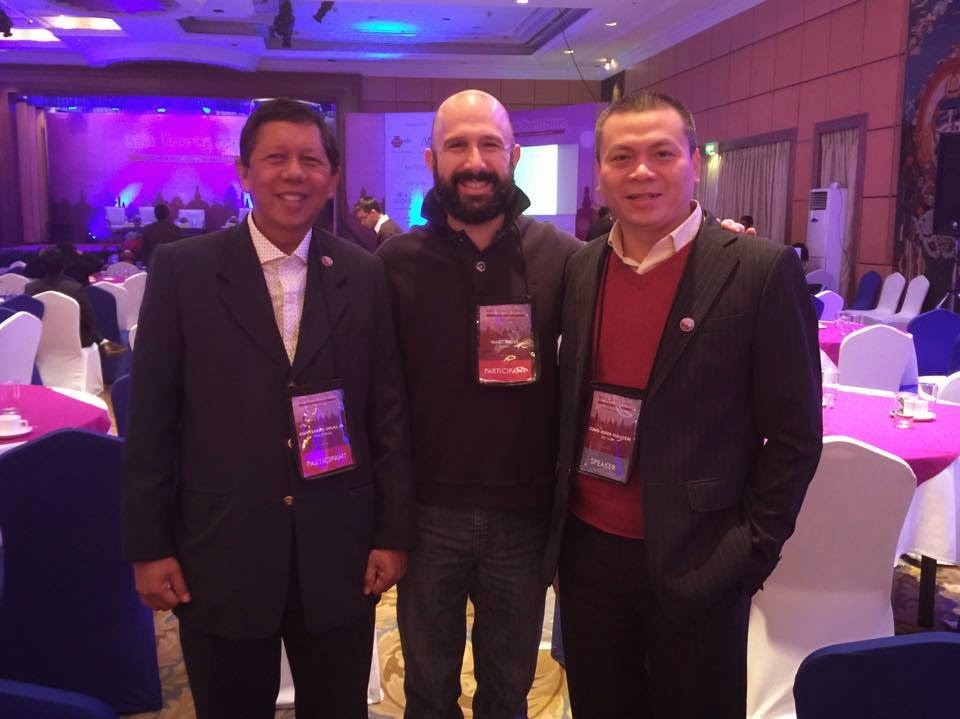
Marc Abela, center, also posed with me and Minh, he represented Mr. You and Yoshida Hiroshi of the Japanese for Tax Reforms (JTR) and Institute for Free Economy (IFE), respectively. Mr. You and Hiroshi were also with us in Phuket in 2005.


Another photo with Minh and Charu. Haaaaa, we were relieving the past. :-)


Ok, here's one of our group photos in Phuket in 2005. This was during the Economic Freedom  Network (EFN) Asia conference, a day after our roundtable discussion. From left: Simon Lee (Lion Rock Institute, Hong Kong), Mr. ____ (Association for Liberal Thinking, Turkey), Chung-ho Kim (then with Center for Free Enterprise, Seoul), Colleen Dyble (Atlas, USA), Mr. You (JTR, Japan), Charu, me, and Yoshida Hiroshi (IPSA, IFE, Japan).


Another photo. Leon Louw holding a camera (Free Market Institute, S. Africa) and Mohit Satyanand (Liberty Institute, India). That was nearly 10 years ago.


More photos during the 3rd ALF. From left: Peter Wong (LRI, Hong  Kong),  Jadranco Brkic (Bosnia), Randy Hencken (Seasteading.org), me. Randy discussed the concept of seasteading, people who want small and limited government wanting to create their own country on the sea, outside the political jurisdiction of any existing country although within the EEZ. It's a bright and revolutionary idea.


From left: me, Cindy Cirquetela (Atlas, USA), Linda Whetstone (Network for a Free Society, UK) and Xingyuan Feng (Unirule, CIPA, Beijing, China). Atlas and NFS, along with FNF South Asia regional office, provided lots of logistical and financial support for that conference.


From left: Bican Sahin (Freedom Research Association, Turkey), me, Gulmira Aidaralieva (Central Asian Free Market Institute/CAFMI, Kyrgyz Republic), _____ also of CAFMI, and Ruki Fernando (Human Rights activist, Sri Lanka).


The Executive Director of Samriddhi Prosperity Foundation, Robin Sitoula. Robin is a friend since about 7-8 years ago. Samriddhi  is the local host that co-sponsored with the Asia Center for Enterprise (ACE) in holding  the 3rd ALF. Great job, fantastic conference, Robin and Samriddhi guys. Congratulations once again.


On the 2nd night  of the conference, after the speeches and before dinner, there was a short song number, it was lively, I pushed Arpita Nepal (lady in white dress on the left), wife of Robin and Director for Research of Samriddhi, to a snake dance. Many participants followed and formed a long snake dance :-)  Man holding the microphone  was the  one  who  sang the  lively song.


Miscellaneous photos: with Wan Saiful Wan Jan (IDEAS, Malaysia) and Barun Mitra (Liberty Institute, India), Adinda Muchtar (Indonesia Institute, Jakarta) and Miho Mochizuki (JTR, Tokyo).


Many thanks again, ACE and Samriddhi, for that wonderful conference.

Special thanks to the following: (1) Media 9/Business 360 for sponsoring my plane fare, (2) ACE/Samriddhi for sponsoring  my 4 nights hotel accommodation, and (3) EFN Asia for sponsoring my related expenses (PH travel tax, Nepal visa fee, etc.).
------------

See also: 
Asian Liberty Forum 2015, Kathmandu, January 07, 2014 

ALF 2: Opening Dinner Program, January 09, 2015

Tuesday, January 13, 2015

Pol. Ideology 60: Lecture in Nepal on Liberalism, Rule of Law, Civil Society

Back here in Kathmandu yesterday afternoon, after giving a talk before a group of university students in Pokhara, Nepal, about 30 minutes by plane from Kathmandu. The other speaker was Prof. Cris Lingle of the US, who also attended the 3rd Asia Liberty Forum last week, January 8-10, here in Kathmandu. Our trip to Pokhara was sponsored by Media 9 and Business 360 magazine.


The students have various academic backgrounds and are just interested to learn about freedom, markets, governments and business.


My presentation outline followed the 7 chapters of the book: (1) F. Hayek, liberty and rule of law, (2) Local government and civil society, (3) Liberalism, socialism and conservatism, (4) Raison d ‘etre of government, (5) Minarchy vs. anarchy, (6) Pork barrel scandal and liberalism, and (7) Concluding notes.


Cris spoke before me and he mentioned about liberty and permits, how the latter often impinge on the former. I rephrase this quote from Hayek, that in a free society, liberty dominates, everything is allowed except for a few prohibited acts (no killing, no  stealing, no abduction,...) whereas in a non-free society, in "liberties", all things are prohibited and disallowed except with permits -- from the government, clans, gangs, etc.


This is the basis for our advocacy, Minimal Government = Maximum Civil Society.


Lao Tzu came much earlier than  the classical liberal thinkers like Adam Smith, David Ricardo and John Locke, even earlier than Plato and Aristotle.

Monday, January 05, 2015

Two Years Writing for Business 360

A friend way back in 2005, Charu Chadha, produced a new monthly business magazine in Kathmandu, Nepal in late 2012. She asked me to contribute an article on free market, I said yes. So far I have written 20 articles for the paper :-). Here they are and the respective magazine covers for those months and years.

1: Nepal and the Philippines, November 26, 2012 
2: Free market means free individuals, December 28, 2012 
3: Fiscal Cliff and Government Irresponsibility, January 23, 2013 
4: Brownouts and Power Deregulation, February 26, 2013


5: Reducing Construction and Electricity Bureaucracies, March 14, 2013 
6: Peace and Prosperity in Asia, April 13, 2013 
7: Jeju Forum for Peace, May 10, 2013 
8: TPP, RCEP, SAARC and Free Trade, June17, 2013


9: Free Trade and Economic Prosperity, July 03, 2013
10: Foreign Aid as Band Aid Solution, August 11, 2013
11: Avoiding Middle Income Trap, September 19, 2013
12: Optimum Size of Government, October 13, 2014


13: US Government Shutdown and Lessons for Asia, November 28, 2013
14: Middle Income Trap and Economic Freedom, January 02, 2014 
15: How to Improve Economic Freedom in Asia, January 22, 2014 
16: ASEAN Economic Community 2016, March 21, 2014


On Wednesday, I will fly to Kathmandu to attend the 3rd Asian Liberty Forum (ALF). Charu and Business 360 are very kind to sponsor my plane fare. Thank you very much Charu. 

And happy birthday too.

Monday, August 25, 2014

Business 360 18: Innovation, Inequality and Inclusive Growth

* This is my article for August 2014 in a business paper in Kathmandu, Nepal.
--------

Social and economic inequality is a political and emotional issue that continues to chase mankind from its most primitive state to its current modern and information-driven lifestyle. Inequality has been seen to be undesirable, and thousands, if not millions, of different policy measures have been tried by various local, national and international or multilateral government bodies to solve or bridge inequality. And many if not all of them have been failures.

What creates inequality? Or better yet, what creates wealth that allows others to earn so much compared to the rest of humanity?

Three papers will help us answer the above questions. The first is from a NYT article last February 15, 2014, by noted economist from Harvard University, Gregory Mankiw, Yes, the Wealthy Can Be Deserving. Dr. Mankiw wrote,

"When people can see with their own eyes that a talented person made a great fortune fair and square, they tend not to resent it…. the most natural explanation of high C.E.O. pay is that the value of a good C.E.O. is extraordinarily high.  That is hardly a surprise. A typical chief executive is overseeing billions of dollars of shareholder wealth as well as thousands of employees. The value of making the right decisions is tremendous. Just consider the role of Steve Jobs in the rise of Apple and its path-breaking products.”

Dr. Mankiw is correct on this observation. Ordinary people are less or non-envious of other people earning so big if they see excellence, hard work and great sacrifices needed to attain such income. It is the politics of envy in government, many NGOs, media, academe, etc. that demonize people because they belong to the top one percent of the income bracket of the nation.

The second paper is from a noted climatologist from the University of Alabama in Huntsville (UAH), Dr. Roy Spencer. He wrote a frank and direct paper on October 17, 2012, It’s Time for the 99% to Start Supporting the 1%.,

"For every successful rich person, there were many more who tried to become rich but lost everything. Why is it that so many people want a greater share from those who have succeeded, but don’t want to share in the losses of those who failed to become rich?... And how would you like to work 12+ hours per day trying to abide by all of the regulations increasingly heaped upon businesses by the government?"

The third paper is a book by Dr. Angus Maddison, Growth and Interaction in the World Economy: The Roots of Modernity, published in 2004 by the American Enterprise Institute (AEI Press, Washington DC. The following table appeared on page 7.


These three articles provided answers to the two questions above. What creates huge wealth for some people is innovation, entrepreneurship and risk-taking. The more innovative the person is, the more risk taker he can be. He/she innovates and find ways endlessly, to reduce costs, optimize the use of production inputs and in the process, sell products and services at a more competitive, more affordable price relative to their quality. Consumers in various parts of the world see this and they reward the innovators by patronizing their products and services.

Dr. Maddison’s table even shows that humanity has benefited from modernization and innovation of some people. Humanity in general, is not hurt by innovation and inequality. It is the politics of envy and the unrealistic philosophy of forced equality that is hurting them more.

Dan Mitchell of Cato Institute made a chart of the Maddison data in his paper, The Miracle of Modern-Day Prosperity…and the Ideas and Policies that Made it Happen. It is a hockey stick figure of human prosperity over the past 2,000 years. In particular, prosperity has jumped about 6x over the past century alone, while almost flat for 18 centuries prior to it.

Before, the poor were riding cows, horses and bicycles while the rich were riding a Toyota sedan. Now the poor ride motorcycles or second-hand sedans while the rich drive SUVs or BMW, Benz or a Ferrari. The upward economic mobility of both the poor and rich are captured in the above hockey stick shape of human prosperity. Add to it the rising life expectancy of people around the world, both from the rich and developing countries. In the Maddison data, average life expectancy around the world in year 1,000 was only 24 years, rose to 31 years by 1900, up to 49 by 1950, and reached 66 years by 2002.

Is this situation bad for the poor? While some people will say Yes, majority of the poor will likely say No. It is not inequality per se but the overall improvement in the living condition of the poor that matters more.

Finally, the politics of envy is being reinvented in public policy formulation. From “equitable growth” in the 60s to 80s, to “broad-based growth” in the 90s to 2000s, it is now popularly called “inclusive growth” starting last decade to the present. The implication is that growth in the past up to the present was non-inclusive, that many were left behind and are dying at conditions similar to 1,000 or 100 years ago, despite heavy involvement by local, national and multilateral governments to have forced equality.

It is not inequality per se that is the problem. Inequality in fact, is a solution to human complacency and politics of envy. The hard working, efficient and highly ambitious people are rewarded with prosperity while the lazy, inefficient and non-ambitious are penalized with lack of wealth.

The primary role of governments is to guarantee and protect the prosperity and private property of those who labored hard, and to penalize those who want to get-rich-quick via robbery and treachery.
---------


Tuesday, April 15, 2014

Business 360 17: Electricity and GDP Growth

* This is my article for Business 360, a monthly magazine published in Kathmandu, Nepal, April 2014 issue.
------------

Electricity powers many economic activities in any society, from small shops that give jobs to micro entrepreneurs to cranes that build huge and tall buildings. Economies that rely more on human and animal power and energy tend to be very poor because of low productivity while those that use more machines that run on extensive electricity tend to be rich because of higher productivity.

Below is an illustration of how selected Asian economies have expanded their electricity use over two decades.


See the big jump in power use in just two decades by Vietnam (10.6x increase), China (5.8x), Maldives (4.6x), Indonesia (4x) and Thailand (3.2x). The other countries have a simple doubling of use, or even flat lined, like the case of Mongolia.

There have been several literatures that show the near causality between electricity use and economic growth. The next table further illustrates this point.


See the pattern and possible causality? In South East Asia, Singapore, Brunei and Malaysia are at the top in electricity consumption and they are also at the top in per capita GDP. At the bottom in both tables are Cambodia, Myanmar and Laos.

In North East Asia, at the bottom are China and Mongolia while the four economic dragons alternate each other at the top in both tables. And in South Asia, it is Maldives and Bhutan at the top, Bangladesh and Nepal at the bottom in both tables.

Of all the countries mentioned above, the electricity-poorest are Afghanistan and Nepal. Nepal’s electricity use in 2010 was just 1/10th of Bhutan consumption, 1/90th of Singapore, and 1/100th  of Taiwan and South Korea.

In the February 2013 issue of this magazine, this column wrote about “Addressing power shedding and rationing” in Nepal and these proposals were made:

One, facilitate and hasten more power imports from India especially those from coal power plants. Coal  is generally cheap and supply is stable. This will require building more transmission lines from India to Nepal.

Two, deregulate power rates. Let those who can afford to pay higher electricity rates in exchange for more stable supply do so, whether imported from India or locally produced. This will encourage faster construction of more power generation plants and transmission lines.

Three, privatize some power plants that produce more losses than revenues for the government, sell to private power companies in a competitive bidding. Such privatization should be coupled with industry deregulation, at least the power generation sector, to encourage more competition among various players.

Four, reduce the requirements, bureaucracies, taxes and fees for companies putting up new power generation plants and transmission lines.  Invite more power supply companies from many countries to enter Nepal and put up more power generation and transmission infrastructures over the medium- to long-term. 

Fifth, entertain the possibility of getting nuclear power as this is a cheap, stable and generally safe power source.

This column reiterates the above proposals once more. In addition, Nepal and other electricity-poor countries may consider using natural gas as this is also a cheap and stable power source. The shale gas revolution in the US, Europe and other Asian countries means that natural gas prices will stabilize or even decline either in the short or long term.

Regardless of the power source that investors will use for their power plants, government bureaucracies that hinder such initiative should be drastically reduced, as well as the taxes, fees and royalties that result in high electricity prices for businesses and households. 
--------------

See also:
Business 360 13: US Government Shutdown and Lessons for Asia, November 28, 2013 
Business 360 14: Middle Income Trap and Economic Freedom, January 02, 2014 

Business 360 15: How to Improve Economic Freedom in Asia, January 22, 2014 

Thursday, November 28, 2013

Business 360 13: US Government Shutdown and Lessons for Asia

* This is my article for the November 2013 issue of Business 360, a monthly business magazine in Kathmandu, Nepal.
----------

The US federal government “shutdown” or more appropriately “slim down” looks confusing for many people around the world. For how can the biggest and richest economy in the world have its central government “shutdown” for two weeks due mainly to financial constraints? A government that can send tens of thousands of troops and heavy armaments in Afghanistan, Middle East and other countries around the world, is shutting or slimming down  because of lack of money?

Technically, not the entire federal government has shut down as many functions – police, defense/military, airports, seaports, state and foreign affairs, etc. – remain in operation. Only certain “non-essential” functions were shut down.  Besides, states, cities and counties are operating as they have their own functions and revenue sources. Thus, the appropriate term would be federal government “slim down”. 

Now, aside from the shutdown/slim down issue, the US government is also facing a constant or perennial debt ceiling issue. The US public debt is rising fast, the debt ceiling set by previous laws is being breached and so they have to pass new laws raising the debt ceiling anew, so that the government can borrow higher, mainly  to pay back old debts and give out more subsidies and welfare programs to its people, poor and non-poor alike.

The way the US government is borrowing endlessly and irresponsibly, with budget deficit of about $1 trillion a year, federal government alone, such practice must be controlled somehow. So the government "shutdown" is an inevitable thing to happen. The average Americans cannot be happy that their federal government has so much public debt, and ever-rising every year.

Figure 1. US Debt Ceiling or Limit


See that, the debt ceiling or limit has been raised 13 times since 12 years ago. The debt curve is getting steeper upwards.

Debt Ceiling/Limit

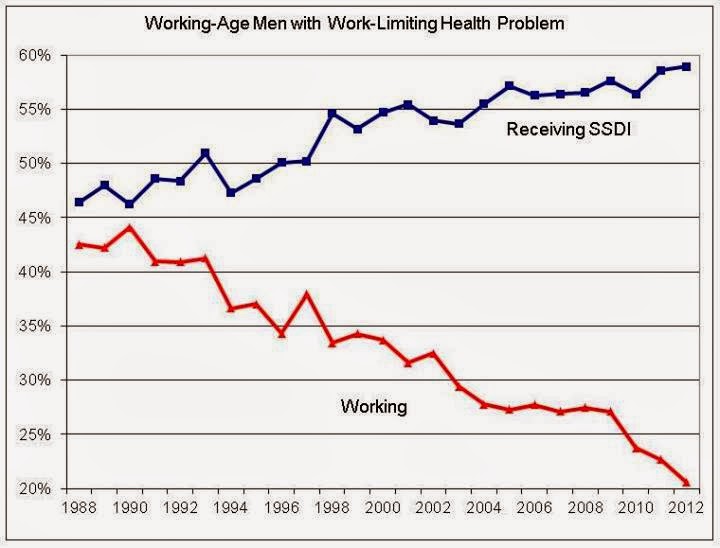
There are many reasons or factors why the US federal government’s spending and public debt is rising fast. This chart is too glaring as one of those reasons and explanations: the number of Americans working and paying more taxes is declining relatively while those receiving social security disability insurance (SSDI) and subsidy is rising.

Figure 2. US citizens working vs those receiving disability insurance.


Source: Cato Institute

The US politicians and government officials may be thinking that that American taxpayers are endless ATM machines whom they can fleece with more taxes to pay these uncontrolled spending.

Lessons for Asian emerging and developing economies

Governments should not become debt addicts, they should learn to live within their means. This is one of the more frank, more realistic assessments of the US government experience. Debts are not grants, they should be paid back in the future, not by current politicians and taxpayers, but by future taxpayers.

Figure 3. Gross Debt as Percent of GDP, Selected Asian Countries, 2000 and 2013

Country
2000
2012
India
74.0
66.7
Pakistan
77.0
63.8
Malaysia
35.3
55.5
Vietnam
n/a
51.3
Myanmar
146.3
48.0
Thailand
57.8
45.4
Philippines
58.8
41.9
Nepal
57.9
33.6
Cambodia
35.4
28.8
China
16.4
26.1
Indonesia
95.1
24.5

Source: IMF, World Economic Outlook 2013 Database

The above numbers show that there are more countries that have significantly reduced their gross debt as share of GDP. This is positive news.

Governments must resist populism and heavy welfarism, giving away one subsidy after another, as if the average citizens are idiots or lazy who must be given endless and forever subsidies and entitlements by the government just to survive.

Governments instead, must allow more room for the free market to fulfill certain social functions and expectations. Like job creation, raising labor productivity and hence, raising wages and benefits for the workers and their families. Producing more goods and services from the same number of workers,  entrepreneurs and machines.
-----------

See also:
Business 360 9: Free Trade and Economic Prosperity, July 03, 2013 
Business 360 10: Foreign Aid as Band Aid Solution, August 11, 2013 
Business 360 11: Avoiding Middle Income Trap, September 19, 2013 

Business 360 12: Optimum Size of Government, October 13, 2013