Showing posts with label US public debt. Show all posts

Thursday, November 28, 2013

Business 360 13: US Government Shutdown and Lessons for Asia

* This is my article for the November 2013 issue of Business 360, a monthly business magazine in Kathmandu, Nepal.
----------

The US federal government “shutdown” or more appropriately “slim down” looks confusing for many people around the world. For how can the biggest and richest economy in the world have its central government “shutdown” for two weeks due mainly to financial constraints? A government that can send tens of thousands of troops and heavy armaments in Afghanistan, Middle East and other countries around the world, is shutting or slimming down  because of lack of money?

Technically, not the entire federal government has shut down as many functions – police, defense/military, airports, seaports, state and foreign affairs, etc. – remain in operation. Only certain “non-essential” functions were shut down.  Besides, states, cities and counties are operating as they have their own functions and revenue sources. Thus, the appropriate term would be federal government “slim down”. 

Now, aside from the shutdown/slim down issue, the US government is also facing a constant or perennial debt ceiling issue. The US public debt is rising fast, the debt ceiling set by previous laws is being breached and so they have to pass new laws raising the debt ceiling anew, so that the government can borrow higher, mainly  to pay back old debts and give out more subsidies and welfare programs to its people, poor and non-poor alike.

The way the US government is borrowing endlessly and irresponsibly, with budget deficit of about $1 trillion a year, federal government alone, such practice must be controlled somehow. So the government "shutdown" is an inevitable thing to happen. The average Americans cannot be happy that their federal government has so much public debt, and ever-rising every year.

Figure 1. US Debt Ceiling or Limit


See that, the debt ceiling or limit has been raised 13 times since 12 years ago. The debt curve is getting steeper upwards.

Debt Ceiling/Limit

There are many reasons or factors why the US federal government’s spending and public debt is rising fast. This chart is too glaring as one of those reasons and explanations: the number of Americans working and paying more taxes is declining relatively while those receiving social security disability insurance (SSDI) and subsidy is rising.

Figure 2. US citizens working vs those receiving disability insurance.
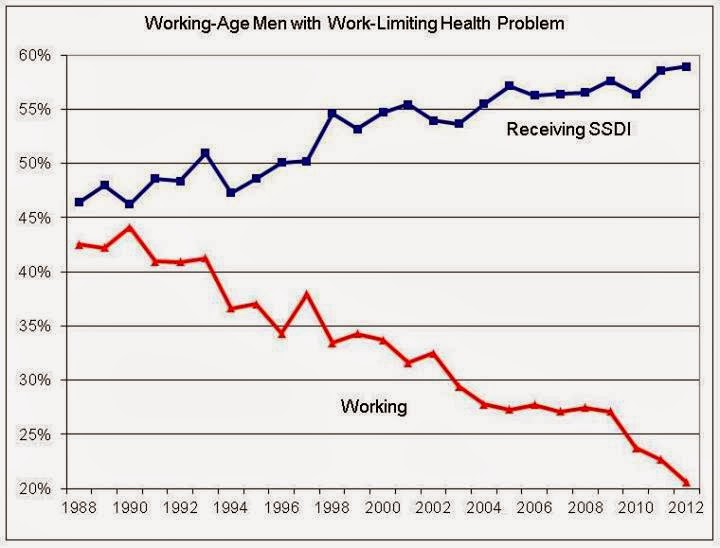

Source: Cato Institute

The US politicians and government officials may be thinking that that American taxpayers are endless ATM machines whom they can fleece with more taxes to pay these uncontrolled spending.

Lessons for Asian emerging and developing economies

Governments should not become debt addicts, they should learn to live within their means. This is one of the more frank, more realistic assessments of the US government experience. Debts are not grants, they should be paid back in the future, not by current politicians and taxpayers, but by future taxpayers.

Figure 3. Gross Debt as Percent of GDP, Selected Asian Countries, 2000 and 2013

Country
2000
2012
India
74.0
66.7
Pakistan
77.0
63.8
Malaysia
35.3
55.5
Vietnam
n/a
51.3
Myanmar
146.3
48.0
Thailand
57.8
45.4
Philippines
58.8
41.9
Nepal
57.9
33.6
Cambodia
35.4
28.8
China
16.4
26.1
Indonesia
95.1
24.5

Source: IMF, World Economic Outlook 2013 Database

The above numbers show that there are more countries that have significantly reduced their gross debt as share of GDP. This is positive news.

Governments must resist populism and heavy welfarism, giving away one subsidy after another, as if the average citizens are idiots or lazy who must be given endless and forever subsidies and entitlements by the government just to survive.

Governments instead, must allow more room for the free market to fulfill certain social functions and expectations. Like job creation, raising labor productivity and hence, raising wages and benefits for the workers and their families. Producing more goods and services from the same number of workers,  entrepreneurs and machines.
-----------

See also:
Business 360 9: Free Trade and Economic Prosperity, July 03, 2013 
Business 360 10: Foreign Aid as Band Aid Solution, August 11, 2013 
Business 360 11: Avoiding Middle Income Trap, September 19, 2013 

Business 360 12: Optimum Size of Government, October 13, 2013

Wednesday, January 23, 2013

Business 360 3: Fiscal Cliff and Government Irresponsibility

* This is the article that I submitted to B360 late last month, when the "fiscal cliff" in the US was being discussed worldwide.
-----------

Fiscal Cliff and Government Irresponsibility

The US government’s public debt, currently at $16.3+ trillion, has touched the 100 percent of GDP mark in 2011. This does not include yet debt of local governments – states, cities and counties – which also have their own public debt. This huge debt and the huge interest payment to service the principal that keeps rising each day, is the main cause of its continuing fiscal and economic uncertainties.

Other rich countries which have reached the 100 percent or higher debt/GDP mark are Iceland in 2008, Portugal and Belgium in 2010, France and Ireland in 2011, United Kingdom in 2012. Greece and Italy have reached that mark early of the last decade. Heavy borrowing and fiscal irresponsibility is the main characteristic of these and many other economies. They have been living beyond their means, maintaining extravagant and populist welfare programs, aided by heavy military spending, even if taxes and other revenues are not sufficient to sustain these.

State owned BBC said in its “Q&A: The US fiscal cliff” that "The roots of the current crisis date back to 2001, when President George W Bush's administration was trying to pass a programme of tax cuts worth $1.7bn." 

This statement is wrong on two counts. One, the "roots" of the fiscal crisis date back many decades ago, of heavy government spending and heavy borrowing as if there is no repayment of those debts tomorrow. And two, tax cut is not the villain, it is heavy spending. Tax cut means allowing people to keep more money in their pockets, bank savings or certain investments. It is their money, they worked for it, they should keep more of it. If they spend or invest it, it creates economic activities and jobs elsewhere, so there is little or no need for government spending to keep expanding "to create jobs" for the people.

Entrepreneurs and private businesses, their staff and employees, have been bailing out through various taxes and fees these bloated governments and their numerous bureaucracies for decades. America and Europe prospered on economic freedom, not on heavy welfarism. People before have welfare because they worked hard and kept ample savings for their enjoyment or future investments, and not because the state has fed and housed them for free or at huge subsidies, at money that were borrowed from elsewhere.

Unfortunately, many Asian governments are following the welfarism and fiscal irresponsibility example of the US and European governments. They too are living beyond their means as shown by persistent budget deficit annually (expenditures are larger than revenues).


Source: computed from ADB’s Key Indicators for Asia and the Pacific 2012, Table 7.1

Nepal government seems to be less extravagant compared to its four neighbors in the region. But this is no consolation as growth can be sustained at deficit of below 2 percent of GDP as shown by the governments of Thailand, Vietnam and Indonesia. The governments of Hong Kong, S. Korea and Singapore even run on fiscal surpluses.

Fiscal responsibility and economic sustainability can be done on a few simple principles.

One, live within one’s means. Do not persistently spend beyond one’s income. Set aside savings for the rainy days and in times of emergencies.

Two, there is big role for personal and parental responsibility in many social and economic services, and not everything is government responsibility.

And three, there is big potential for tax cuts, or at least not creating new taxes, and allow the people to keep more of their income and savings. They know their priorities better than government officials and politicians. 

Let the new year usher in new thinking, away from the old thinking of more social engineering and economic central planning by the state, politicians and foreign aid bureaucracies. Modern technology has allowed people to learn new and more skills outside the formal school system, and opened up more economic opportunities beyond their country’s borders. Overall productivity should be rising and not stagnating. This is a good ingredient to create more jobs, fight poverty and have sustained inclusive growth.
-----------

See also:
Busiiness 360 1: Nepal and the Philippines, November 26, 2012
Business 360 2: Free market means free individuals, December 28, 2012

Wednesday, October 10, 2012

Fat-Free Econ 26: US Public Debt and the November Elections

* This is my article today in TV5's news portal,

http://www.interaksyon.com/business/45173/fat-free-economics-us-public-debt-and-the-november-elections
-----------

Whoever wins in the US Presidential elections next month will govern the biggest economy in the world, which also has the largest public debt worldwide. In fact, the US public debt is larger than its gross domestic product.

At the start of the current fiscal year, October 01, 2012, the US public debt stood at $16.159 trillion, composed of (a) debt held by the public at $11.311 trillion, and (b) intra-governmental holdings at $4.848 trillion. A day after, the total moved up to $16.171 trillion or an increase of $12 billion in just one day. For a good debt clock of the US to watch that is moving every minute and every second, just refresh this link.

And here is the growth of such debt through the years.

While the US government holds the 1st place worldwide in absolute amount of public debt, the Japanese government holds the 1st place worldwide in terms of the ratio of public debt to GDP, followed by Greece and Portugal in 2nd and 3rd places.

What explains the huge spike in US public debt and spending, especially in recent years? Or where can the next administration possibly make some spending cuts in order to minimize the fiscal bleeding and reduce the need for endless borrowings?


chart 4

Source: http://s.wsj.net/public/resources/images/RV-AI016A_ENTIT_G_20120831013902.jpg

The welfarist and collectivist philosophy prevents or opposes cutting such spending. The advocates of this philosophy argue that the main function of government is to redistribute income, to confiscate more money from the haves and give it to the “have nots” or “have little” through a thick layer of bureaucracy at the national and local government levels that act as middlemen between these supposedly contradicting camps.

There is a twist somewhere here. As the need for more taxes by the US government rises, the number of people who do not pay federal income tax also rises. And this contributes to a pernicious situation where expenditures keep rising while tax revenues do not follow in step.


chart 4


Source: The Economist, September 18th 2012,http://www.economist.com/blogs/graphicdetail/2012/09/daily-chart-9

The appropriate solution to reduce revenues would have been to reduce spending. Ordinary households do that. When the income is low, they cut on spending and minimize borrowings whenever possible. Most governments - the US and the Philippines among them - do the reverse. As the funding gap between expenditures and revenues rises, they keep borrowing to maintain high expenditures as if the public debt burden can be solved by Batman or other fictitious characters.

The biggest challenge for the next President of the US is how to reduce public debt and government spending without compromising the productive capacity of the citizens, the entrepreneurs and ordinary workers, who will ultimately pay off those mountains of debt that have been accumulated through decades of fiscal irresponsibility by various administrations.

And the public – in the US, Europe, the Philippines and elsewhere – have to reconsider the welfarist and forced collectivism philosophy.  There is ample room to manage or allow society to run on more personal, parental and civil society responsibility, and less on government responsibility.
-----------

Here is the additional chart and table that were not included due to space constraints:

a. Growth of US public debt through the years:


b. Top debtors, OECD member countries.

I marked in red huge jumps in the ratio, moving up by 10 percentage points or more in just one year. Except Ireland and Iceland, those huge spikes in public indebtedness among the industrialized countries occurred in 2009 and 2010, with hang over until 2011.


----------

See also:
Fat-Free Econ 22: Three Years of Drug Price Control Policy, August 30, 2012
Fat-Free Econ 23: Penang Workshop on Markets in Healthcare, September 10, 2012
Fat-Free Econ 24: Government Fat and Public Expectations, September 21, 2012
Fat Free Econ 25: Property Rights and the Cybercrime Prevention Law, October 01, 2012

Fiscal Irresponsibility 23: High Debt and Unemployment and Parliamentarism Hard Sell, May 02, 2012
Fiscal Irresponsibility 24: More on the PIIGS and European Debt, May 16, 2012
Fiscal Irresponsibility 25: Spain Panic, More Eurozone Woes, June 06, 2012

Fiscal Irresponsibility 26: On the $1 B Philippine Loan to the IMF, June 27, 2012

Sunday, September 11, 2011

Fiscal irresponsibility 16: On government bail outs

The recent US bail out was meant to save corporate irresponsibility of some favored or crony corporations like BA. And to some extent, government irresponsibility like Freddie, Fannie and FHA. A fiscally irresponsible government is capable of using taxpayers' money to bail out corporate irresponsibility, personal irresponsibility, and its own fiscal irresponsibility.

The on-going European bail out is meant to save clearly fiscally irresponsible governments -- like Greece, Ireland and Portugal;, and soon, Spain, Italy, France, UK,... So it's a government to government bail out.

So on both sides of the Atlantic, its a problem of BIG governments getting big debts and big troubles. The biggest market player -- the taxpayers -- are out to bail out big governments, their big debts and their big troubles.

I and many other free marketers NEVER supported govt bail out of failing private companies, whether rich or poor country government. It was the statists and lovers of BIG and more government who endlessly advocate more govt intervention, including bailing out failing private companies.

Bail out of private companies is almost always government cronyism. Cronyism is not a monopoly of poor country governments like the Philippines. Rich governments like the US also have cronyism. Lehman maybe was a crony before, but at the height of the financial meltdown, it was no longer a crony, they allowed it to sink. But BA and others are cronies.

If people re looking for someone to blame in the on-going economic and financial turmoil, let them blame the statists, blame Paul Krugman, blame Obama and Bush and other architects of endless borrowings, of government living beyond their means. The free marketers have been advocating the opposite of what these people mentioned have been doing.

Over here, the main subject of discussion is not corporate bankruptcies or corporate debts, but BIG Philippine government debt, big annual budget deficit, big interest payment, which siphons off money away from more productive spending. If people will contest my above statement of "big deficit, big interest payment" then consider this: Interest payment alone, excluding principal amortization: P294 billion in 2010, P357 billion in 2011, P333 billion in 2012. Are these small numbers?

When the plan to impose a VAT on both expressways (NLEX and SLEX) was floated, some motorists already wanted to start a civil war. By how much would the DOF get from such move? I read about P1B per year.

When the plan to remove altogether the MRT subsidy was floated, some train commuters already wanted to start a civil war. How much is the MRT subsidy, P5B/year.

Such "marginal" tax revenues or subsidies can already spark high public discontent, how much more with P300B+ per year on interest payment alone? And that's one of several functions of government -- to accumulate more public debt, to give endless subsidies with no time table, to give endless pork barrel to more politicians.

And some guys think that letting go of endless fiscal irresponsibility, of going back to the market and more personal responsibility, is a bad thing. Bleeding heart formulation, but makes no sense.
-------

On July 15, 2009, I wrote this:

Bailout money and the US bureaucracy

Below is one update of where a portion of the bail-out money went -- to the ever-expanding government bureaucracy in Washington DC. The additional groth of the bureaucracy goes something like this:

First, create a new set of bureaucracy to assess and decide who should get how much and when.

Second, the bureaucracy will monitor who spent the bailout money well and who wasted it.

Third, the bureaucracy will explain to US Congress and the public that the bailout went well, cover up the wastage if necessary.

Fourth, since they did a good job, the bureaucracy should stay forever whenever possible. Stimulus 2 may be necessary to "sustain the momentum" of stimulus 1.

The taxpayers? They should be thankful of the bureaucracy and the administration in the white house and capitol hill. In recognition of a well-done job, taxpayers will pay ever-higher taxes and fees, and wait for another borrowings for stimulus 2, another borrowings for stimulus 3 (for health care reform), and so on.

Below is the news report.

10 Cities With the Most Job Postings Per Capita

By Liz Wolgemuth Mon Jul 13, 11:03 am ET

Among the 50 largest cities in the U.S., one stands out for having the most abundant job postings per capita: Washington, D.C. The nation's capital boasted 133 postings per 1,000 residents in the second quarter of 2009, according to a report by Indeed.com, a broad job search engine that combs company and association websites, job boards, newspapers, and blogs for postings. That Washington took the top spot is no great surprise, as government hiring has held up during the recession.

The runner up is Baltimore, Md., which is aided by its close proximity to Washington, but also boasts an economy fueled by recession-hearty industries like healthcare and higher education. Baltimore's unemployment rate was 7.2 percent in May, well below the 9.4 percent national average that month.

Here's the top 10 list--pulled from Indeed's list of 50 largest metro areas ranked according to job postings per capita in the second quarter of this year (last quarter's ranking is in parentheses) :

1. (1) Washington, D.C.
2. (2) Baltimore
3. (3) San Jose, Calif.
4. (7) Austin
5. (6) Hartford, Conn.
6. (9) Seattle, Wash.
7. (8) Salt Lake City
8. (11) Denver
9. (5) Boston

10. (4) Las Vegas (Note: Charlotte, N.C. shared the same number of postings per capita as Las Vegas)

The city capturing the bottom spot on Indeed's list is Detroit. See the full list: http://news.yahoo.com/s/usnews/20090713/ts_usnews/10citieswiththemostjobpostingspercapita

Sunday, August 21, 2011

Weekend fun 21: Humor in global financial turmoil

(This is my article yesterday in thelobbyist.biz with original title, Economic and humor contagion)

The economic and financial uncertainties primarily caused by public debt burden (ie, high fiscal irresponsibility) in the US and Europe is continuing. Heavy turmoil last week, extended up to this week, and most likely until the next few weeks and months.

Here is another refresher how the current global financial turmoil started – on the big debate what to do with the federal debt limit.

Source: Mercatus Center, 30 Years of Bipartisan Debt Ceiling Raises, August 16, 2011

The rise in debt ceiling has become more frequent and each rise is becoming more steep. The recent rise in debt limit for instance was $2.3 trillion, from $14.3 to $16.6 trillion. And such high debt limit is expected to be reached in less than two years. That is how fiscal irresponsibility can trigger government failure with bitter global consequences.

Some sectors have analyzed the recent and on-going financial turmoil not via graphs, jargons and equations. Instead, they turn to exaggeration with humor to depict the current and future condition of the US and global economy. Below are some of those witty comments, gathered from different sources. I have also contributed or invented 3 of them here 

How bad is the situation in the United States? It's sooo bad, that…

- My neighbor got a pre-declined credit card in the mail.
- CEOs are now playing miniature golf.
- Exxon-Mobil laid off 25 congressmen.
- I saw a Mormon with only one wife.
- If the bank returns your check marked "Insufficient Funds," you call them and ask if they meant you or them.
- McDonald's is selling the 1/4 ouncer.
- Angelina Jolie adopted a child from America.
- Parents in Beverly Hills fired their nannies and learned their children's names.
- A man had an exorcism but couldn't afford to pay for it, and they re-possessed him.
- A truckload of Americans was caught sneaking into Mexico.
- A picture is now only worth 200 words.
- The Treasure Island casino in Las Vegas is now managed by Somali pirates.
- GM and Ford are now manufacturing jeepneys and tricycles.
- Starbucks is now selling 3-in-1 coffee in sachets.
- Delta airlines now flying cheap standing only tickets.
- S&P forecast chapter for the US economy: Chapter 11.
- President Obama's economic policies will create millions of new jobs, but they are all for Iraqi and Afghani soldiers.
- The Debt Ceiling debate is a mess because Al Qaeda is trying to take credit for it.
- It’s good that gas prices have fallen because people can now afford to drive the cars they're living in.

My favorite is a quip from a friend who said that the US may need technical assistance from the Philippines on how to handle their public debt problem. I added that USAID and WB will jointly fund that project of Philippine technical assistance to the US how to (a) move from AA to BB rating, and (b) handle the debt problem while getting more new loans to save the planet, save the poor, save the economy, save the bureaucracy.

Market failure often opens up opportunities for market solutions. But government failure opens up opportunities for more government intervention, taxation and regulation. And that explains why the economic turmoil can easily jump from one big economy to another down to the smaller economies. Huge public debt and fiscal irresponsibility by the governments of those economies are the main facilitators of such contagion.
---------

See also Fiscal irresponsibility 12: More on US debt default, July 28, 2011

Tuesday, August 02, 2011

Fiscal irresponsibility 13: Obama on debt limit, 2006

Nice video here. Who said that " raising America's debt limit is a sign of leadership failure" in 2006?


"The fact that we are here today to debate raising America's debt limit is a sign of leadership failure. It is a sign that the U.S. Government can't pay its own bills. It is a sign that we now depend on ongoing financial assistance from foreign countries to finance our Government's reckless fiscal policies...

Increasing America's debt weakens us domestically and internationally. Leadership means that "the buck stops here." Instead, Washington is shifting the burden of bad choices today onto the backs of our children and grandchildren. America has a debt problem and a failure of leadership. Americans deserve better."

- Sen. Barack Obama (D-IL), March 20, 2006
--------

Meanwhile, here's another good graph, posted by my favorite climatologist who has a knack in economics too, Dr. Roy Spencer, in his blog post, The Debt Crisis: Compromise is Not an Option.

Dr. Spencer wrote,
... Unfortunately, just like the family that could not rein in its spending, so much of our population has become dependent on government handouts (which means, taking from those taxpayers who help keep our economy going) that it will be difficult for politicians to do what needs to be done to put us back on a path toward prosperity.

We must reduce wasteful spending, and we must reduce the governmental tax and regulatory burdens on businesses which are keeping those businesses from growing. Politicians must make tough decisions that will save the country without regard for whether they will be re-elected or not.

The problem cannot be fixed by “taxing the rich more” because (1) there is not nearly enough money there to fix the problem, and even more importantly, (2) unless there is at least some incentive for people to financially benefit in proportion to their good ideas, there is no motivation to take the risks involved in bringing new and better products and services to market. After all, most of those attempts fail, and people who want more of what “the rich” have, are not willing to share in the failures of those who tried and failed.


Living within one's means. Modesty in lifestyle. Humility to recognize the unsustainability of the spending spree. These things are lacking in many governments, poor and rich alike.

BIG governments, whether socialist or democratic (or republican) simply create big problems than solutions.

Thursday, July 28, 2011

Fiscal irresponsibility 12: More on US debt default

Last week, July 21, I wrote this:

In less than two weeks, on August 2, the US federal government's public debt of $14.294 billion threshold where the government can no longer borrow, will be reached. That is why the noise on "debt default" is becoming louder. See my paper on this 3 days ago, Fiscal irresponsibility 11: US debt default talks.

Source of this chart, The Economist, America's public debt: Down to the wire, July 18, 2011.

Please note that these figures are public debt by the federal government alone. Not included here are debt by local governments -- states, counties and cities. Those lower government levels have their own share of debt crisis too, like the state of California.

The extent of fiscal irresponsibility, of persistently living beyond their means, criss-crosses various levels of government.

The next chart is from Dan Mitchell of Cato, Mr. President, Here’s that Balanced Approach You Keep Demanding, July 15, 2011.

He made a 5-10 years projection in both US tax revenues and federal spending. From the data he gathered from OMB and CBO, projected revenues will remain at 18 percent of GDP, similar to the average figure for 1950-2000. But projected spending will be 23.6 percent of GDP, much higher than the 50-years average of 19.8 percent of GDP from 1950-2000.

Over-spending, then over-borrowing to finance the excess spending. This is the plain and simple reason why the US government is digging deeper in public indebtedness and the various economic, financial and political problems attached to it.

There should be other potential government revenues aside from more taxation. Privatization of many government assets (land, corporations, banks, universities, hospitals, etc.) is one important policy tool. But it is not palatable to the political class. And this attitude is not unique to the US. There is deep insecurity and hypocrisy in the political and bureaucratic class not to entertain this policy tool.
-----

Today, July 28, 2011


There is a good graphics I saw from CQ.com, Debt limit of the US federal government from 1980 to 2011. There are 4 lines there. Topmost is US GDP, next (light brown) is the debt limit, below it is the debt subject to debt limit (light green) and further below (dark green) is marketable debt.

The debt limit started rising more frequently since 2003. And the gap between the size of GDP and debt limit used to be far until about mid-2008. Since then, the gap between the 2 has become narrower and narrower. The two almost intersected in early 2010. That's when the US government was bailing out many big private corporations using money it borrowed from many sources. Click these charts for a larger image.


This table is interesting. It shows who lent how much to the US federal government, as of end-March this year.

Domestic private investors lent $3.23 trillion while foreign investors, mostly governments and foreign central banks, lent $4.48 trillion. Of the latter, the Chinese government lent $1.15 trillion, Japan government lent $0.91 trillion. Graph source, Who holds the federal debt.


Chart source below, The Economist, Daily Chart July 28th 2011. It shows the overall debt over GDP ratio for both the US and Canada. I just copy-pasted them from the interactive graph of The Economist. All 4 sectors -- financial, government, non-financial business, and households, contribute to rising overall debt.

Fiscal irresponsibility of the government is often matched by corporate and household irresponsibility, of further accumulating more debt. Having debt is normal, especially for investments or for emergency spending. But having an ever-rising debt is not normal, or not proper as the cost of their future payment becomes more and more difficult.

Monday, July 18, 2011

Fiscal irresponsibility 11: US debt default talks

(This is my article yesterday in thelobbyist.biz with original title, Fiscal irresponsibility and debt default)

The term “debt default” suddenly has become a common term in public discourse in the US. The biggest economy in the world, the strongest military power in the world, and among the beacons of the “rule of law” in the world, is entertaining the idea of violating the rule of law, by defaulting on its huge public debt payment. What happened?

It is actually common sense and will not take a degree in astrophysics or financial economics to understand that living beyond one’s means will bring someone to big trouble someday. By spending larger than one’s income or revenue, regularly and consistently, then one’s debt will simply pile up year after year. And that is what has happened to the US and so many other countries in the world now, rich and poor alike.

I will limit my words and show these charts and a table below to speak for themselves. These will help readers make their own conclusions too.

source: The Economist, Buy now, pay later, April 13th 2011 issue.

The US’ budget deficit (expenditures larger than revenues) from 2010 to 2012 is projected to average around 9 percent of GDP. This is a very high figure. The ballpark “sustainable” level is 3 percent of GDP or lower. I discussed this chart earlier in ATR and the soul of limited government.

Fiscal irresponsibility, of public spending larger than taxes and other revenues, has been around since the 70s or earlier. There was a short period of fiscal surplus in the last decade (mainly during Pres. Bill Clinton’s term) but were erased immediately. Source of this chart and below is The Economist, I just forgot to note the issue date.

While the US war in Afghanistan, Iraq and elsewhere, then the huge corporate bail-outs in 2009-2010 have contributed a large part for the big jump in public spending in recent years, it will be the expensive welfare and entitlement programs plus high interest payment that will tear down the American taxpayers’ and government’s pockets in the coming years and decades.

Recently, it was Ireland and Greece that experienced deep fiscal crisis. Soon, Portugal, Spain, Italy, UK and other European countries, and the US, will follow suit. Note the 14 countries above which have gross debt of 77 percent of GDP or higher in 2010.

The US, or any other highly indebted economies around the world, should NOT default on their debt payment. The current high debt payment is penalty for past wastes and excesses. It should be a painful reminder that fiscal irresponsibility is wrong.

What the US and other highly indebted countries should DO, is to cut spending, from the size of their bureaucracy to military spending to expensive entitlements to foreign aid. If revenues are not sufficient to cover whatever bleeding heart programs, then that’s it. Governments should learn to live within their means.
-------

Five years ago, I wrote this:

How Bloated is the US Government?

MAY 08, 2006

The US has the largest economy in the world.
But it also is the most indebted country in the world.
And it has the biggest government spending, the biggest bureaucracy, in the world.
Just how big are the spending, and the taxes and borrowings to keep those huge expenditures?

Lucky that I checked the Mackinac website, and I saw Mr. Mark Brandly's article, "How big is Bush' big government?". For brevity purposes, I removed certain paragraphs; if interested to see the whole paper, please see http://www.mackinac.org/article.aspx?ID=7689

Below are the relevant numbers from Mr. Brandly's paper:

* Federal spending alone in fiscal year 2006 is expected to be over $2.7 trillion, which means the federal government spends $7.4 billion a day or $5.1 million in every minute of the year. This is 815 times the level of federal spending in 1930.

* This $2.7 trillion in federal spending breaks down to $9,000 per capita or more than $36,000 for the average family of four. If we add in all state and local spending, then total government depredations (a term Murray Rothbard used to describe the greater of government spending and government receipts) are currently over $4.4 trillion or about $14,700 per person annually.
* A significant portion of this spending is being financed with government borrowing. In 1930, the per capita debt load was $140 per person. The current federal total debt level is $8.4 trillion, which works out to around $28,000 per person. In short, the per capita debt load is 200 times larger than it was in 1930. Adjusting for inflation, the real debt per capita is still over 16 times more than it was in 1930.

* Federal government debt increased $553 billion in fiscal year 2005 alone. That's more than $1.5 billion of additional debt per day and over $1 million of borrowing per minute for every minute of the year. The interest on the debt in 2005 was $352 billion or more than $1,100 for every man, woman and child in the country. These interest payments are roughly equal to 37 percent of federal income tax revenues.

* Much of this debt is owed to the Federal Reserve. U.S. taxpayers are on the hook for $758 billion of government securities that are held by the Fed. So, on average, every person in the country owes the Fed about $2,500.

* One way to see the harm of government intervention is to realize its effects on our standard of living. The depredations of the state reduce the incentives to be productive, destroy our capital base and have a negative effect on economic growth. From 1959 to 2005, adjusting the numbers using the implicit price deflator, real Gross Domestic Product increased an average of 3.37 percent annually.

* Consider the possibility that government interventions reduced real economic growth 1 percent annually during this time. If there had been an additional 1 percent per year economic growth since 1959, then real GDP would currently be 55 percent higher than it is. The 2005 GDP of $12.5 billion would have been $19.3 billion. The median family income is estimated to be $44,389. A proportionate increase in this statistic results in a median income of $68,800.

* In this scenario, a worker with a salary of $44,389 who is losing 35 percent of his salary to taxes has a tax liability of $15,536. After paying the various types of taxes he gets to keep only $28,853 of his salary. With the extra 1 percent growth per year since 1959, if that worker represented the average, his gross salary would be $68,800 and he would get to keep all of it.

* It is conceivable that the $4.4 trillion of annual depredations could have caused more than 1 percent annual damage to our economic growth since 1959. What are the implications of a 2 percent negative impact on GDP? If the absence of interventions had added an additional 2 percent annual growth, this would have resulted in 141 percent more output today. The 2005 GDP would have been over $30 trillion and the median family income would now be $107,000. The worker described above with the $44,389 gross salary and the $28,850 of after tax pay, would have an income of $107,000. The depredations have reduced his net income by 73 percent.

* Those of us making the case for liberty have logic, history and morality on our side. Government intervention is immoral and should be stopped for that reason alone. However, the economic costs of the intervention are also important. Part of the appeal of freedom is that it leads to tremendously higher standards of living and these numbers show that government interventions that cause seemingly small amounts of harm, over time, impoverish a society.
-------

See also:
Part 10, Rich countries' public debt, April 27, 2011
Part 9, ATR and the soul of limited government, April 26, 2011

Tuesday, April 26, 2011

Fiscal irresponsibility 9: ATR and the soul of limited government

There is an on-going protracted debate whether to raise taxes in the US to reduce the fiscal bleeding of the US federal government each year, caused by past and present fiscal irresponsibility by the occupants of the White House and the leaders in Capitol Hill. But such debate is not so much between the Republicans and the Democrats, but within or among Republicans themselves and their supporters.

Dan Mitchell of Cato wrote today a good article, Tax increases are political poison for the GOP, about the debate between Sen. Tom Coburn (R-Oklahoma) and Grover Norquist, the head of the Americans for Tax Reforms (ATR). The former is arguing that Republicans should accept some tax hikes and compromise with the Democrats to reduce the budget deficit, the latter is arguing that such compromise will result in even bigger government, not smaller, in the future. Dan Mitchell wrote,

From an economic perspective, there are all sorts of important issues:

1. What is better for the economy, lower spending or higher taxes?

2. Is it possible to balance the budget without higher taxes?

3. Would tax increases be used for deficit reduction or more spending?

The US federal government is projected to have another double-digit budget deficit this year after a similar deficit of more than 10 percent of GDP last year. Chart is from The Economist, Buy now, pay later, April 13th 2011 issue.

Politicians, even from a political party that is supposed to advance limited government, fiscal responsibility and free market, are generally easy to be hoodwinked into believing that more taxes, not more spending cuts, will promote more economic growth and more job creation (and reduce poverty) over the long-term. It is important, therefore, that independent and private think tanks and citizen pressure groups which are not organizationally part of any political party -- like the ATR -- exist and do their work of reminding elected politicians of their pledge to the voters when they were still campaigning.

There is no way that more taxes, more transfer of money from the citizens' pockets to the state and politicians' whims, will promote fiscal and personal responsibility. Where there is fiscal irresponsibility, personal irresponsibility would quickly follow. When government for instance, would subsidize healthcare even for unhealthy lifestyle-acquired diseases, then more people will become less watchful, less responsible, about their personal health.

Grover and his staff at ATR are doing their job well. But even their best effort will not be enough to block politicians' populism and its slow slide towards more statism, more welfarism, and ultimately towards the "big bang" of a real fiscal crisis. Ordinary citizens -- Americans, Europeans, Asians, and so on -- should realize that surrendering their personal freedom to state or collective freedom will be counter-productive.

Independent and free market-oriented think tanks like ATR and Cato can only help provide the philosophical guideposts and economic studies. The ordinary people, aware of the limits of government and their individual potentials, will have to put the future into their hands now.
-----

Related topics here will be

Fiscal irresponsibility 4: US public debt, and

Fiscal irresponsibility 5: US entitlement spending.

Saturday, September 18, 2010

Tax Cut 11: US Tax Cuts, Retain Them

The size and weight of a government (Expenses) is directly proportional to the taxes and fees (T&F) to be paid by the citizens to sustain a particular government plus borrowings (New Debt) if the fiscal gap is unsolved. Or put simply,

      Expenses = T&F + New Debt.

If the economy has matured and its economic managers have realized the ugliness of endless borrowings and endless fiscal irresponsibility, public debt will slowly decline. That is,

      Expenses = T&F - Debt payment.

In the US, Mr. Bush Junior's certain tax cut legislations will expire this year and the next. So legislators there discuss whether to extend the tax cut or not. This is the projected picure of US' fiscal situation under certain scenarios. Graph from The Economist, Seotember 16, 2010 issue.

The main issue here, at least for me, is why (federal) spending will keep increasing -- up to 24 percent of GDP by 2020 -- even if tax revenues will decline. The immediate result is of course more borrowings to keep up with ever-rising spending. And more borrowings mean more debt payment in the future, both for the principal and interests.

A tax cut coupled with some spending cut, is tbe most appropriate policy measure to encourage private households and corporations' additional spending. Someone's spending is somebody else' income. And this will have a positive spiral effect on the economy. If a government will keep punching a hole in the citizens' pockets, there will be less spending that the citizens can do, unless they also borrow their government's attitude of living beyond one's means. Which will worsen the situation, dragging the economy into bigger fiscal and personal debts. The bigger the debts as a share of income, the bigger the risk of debt default in the future.

I think the US government has lots of assets to dispose and privatize to help reduce the public debt stock. This will have dual positive impact of reducing the debt while keeping the tax cut. But I think this option is still not in the minds of many policy makers there, even among the public.

This policy measure should apply to many other economies, rich and poor, like the Philippines.
--------

See also:

Wednesday, June 02, 2010

US Debt 9: Government Debts and Irresponsibility

(Note: this is my article for "People's Brigada News", May 29, 2010)

A new global financial turmoil has been forming recently. Unlike the recent financial turmoil in 2008-09 which originated from corporate bankruptcies, this time, the originators are governments. Governments which have huge budget deficit (revenues are lower than expenditures and huge public debts.

The generator of the crisis was a small European country with big public debt, Greece. Then other European countries with similar problem of persistent high budget deficit and high indebtedness are lining up to be the next crisis-in-the-making. In particular, Portugal and Spain.

Actually it is not only the smaller European countries that characterize heavy indebtedness. The world’s seven major industrialized countries (the G7) are also guilty. See the table below.

Table 1. General Government Gross Debt, percent of GDP

1990 2000 2009
Japan, 66.7 141.7 217.6
Italy, 94.6 109.2 115.8
US, 63.8 54.8 83.2
Canada, 75.2 80.8 81.6
France, 35.2 57.3 77.4
Germany, n.a. 59.7 72.5
UK, 32.6 40.9 68.2

Source: IMF, World Economic Outlook 2010, database, http://www.imf.org/external/pubs/ft/weo/2010/01/weodata/weorept.aspx?sy=1980&ey=2015&scsm=1&ssd=1&sort=country&ds=.&br=1&c=156%2C158%2C132%2C112%2C134%2C111%2C136&s=GGXWDG_NGDP&grp=0&a=&pr.x=49&pr.y=10

The G7 countries are seen as the richest and the most industrialized economies in the world. Hence, they are expected to provide the financial muscles in bailing out smaller governments and economies which experience fiscal and monetary problems.

That may be true two or three decades ago. Now, some if not all of them will need to be bailed out soon. By whom? By their own taxpayers, who else. Governments have no money of their own except what they collect or forcibly get from the pockets and savings of the hard-working people. Governments though, has another power: to print money out of nowhere through their central banks.

Thus, when a government needs lots of money to pursue certain “developmental” or welfarist programs, it has three major options. (1) Collect more taxes from the people, (2) Borrow money from elsewhere, domestic or foreign, and (c) Print money.

Printing money repeatedly is not advisable. Money itself is useless unless it is used to buy or purchase certain goods or services. When there is plenty of money but little goods and services produced in the economy, the result is very high inflation, and people will complain that they need to fork out lots of money to buy very little consumer items.

The incoming Philippine government should not fall into the trap entered by many administrations before it. To continue the fiscal irresponsibility of forever bloating the public debt, of borrowing and borrowing to plug the lack of revenues while spending huge money on various expenditures and bureaucracies.

If revenues are not big, then the most logical step is to cut spending, or to sell (privatize) certain assets that are not earning, if not directly contributing to public debt. Households and individuals who spend more than what they earn are courting trouble. The same applies to corporations and governments.
--------

See also:
See also 
US Debt 1: How Bloated is the US Govt? May 08, 2006
US Debt 2: Private Sector Bailout of Government, September 26, 2008
US Debt 3: Crisis of Irresponsibility, October 13, 2008
US Debt 4: Obama and US Entitlement, November 11, 2008
US Debt 5: Obama's Taxes, Bail Outs, $56 Trillion Debt Bomb, November 13, 2008
US Debt 6: Stimulus Trap, $1.75 Trillion Deficit, and Taxation Blackhole, March 08, 2009
US Debt 7: US Budget Deficit and G8 Debt, July 29, 2009
US Debt 8: Big Government Getting Bigger, So Are Their Debt, January 23, 2010