Tuesday, November 01, 2022

BWorld 566, Appreciating life, family, and friends

* My column in BusinessWorld last October 24. 
--------------

Today is a special day for me and I want to thank, appreciate, and mention certain groups and people who have helped me all these years.

But before that, I want to mention the Asia-Pacific Economic Cooperation (APEC) Finance Ministers Meeting (FMM) held on Oct. 19 and 20 in Bangkok, Thailand. This seems to have escaped the coverage of many local business reports.

The period 2020-2022 have been years of severe fiscal challenges for practically all countries around the world. Finding new revenues, cutting certain expenditures and subsidies, reducing borrowings while controlling inflation and encouraging fast growth are multiple challenges that responsible governments must address.

Finance Secretary Benjamin Diokno attended the APEC-FMM and in his panel on “Digitalization for Fiscal Policy and Efficient Tax Collection,” he mentioned that the Philippines’ online filing and payment even improved collections amid the pandemic — a 5% increase in the number of tax payers, an 84% increase in electronic payments in 2021, and revenue collections expanded by 5.2% that year. Collections from January to August 2022 grew by 18% compared to the same period in 2021.

I support with caution the rapid shift to digital commerce and payment system. It is faster, convenient, and more transparent. But caution should be put in place when governments have more data about people and companies because when authoritarian leaders and political parties rise in power in any country, they will definitely weaponize the digital information for their political repression and economic central planning agenda.

The Finance, Budget, and Economic departments can use the digital information to rationalize the expanding welfare system. If some people are added to the system, some must get out and their subsidies should not be forever.

Now, I have 10 groups of people to say a big “Thank you” to.

One, my family. My wife and our two girls, Elle Marie and Bien Mary, for the gift of fatherhood. They are 16 and 12 years old and growing pretty and healthy. I practice my firm belief that there should be more personal and parental responsibility, and less government responsibility, in running people’s lives.

Two, my siblings, especially my sister Marycris Oplas, the single biggest donor in kind to my think tank, Minimal Government Thinkers (MGT), all these years; and my sister Lilibeth and younger brother Bonifacio who helped take care of Papa and Mama when they were still alive.

Three, my non-biological siblings, the Millora family who took me in as part of their family too, especially Dr. Judea Millora who has become my personal doctor. The Millora family has a big agro-forest farm in Pangasinan which I helped monitor since 1992. The farm allowed me to have firsthand insight into rice, mango and animal farming, forestry practices, and harvesting.

Four, my friends and co-founders of MGT. And allies, in particular the Friedrich Naumann Foundation for Freedom (FNF, Berlin, Bangkok, and Manila offices), the Property Rights Alliance and the Heartland Institute (both in the US), the Geneva Network and previously International Policy Network (both in the UK), the World Taxpayers Association, the Lion Rock Institute (Hong Kong), and IDEAS (Malaysia). And certain friends and supporters in the US and the UK — Jo Kwong, Cathy Windels, Grover Norquist, Lorenzo Montanari, Julian Morris, and Philip Stevens.

Five, my past and current editors, from interaksyon to BusinessWorld — Arnold Tenorio, Ricky Torre, Boojie Basilio, Roby Alampay, Alice Herrera, and Willy Reyes. And BusinessWorld CEO Miguel Go Belmonte. I thank them for their continued trust in me as a writer and researcher.

Six, the Concerned Doctors and Citizens of the Philippines (CDC PH), for their courage in fighting the authoritarian lockdown, the mandatory use of face shields and masks even outdoors, the mandatory vaccination, and discrimination based on the vax card.

In particular, I wish to thank past CDC PH presidents Dr. Benigno “Iggy” Agbayani, Jr., Dr. Homer Lim, and current President Dr. Marivic Villa. Other key leaders and weekly Huddle hosts Ann Cuisia, Mari Kaimo, Francis Abraham, and Eli Abella. The brave doctors and allies of CDC PH, Docs Eric Tan, Jade del Mundo, Allan Landrito, Romy Quijano, Rafael Castillo, and Jody Dalmacion. And brave lawyers Tanya Lat and Ting Bello. And many other supporters and donors of CDC PH. I still wish that the next Health Secretary will be either Dr. Iggy Agbayani or Dr. Jody Dalmacion.

Seven, my classmates and batchmates from Cadiz City High School batch 1980 in Negros Occidental. My friends and classmates from the University of the Philippines (UP) — UP Sapul, UP ETC, UP Cebu, UPSE batch 1984, UPSE Alumni Association (UPSEAA), UPSE PDE batch 33, UP Narra dormmates. My three good friends from ETC who have gone to the afterlife — Fermin Taruc, Roger Ynzon, Raul Tomas — thank you for the laughter many years ago.

Eight, folks in the energy sector here, both government and corporate. I particularly want to thank the guys in the competitive generation sub-sector for continuously expanding the country’s power capacity and giving Philippine consumers competitive power rates. Then the guys in the partly competitive power distribution sub-sector, especially the private utilities.

See the comparative electricity rates that I gathered in the table. I wrote to some friends in the provinces to get a photo of their electricity bills for the October 2022 billing. So far I got five plus our bill here in Metro Manila. So, two from private distribution utilities, Manila Electric Company (Meralco) and Davao Light and Power Company (DLPC); and four electric cooperatives (EC) — Central Pangasinan EC (Cenpelco) and Cagayan EC 2 (Cagelco 2) in Luzon; Iloilo EC 1 (Ileco 1) and Northern Negros EC (Noneco) in the Visayas.

ECs must work on getting cheaper generation rates and cutting or reducing their big system losses. Private distribution utilities (DUs) have higher distribution charges but they have stable power supply and blackouts are very rare, unlike in most EC areas. DUs also have much stronger distribution lines that do not easily fall down during strong storms.

Last week, the Independent Electricity Market Operator of the Philippines (IEMOP) held a media briefing. Among the important data presented in the briefing were:

First, there were higher spot prices, from P7.26/kilowatt hour (kwh) in August to P9.12/kwh and P9.31/kwh in the September and October billings. The main reason was the higher demand and lower supply and hence, lower margins in October.

And second, that the average peak demand for the third quarter were as follows: July-Sept. 2020 was 12,419 megawatts (MW); July-Sept. 2021 was 12,611 MW; and July-Sept. 2022 was 13,462 MW, a 6.7% growth. This number bolsters my view that GDP growth in Q3 is around 7-7.5%, so that the full year 2022 GDP growth would be around 7.5%.

Nine, other friends from other business sectors and NGOs. In particularly my classmates in Rotary Year 2006-2007 District 3830 led by past governor Butch Francisco. And my classmate who later became governor, Edwin Afzelius.

Ten, the economic team of the Marcos Jr. administration. I still believe that they are the most experienced, most respected economists and the most cohesive team to instill more business confidence in the country.

Thank you, friends and family.
-----------------

See also:
BWorld 563, Economic freedom, power reserves, and declining births, October 06, 2022
BWorld 564, The ERC, NGCP, inflation and public debt, October 20, 2022
BWorld 565, Economic briefing in Washington DC, PPP Center, Tariff Commission, and agencies with no secretaries, October 21, 2022.

Macroecon 21, Presentation on inflation, gloal and national pictures

This is my talk at UP Ibalon -- an organization of Bicolano students in UP -- last week. Enjoy.
-----------------


-----------------

Friday, October 21, 2022

BWorld 565, Economic briefing in Washington DC, PPP Center, Tariff Commission, and agencies with no secretaries

* My article in BusinessWorld last Oct. 17.
----------------

On Oct. 7, I was interviewed on the BusinessWorld Live program of One News, Cignal TV which is hosted by very articulate broadcasters Danie Laurel and Jes delos Santos. The topic was about the impact of the OPEC+ decision to cut their combined oil production by 2 million barrels per day (mbpd), from 43.8 mbpd until this October to 41.8 mbpd by November. Projected global oil demand is 100 mbpd.

Towards the end, they asked me for my assessment of President Ferdinand Marcos, Jr.’s first 100 days, I said that on a scale of one to 10, 10 being the highest, I would give him a seven overall. I would add now that if we focus on economic policies, I would give him an 8.5. For three reasons.

One, the quick formation of the administration’s economic team — Bangko Sentral ng Pilipinas (BSP) Governor Felipe Medalla, Finance Secretary Benjamin Diokno, Economic Planning Secretary Arsenio Balisacan, Budget Secretary Amenah Pangandaman — high caliber economic minds and public officials, as early as May 30 or just three weeks after the May 9 elections. The President wanted to send a clear signal to investors and the public that his economic team are mainly technocrats and the choice was not based on political patronage.

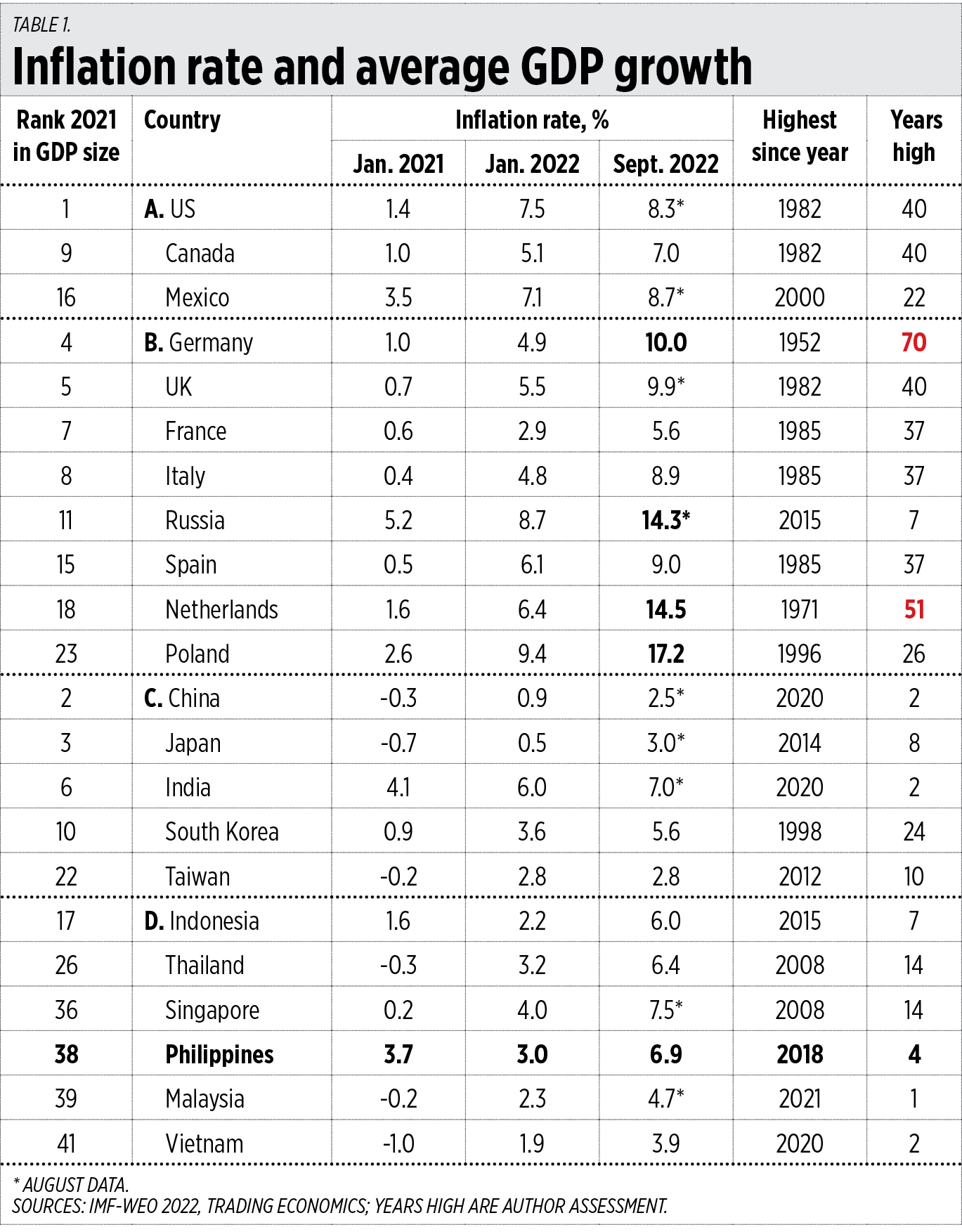
Two, the prudent management of inflation, the main concern of many people. The 6.9% inflation rate in September was indeed high but it was only a four-year high, at the same level as 6.9% in October 2018. Compare that with Germany’s 10% which is a 70-year high (the highest since 1952), the Netherlands’ 51-year high, the US, UK, and Canada’s 40-year high, and so on. The discontinuation of geographical lockdowns by the previous administration was a big factor for more production and transportation of goods and services leading to controlled inflation.

Three, the three Philippine Economic Briefing (PEB) events abroad, a series of investment promotion campaigns telling global investors that the country is ready and prepared to welcome them. The President, the economic team, and infrastructure team, about nine Cabinet Secretaries plus the BSP Governor, telling investors face to face to come to the country. The PEB in Jakarta and Singapore on Sept. 6-7 resulted in about $14.4 billion in investment pledges, and the PEB in New York on Sept. 22 saw about $4 billion investment plans.

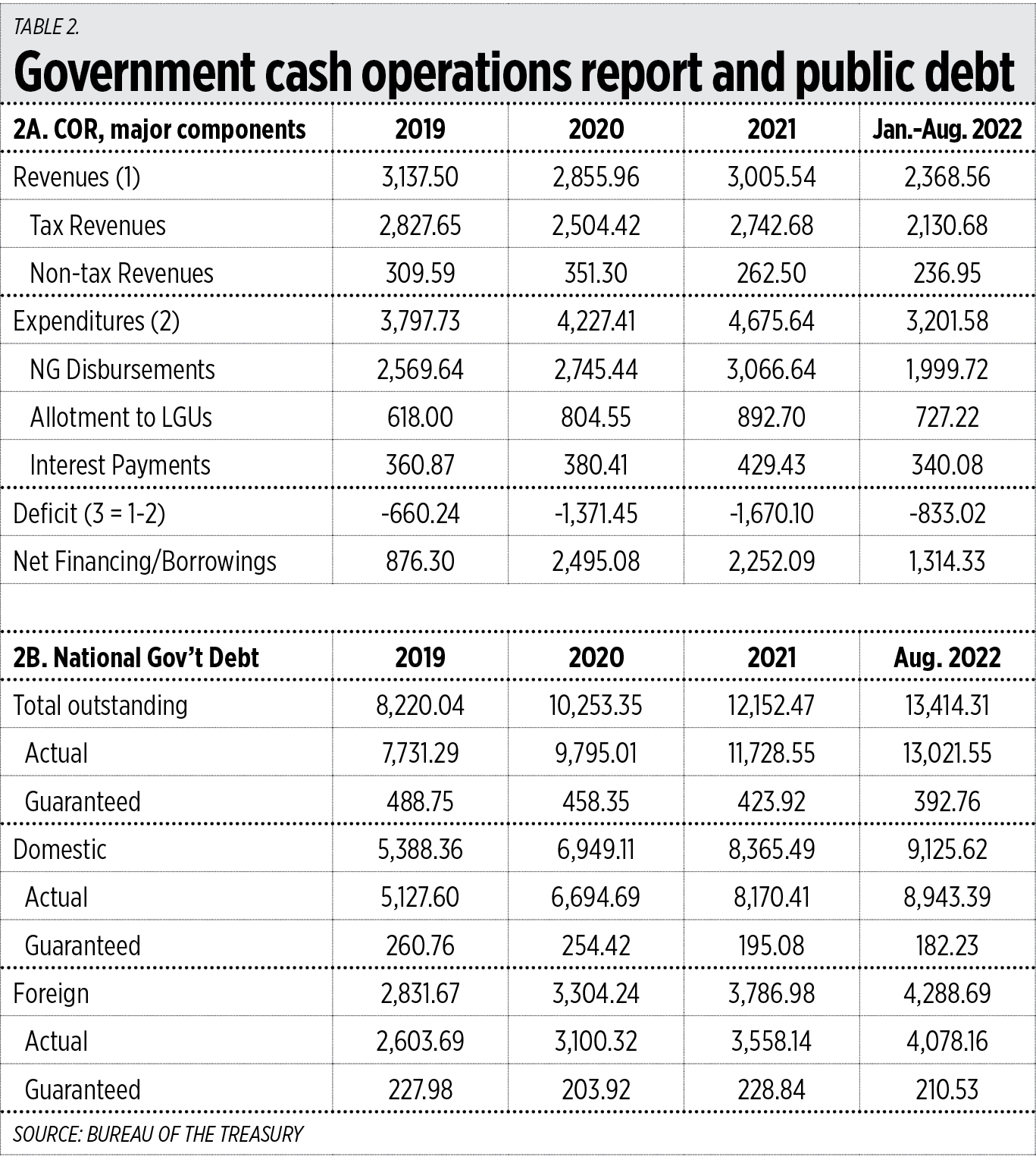
I cannot say the economic policies are near-perfect (a score of nine to 10) because of one big burden — the continued huge borrowings and high interest payments yearly are a big pulldown. The government’s outstanding public debt rose from P8.22 trillion (actual + guaranteed) in 2019 to P12.15 trillion in 2021 and P13.41 trillion as of August 2022. It is projected to reach P14.0 trillion by the end of this year. The net financing (gross borrowings minus principal amortization) rose from P0.88 trillion in 2019 to P2.37 trillion a year average for 2020-2021.

These numbers I explained today during an interview by veteran host Cito Beltran on his program Agenda on One News, Cignal TV. Thanks for the opportunity to discuss these economic numbers and their implications, Cito.

PEB IN WASHINGTON DC

Last Saturday, Oct. 15, another PEB was held in Washington DC. BSP Governor Medalla, Secretaries Diokno and Pangandaman, and National Economic and Development Authority (NEDA) Assistant Secretary Sarah Lynn Daway-Ducanes spoke to the assembled investors and some US federal officials, and reiterated the optimistic condition in the country — that we have institutionalized and legislated a conducive regulatory and investment environment.

Also last week, the International Monetary Fund (IMF) released the October update of the World Economic Outlook (WEO). The Philippines is the 39th largest economy in the world, tailing No. 38 Singapore by just $3 billion.

The latest projections of the three multilaterals — the Asian Development Bank or ADB, the World Bank or WB, and the IMF — put the Philippines’ 2022 GDP growth at 6.5%. If true, that should be the 4th fastest growth in the world’s top 50 largest economies, trailing Bangladesh’s 7.2%, Vietnam’s 7%, and India’s 6.8% (see table).

I think the multilaterals’ assessment of the Philippines is not realistic enough. In the first half (H1), or quarters 1 and 2, our growth was already 7.8%. This implies that they project H2 growth only at 5.2% to have a full year growth of 6.5%.

Using the power and electricity demand for July-September of about 6-7% (the Luzon-Visayas grids) as a proxy for GDP growth, I see growth of 7-7.5% in Q3 and this will likely be sustained in Q4. So, the full year 2022 growth would be around 7.5%, not the 6.5% projection of the multilaterals.

And from anecdotal data that I see both in Metro Manila and some provinces, there is high and fast recovery this year given the muted and slow growth in 2021.

Investors who attended the four PEB in four big cities abroad should be assured that they are entering a dynamic economy with a big consumer base.

PPP CENTER AND TARIFF COMMISSION

Last week at the Economic Journalists Association of the Philippines (EJAP) forum, the new Public-Private Partnership (PPP) Center Executive Secretary Cynthia Hernandez identified the emerging PPP sectors — health, water and sanitation, transportation, solid waste management, and ecozones, among others — as priorities for development on top of traditional PPP sectors like toll roads, seaports, airports, and power.

Given the huge annual budget deficit and net borrowings that started in 2020, many projects should be taken out of an “all taxpayers pay” scheme and be put under “only users pay” scheme. The PPP projects embody this principle and Ms. Hernandez — an engineer, economist, and financial advisor, a three-in-one brain — has the will and expertise to make this pivot of unburdening taxpayers while having big infrastructure projects.

Also last week, the Tariff Commission (TC) ruled on two different cases on cement tariffs. First, that the safeguard measure against cement imports cannot be extended beyond October 2022 because the requirements of the law (RA 8800) were not met. And second, the imposition of anti-dumping (AD) duties against imports of cement from Vietnam — that there will be no AD duties for exporters with de minimis or negative dumping margins (DMs), and have AD duties on exporters which have non-de minimis positive DMs.

A legal technicality for me, but as I understand it that the TC overall has ruled in favor of free trade in cement. Congratulations to the commission, headed by Chairperson Marilou Mendoza. My free trade mind actually supports dumping. If Vietnam will burden its taxpayers to subsidize cheap cement exports to the Philippines, so be it. The biggest protection against strong storms, floods, and earthquakes is not more politics. It is strong houses and buildings. People should use more cement and steel to live and work in strong structures.

DEPARTMENTS WITH NO SECRETARIES YET

The Office of Press Secretary (OPS) and Department of Health (DoH) are among the departments and agencies with Acting or Officer in Charge (OIC) leaders only.

I think a Press Secretary/Presidential Spokesperson is someone with at least four characteristics. One, they are savvy in the law because many Presidential pronouncements have legal implications. Two, they have past or current media and public relations experience, preferably both in broadcast/TV and print media. Three, they have a deep corporate background to augment and better appreciate the economic team’s big push to attract more investments into the country. And four, they must have good looks, and a mature and charismatic personality.

I can think of one person who fits this shoe — Michael “Mike” Toledo.

For Health Secretary, I think that the previous and current leadership of the DoH and their consultants were responsible for the very strict lockdown policies in 2020 — leading to the Philippines having the worst economic contraction in Asia, also the worst contraction in Philippine history since post-World War 2. They seem to plan for an endless health emergency situation, and they do not seem to mind if public borrowings remain at P2+ trillion yearly for many years so long as their yearly budget and vaccine procurement remain high.

Two doctors would be good as the next DoH Secretary. One is Dr. Godofreda “Jody” Vergeire-Dalmacion, an epidemiologist and retired professor from the Department of Pharmacology, University of the Philippines (UP) College of Medicine. The other is Dr. Benigno “Iggy” Agbayani, Jr., also a product of the UP College of Medicine and former President of Concerned Doctors and Citizens of the Philippines (CDC PH). Both physicians have high credibility and independence, they opposed the lockdown, and advocated focused protection via cheap, proven, and off-patent medicines.

I hope President Ferdinand “Bongbong” Marcos, Jr. will consider Mike Toledo, Dr. Jody Vergeire-Dalmacion or Dr. Iggy Agbayani for those positions.
-------------

See also: 
BWorld 562, PEB in NYC, UPSE homecoming, and transport liberalization, October 04, 2022
BWorld 563, Economic freedom, power reserves, and declining births, October 06, 2022
BWorld 564, The ERC, NGCP, inflation and public debt, October 20, 2022.

Agenda One News, Part 8

Last Monday, October 17, veteran TV host Cito Beltran interviewed me again in his daily, Monday-Friday 8-9am tv program, "Agenda" in One News, Cignal TV, https://www.facebook.com/ONENewsPH

Cito is also a columnist in Philippine Star, every Monday, Wednesday and Friday, https://www.philstar.com/authors/1804831/cito-beltran.

Two topics supposedly he would ask me -- about banks on GFANZ (Glasgow Financial Alliance for Net Zero) and the Philippine economy.

But during the staff intro about me (thanks, Jhoanna), Cito was intrigued again by my think tank, Minimal Government Thinkers (MGT. That's where he asked me several questions about the philosophy and advocacies of the group.


I said that MGT is a think tank advocating minimal government, small limited government that require less taxes, less interventions. A government limited in primary function to protect the people's three basic rights -- right to life (vs violence, murder,...), right to private property (vs thieves, arsonists,...) and right to liberty (vs bullies, dictatorship,...).  That we need to remind people to assume more personal and parental responsibility and not assume that many things should be government responsibility, including their children's healthcare, education, etc. Because a government that's big enough to give everything you want is also big enough to take everything you have. Cito liked this, repeated and emphasized this.

Going to the Philippine economy and MGT advocacies, I said that we need to cut spending, cut borrowings and cut taxes. Our outstanding public debt rose from P8.22 trillion in 2019 to about P12.15 in 2021, P13.4 trillion as of August 2022, our interest payment alone about P360 billion in 2020, P380 billion in 2021, and projected to reach P500 billion this year. Interest payment alone, principal amortization not included yet.


Then we went into infrastructure spending, Cito also believes that big conglomerates here have the resources and engineering capacity to undertake many huge infra. I added that we should indeed move away from "all taxpayers pay" to "only users pay" scheme in many infra projects.


Two things that the national government can do to avoid huge taxation of the people due to our huge public debt: reduce spending by the national government as local governments have more money under the Mandanas ruling, and have large-scale privatization of government assets and corporations.


Parting words, I reiterated that we should go back to people assuming more personal and parental responsibility and have less government responsibility in running our own lives. Stick to the rule of law, from small things like traffic rules where ordinary motorists are easily penalized while red plates (government) and those with govt connections can park in No Parking areas, violate or be exempted from car-prohibition (coding) days, etc.

The interview lasted for 30 minutes, see here starting from 28 minutes mark, https://www.youtube.com/watch?v=vMiTWpjIfvU. 

Many thanks again, Cito.
----------------

See also:
Agenda One News, Part 5, July 28, 2020
Agenda One News, Part 6, August 31, 2020
Agenda One News, Part 7, February 07, 2022.

Thursday, October 20, 2022

BWorld 564, The ERC, NGCP, inflation and public debt

* My column in BusinessWorld last October 10.
----------------

Four important events that occurred last week: the Energy Regulatory Commission (ERC) dismissed the rate hike petition of the power companies of San Miguel Corp. (SMC); the continuing threat of blackouts was highlighted; the jump in the inflation rate; and, the government’s cash operations and debt payment information were released.

ERC’S DISMISSAL OF SMC POWER COMPANIES PETITION

Last Monday, the ERC published its decision denying the petition of SMC for a rate hike for its two power plants. See these reports in BusinessWorld: “Meralco vows to prevent termination of SMC deals” Oct. 5), “SMC studies legal options after rate hike denial” (Oct. 6), and, “SMC plans to sell power to WESM after rate-hike denial” (Oct. 7).

For me the main issue that the ERC has to grapple with is not the projected higher electricity rate hike if the SMC petition was not granted. The main issue is rule of law and sanctity of contract. If the ERC granted the SMC petition, then it would be a signal for many other generation companies to also go to the ERC and demand a rate hike. Since the rule of law mandates that the law applies equally to unequal people and companies, that no one should grant exception and favoritism, then the ERC would be obliged to also grant those new petitions. A cascade of new generation rate hikes for the consumers would be much larger than the price hike threats of SMC.

The ERC made the correct decision. Thank you, ERC, for doing your job and protecting the consumers.

NGCP AND CONTINUING BLACKOUT THREATS

Last week, Sen. Sherwin Gatchalian urged the National Grid Corp. of the Philippines (NGCP) to increase the level of standby power available to it, that it “should not neglect its duty of contracting ancillary services so that we can ensure continuous energy supply and avoid the harm caused by constant brownouts to our citizens.” See this report in BusinessWorld: “NGCP urged to raise level of power available via standby contracts” (Oct. 4).

Senator Gatchalian is correct in his position that the NGCP should have a firm contract of reserve power exclusive to it, and that the frequent threats of blackouts are ugly. See also five reports and opinions in this column last week, “Economic freedom, power reserves, and declining births” (Oct. 3).

I saw the “Transition Report: Energy Sector Accomplishments for 2016-2022” section in the report “Areas of Major Concern for the Next Administration.” On the NGCP — the only remaining private monopoly nationwide via Congressional franchise — the report pointed out the following, among others:

One, the NGCP never heeded, never complied with certain Department of Energy (DoE) directives like DC2017- 12-0016, DC2019-120018, on a.) conduct of performance assessment and audit of power transmission operations, business and assets, b.) conversion of ancillary contracts from non-firm to firm, c.) conduct of competitive selection process (CSP) for the procurement of ancillary services, and, d.) requirements in the preparation and review of the Transmission Development Plan.

Two, NGCP argues that only the ERC has regulatory jurisdiction over them. But RA 7638 of 1992 creating the DoE mandates it as “the central coordinating machinery of the government for the implementation of energy policies and programs.” So, the DoE insists that its “policy-making mandate does not conflict with ERC’s mandate… ERC’s exercise of its authority necessarily must only operate within the bounds of policies and framework set by the DoE.”

Three, the NGCP as systems operator has a national security aspect. The original National Transmission Corp. (TransCo) Supervisory Control and Data Acquisition (SCADA) of equipment in transmission substations has been replaced by a Chinese SCADA system and it can “remotely control (turn on and shut down) all power plants and substations that are connected to the grid.” That is why the DoE and TransCo, as the owner of the physical assets, insist on having a performance audit of the NGCP’s new SCADA. The State Grid Corp. of China (SGCC) is NGCP’s technical partner and four of 10 NGCP Board members are from China, and six from the Philippines.

In 2021, the Philippines had a total power generation of 106 terawatt-hours (TWH). That year, Vietnam had 245 TWH, Malaysia had 177 TWH and Thailand had 176 TWH. These three neighbors of ours have smaller populations than us but have power generation much larger than ours.

Among the reasons I believe, are: a.) the NGCP delayed the construction of new transmission lines that results in frequent congestion of existing power plants, and can the discourage building of more new plants; b.) the NGCP not getting firm and exclusive contracts of ancillary services and is relying more on getting any excess reserves in the spot market which can be thin already.

The Transition Report proposes “unbundling the transmission sector by separating the system operator (SO) in charge of grid security, and transmission network provider (TNP) in charge of development, operation and maintenance of the transmission network and assets.”

I support that. Monopolies are almost always ugly. Under the government national monopolies like PhilHealth and SSS, people in the formal sector have no choice to opt out. Under the private national monopoly NGCP, power generators and distributors also have no choice to opt out from its inefficiencies.

BIG JUMP IN INFLATION RATES

Last week, the Philippine Statistics Authority reported the September inflation rate at 6.9%, up from August’s 6.3%. This is indeed high but is still only a four-years high compared to Germany’s 70-years high, the Netherlands’ 51-years high, the US, Canada, and the UK’s 40-years high, and France, Italy, and Spain’s 37-years high (Table 1).

The 6.9% inflation rate was used by some bashers of the Marcos Jr. administration and its economic team’s performance. This is misplaced criticism. One, our four-years high in inflation is among the more benign levels in Asia and the world’s large economies as shown in the table. Two, no price control was imposed, especially on oil products.

DOF-DBM CASH OPERATIONS AND DEBT PAYMENT

Last week, the Bureau of the Treasury released the National Government’s cash operations report (COR) and outstanding public debt. In the past two years, the budget deficits were P1.4 trillion and P1.7 trillion, while net financing or borrowings were P2.5 trillion and P2.2 trillion. From January-August 2022, financing has tamed to P1.3 trillion — hopefully it will not reach P2 trillion this year.

With high borrowings come high interest payments, P429 billion in 2021 and it might reach P500 billion this year.

The public debt stock has increased from P8.22 trillion in December 2019 to P13.41 in August 2022 (Table 2). It might reach P14.0 trillion by the end of this year.

The big challenge for the administration and the economic team is how to control the spending that leads to high borrowings and high interest payments. This can be done at least three ways.

One, reduce the size of many national agencies and let the local governments, which now have more funding under the Mandanas ruling, do more work. The Department of Budget and Management’s Bureaucracy Rightsizing program should materialize.

Two, reduce if not abolish old subsidies whenever new subsidies are created. The creation of a new welfare program is implicit admission that the old welfare programs are not working.

Three, reform and reduce certain entitlements like the huge military and uniformed personnel (MUP) pension. The pension of all retired civilian personnel in 2022 is P7.14 billion but the pension of MUP is P153.13 billion or 21.4 times larger than the former.
----------------

See also:
BWorld 561, Power demonopolization, privatization, and smuggling, September 27, 2022
BWorld 562, PEB in NYC, UPSE homecoming, and transport liberalization, October 04, 2022
BWorld 563, Economic freedom, power reserves, and declining births, October 06, 2022.

Deindustrialization 6, UK, Sept. 2022 reports

More reports, past UK government ecological central planning and energy rationing leads to current energy and economic predicament. Enjoy.
--------------- 

1. Earnings to collapse to 2003 levels as inflation batters living standards
Households facing worst hit for a century, warns Resolution Foundation
Tom Rees and Howard Mustoe  1 September 2022
https://www.telegraph.co.uk/business/2022/09/01/earnings-collapse-2003-levels-inflation-batters-living-standards/

2. Government’s green energy policy is a “national disaster”
1st September 2022
https://www.netzerowatch.com/governments-green-energy-policy-is-a-national-disaster/

3. Cost of living: Workers could be asked to layer up as bills soar
1 September 2022
https://www.bbc.com/news/uk-england-birmingham-62737686

Tony Constance runs Stockfield Metal Spinners in Birmingham and said his latest energy quote was £734K a year, up from his usual annual rate of £135K.

4. World’s Second-Largest Steelmaker Closes European Plant
Tsvetana Paraskova - Sep 02, 2022
https://oilprice.com/Latest-Energy-News/World-News/Worlds-Second-Largest-Steelmaker-Closes-European-Plant.html

5. Turn Off the Lights if the Wind Stops Blowing – Welcome to Net Zero Britain!
TOBY YOUNG 2 SEPTEMBER 2022
https://dailysceptic.org/2022/09/02/turn-off-the-lights-if-the-wind-stops-blowing-welcome-to-net-zero-britain/

6. Know why your fuel bills are soaring? 20 years of 'renewables' lies, says JOHN CONSTABLE
THE UK's energy crisis has been in the making for more than 20 years and is the result of the incompetent policies of Mr Blair, Mr Brown, Mr Cameron, Mrs May, and Mr Johnson, and all their hapless energy minsters and advisors too numerous to name.
DR JOHN CONSTABLE Sep 2, 2022
https://www.express.co.uk/comment/expresscomment/1663771/energy-bill-energy-cap-cost-of-electricity-gas-are-renewables-more-expensive-Putin-gas

7. Six in 10 British Factories at Risk of Going Under as Bills Soar
Julian Harris September 3, 2022
https://www.bloomberg.com/news/articles/2022-09-02/six-in-10-british-factories-at-risk-of-going-under-as-bills-soar#xj4y7vzkg

8. Energy crisis: Can Britain weather the winter without blackouts?
Ben Spencer and Laith Al-Khalaf  September 03 2022
https://www.thetimes.co.uk/article/energy-crisis-can-britain-weather-the-winter-without-blackouts-nwhpww6k5

9. Energy crisis may force manufacturers to cut production or even close – study
Make UK said its research showed firms were warning that their energy costs have already “spiralled out of control”.
Alan Jones Sept 3, 2022
https://www.independent.co.uk/news/uk/government-vat-italian-alan-jones-b2158821.html

10. Police fear hard winter of surging crime and civil unrest
Chiefs draw up emergency plans to maintain law and order as economic squeeze tightens
Harry Yorke, Dipesh Gadher and Tim Shipman September 04 2022, 12.01am 
https://www.thetimes.co.uk/article/07b8a936-2bb9-11ed-b39f-ae396665d39a

11. UK pubs must hike pint prices to £20 each or face closure this winter, expert warns
Running costs for pubs are set to increase by 500-600%, putting a huge number at risk of closure, says Tom Stainer, chief executive of real ale campaign group CAMRA
Harry ThompsonTrends WriterSara Odeen-Isbister. 4 Sep 2022
https://www.mirror.co.uk/money/uk-pubs-must-hike-pint-27903355

12. Energy crisis impacts Christmas celebrations as councils cancel light switch-ons
SKYROCKETING ENERGY BILLS have already impacted Christmas celebrations up and down the country as councils cancel light switch-on events.
EMMA CRABTREE Sep 4, 2022
https://www.express.co.uk/news/uk/1664387/energy-crisis-Christmas-light-switch-on-ont

13. Six in 10 UK manufacturers at risk of closure, lobby group warns as energy prices soar
The MakeUK lobby group proposed a 100-day plan for the incoming prime minister
THOMAS BROOKE  September 05, 2022
https://rmx.news/united-kingdom/six-in-10-uk-manufacturers-at-risk-of-closure-lobby-group-warns-as-energy-prices-soar/

14. British energy firms brace for ANOTHER big spike in wholesale gas prices of up to 50 PER CENT today after Russians refuse to reopen the Nord Stream 1 pipeline to Europe

* Gas prices could surge by as much as 50 per cent today after key pipeline closes
* The Nord Stream 1 pipeline is the biggest gas link from Russia to Europe
* The UK receives only 4 per cent of its gas from Nord Stream 1
* But other countries such as Germany are much more reliant on the pipeline
DAILY MAIL REPORTER 5 September 2022
https://www.dailymail.co.uk/news/article-11179745/Power-firms-fear-new-spike-European-nations-announce-raft-measures.html

15. GB News viewer calls on next PM to scrap 'mad dash' to net zero and frack for Britain's 'energy independence'
Linda in Cheshire told Breakfast with Isabel and Stephen that Boris Johnson's successor must tackle the cost-of-living crisis "first thing"
Max Parry 05 September 2022 
https://www.gbnews.uk/news/gb-news-viewer-calls-on-next-pm-to-scrap-mad-dash-to-net-zero-and-frack-for-britains-energy-independence/361640

16. UK faces recession as energy prices hammer factories and hospitality
UK's economic contraction led by the manufacturing industry which is heavily exposed to soaring bills
Tim Wallace. 5 September 2022
https://www.telegraph.co.uk/business/2022/09/05/uk-faces-recession-energy-prices-hammer-factories-hospitality/

17. Liz Truss to the British Rescue
Britain’s new leader faces an energy crisis and failing economy.
By The Editorial Board Sept. 5, 2022
https://www.wsj.com/articles/liz-truss-to-the-british-rescue-u-k-prime-minister-boris-johnson-election-economy-conservative-party-11662388952

18. ‘Apocalyptic’: 500 per cent energy price hikes plunge schools into winter crisis
Skyrocketing prices force school leaders into 'unpalatable' choices to keep classrooms open this winter
Tom Belger. 6 Sep 2022
https://schoolsweek.co.uk/school-energy-bills-government-help-apocalyptic-rises/

19. The great wind farm rip off: greedy energy giants sell us wind electricity at wholesale gas price
The UK is facing an unprecedented energy crisis with a £100billion bailout set to blow the country's bank balance – and all the while renewables firms are finding huge profits literally blowing in the wind
Ben Borland  7 SEP 2022
https://www.scottishdailyexpress.co.uk/news/uk-news/great-wind-farm-rip-off-27889339

20. Britain Goes the Wrong Way on Energy Bailout
Truss price freeze ignores critical questions on conservation, funding
Javier Blas. September 9, 2022
https://www.bloomberg.com/opinion/articles/2022-09-09/britain-goes-the-wrong-way-on-energy-bailout

21. Thatcher would be turning in her grave: how the Tories embraced state intervention
After bank bailouts and furlough, we now expect the government to wade in when times get tough. But we may be storing up trouble for later down the line
11 September 2022
https://www.thetimes.co.uk/article/thatcher-would-be-turning-in-her-grave-how-the-tories-embraced-state-intervention-hh03pb09f

22. The U.K. Can Slash Energy Prices – But Only If We Stop Sending All Our Electricity to Europe
ANDREW MONTFORD AND GORDON HUGHES 13 SEPTEMBER 2022
https://dailysceptic.org/2022/09/13/the-u-k-can-slash-energy-prices-but-only-if-we-stop-sending-all-our-electricity-to-europe/

23. UK Extends Life of Third Coal Plant to Secure Winter Electricity
Todd Gillespie. September 14, 2022
https://www.bloomberg.com/news/articles/2022-09-13/uniper-extends-life-of-uk-coal-unit-to-secure-winter-electricity#xj4y7vzkg

24. Truss energy bills freeze hands suppliers up to £1.6bn in taxpayer-funded profit
Companies' margin of 1.9pc preserved under bailout plan
Rachel Millard 14 September 2022
https://www.telegraph.co.uk/business/2022/09/14/energy-bill-freeze-hand-suppliers-16bn-profit/

25. HALF of Britons are finding it 'difficult' to pay their energy bills as Kwasi Kwarteng thrashes out tax-cutting 'Emergency Budget' for next Friday
ONS research finds 48 per cent are finding it difficult to pay their energy bills
Government has already acted to prevent energy bills soaring again in October
Chancellor Kwasi Kwarteng is drawing up an 'Emergency Budget' for next Friday
JAMES TAPSFIELD, 16 September 2022
https://www.dailymail.co.uk/news/article-11219231/HALF-Britons-finding-difficult-pay-energy-bills.html

26. Truss dismantles the eco ‘axis of evil’
Steerpike 16 September 2022
https://www.spectator.co.uk/article/truss-dismantles-the-axis-of-evil-

27. Patagonia Billionaire Who Gave Up Company Skirts $700 Million Tax Hit
Devon Pendleton and Ben Steverman. September 16, 2022
https://www.bloomberg.com/news/articles/2022-09-15/patagonia-billionaire-who-gave-up-company-skirts-700-million-tax-hit

28. We just paid Belgium 50 times the going rate to keep London's lights on – how did it come to this?
We need a public enquiry to get to the bottom of Britain's energy humiliation
TONY LODGE  17 September 2022
https://www.telegraph.co.uk/business/2022/09/17/just-paid-belgium-50-times-going-rate-keep-londons-lights/

29. Jacob Rees-Mogg claims fracking opponents are funded by the Kremlin
Business Secretary accused those who oppose fracking of 'hysteria' and 'ludditery' and said drilling is in the 'national interest'
Rachel Millard and Tony Diver,  23 September 2022 
https://www.telegraph.co.uk/business/2022/09/22/jacob-rees-mogg-lifts-fracking-ban-bet-shale-gas-revolution/

30. Blindly pursuing Net Zero threatens to hasten the decline of the West and therefore poses an existential threat to the free world, says Mark Dolan
Sir Patrick Vallance, a man who in my view all but bankrupted this country with the disastrous and failed experiment of lockdown, is at it again
Mark Dolan  22 September 2022
https://www.gbnews.uk/news/blindly-pursuing-net-zero-threatens-to-hasten-the-decline-of-the-west-and-therefore-poses-an-existential-threat-to-the-free-world-says-mark-dolan/369952

31. UK motor groups call for more energy help as rising costs hit investment 
29 September 2022
https://www.ft.com/content/1f364365-2136-44d4-adbc-70f1ca9f946b

32. Shock therapy: turmoil engulfs Britishvolt’s £3.8bn battery factory
Future of company hailed by Boris Johnson as key to green industrial revolution hangs in the balance, as the first in our Electric Dreams series on Britain’s fledgling battery industry reveals
Jasper Jolly  29 September 2022
https://www.theguardian.com/business/2022/sep/29/britishvolt-38bn-battery-factory-green-industry

33. UK weighs plan to drive down energy demand as winter looms
Ministers are concerned about browbeating Brits with energy demands so soon after tough COVID measures.
CHARLIE COOPER. SEPTEMBER 29, 2022 
https://www.politico.eu/article/uk-mulls-energy-demand-reduction-plan/

34. The Headlong Rush to ‘Net Zero’ Makes a New Great Depression a Racing Certainty
ANDREW MONTFORD 29 SEPTEMBER 2022
https://dailysceptic.org/2022/09/29/the-headlong-rush-to-net-zero-makes-a-new-great-depression-a-racing-certainty/

35. Energy prices: Households turning to coal ahead of 'hard winter'
29 September 2022
https://www.bbc.com/news/uk-england-somerset-63072561

36. Cold weather puts Scottish grouse breed in danger of extinction
‘Worrying’ decline causes capercaillie numbers to drop below 1,000 for the first time, with risk the bird could die out in years ahead
Olivia Rudgard, 30 September 2022
https://www.telegraph.co.uk/environment/2022/09/30/cold-weather-puts-scottish-grouse-breed-danger-extinction/
---------------

See also:
Deindustrialization 3, United Kingdom, August 2022 reports, September 6, 2022
Deindustrialization 4, Other Europe, September 11, 2022
Deindustrialization 5, Germany, August-Sept. 2022 reports, October 03, 2022.

Thursday, October 06, 2022

BWorld 563, Economic freedom, power reserves, and declining births

* My article in BusinessWorld last Monday, October 3.
-----------------

The Asia Liberty Forum 2022 was successfully held last week Sept. 29-30 at Shangri-La The Fort, sponsored by the Atlas Network and Foundation for Economic Freedom (FEF). Among my old friends from the US who came were Simon Lee, formerly with the Lion Rock Institute-HK, Philip Thompson of the Tholos Foundation, Joe Lehman of the Mackinac Center, Kris Mauren of the Acton Institute, Fred McMahon of the Fraser Institute in Canada, and Basanta Adhikari of Bikalpa in Nepal.

The day before, Sept. 28, there was an Economic Freedom Audit of the Philippines, presenting the results from the Economic Freedom of the World (EFW) Index which is done annually by the Fraser Institute. EFW 2022 showed the Philippines’ global rank was No. 66 out of 186 countries and territories covered. It is higher than Thailand, India, Laos, Vietnam, and China.

But the impact of the COVID-19 lockdown is not included in the report. The two years of lockdown were a triumph of Big Government and saw the retreat of economic freedom. Many free market leaders themselves did not oppose the mandatory shutdown of many businesses and shops, mandatory stay-home orders, mandatory distancing, and mandatory vaccination. Mandatory means choice and individual freedom are zero or near-zero.

ECONOMIC FREEDOM DETERIORATION INDEX

I will attempt to measure and quantify the impact of mandatory shutdowns of many businesses (lockdown) and mandatory vaccination by introducing the concept of an Economic Freedom Deterioration Index (EFDI). A more direct term would be Economic Freedom Bastardized by Lockdown Index but EFDI is the more pragmatic term.

This is a rough measurement with limited components and countries covered. For this exercise, I use only four components: percent changes in mobility from the baseline period January to Feb. 6, 2020 of Google COVID-19 Community Mobility Reports’ 1.) Transit Stations (TS), and, 2.) Retail and Recreation (RR); 3.) GDP growth percentage points increase from 2019-2020, and, 4.) Gross debt/GDP ratio percentage points increase from 2019-2021 (Table 1).

I assigned scores of 1 to 5. The higher the score, the bigger the deterioration in economic freedom. For the four components, here are their respective scores:

TS: below 10 is 1; 11-20, 2; 21-30, 3; 31-40, 4; larger than 40 is 5.

RR: below 10 is 1; 11-20, 2; 21-30, 3; 31-40, 4; larger than 40 is 5.

GDP points increase: below 3 is 1; 3.1-6, 2; 6.1-9, 3; 9.1-12, 4; larger than 12 is 5.

Debt/GDP points increase: below 4 is 1; 4.1-8, 2; 8.1-12, 3; 12.1-16, 4; larger than 16 is 5.

Then the respective weights: I assigned TS with 15%, RR also 15%, GDP points decline is 40%, and Debt/GDP points increase 30%. The score multiplied by respective weights gives the respective index, shown in Table 2. The Philippines under the previous Duterte administration has the worst EFDI among eight economies covered.

Other researchers can expand on this and introduce more components and factors, assign different scores and weights, and cover more countries. I hope to do that someday.

POWER RESERVES AND TRANSMISSION ISSUES

Consider these columns and reports in BusinessWorld:

1. “The way forward for the power industry” by Romeo Bernardo (Jan. 26, 2014): “… ensuring that the systems operator National Grid Corporation of the Philippines (NGCP) fully contracts what the system requires. The establishment of a reserve market has been long delayed.”

2. “Red Alert and EPIRA” also by Romeo Bernardo (June 13, 2021): “… the transmission line operator has not fully contracted firm power reserves. Where the system operator’s role is to procure reserves, much like procuring a genset for your home, to call on in a time of power crisis… NGCP over the past 10 years has been non-compliant with the rules… in the form of a lack of transmission lines, a lack of redundancies in our network, a lack of power reserves, and not meeting the IPO requirements under the law.”

3. “NGCP power reserve compliance inadequate, key legislator claims” by Angelica Yang (June 9, 2021). She quoted Senator Sherwin Gatchalian: “The NGCP (is) not contracting the right amount of reserves. Clearly, they are violating that policy… ERC (Energy Regulatory Commission) should now implement the policy. The foundation has been laid down by the Supreme Court that DoE (Department of Energy) produces the policy and ERC enforces the policy. In this case, since NGCP is not contracting, ERC should punish them.”

4. “DoE’s Cusi urges NGCP to meet reserve contract requirement instead of seeking Palace intervention” by Marielle Lucenio (Feb. 13, 2022): “The DoE requires the grid to have reserve power, known as ancillary services (AS) on tap committed under firm contracts. The NGCP’s position is that full compliance with the firm-contract requirement will ultimately raise power prices because of the expense involved in committing reserves. It said it instead proposes to tap a network of AS providers under firm and non-firm contracts.”

5. “ERC to NGCP: Explain failure to comply with reserve power rules” by Ashley Erika Jose (Sept. 19, 2022): “The ERC cited three sections of the DoE’s department circular which it said NGCP failed to comply. Section 4.2 requires NGCP to seek approval from the DoE on its ancillary service agreement procurement plan; Sections 7.4 and 7.5 mandate NGCP to seek the approval of the DoE on the terms of reference of the ancillary service competitive selection process (AS CSP); and Sections 7.1 and 7.11 require NGCP to complete the AS CSP within six months from the effectivity of the circular.”

As shown by the continuing yellow and red alerts in the grid until this year, it is obvious that the NGCP — the only remaining private monopoly nationwide — is abusing its power and showing continued insensitivity to the power needs of Philippine businesses and households. The new ERC leadership should go after them as the previous ERC leadership was too lazy to do its job.

DECLINING BIRTHS, CAUSES OF DEATH

The Philippine Statistics Authority (PSA) released the updates on monthly vital statistics and causes of deaths of the country last Saturday. I count only data for January to April because the data from May-June are still incomplete.

Notable trends are: 1.) continued decline in births, 2.) some stabilization in deaths in 2022, 3.) continued erosion in net increase in population, 4.) big decrease in deaths from pneumonia, 5.) likely due to labeling of pneumonia deaths as COVID-19 deaths.

Among the possible explanations for the continued decline in births would be: 1.) the reduced number of marriages in 2020-2021, 2.) fewer babies planned by couples due to economic hardships, and, 3.) possible adverse effects on fertility by COVID vaccines.

Declining births is a bad and dangerous trend. This will lead to less workers and entrepreneurs, and less producers and consumers someday. Government must study in depth its causes and quickly remedy the situation.
------------------

See also:
BWorld 560, PEB Singapore, the PPP Center, transport liberalization, and IPRI 2022, September 20, 2022
BWorld 561, Power demonopolization, privatization, and smuggling, September 27, 2022
BWorld 562, PEB in NYC, UPSE homecoming, and transport liberalization, October 04, 2022.

Tax Cut 36, WTA's Asian Taxpayers regional forum 2022

This is my presentation last week. Thanks to WTA President John O'Connel (TaxPayers Alliance, TPA UK) and Cristina Berechet, WTA Sec. Gen.


----------------